
Best Castles in Germany: 15 Most Famous and Romantic Picks
Disney-inspired Neuschwanstein, 33-generation Burg Eltz, Sanssouci's rococo and Luther's Wartburg: 15 must-see German castles.
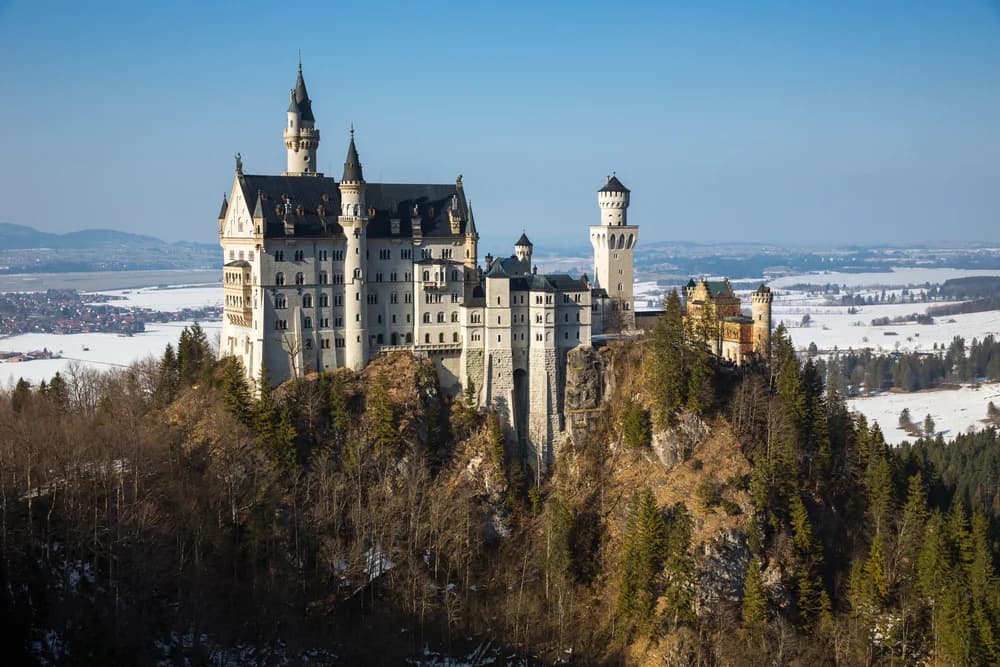
The best castles in Germany run from Schloss Sanssouci in Potsdam (~1.5 million visitors a year) and Schloss Neuschwanstein in Bavaria (~1.4 million, the silhouette Disney borrowed for Sleeping Beauty Castle) to the spectacularly ruined Heidelberger Schloss (~1 million). Three things make the German castle landscape a category of its own. Burg zu Burghausen on the Inn river is the longest castle complex in the world per Guinness, at 1,051 metres of strung courtyards.[1] Wartburg in Thuringia is where Martin Luther translated the New Testament into German between 1521 and 1522 while sheltering as Junker Jörg. And Burg Eltz on the Mosel has been continuously occupied by the same family for 33 generations since at least 1268. Underneath those headline-tier sites runs an 8,500-site EBIDAT register of medieval castles, climbing past 20,000 surviving fortified structures under broader heritage definitions across the 16 federal states.[2] Linderhof drew 417,692 visitors in 2025, Herrenchiemsee 309,353.
| Rank | Castle | State | Built | Annual visitors | Operator |
|---|---|---|---|---|---|
| 1 | Schloss Sanssouci | Brandenburg (Potsdam) | 1745-47 (Frederick the Great) | ~1.5 million | SPSG |
| 2 | Schloss Neuschwanstein | Bavaria (Füssen) | 1869-86 (Ludwig II) | ~1.4 million | Bayerische Schlösserverwaltung |
| 3 | Heidelberger Schloss | Baden-Württemberg | 13th c. (ruined 1693) | ~1.0 million | State museum |
| 4 | Charlottenburg Palace | Berlin | 1695-1713 (Sophie Charlotte) | ~600,000 | SPSG |
| 5 | Schloss Linderhof | Bavaria (Ettal) | 1869-86 (Ludwig II) | 417,692 (2025) | Bayerische Schlösserverwaltung |
| 6 | Burg Hohenzollern | Baden-Württemberg | 1850-67 (3rd version) | ~350,000 | Hohenzollern princes (private) |
| 7 | Wartburg | Thuringia | 1067 onwards | ~350,000 | UNESCO WHS (1999) |
| 8 | Schloss Herrenchiemsee | Bavaria (Chiemsee) | 1878-86 (Ludwig II Versailles model) | 309,353 (2025) | Bayerische Schlösserverwaltung |
| 9 | Burg Eltz | Rhineland-Palatinate | 12th c. (continuous) | ~250,000 | Eltz family (33 generations) |
| 10 | Walhalla Donaustauf | Bavaria | 1830-42 | 203,056 (2025) | Bayerische Schlösserverwaltung |
| 11 | Marksburg | Rhineland-Palatinate | 12th c. | ~150,000 | Deutsche Burgenvereinigung |
| 12 | Cecilienhof Palace | Brandenburg (Potsdam) | 1914-17 (Potsdam Conference 1945) | ~250,000 | SPSG |
| 13 | Burg zu Burghausen | Bavaria (Inn river) | 11th-16th c. (1,051m world record) | 81,090 (2025) | Bayerische Schlösserverwaltung |
| 14 | Schloss Salem | Baden-Württemberg | 14th c. monastery | ~150,000 | Margraves of Baden (private) |
| 15 | Burg Stolzenfels | Rhineland-Palatinate (Rhine) | 1836-1845 (Frederick William IV) | ~80,000 | Generaldirektion Kulturelles Erbe |
Sanssouci and Neuschwanstein lead the top tier, split between Prussian and Bavarian heritage traditions
Schloss Sanssouci in Potsdam is Frederick the Great's personal summer retreat. He had it built between 1745 and 1747 in the German rococo style on a vine-terraced hill. The name (sans souci, "without care") reflects the intention. Frederick wanted the small one-storey palace to serve as his private retreat from formal court life. He designed substantial elements himself with the architect Georg Wenzeslaus von Knobelsdorff. Frederick's tomb sits on the upper vine terrace below the palace. UNESCO listed Sanssouci in 1990 within the broader Palaces and Parks of Potsdam and Berlin.[3]
Schloss Neuschwanstein is Ludwig II of Bavaria's Romantic-era hilltop fantasy. He had it built between 1869 and 1886 near Füssen in the Bavarian Alps. Construction was incomplete at Ludwig's death in June 1886, so the castle never functioned as a meaningful royal residence. Around 1.4 million visitors a year now come through under the Bayerische Schlösserverwaltung. The Disney "Sleeping Beauty Castle" silhouette is widely understood to derive from the Neuschwanstein roofline.[1]
The Sanssouci/Neuschwanstein pairing is structurally illustrative. Sanssouci defines the Prussian Hohenzollern palace tradition, built before Frederick's accession and used as a personal retreat across his reign. Neuschwanstein represents the Bavarian Wittelsbach Romantic-era reaction against industrial modernity. It was built decades later by a king who explicitly sought to escape modern political life.
The Bavarian Wittelsbach palace cluster: Linderhof, Herrenchiemsee, Burghausen, Walhalla
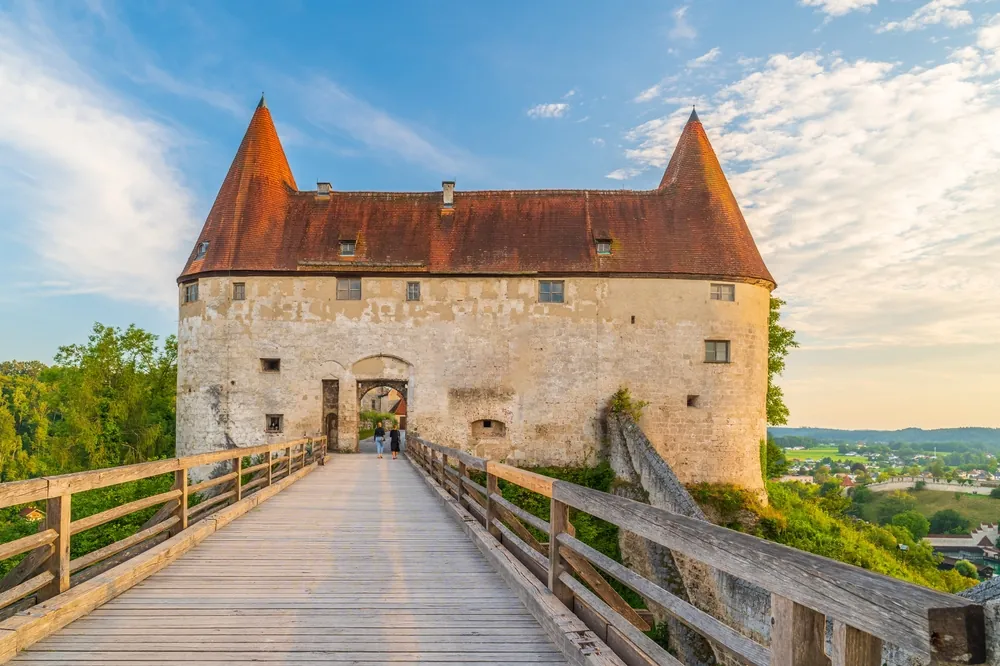
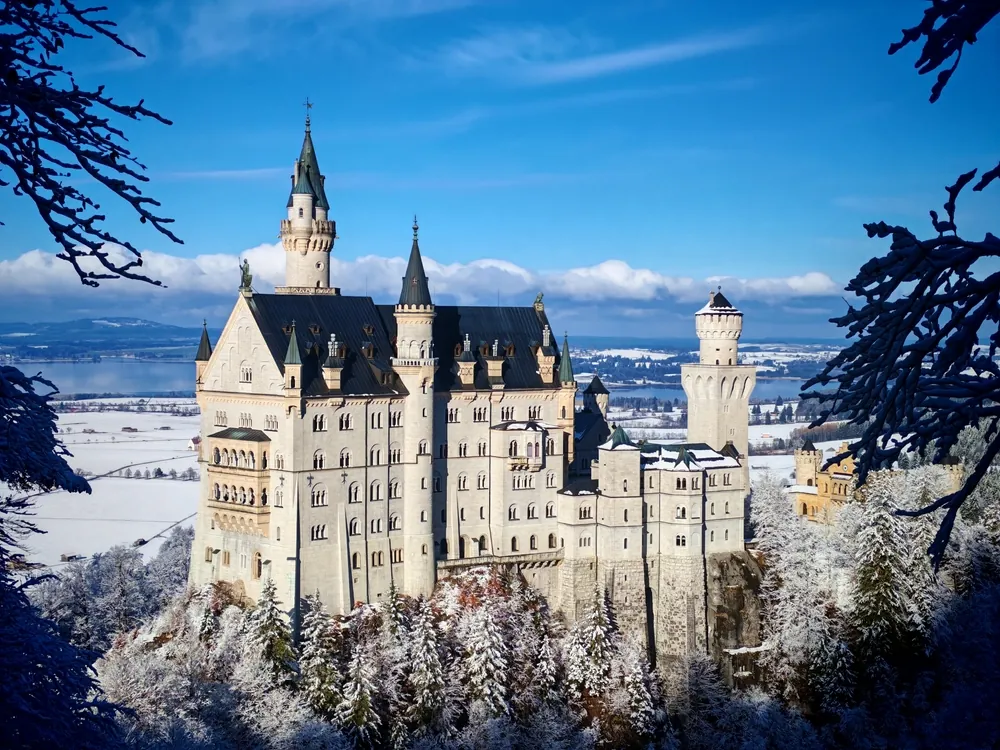
The Bayerische Schlösserverwaltung Bilanz 2025 puts the broader Bavarian state castle portfolio at substantial visitor scale. Schloss Linderhof at 417,692 visitors (+18% YoY) is Ludwig II's only completed palace, a smaller-scale Versailles-references residence near Ettal. Schloss Herrenchiemsee at 309,353 (essentially flat) is Ludwig's incomplete attempt at a full-scale Versailles replica on Herreninsel in the Chiemsee. Walhalla Donaustauf at 203,056 is the neoclassical Bavarian "hall of fame" temple modelled on the Athenian Parthenon. Burg zu Burghausen at 81,090 holds the Guinness World Records designation as the longest castle complex in the world at 1,051 metres. Six successive courtyards run along a narrow ridge above the medieval Burghausen town on the Inn river.[1]
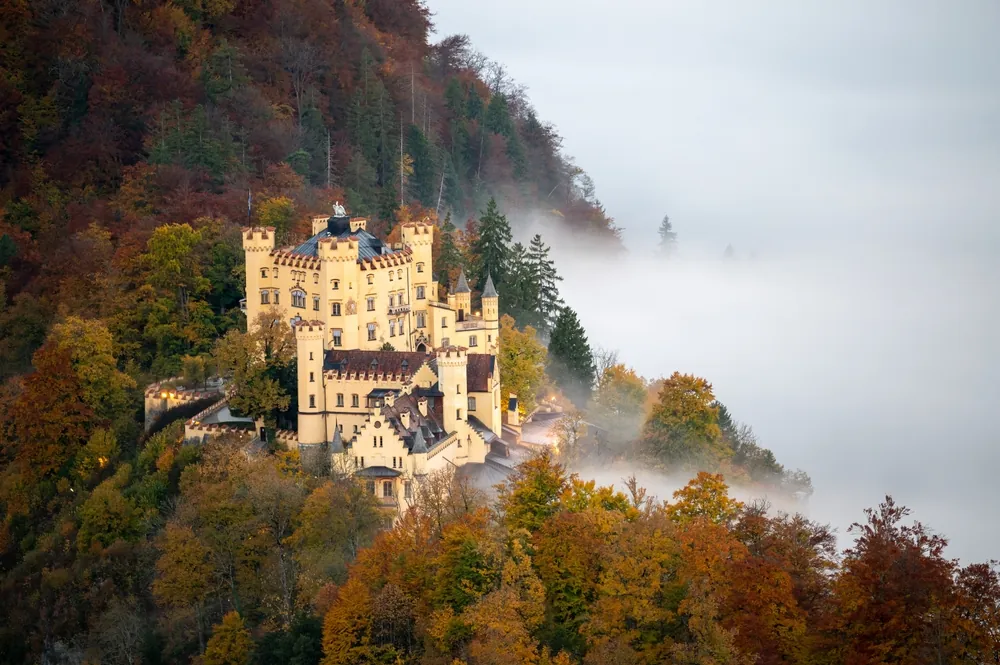
Burg Hohenzollern near Hechingen carries roughly 350,000 visitors per year under continuing Hohenzollern family ownership. The current third-version castle is a 19th-century neo-Gothic reconstruction by Friedrich August Stüler for King Frederick William IV of Prussia on the Hohenzollern dynastic mountain site.
The Rhine corridor, Heidelberg, Wartburg and Burg Eltz round out the canon
Robert Taylor's Castles of the Rhine documents the Middle Rhine castle landscape. Around 1500, between Bad Godesberg and Bingen, at least 20 castles on the east bank and over 17 on the west bank were taking tolls from river merchants. That is the densest medieval river-fortification line in Europe.[4] Burg Stolzenfels was rebuilt 1836-1845 under Crown Prince (later King) Frederick William IV of Prussia. Burg Rheinstein (originally Voigtsburg) was the first Rhine ruin rebuilt, between 1825 and 1829, by Prince Frederick Louis. Both reconstructions established the Romantic-historicist style that subsequently spread across Europe and produced the Neuschwanstein generation a few decades later.
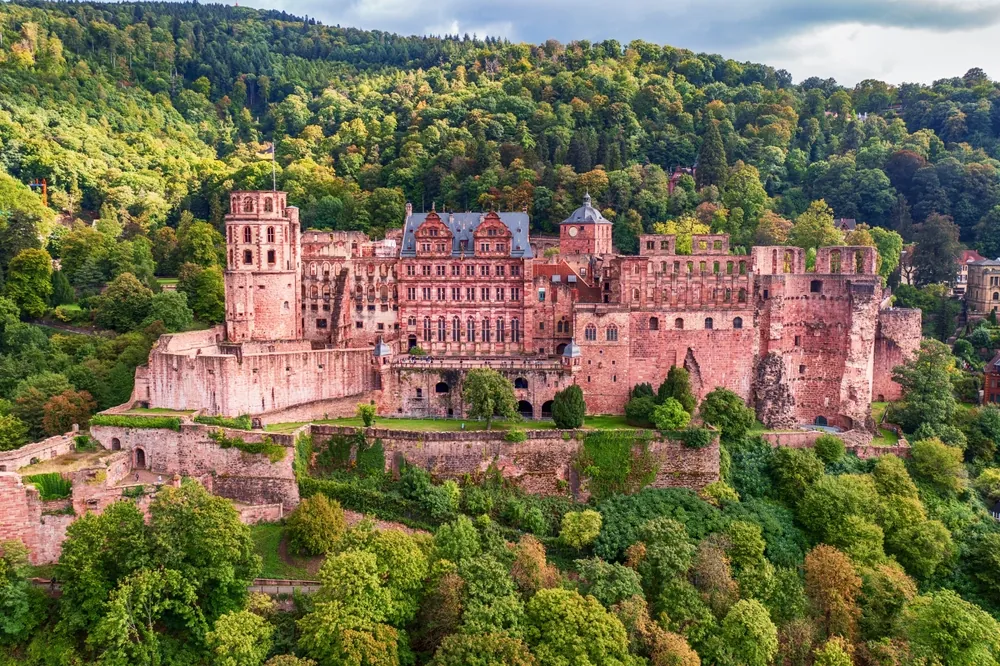
Heidelberger Schloss moves roughly one million visitors per year through its tour operation. The post-1693 destruction during the War of the Grand Alliance left the castle in spectacular ruin. The partial-restoration debate of the 19th century established the modern conservation principle that ruins should be conserved rather than reconstructed.
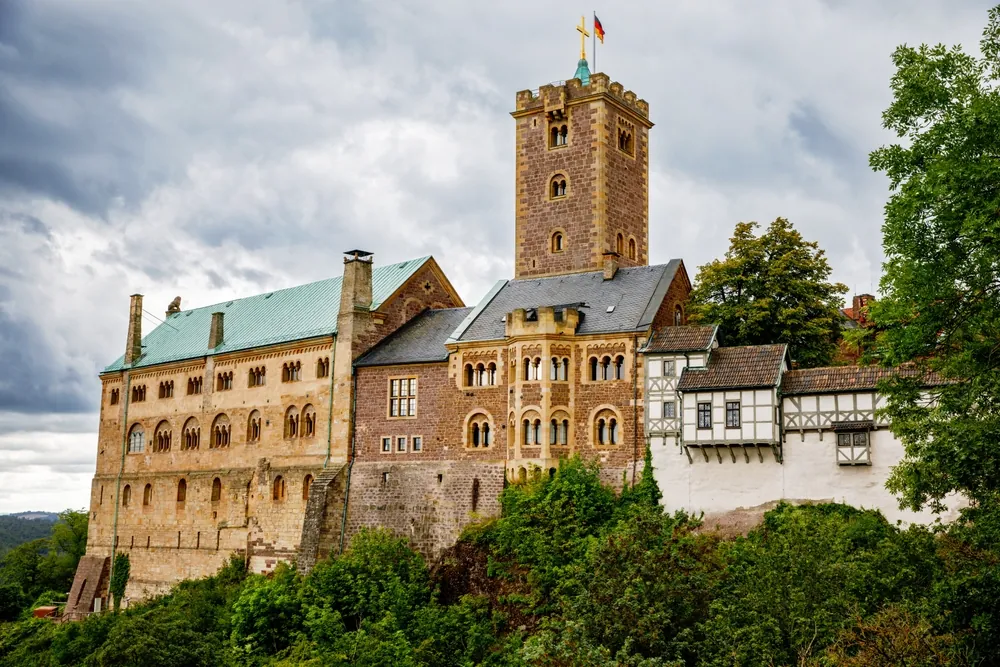
Wartburg in Thuringia (~350,000 visitors per year) carries UNESCO inscription 1999 for its role in German cultural history. Martin Luther translated the New Testament into German between 1521 and 1522 while sheltering at Wartburg as Junker Jörg, one of the foundational events of the Reformation.
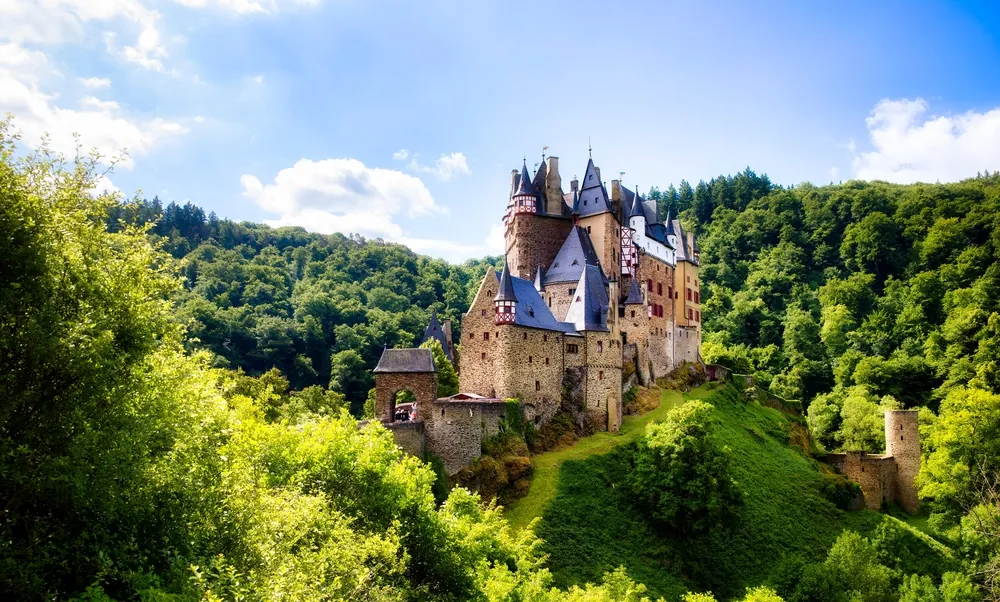
Burg Eltz in Rhineland-Palatinate is the structurally distinctive case in the German castle stock. The current Graf zu Eltz lives in the building. He is the 33rd-generation owner, with continuous family succession since at least 1268. He runs the castle with no domestic staff, cooks his own meals and treats it as a home office.[5] That continuous-occupation model is what most prospective German-castle buyers are quietly trying to recreate at smaller scale. Burg Eltz is the proof-of-concept on a four-figure-year horizon. ~250,000 visitors per year.
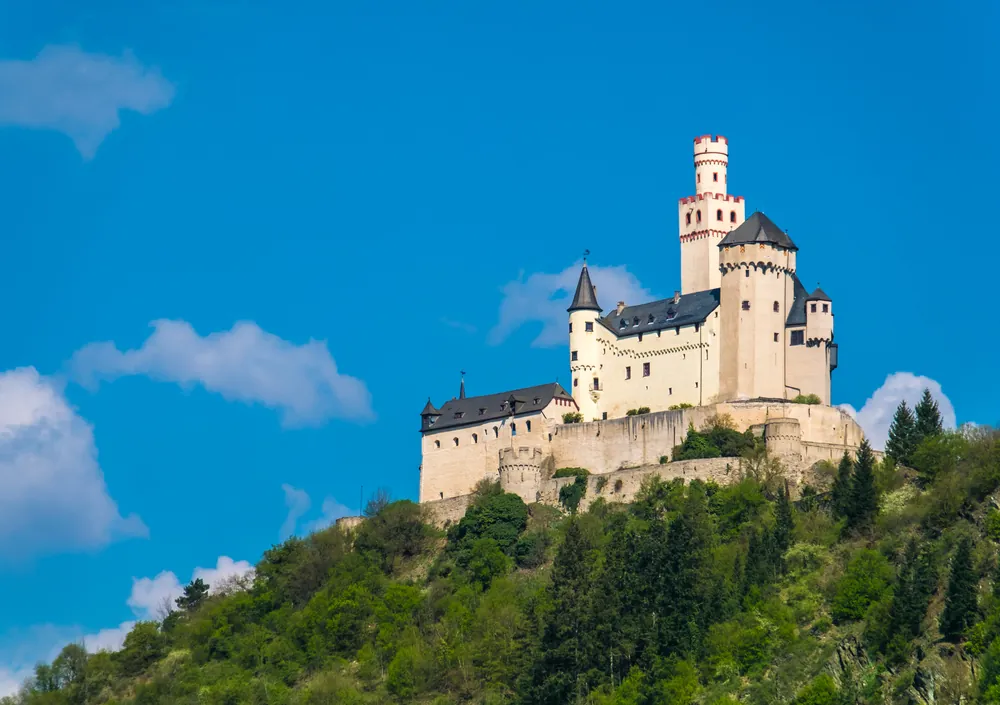
Marksburg near Braubach stands 150 metres above the Rhine and is the oldest Middle Rhine castle that approximates the look of a medieval stronghold. It was never destroyed in any of the Rhine wars.[4] The Deutsche Burgenvereinigung operates it as the standard-setting site for medieval-castle interpretation in Germany.
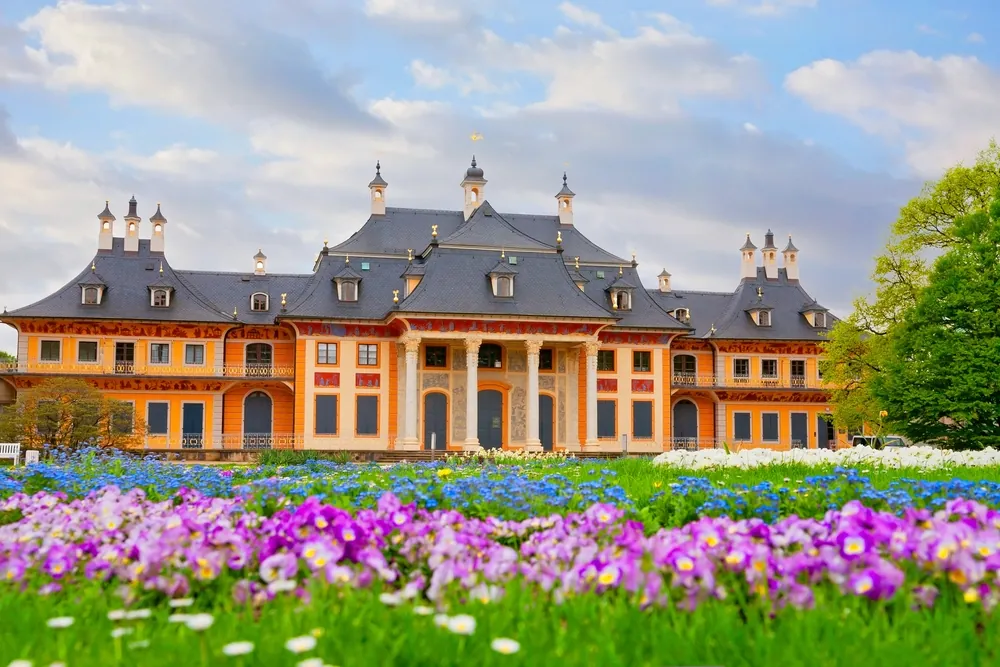
Schloss Salem in Baden-Württemberg (a 14th-century monastery converted to Schloss) cleared at €25.8 million in postwar Germany's largest castle transaction by the Margraves of Baden. Cecilienhof Palace in Potsdam (built 1914-17) is the site of the Potsdam Conference of July-August 1945 between Truman, Stalin and Churchill/Attlee that determined the postwar division of Germany.
For visitors planning a comprehensive German castle itinerary across Bavaria, Rhineland-Palatinate, Baden-Württemberg, Berlin/Brandenburg and Thuringia, allow 10-14 days. The cluster headlines are: Bavaria (Munich plus the Royal Castles tour), the Rhine corridor (Koblenz to Bingen), Berlin/Brandenburg (Sanssouci, Cecilienhof, Charlottenburg, Spandau), Heidelberg and Stuttgart (Baden-Württemberg), and Wartburg plus Erfurt (Thuringia).
References
[1] Bayerische Schlösserverwaltung — Besucherbilanz 2025.
[2] EBIDAT — European Castle Database (Europäisches Burgeninstitut, Philipps-Universität Marburg).
[3] Stiftung Preußische Schlösser und Gärten Berlin-Brandenburg (SPSG).
[4] Taylor, R. R. Castles of the Rhine: Recreating the Middle Ages in Modern Germany. Wilfrid Laurier University Press, 1998.
[5] DW Travel — "Eltz Castle in Germany: Would you like to live here?".