
The Largest Castle in the World and 9 Others Bigger Than Most Cities
Malbork Castle in Poland is the world's largest castle at 21 hectares (52 acres) of enclosed walls. Compare it to Prague, Windsor and 7 others by verified area, history, and what each is worth.
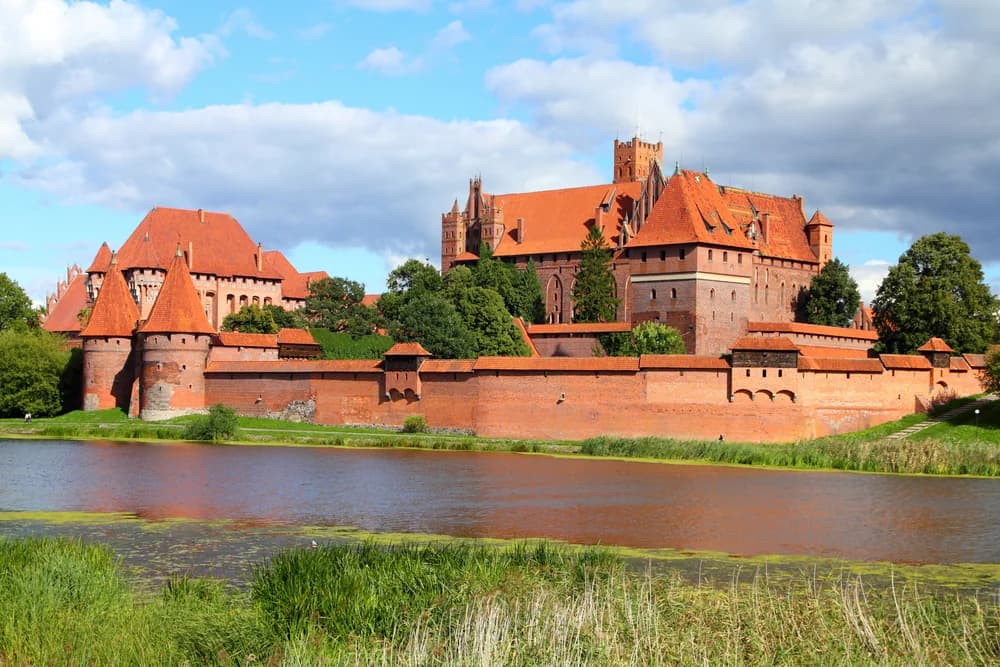
Malbork in Poland is the world's largest castle by enclosed area, four times the footprint of Windsor. Nine more, ranked from a Teutonic brick city on the Nogat to a Rajput fort on the cliffs of Jodhpur.
Castle size is a definitional question before it is a numerical one. Pick the metric and you change the answer. Enclosed area inside the outer walls is the metric architectural historians use, the one heritage authorities publish, and the one that lets European brick fortresses sit alongside Japanese hilltop keeps and Indian desert citadels in a single ranking. By that measure, Malbork is the largest castle ever built, the Teutonic Order's brick capital on the Nogat, four times the size of Windsor.[1]
The ten below carry verified figures from the operators that run them or the heritage registers that protect them. Five sit in our visit database, with confirmed 2026 hours and prices. Five more lie further afield (Jodhpur, Budapest, Himeji, Aleppo, Salzburg) and are sourced from the operator sites and UNESCO. Each entry covers what the place is, why it earns the size claim, and what it costs and takes to visit.
1. Malbork Castle, Poland
Pomeranian Voivodeship Open daily; free Mondays World's largest brick castle (21 ha enclosed) Map
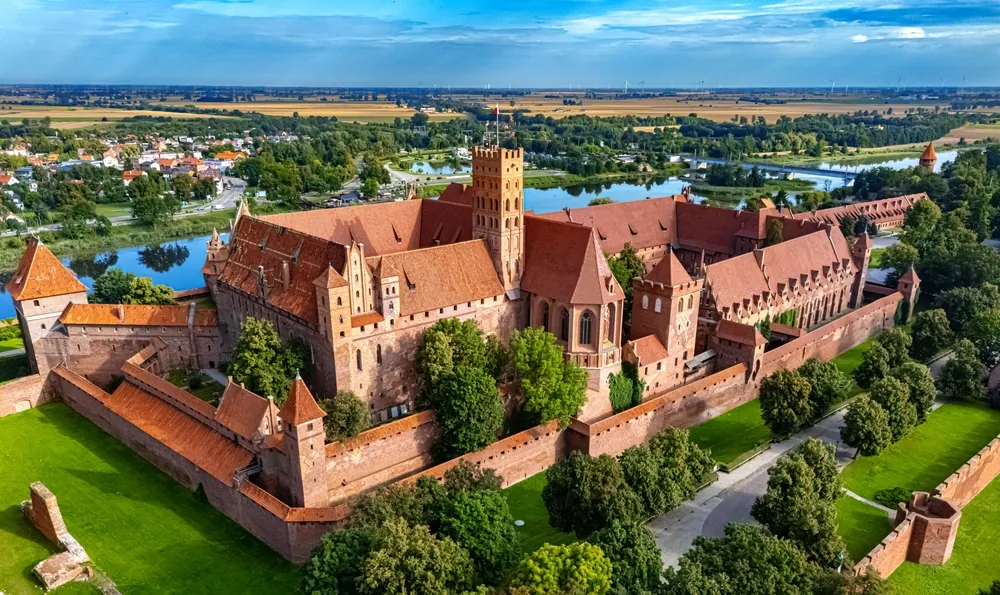
Malbork's outer walls enclose 21 hectares (about 52 acres), four times the footprint of Windsor and the largest of any castle on Earth.[1] The Teutonic Knights began construction in 1274 and used the complex as the Grand Master's seat from 1309. At its peak it housed roughly 3,000 brothers in arms.[1] The Order's defeat at Grunwald in 1410 ended its dominance of the Baltic; the castle then served as a Polish royal residence until 1772.[1]
Brick was the building material of necessity. Suitable stone is scarce in the Vistula delta, so the Order set up kilns at scale along the river. The Gothic ensemble of three connected wards (High, Middle and Lower Castle), separated by dry moats and defensive towers, is the largest brick castle in the world.[2] Aleksander Pluskowski, in his 2013 study of the Prussian Crusade, frames Marienburg/Malbork as the political and ceremonial centre of the Ordensstaat, expanded substantially through the 14th century.[3] Allied artillery destroyed more than half the structure in 1945; UNESCO inscribed the rebuilt site in 1997.[4]
Practical: open daily, Monday 09:00–20:00, Tuesday to Sunday 09:00–19:00 (high season; hours shorten in low season). Historical Castle Route adult PLN 80, reduced PLN 60; Castle Grounds Route PLN 35. Mondays free on the Grounds Route. Audio guide included. Train from Gdańsk Główny to Malbork (~50 min) plus a 15-minute walk. Plan your visit.[2]
2. Prague Castle, Czech Republic
Hradčany, Prague Grounds free; circuits ticketed Largest ancient castle on Earth (7.28 ha) Map
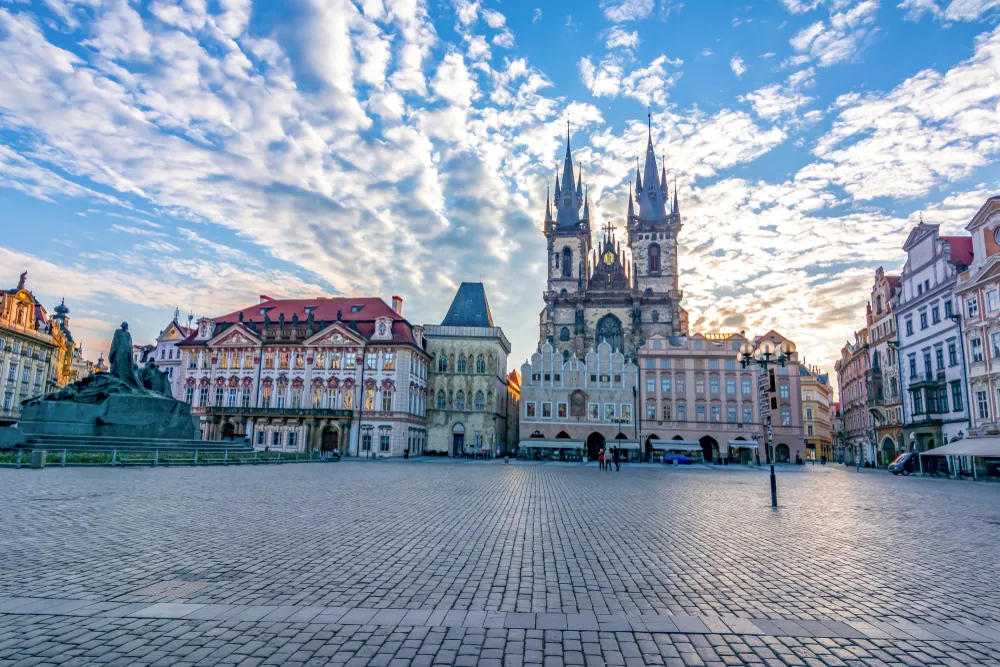
Prague Castle holds the Guinness World Record for the largest ancient castle on Earth: an oblong irregular polygon, 570 metres long by 128 wide on average, with a surface area of 7.28 hectares (18 acres).[5] Founded around 879 as a walled Bohemian seat, it accumulated Romanesque, Gothic, Renaissance and Baroque additions across more than eleven centuries of continuous royal, then republican, function.[5] It remains the official residence of the Czech President.[6]
St Vitus Cathedral sits at the heart of the courtyard, six centuries in the building, finished on 28 September 1929. The Bohemian Crown Jewels are kept inside the castle. Šnorbert reads the site as an urban-scale ensemble whose distinction lies less in raw size than in the rare concentration of secular and religious functions inside one fortified complex.[7] In 2024 the castle drew 2.59 million visitors, the most of any tourist site in the country.[8]
Practical: grounds open daily 06:00–22:00 year-round; historical interiors 09:00–17:00 in summer (Apr–Oct), 09:00–16:00 in winter (Nov–Mar). Prague Castle Circuit (Old Royal Palace, St George's Basilica, Golden Lane, St Vitus): adult CZK 450, valid two consecutive days. Story of Prague Castle exhibition CZK 300. Tram 22 to Pražský hrad, or metro to Malostranská and walk. Plan your visit.[6] See castles for sale in Czech Republic.
3. Windsor Castle, England
Royal Borough of Windsor and Maidenhead Built from 1070 Closed Tue and Wed Longest-occupied palace in Europe (5.3 ha) Map
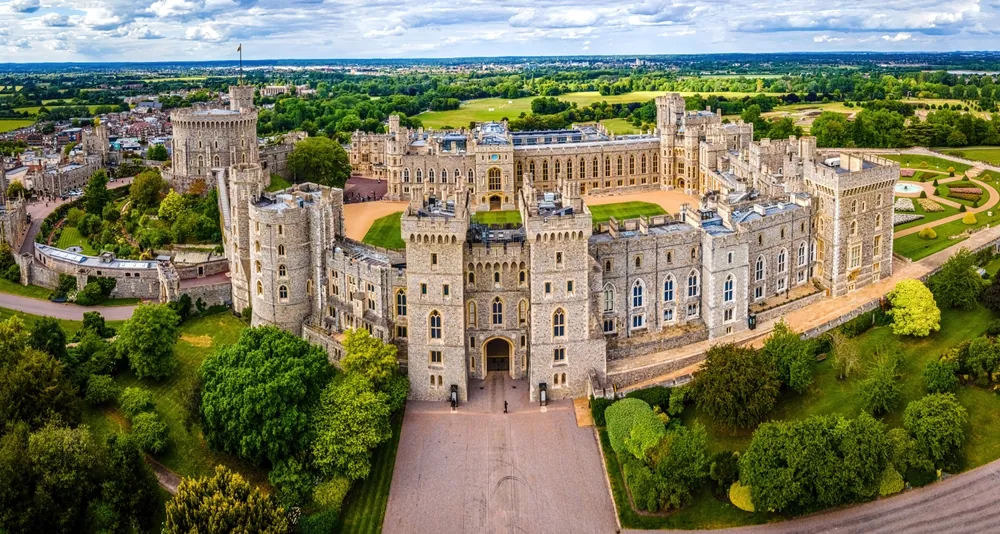
Windsor's grounds cover 13 acres (5.3 hectares). It is the longest-occupied palace in Europe, in continuous royal use since Henry I (1100–1135).[9] William the Conqueror commissioned the original fortification in the decade after the Norman Conquest of 1066, and successive monarchs have shaped its architecture across more than 950 years.[9] Inside are the State Apartments, St George's Chapel (the burial place of Henry VIII, Charles I and Elizabeth II), the Royal Archives, and the Round Tower.
The 1992 fire spread from the Private Chapel and was extinguished after 15 hours, damaging 115 rooms. John Goodall puts the cumulative restoration cost at £37 million across five years.[10] Wikipedia's authority-cited £36.5 million figure aligns within rounding; earlier press estimates ran higher and are now superseded.[11] Seventy per cent of the cost was met by opening the precincts of Windsor and Buckingham Palace to paying visitors for the first time.[11]
Practical: open Thursday to Monday year-round; closed Tuesday and Wednesday (working royal palace). Standard adult admission £21 advance / £25 on the day; under-5s free; concessions available, plus £1 tickets for UK benefit recipients (up to six per household). Semi-State Rooms reopen autumn 2026. South Western Railway from London Waterloo to Windsor & Eton Riverside (~55 min), or GWR via Slough to Windsor & Eton Central (~30–40 min). Plan your visit.[12] See castles for sale in the UK.
4. Mehrangarh Fort, India
Jodhpur, Rajasthan Open daily 09:00–17:00 Rajput cliff-top fortress Map
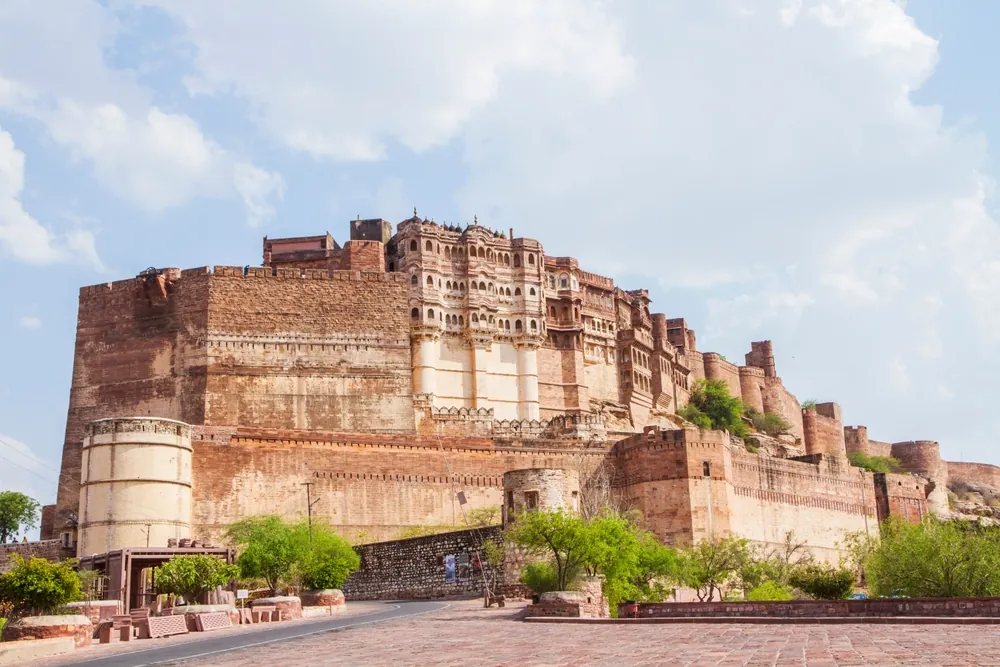
Mehrangarh's complex spans 1,200 acres (486 hectares) on a sandstone plateau 122 metres above the Jodhpur plain, with curtain walls reaching 36 metres high and 21 metres thick.[13] Rao Jodha founded the fort on 12 May 1459, though most surviving structures date from the 17th century onward under the Rathore dynasty. Seven gates mark the winding approach, each commemorating a military victory; Loha Pol still bears the handprints of royal widows who burned themselves on the funeral pyres of the Maharajas.
Inside, the Sheesh Mahal (Mirror Palace), Phool Mahal (Palace of Flowers) and Moti Mahal show Rajput sandstone latticework of unusual delicacy. Rudyard Kipling, visiting in 1895, described the fort as a palace that might have been built by Titans and coloured by the morning sun.[13] The Mehrangarh Museum Trust, set up in 1972 by H.H. Maharaja Gaj Singhji, runs the property today and receives more than one million visitors a year.[14]
Practical: open all days, 09:00–17:00 (last ticket sale 17:00). Foreign visitor admission ₹800 (audio guide included); Indian visitor admission ₹200; student concessions available. Lift Rs. 50 one way. From Jodhpur city, the fort is a short auto-rickshaw or taxi ride; nearest airport is Jodhpur (JDH). Plan your visit.[14]
5. Buda Castle, Hungary
Buda, Budapest Built 1247–1265 Castle Hill open daily; museums Tue–Sun UNESCO Castle Quarter Map
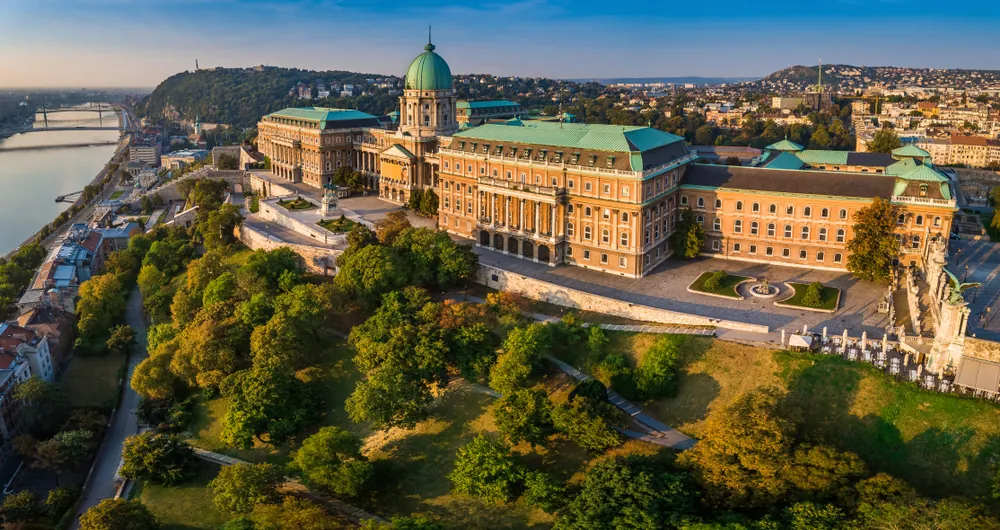
The palace footprint covers about 44,674 square metres; the wider Castle Hill quarter inscribed by UNESCO covers roughly 4.73 km².[15] King Béla IV built the first royal residence here between 1247 and 1265, in response to the Mongol invasion that had devastated Hungary. Under Sigismund of Luxembourg (1410–1437) the palace expanded into what was probably the largest Gothic palace of the late Middle Ages.[15]
Ottoman occupation, Habsburg reconstruction and catastrophic Second World War damage transformed the structure repeatedly. The palace today houses three of Hungary's most important cultural institutions: the Hungarian National Gallery, the Budapest History Museum, and the National Széchényi Library. UNESCO inscribed the Buda Castle Quarter in 1987 as part of the Banks of the Danube property.[16]
Practical: Castle Hill is open access. The Hungarian National Gallery is open Tuesday to Sunday (closed Mondays); permanent exhibition admission around HUF 3,800 (concessions for EU youth and seniors); confirm seasonal hours and combined-ticket options at the operator. Buses 16A and 116 from Széll Kálmán or Deák Ferenc tér; the Castle Garden Bazaar lift from the Danube quay is free. Plan your visit.[17]
6. Himeji Castle, Japan
Hyōgo Prefecture Open daily 09:00–17:00 Most complete feudal castle in Japan Map
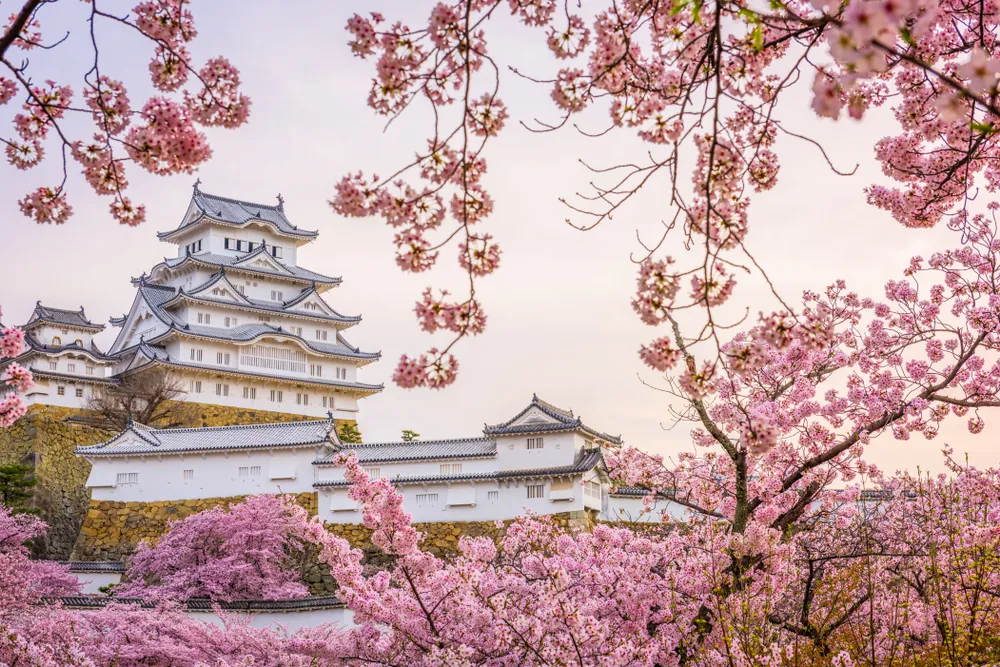
Himeji's grounds cover 233 hectares (576 acres). The inner fortified bailey containing the main keep measures 41,468 m², which is the figure used for direct comparison with European castles measured by the enclosed wall circuit.[18] Construction began in 1333 and reached its present form in 1609 under Ikeda Terumasa. UNESCO inscribed the site on 11 December 1993, among the first World Heritage properties in Japan.[19] Five structures carry National Treasure designation: the main keep, three smaller keeps, and the connecting corridors.
Known as Shirasagi-jō (the White Heron Castle) for its white plaster exterior, Himeji's defensive system of winding approach paths and stone-dropping ports survived civil wars, earthquakes and Allied bombing intact. A five-year restoration that finished in 2015 returned the white walls to their original brilliance. From March 2026 the non-resident adult admission rose from ¥1,000 to ¥2,500 to fund maintenance and seismic upgrades; the city projects around 1.2 million annual visitors at the new fee.[20]
Practical: open daily 09:00–17:00 (last entry 16:00); closed 29–30 December. Adult (non-resident) ¥2,500; Himeji resident ¥1,000; under-18 free. Combined ticket with Kokoen Garden ¥2,600; annual pass ¥5,000. Bring socks or indoor shoes (interiors are wood-floored). 20-minute walk from Himeji Station on the Sanyō Shinkansen line; ~1h from Osaka. Plan your visit.[21]
7. Spiš Castle, Slovakia
Spišské Podhradie, eastern Slovakia First written record 1120 Closed for reconstruction in 2026 UNESCO ruin on a limestone cliff (4.1 ha) Map
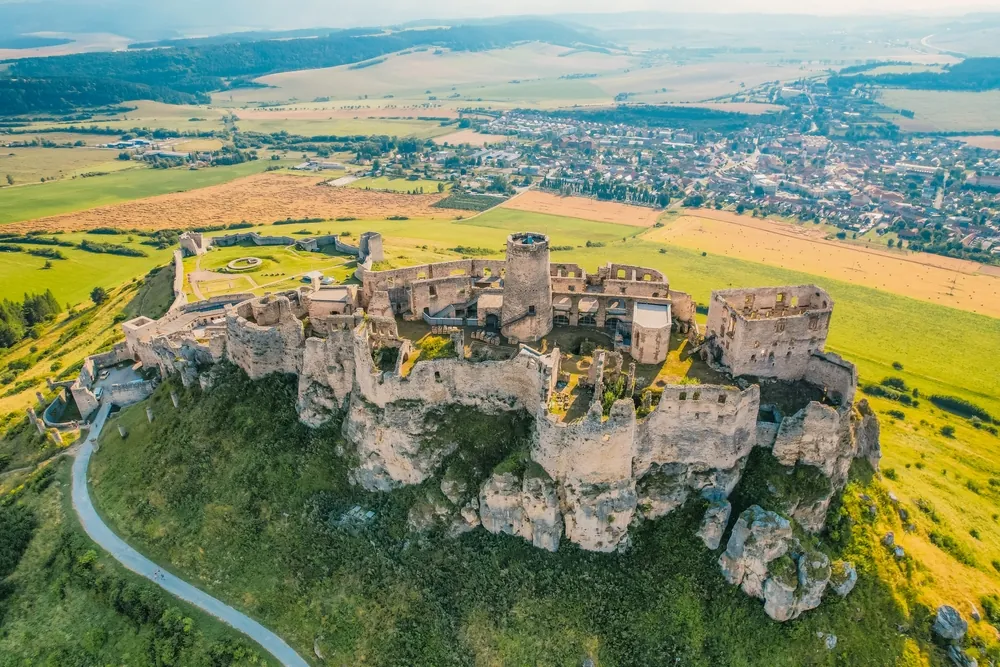
Spiš Castle covers 41,426 m² (about 4.1 hectares) on natural limestone cliffs that rise 20 to 40 metres above the eastern Slovak countryside.[22] The earliest written reference is from 1120, and for centuries the castle served as the administrative seat of Szepes County in the Kingdom of Hungary. A fire in 1780 gutted the residential core, and the site stood abandoned for nearly two centuries before 20th-century conservation stabilised the walls.[22]
The Spiš Museum now occupies the restored sections. UNESCO listed the site in 1993 alongside Spišská Kapitula and the church at Žehra.[23] Pre-pandemic visitor numbers ran around 200,000 a year, with recent counts approaching 212,000.[24] The fortifications, climbing the cliff in three terraced wards, are among the largest castle ruins in Slovakia and a defining silhouette of the Spiš region.
Practical: Spiš Castle is reportedly closed for major reconstruction works during 2026; reopening date not announced. When open, hours run 9:00–19:00 May to September. Indicative admission: adult €5–€8, concession €3 (verify with the operator before travelling). Eastern Slovakia, ~370 km east of Bratislava; access by car via the D1 motorway, or bus from Levoča or Prešov. Plan your visit.[23]
8. Citadel of Aleppo, Syria
Old City of Aleppo Earliest occupation 3rd millennium BC Reopened 2024 after restoration UNESCO World Heritage in Danger Map
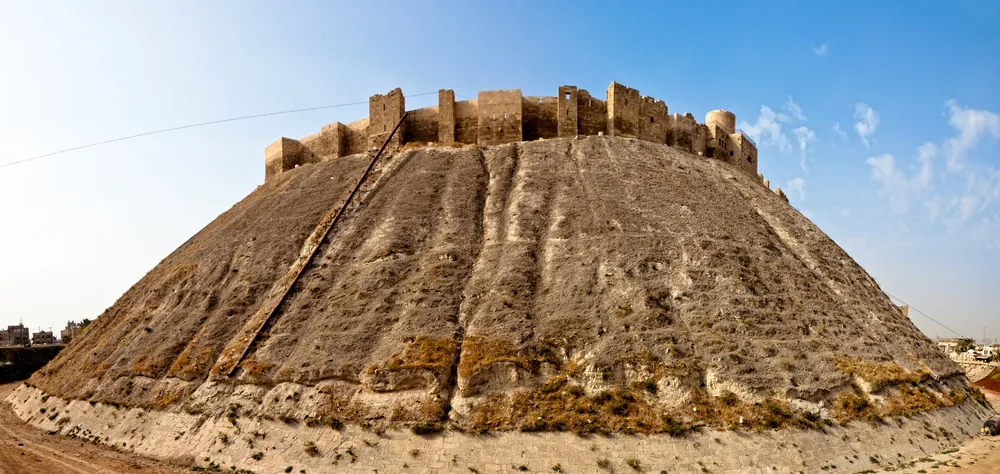
The hill at Aleppo has carried fortification since the 3rd millennium BC, when a temple to the storm-god Hadad first crowned it.[25] The mound measures roughly 450 metres long by 325 wide; the inner fortified enclosure covers approximately 40,000 m². Most of the visible architecture was built in the early 13th century under the Ayyubid sultan al-Zahir al-Ghazi (1193–1215). His monumental entrance bridge with bent-axis gates (defensive turns that forced any attacker to expose their flanks) remains a textbook study in medieval military architecture.
Successive rulers rebuilt on the same mound: Hittites, Greeks (Seleucids), Romans, Byzantines, Ayyubids, Mamluks and Ottomans. UNESCO inscribed the Ancient City of Aleppo in 1986 (reference 21), and the property has sat on the World Heritage in Danger list since 2013.[26] The 2012–2016 Battle of Aleppo damaged the external gate (a tunnel bomb in July 2015), and the February 2023 Turkey–Syria earthquake caused further structural damage. The Citadel reopened to visitors on 17 February 2024 after restoration of the southern forward tower.[27]
Practical: open to visitors after the 2024 restoration phase, though further conservation continues. Specific 2026 ticket prices and hours are not consistently published in English-language operator channels; verify with local tourism authorities or experienced regional operators before planning a visit. The Citadel is in the heart of Old Aleppo, walking distance from the souks and the Great Mosque.[27] The site is one of the oldest castles in the world by any measure.
9. Edinburgh Castle, Scotland
Castle Rock, Edinburgh Built from c. 1103 Daily, year-round 26 sieges in 1,100 years (3.6 ha) Map
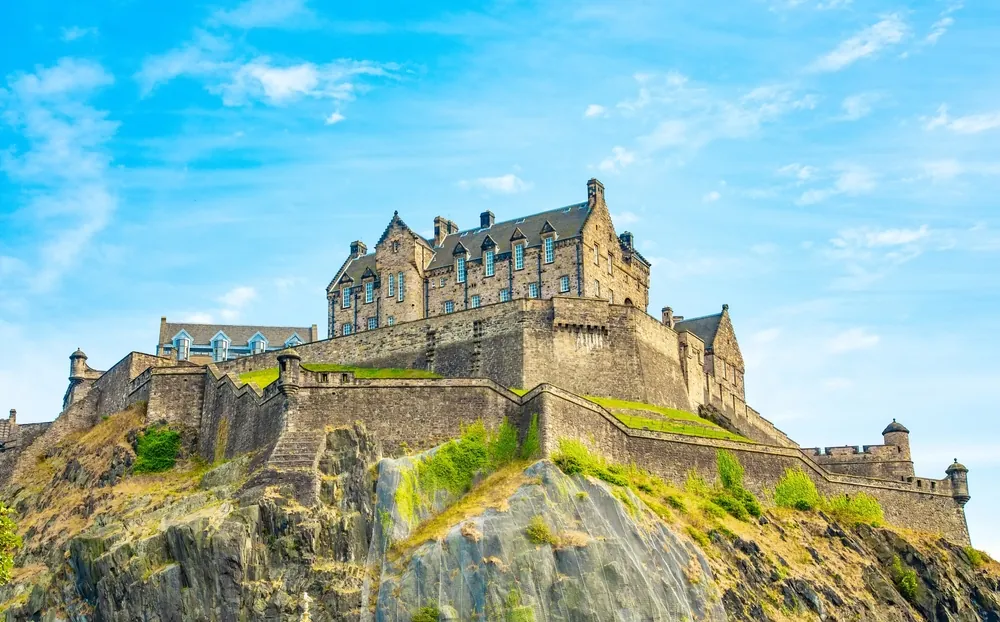
Edinburgh Castle is the most besieged place in Great Britain, with 26 sieges identified in 2014 research over its 1,100-year castle history.[28] Its 35,737 square metres (3.6 hectares) sit on Castle Rock, a volcanic plug that has carried fortification since at least the 11th century. King David I built the present castle around 1103; St Margaret's Chapel, Edinburgh's oldest surviving building, dates from his reign (1124–1153).[28]
The walls hold the Honours of Scotland (the crown jewels), the Stone of Destiny, and the Scottish National War Memorial. The Edinburgh Military Tattoo on the castle esplanade draws global audiences each summer. Visitor numbers reached 2,201,354 in 2019 and 2,044,963 in 2025.[29] The Crown Room is closed from 12 January to April 2026 for refurbishment, so the regalia display is restricted during that window.[30]
Practical: open daily, 09:30–18:00 (Apr–Sep, last entry 17:00); 09:30–17:00 (Oct–Mar, last entry 16:00). Closed 25–26 December. Adult £23.50 online (16–64), concession £19, child £14 (7–15), under-7 free. Family pricing from £48.50. On-the-day gate price is £2.50 higher per adult. 15–20-minute walk up the Royal Mile from Waverley Station; buses 23, 27 or 41 to George IV Bridge. Plan your visit.[30]
10. Hohensalzburg Fortress, Austria
Mönchsberg, Salzburg Built from 1077 Open daily, year-round One of Central Europe's largest castle complexes (3.2 ha) Map
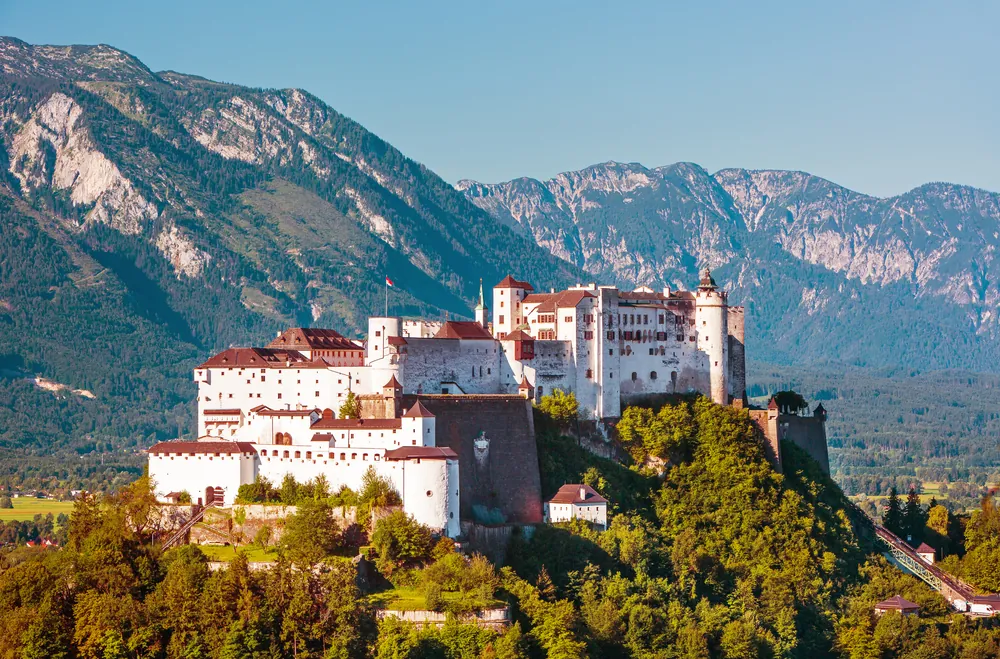
Hohensalzburg covers 32,000 m² (3.2 hectares) on the Mönchsberg above Salzburg's old town. Archbishop Gebhard von Helfenstein began construction in 1077 during the Investiture Controversy (the medieval dispute between popes and emperors over who could appoint bishops), and his successors expanded the fortress over five centuries.[31] The official site describes it today as one of the largest castle complexes in Central Europe.[31]
The only siege in the fortress's history, during the German Peasants' War of 1525, failed; it has never been taken by force. The Prince-Archbishop's garrison did surrender to French troops under General Moreau without a fight in 1800 during the War of the Second Coalition, so claims of pure invincibility need that footnote.[32] The Festungsbahn funicular has carried visitors up the rock since 1892, and more than 300 chamber music concerts run inside the fortress every year as the Salzburg Fortress Concerts.[33]
Practical: open daily, year-round. With funicular: All-Inclusive ticket €19.20 adult / €7.30 child (6–14); Basic ticket €15.50 / €6.30. On foot up: All-Inclusive €14.50 / €5.60; Basic €12.00 / €4.90 (the funicular ride down is included). The Festungsbahn departs from Festungsgasse, a few minutes' walk from Salzburg Cathedral. Plan your visit.[31]
At a glance
| Castle | Region | When to go | |
|---|---|---|---|
| Malbork Castle, PolandWorld's largest brick castle (21 ha enclosed) | Pomeranian Voivodeship | Open daily; free Mondays |
| Prague Castle, Czech RepublicLargest ancient castle on Earth (7.28 ha) | Hradčany, Prague | Grounds free; circuits ticketed |
| Windsor Castle, EnglandLongest-occupied palace in Europe (5.3 ha) | Royal Borough of Windsor and Maidenhead | Closed Tue and Wed |
| Mehrangarh Fort, IndiaRajput cliff-top fortress | Jodhpur, Rajasthan | Open daily 09:00–17:00 |
| Buda Castle, HungaryUNESCO Castle Quarter | Buda, Budapest | Castle Hill open daily; museums Tue–Sun |
| Himeji Castle, JapanMost complete feudal castle in Japan | Hyōgo Prefecture | Open daily 09:00–17:00 |
| Spiš Castle, SlovakiaUNESCO ruin on a limestone cliff (4.1 ha) | Spišské Podhradie, eastern Slovakia | Closed for reconstruction in 2026 |
| Citadel of Aleppo, SyriaUNESCO World Heritage in Danger | Old City of Aleppo | Reopened 2024 after restoration |
| Edinburgh Castle, Scotland26 sieges in 1,100 years (3.6 ha) | Castle Rock, Edinburgh | Daily, year-round |
| Hohensalzburg Fortress, AustriaOne of Central Europe's largest castle complexes (3.2 ha) | Mönchsberg, Salzburg | Open daily, year-round |
What counts as the largest?
Castle size is measurable three ways: by enclosed land area inside the outer walls, by built floor space across all storeys, or by total estate acreage. Each gives a different ranking, which is why Malbork, Prague, Windsor and Mehrangarh all carry "largest" claims that are simultaneously true.
Enclosed area inside the outer walls is the metric heritage authorities and architectural historians use, and it is the metric that makes the question answerable. Malbork's 21 hectares is the largest enclosed castle area on Earth: Britannica calls it Europe's largest fortress by land area, and Pluskowski (2013) confirms it as the largest brick castle in the world by surface area.[34] Prague's 7.28 hectares carries the Guinness record specifically for the largest ancient castle, an older typological category.[5]
Total estate acreage is a different question. Mehrangarh's 1,200 acres and Himeji's 233 hectares dwarf any European fortress if you count surrounding parkland and ceremonial approaches, but those figures take in landscape rather than fortified ground. Built floor space, the third metric, favours palaces over castles: it would put Versailles and the Forbidden City ahead of every entry on this list. The ranking above uses enclosed area inside the outer walls throughout, with alternative figures noted where they would change the position.
For more on what these places are worth and how castles trade when they trade at all, see our notes on who buys castles and the cost to own a castle. Most of the ten above are state-owned, charitable-trust held, or actively royal; almost none will ever come to market.
Sources
1. Britannica, Malbork castle.
2. Muzeum Zamkowe w Malborku (Malbork Castle Museum), official tickets and visitor information.
3. Pluskowski, A. The Archaeology of the Prussian Crusade: Holy War and Colonisation. Routledge, 2013, pp. 158–184.
4. UNESCO World Heritage List, ref. 847. Castle of the Teutonic Order in Malbork.
5. Guinness World Records, record ID 15-69343. Largest ancient castle.
6. Prague Castle Administration / Office of the Czech President, Prague Castle for Visitors.
7. Šnorbert, M. Internal and External Image of Hradčany and Prague Castle. Stavební obzor (Civil Engineering Journal), 2022.
8. Czech Statistical Office and Prague Castle Administration visitor reports, cited in Prague Castle 2024 press releases (2.59 million visitors, most-visited site in the Czech Republic).
9. Royal Collection Trust, Windsor Castle history.
10. Goodall, J. The Castle: A History. Yale University Press, 2022, p. 350 (1992 fire damaged 115 rooms; restoration completed in five years at £37 million; 70% of cost raised by opening Buckingham Palace to the public).
11. Royal Collection Trust, history of the 1992 fire and restoration, with cost reported at approximately £36.5 million completed 17 November 1997.
12. Royal Collection Trust, Plan your visit to Windsor Castle.
13. Mehrangarh Museum Trust, About Us.
14. Mehrangarh Museum Trust, Mehrangarh Museum, visit information.
15. Buda Castle history, palace footprint and dimensions: see UNESCO ref. 400 (below) and the official Castle Quarter visitor portal at
16. UNESCO World Heritage List, ref. 400. Budapest, including the Banks of the Danube, the Buda Castle Quarter and Andrássy Avenue.
17. Buda Castle visitor portal, Visit Buda Castle.
18. Himeji Castle Management Office, About Himeji Castle.
19. UNESCO World Heritage List, ref. 661. Himeji-jo.
20. Japan Travel, Entry to Himeji Castle Increases From 2026.
21. Himeji Castle official site, Visitor Information.
22. Slovenské Národné Múzeum / Spiš Museum, official visitor portal.
23. UNESCO World Heritage List, ref. 620. Levoča, Spišský Hrad and the Associated Cultural Monuments.
24. Slovakia Travel official tourism portal, Spišský hrad / Spiš Castle.
25. UNESCO World Heritage Centre, State of Conservation reports, Ancient City of Aleppo (occupier sequence and citadel chronology).
26. UNESCO World Heritage List, ref. 21. Ancient City of Aleppo.
27. Reuters / Xinhua / The Media Line, Citadel in Syria's Aleppo reopens to public after post-earthquake restoration, 17 February 2024.
28. Historic Environment Scotland, Edinburgh Castle history.
29. ALVA (Association of Leading Visitor Attractions), Edinburgh Castle visitor numbers (2,201,354 in 2019; 2,044,963 in 2025).
30. Historic Environment Scotland, Plan your visit to Edinburgh Castle, opening times and tickets.
31. Festung Hohensalzburg, official site.
32. Salzburg historical record, Napoleonic War of the Second Coalition (Hohensalzburg surrendered to French troops under General Jean Victor Marie Moreau, 1800; only siege in fortress history was the 1525 German Peasants' War, which failed).
33. Salzburg Fortress Concerts (Festungskonzerte).
34. Britannica, Malbork castle (Europe's largest fortress by land area); Pluskowski 2013 (largest brick castle in the world by surface area).