
Castles near Edinburgh: 10 day-trips from Scotland's capital
Stirling 50 minutes by train, Linlithgow 25, plus Tantallon, Dirleton, Craigmillar and Rosslyn: 10 castles within day-trip reach of Edinburgh.
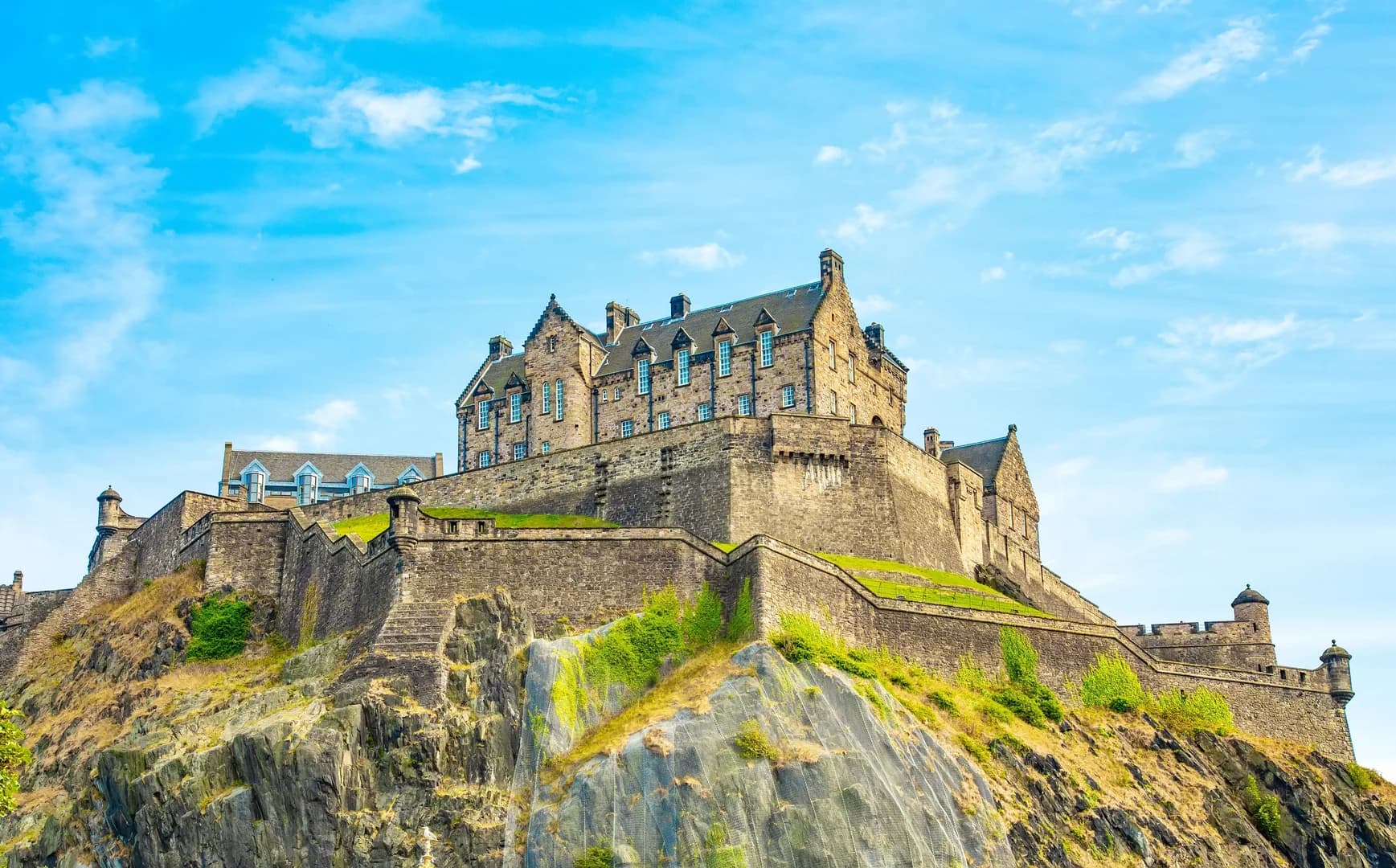
Edinburgh sits at the centre of the densest castle cluster in Britain. Ten castles you can reach in a day from the capital, from the rock at the top of the Royal Mile to the Renaissance ruin where Mary Queen of Scots was born.
The capital itself carries two of Scotland's most important royal buildings: Edinburgh Castle on its volcanic plug at the head of the Royal Mile, and the Palace of Holyroodhouse at the foot of it. Walk between them in twenty minutes and you have the entire arc of Stewart court history inside one mile.
Step out by train, bus or car and the cluster opens up. Linlithgow Palace (the birthplace of Mary, Queen of Scots) is twenty-five minutes west. Stirling Castle, the only serious peer Edinburgh has in the central belt, is fifty minutes north. Tantallon and Dirleton sit on the East Lothian coast. Craigmillar and Crichton fill in the inland Midlothian texture. Rosslyn Chapel, made famous by The Da Vinci Code, is twenty-five minutes south.
Each entry below covers what to see, when to go, what it costs, and how to get there from Edinburgh.
1. Edinburgh Castle
In-city, walk Daily, year-round Honours of Scotland Map
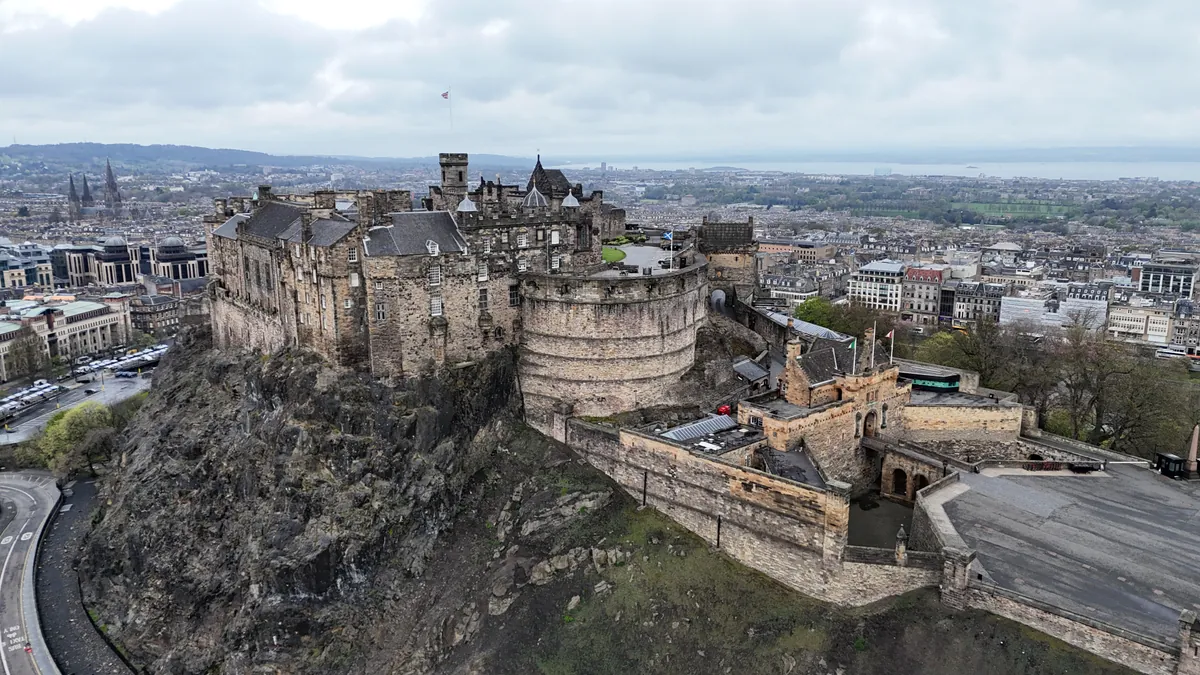
Edinburgh Castle sits on Castle Rock, a volcanic plug that has carried fortification since at least the 11th century. Saint Margaret's Chapel within the precinct dates from the reign of King David I in the early 1100s and is the oldest surviving building in Edinburgh. The architectural fabric is a layered record of medieval, Renaissance and 18th-century military rebuilding, with crow-stepped gabled features that MacGibbon and Ross identified as a defining Scottish baronial detail.[1] It is the most-visited paid attraction in Scotland: 1,981,152 visitors in 2024 according to ALVA, up four per cent year-on-year.[2]
Inside today are the Honours of Scotland (the Scottish Crown Jewels), the Scottish National War Memorial, and the National War Museum. The Stone of Destiny moved permanently to the new Perth Museum in 2024, so visitors looking specifically for the coronation stone now need a different ticket. The esplanade hosts the Royal Edinburgh Military Tattoo each August, with separate ticketing and a global broadcast audience.
Practical: open daily 09:30, last entry 17:00 in summer (Apr–Sep) and 16:00 in winter (Oct–Mar); closed 25–26 December. Adult £23.50 online, £26 at the gate, with concessions and family tiers. The Crown Room is closed for refurbishment between 12 January and April 2026, which affects the Honours of Scotland display, so check before booking. Walk up the Royal Mile from Waverley station (15–20 minutes) or take the Lothian buses 23, 27 or 41 to George IV Bridge. Plan your visit.[3]
2. Palace of Holyroodhouse
In-city, walk Closed Tue–Wed Mary, Queen of Scots' rooms Map
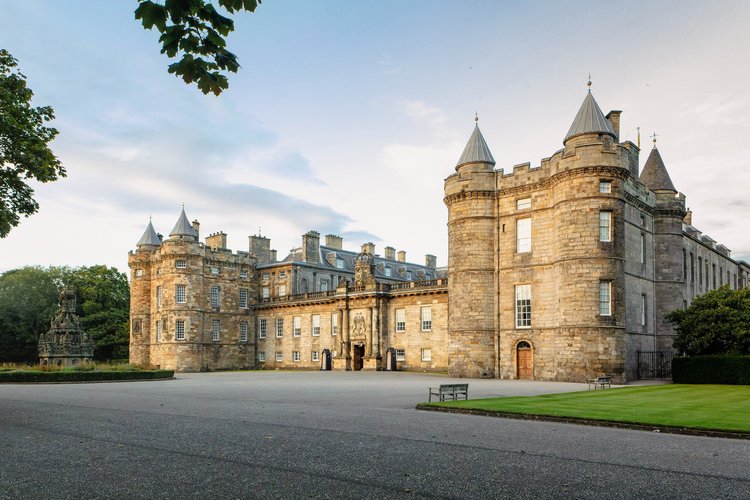
Holyroodhouse closes the Royal Mile at the eastern end. The 12th-century Augustinian abbey came first; James IV built the palace alongside it in the early 1500s. Mary, Queen of Scots, made it her principal Edinburgh residence between her return from France in 1561 and her forced abdication in 1567. The murder of her secretary David Rizzio in 1566 took place in rooms that sit on the visitor route today. The Royal Collection Trust 2024/25 Annual Review records £8,984,000 in admissions revenue from the Edinburgh sites, making Holyroodhouse and the King's Gallery one of the city's busiest paid attractions outside Edinburgh Castle itself.[4]
The palace is a working royal residence: when the British monarch is in Edinburgh (typically during Holyrood Week each summer) public access closes. Outside those windows, the State Apartments, Mary's chambers and the abbey ruins are the visit. The adjoining King's Gallery rotates exhibitions from the Royal Collection.
Practical: open Thursday to Monday 09:30–18:00 (Apr–Oct, last admission 16:30) or 09:30–16:30 in winter; closed Tuesday and Wednesday year-round and during state visits. Adult £19.80 in advance, £23.40 on the day; concession £18 (60+); child £9.90 (5–17). Includes multimedia guide. Walk fifteen minutes downhill from Waverley station along the Royal Mile, or take Lothian bus 35. Plan your visit.[5]
3. Craigmillar Castle
5 km 20 min by bus 14th–16th century Daily, year-round Mary, Queen of Scots refuge Map
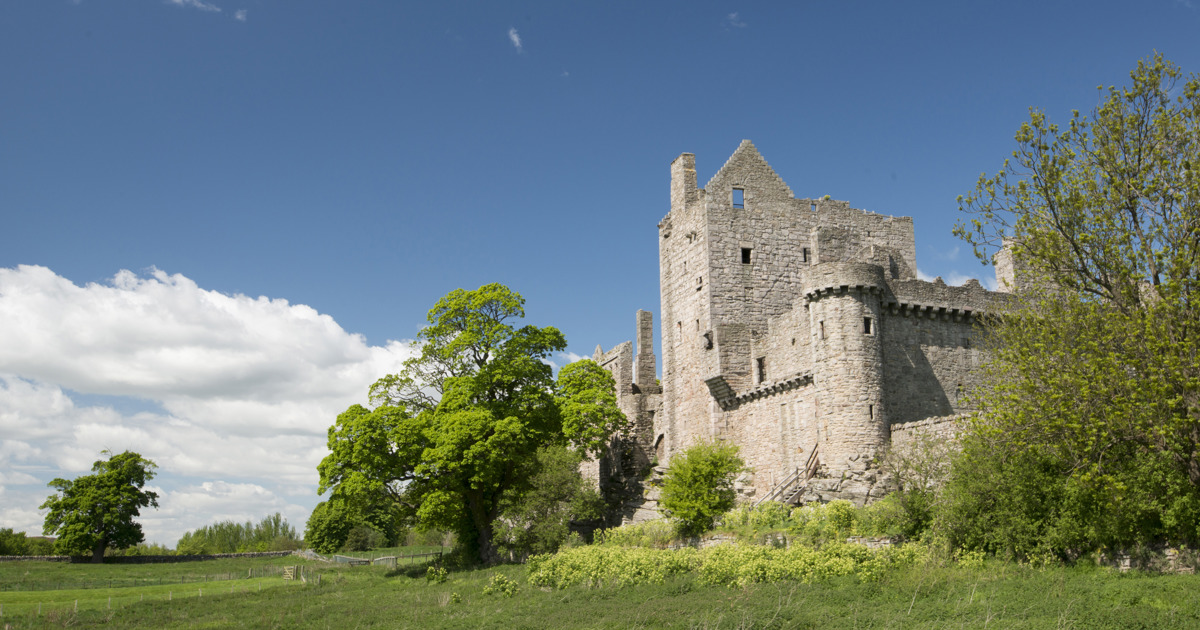
Craigmillar is the medieval castle most Edinburgh visitors miss. Twenty minutes by bus from Princes Street, almost never queued, and historically substantial: Mary, Queen of Scots, retreated here in November 1566 to recover from Rizzio's murder, and the Craigmillar Bond (the conspiracy among the Scottish nobility to dispose of her husband Lord Darnley) was drawn up at the castle that month. Hubert Fenwick's 1976 survey treats Craigmillar as the load-bearing site in the Edinburgh-Midlothian cluster behind Edinburgh Castle's headline status.[6] MacGibbon and Ross identified its courtyard plan as a characteristic Scottish type.[1]
The 14th-century tower-house is encased in a 15th-century courtyard wall, with substantial extensions across the 16th. There is enough fabric here to spend a full afternoon climbing, with views back across south Edinburgh from the upper levels.
Practical: open daily, year-round; 09:30–17:00 (Apr–Sep) or 10:00–16:00 (Oct–Mar). Adult £7.50 online or £8.50 walk-up; concession from £6; child from £4.50; family (2A+2C) £21.50 online. The Northwest Gilmour Tower is closed as a precaution at the time of writing. Reach by Lothian bus from the city centre, or drive to the small on-site car park. Plan your visit.[7]
4. Rosslyn Chapel and Roslin Castle
12 km 30 min by bus Late medieval Chapel open daily, ticketed Da Vinci Code site Map
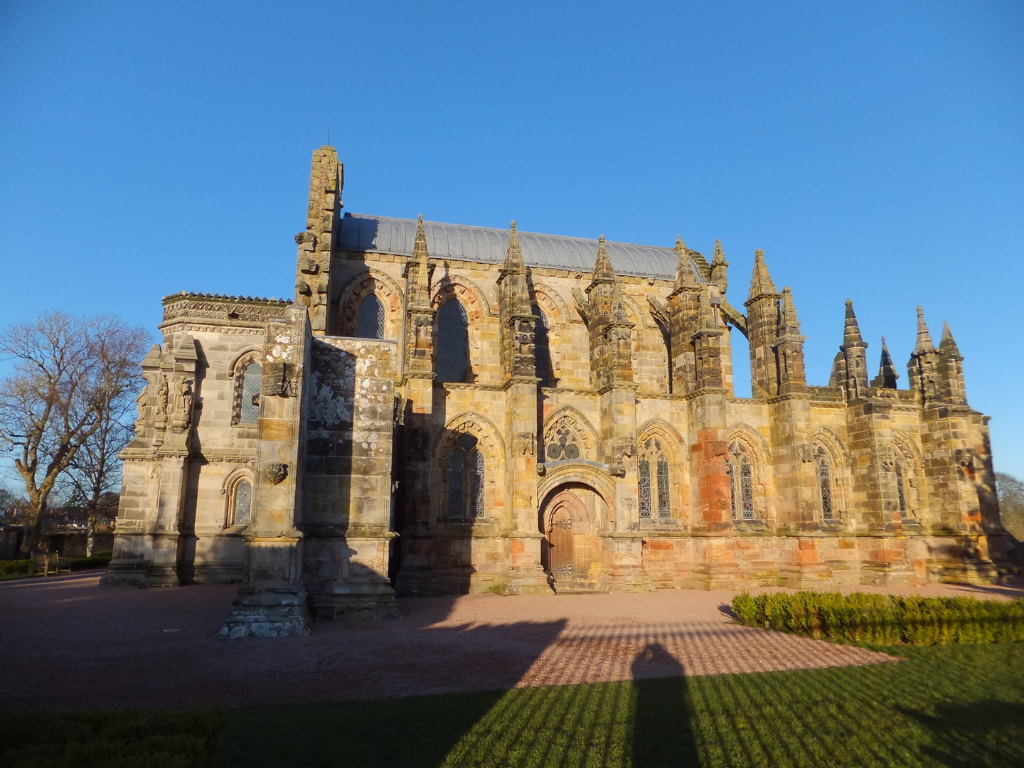
Rosslyn Chapel had a small, devoted following until Dan Brown published The Da Vinci Code in 2003. Visitor numbers jumped sharply after the 2006 film and now run at around 180,000 a year, making the chapel one of the busiest single religious buildings in Scotland.[8] The 15th-century interior, dense with allegorical carving (the Apprentice Pillar being the most-photographed detail) earns the visit on its own merits regardless of any Templar or Holy Grail framing.
The adjacent Roslin Castle, perched above the gorge of the River North Esk a short walk down through the glen, is the actual castle of the title. The 14th-century stronghold of the Sinclair family is partly ruin and partly intact: the East Range was restored in a £4 million project completed in recent years and is now let as a Landmark Trust holiday property, while the rest of the structure is exterior-only. The free Rosslyn Glen footpath from the chapel passes the castle ruin.[9]
Practical: the chapel is open daily, ticketed, with Sunday morning closures during services. Adult £11.50; concession and family rates available; under-18s free with a paying adult. The castle has no formal opening hours: walk past it on the Rosslyn Glen path, free. From central Edinburgh, take Lothian bus 37 to Roslin (around 30 minutes). Plan your visit.[8]
5. Lauriston Castle
8 km 25 min by bus 16th–early 20th century Tour only, gardens free Edwardian time-capsule interior Map
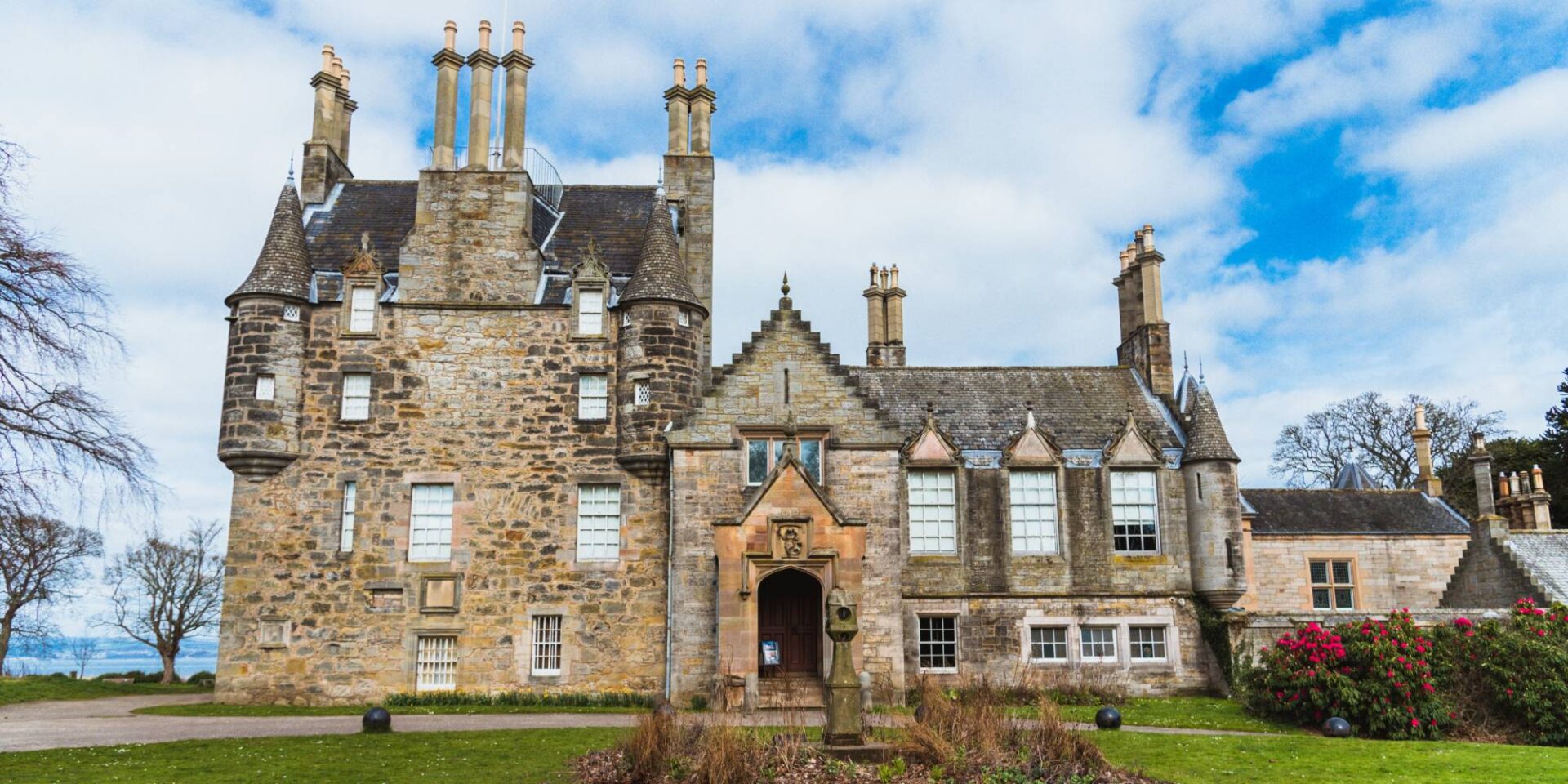
Lauriston sits on the western edge of Edinburgh in Cramond, looking out over the Firth of Forth. The 16th-century tower house was extended in the 1820s and bequeathed to the nation in 1926 by the Reid family; the interior is preserved as it stood at that handover, a rare Edwardian time-capsule. The City of Edinburgh Council runs the building through Culture Edinburgh, with interior access by guided tour only, while the gardens are free year-round.
The Highlights Tour walks the family rooms, the working library and the dining room with the original Reid furniture in place. Lauriston is the contrast piece on this list: not a defensive site, not a royal residence, but a domestic castle frozen in 1926.
Practical: Highlights Tours run year-round, booked online; adult £10; concession (senior, student, under-16) £8; family tiers £17 (1A+up to 3 under-16s) or £27 (2A+up to 3 under-16s). Gardens open daily dawn to dusk, free. Take Lothian bus 41 from the city centre to Cramond. Plan your visit.[10]
6. Crichton Castle
25 km 45 min by car 14th–16th century Grounds only, free Italianate diamond facade Map
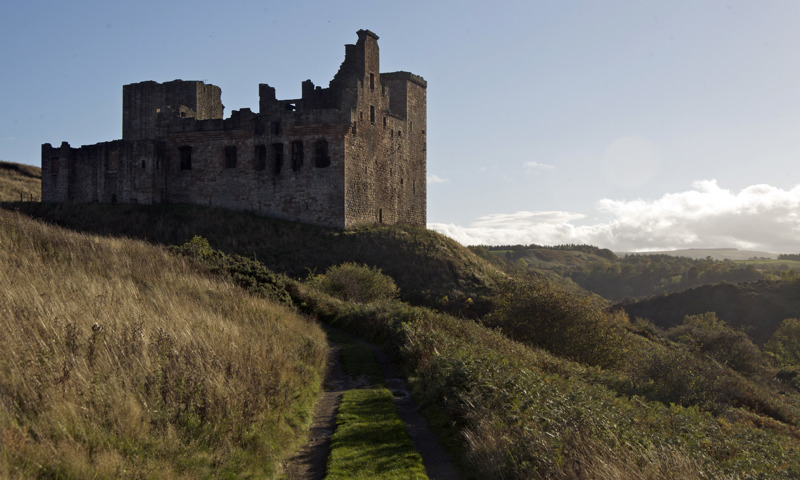
Crichton is the architectural curio of the Edinburgh ring. The 5th Earl of Bothwell, after a 1581 visit to Italy, grafted a north range onto the existing 14th-century castle with a courtyard facade of carved diamond-faceted stonework that has no equal anywhere else in Scotland: a single elevation that reads as Renaissance Italy dropped into a Midlothian valley.
The interior is closed for high-level masonry safety inspections by Historic Environment Scotland (no published reopening date). The grounds remain free to visit and the diamond courtyard is visible from the path. Treat this as a half-day side-trip from a Pathhead or Borders drive rather than a standalone Edinburgh day.
Practical: grounds accessible year-round, free; interior closed for masonry inspections (no published reopening date). Drive south on the A68 to Pathhead and follow signs (a roughly 2 km walk from the car park). Limited bus to Pathhead from Edinburgh. Operator notice.[11]
7. Linlithgow Palace
30 km 25 min by train 15th–16th century Daily, year-round Birthplace of Mary, Queen of Scots Map
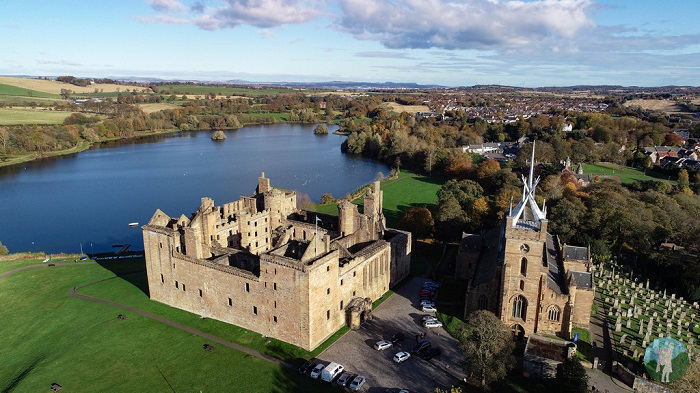
Linlithgow Palace is a roofless Renaissance ruin beside Linlithgow Loch, halfway between Edinburgh and Stirling on the main rail line. Mary, Queen of Scots, was born here on 8 December 1542; her father James V died six days later, making her queen at less than a week old. The palace had been a principal Stewart royal residence across the 15th and 16th centuries, with the great hall, the King's Fountain in the inner courtyard and the Queen's Chamber all substantially legible despite the missing roof.
The roof was destroyed by fire in 1746 when the army of the Duke of Cumberland, retreating after the Battle of Falkirk Muir, accidentally set the palace alight. It has stood roofless since.
Practical: open daily, year-round; 09:30–17:00 (Apr–Sep) or 10:00–16:00 (Oct–Mar). Adult £10 online or £11 walk-up; concession from £8; child from £6; family 2A+3C £37.50 walk-up. The King's Bed Chamber and Court Kitchen are currently closed for conservation. Direct trains from Edinburgh Waverley take 25 minutes; the palace is a 7-minute walk from the station. Plan your visit.[12]
8. Dirleton Castle
40 km 50 min by car 13th–16th century Reduced access, ticketed 13th-century stronghold Map
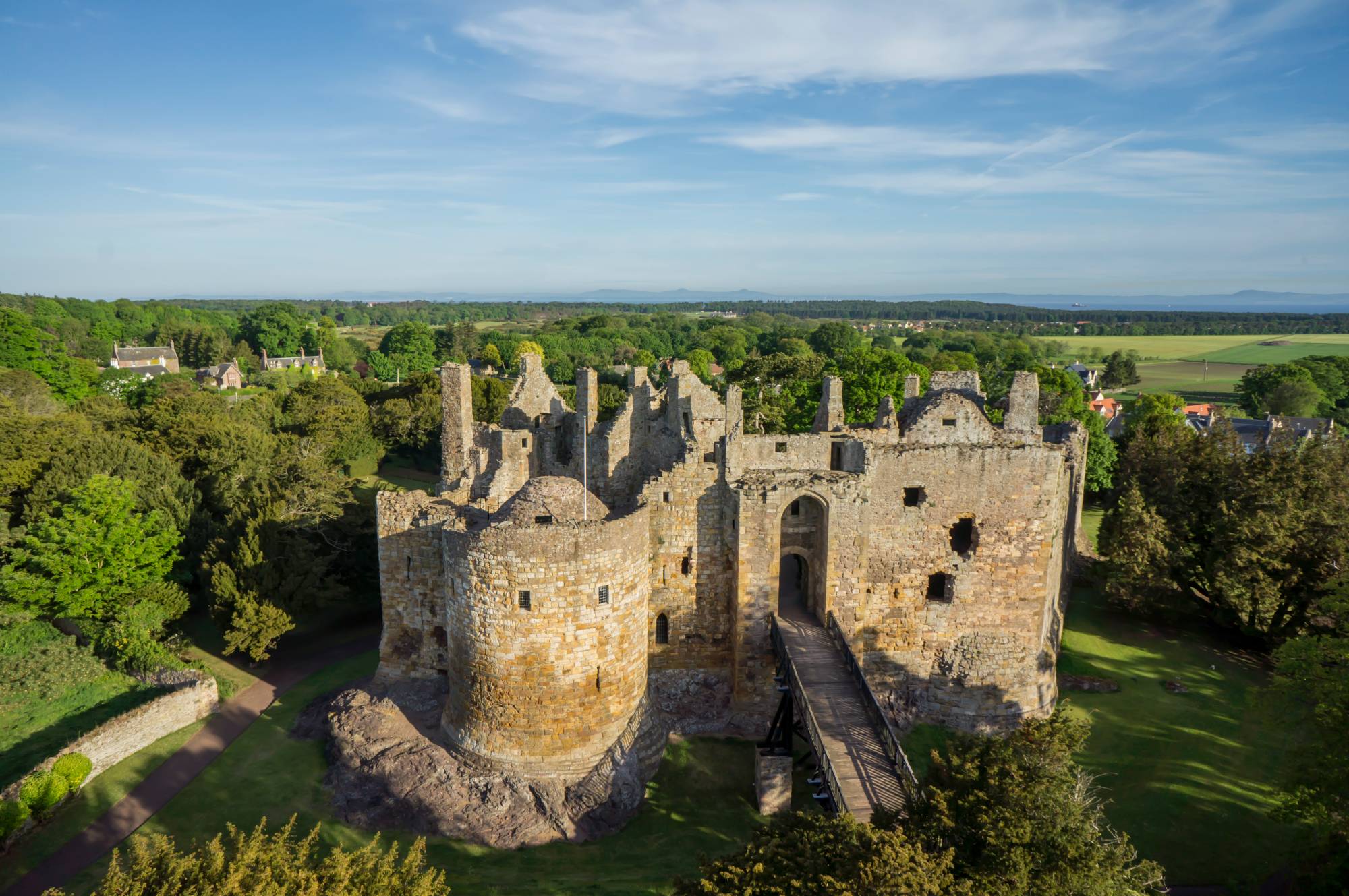
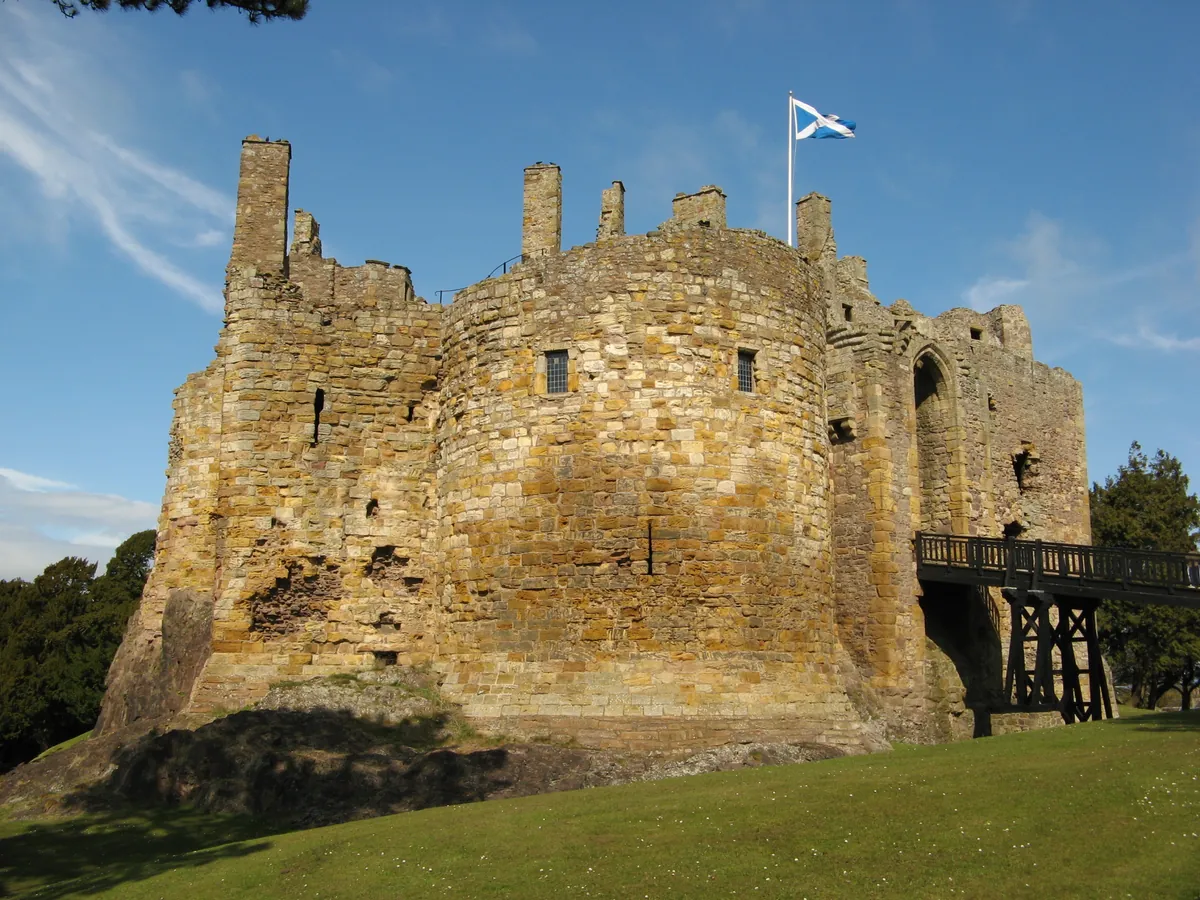
Dirleton sits in the East Lothian village of the same name, five kilometres west of Tantallon. The original 13th-century castle of the de Vaux family was expanded in the 15th and 16th centuries, with three families (de Vaux, Halyburton, Ruthven) building successively across the period. MacGibbon and Ross document Dirleton alongside Tantallon as anchoring the late-medieval East Lothian cluster.[13]
The castle is set within walled gardens that include one of the longest herbaceous borders in Britain. The bowling green, the dovecote and the working garden round out a longer visit than the compact ruin would suggest. Conservation work has reduced access: no entry to the Guard House, the South Entrance or the De Vaux range.
Practical: open daily 09:30–17:00 (Apr–Sep); closed Thursday and Friday October to March, 10:00–16:00 the rest of the week. Reduced ticketing during conservation: adult £4.50, concession £3.50, child £2.50; standard walk-up rises to £8.50 once full access returns. Drive on the A1 from Edinburgh, or take Lothian Country bus 124, or rail to North Berwick (35 min) plus a short bus or taxi. Plan your visit.[14]
9. Tantallon Castle
50 km 1 hour by car Mid-14th century Daily, year-round Cliff-top Douglas fortress Map
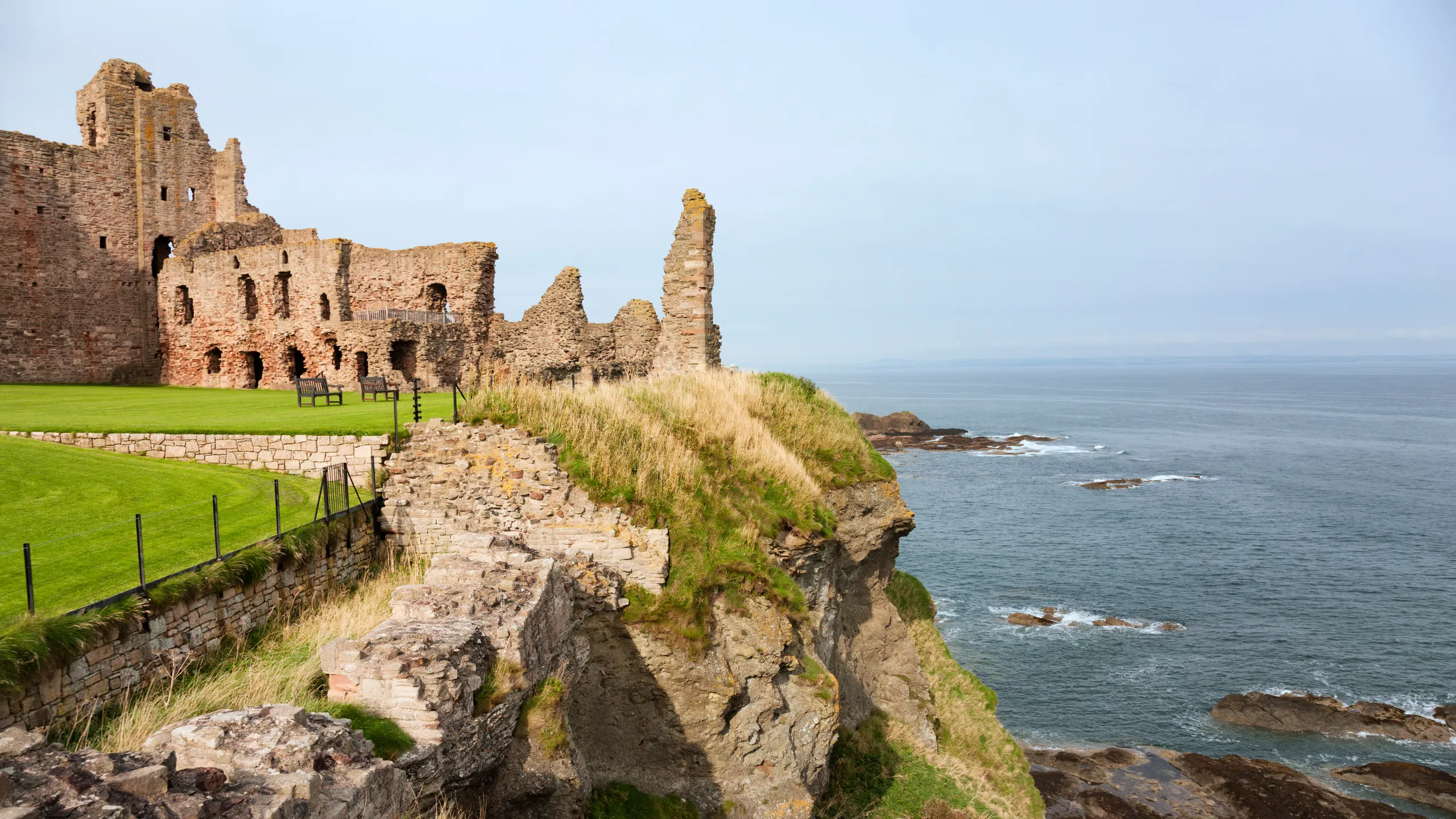
Tantallon is the most dramatic clifftop castle within day-trip range of Edinburgh, perched on the cliffs above the North Sea with the Bass Rock visible offshore. William, 1st Earl of Douglas, built it in the 1350s as the principal Douglas stronghold in southeast Scotland. MacGibbon and Ross treated Tantallon, alongside Doune, as one of the earliest Scottish examples of the courtyard castle plan in the manner of certain French models, with a separate keep block detached from the rest of the structure.[15]
Cromwellian forces under General Monck partially reduced Tantallon during the 1651 siege of the Third English Civil War. The east wall was breached, but the north and south curtain walls remain substantially intact. The walking approach from the car park along the cliff edge gives the most photographed view of the castle, with the Bass Rock seabird colony framed behind.
Practical: open daily 09:30–17:00 (Apr–Sep) or 10:00–16:00 (Oct–Mar). Adult £7.50 online / £8.50 walk-up; concession from £6; child from £4.50; family 2A+3C £29 walk-up. The east tower staircase, doocot and vaults are currently closed for safety; the rest of the castle is open. Drive on the A1 from Edinburgh; the nearest rail station is North Berwick (35 minutes from Waverley, plus a short taxi or bus). Plan your visit.[16]
10. Stirling Castle
60 km 50 min by train 12th–16th century Daily, year-round Renaissance royal palace Map
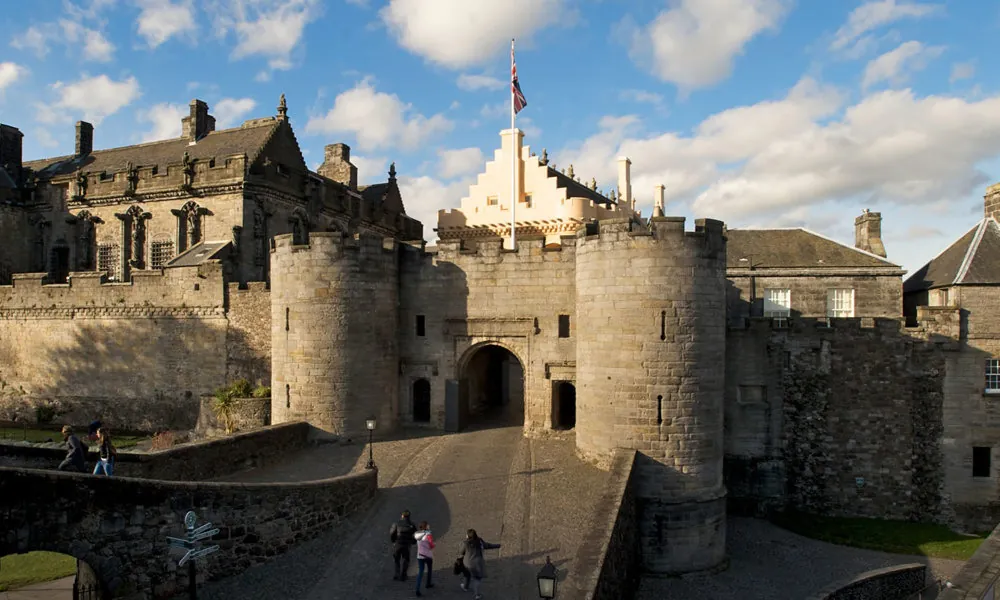
Stirling is Edinburgh's only serious peer in central-belt Scotland and arguably the more strategically important historically. The castle controls the lowest crossing of the River Forth, which made it the gateway between Lowland and Highland Scotland and the prize in successive Wars of Independence. James VI was baptised here in December 1566; Mary, Queen of Scots, was crowned in the Chapel Royal in 1543 at nine months old. MacGibbon and Ross noted Stirling and Edinburgh together as the canonical Scottish royal fortresses preserving crow-stepped gabled detail through their medieval and Renaissance fabric.[1]
The re-presented Royal Palace interiors, finished in 2011 with replicated Renaissance unicorn tapestries and reproduced ceiling carvings, are the finest surviving register of Scottish royal court decoration anywhere. For a return visitor specifically interested in the Stewart heritage, Stirling offers more architectural depth than Edinburgh Castle itself.
Practical: open daily 09:30, last entry 17:00 (Apr–Sep) or 16:00 (Oct–Mar); closed 25–26 December, 11:00 start on 1 January. Adult £18.50 online / £20.50 walk-up; concession from £15; child from £11; family tiers up to 2A+3C £63 online. Twenty-five per cent off admission for car-free arrivals. Direct trains from Edinburgh Waverley take 50 minutes, with a 15-minute walk uphill to the gate. Plan your visit.[17]
At a glance
| Castle | Distance | How to get there | |
|---|---|---|---|
| Edinburgh CastleHonours of Scotland | In-city, walk | — |
| Palace of HolyroodhouseMary, Queen of Scots' rooms | In-city, walk | — |
| Craigmillar CastleDaily, year-round | 5 km | 20 min by bus |
| Rosslyn Chapel and Roslin CastleChapel open daily, ticketed | 12 km | 30 min by bus |
| Lauriston CastleTour only, gardens free | 8 km | 25 min by bus |
| Crichton CastleGrounds only, free | 25 km | 45 min by car |
| Linlithgow PalaceDaily, year-round | 30 km | 25 min by train |
| Dirleton CastleReduced access, ticketed | 40 km | 50 min by car |
| Tantallon CastleDaily, year-round | 50 km | 1 hour by car |
| Stirling CastleDaily, year-round | 60 km | 50 min by train |
How many castles are near Edinburgh?
Within roughly 60 minutes of Edinburgh by road or rail you can reach the ten castles listed above plus several smaller sites. Hubert Fenwick's 1976 survey catalogues a deeper Edinburgh-Midlothian cluster that includes Crichton, Dalhousie, Dalkeith Palace and Craigcrook alongside Craigmillar, calling these the "deep historic-castle texture" surrounding Edinburgh Castle itself.[6] MacGibbon and Ross add Tantallon, Dirleton and Hailes for the East Lothian coast.[13] Most are in private ownership or heritage-managed; the public-access subset is what this list covers.
Historic Environment Scotland operates the bulk of the publicly ticketed sites in the area (Edinburgh, Stirling, Linlithgow, Tantallon, Dirleton, Craigmillar, Crichton). The Royal Collection Trust runs Holyroodhouse. Rosslyn Chapel sits with the chapel's own trust. Lauriston is council-run. UNESCO inscribed Edinburgh's Old and New Towns as a World Heritage site in 1995, with Edinburgh Castle and the Royal Mile inside the inscription.[18]
Famous, medieval, Renaissance and largest
Famous. Edinburgh Castle leads visitor demand at around 1.98 million in 2024.[2] Stirling and Holyroodhouse follow, with Linlithgow and Rosslyn Chapel sitting in the next tier.
Medieval. Craigmillar, Tantallon, Dirleton and Crichton are the strongest medieval-period survivors as standalone visits. Craigmillar's courtyard plan and Tantallon's cliff-top siting are the architectural anchors of the cluster.
Renaissance. Linlithgow Palace and Stirling's Royal Palace interiors are the canonical Scottish Renaissance survivors near the capital. Crichton's Italianate diamond courtyard is the curio: a single elevation that reads as Italy in Midlothian.
Largest. Edinburgh Castle is the largest fortified site in the area by visitor footprint and the most-photographed across the cluster. Stirling is the largest by ceremonial-room volume once the Royal Palace, Chapel Royal and Great Hall are added together.
If you're looking to buy
Scotland produces the standout European castle-appreciation case in the Castle Price Index dataset. Dalhousie Castle in Midlothian (around 8 miles south of Edinburgh, now a 29-room luxury hotel rather than a public attraction) moved from £2,499,994 in April 2012 to £5,599,998 in October 2023, a 124% gain across 11 years against an active hotel operation, all of it verified through Registers of Scotland.[19] David Cannadine traces Dalhousie's earlier dispersal in The Decline and Fall of the British Aristocracy: Lord Dalhousie sold 10,000 acres in Angus after an 850-year family ownership during the post-WWII estate-disposal wave.[20] The active for-sale market sits across a wide range, from Highland castle ruins for restoration through to the £15–50 million trophy tier. Land and Buildings Transaction Tax runs 0–12% on a sliding scale with no non-resident surcharge. See castles for sale in Scotland for live listings, and the guide to buying a castle for the operational side.
Sources
1. MacGibbon, D. and Ross, T. The Castellated and Domestic Architecture of Scotland from the Twelfth to the Eighteenth Century, Volume II. David Douglas, Edinburgh, 1887; pp. 78, 182, 328 (Craigmillar), 353 (crow-stepped gabled features at Edinburgh and Stirling Castles).
2. Association of Leading Visitor Attractions, Edinburgh Castle visitor figures 2024.
3. Edinburgh Castle, Historic Environment Scotland. Tickets and opening times at
4. Royal Collection Trust Annual Review 2024–25, p. 48 (Edinburgh admissions revenue £8,984,000).
5. Palace of Holyroodhouse, Royal Collection Trust.
6. Fenwick, H. Scotland's Castles. Robert Hale, 1976; pp. 75–76, 93–97, 102, 270, 296 (Edinburgh-Midlothian castle cluster: Craigmillar, Crichton, Dalhousie, Dalkeith Palace, Craigcrook).
7. Craigmillar Castle, Historic Environment Scotland.
8. Rosslyn Chapel Trust, official site.
9. VisitMidlothian, "Rosslyn Castle: major restoration complete and bookings re-open for self-catering in the East Wing".
10. Lauriston Castle, Culture Edinburgh / City of Edinburgh Council.
11. Crichton Castle, Historic Environment Scotland (operator notice on interior closure).
12. Linlithgow Palace, Historic Environment Scotland.
13. MacGibbon and Ross, op. cit., Vol. II chapter on East Lothian (Tantallon, Dirleton, Hailes).
14. Dirleton Castle, Historic Environment Scotland.
15. MacGibbon and Ross, op. cit., p. 585 ("Some of the earlier examples, such as Doune and Tantallon, seem to have been erected on the model of certain French castles of the period").
16. Tantallon Castle, Historic Environment Scotland.
17. Stirling Castle, Historic Environment Scotland.
18. UNESCO World Heritage List, ref. 728: Old and New Towns of Edinburgh.
19. Castle Collector, Castle Price Index, March 2026 edition. Registers of Scotland (ScotLIS) verified transaction trail for Dalhousie Castle.
20. Cannadine, D. The Decline and Fall of the British Aristocracy. Yale University Press, 1990 (Vintage Books edition 1999); p. 642.