
Castles near Munich: 10 Bavarian palaces from Neuschwanstein to Nymphenburg
Ludwig II's Neuschwanstein draws 1.4 million visitors a year. Linderhof, Herrenchiemsee and Hohenschwangau complete the Bavarian fairy-tale set near Munich.
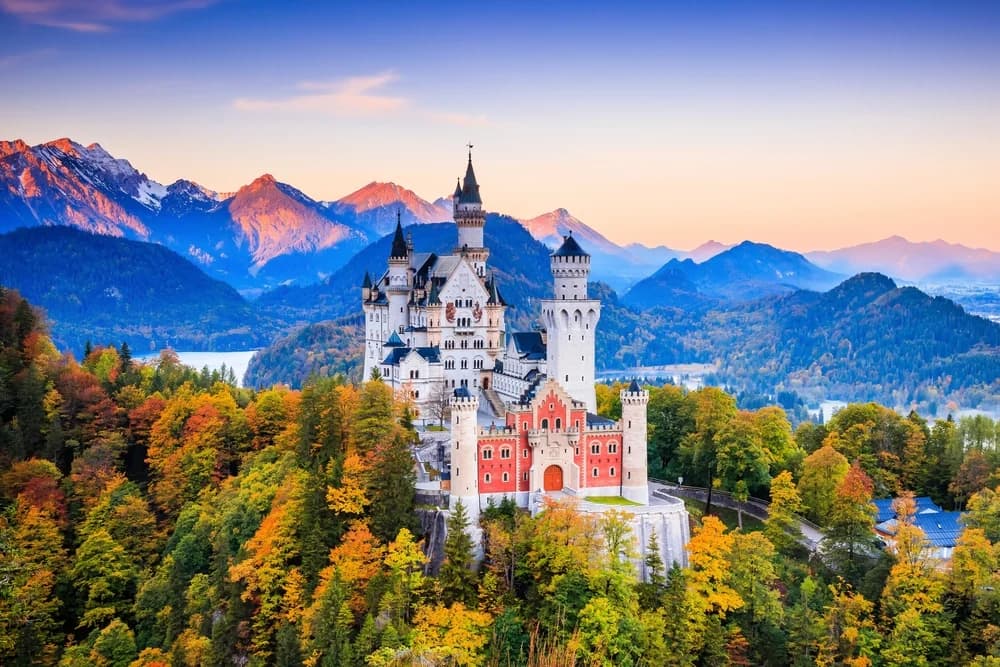
Munich anchors the densest castle landscape in southern Germany. Ten palaces and fortresses within a day of the city, from Ludwig II's Romantic-era Neuschwanstein to a Wittelsbach summer palace inside the city limits and the longest castle complex in the world.
Munich is the structural centre of Bavarian castle tourism. The Wittelsbachs ruled Bavaria from Munich for over 700 years, and their dynastic taste shapes almost every property in this list: the in-city baroque seats (Nymphenburg, Schleissheim), the late-medieval and Renaissance fortresses on the eastern frontier (Burghausen), and most distinctively the 19th-century Romantic-era palaces commissioned by Ludwig II between the 1860s and his death in 1886 (Neuschwanstein, Linderhof, Herrenchiemsee).[1] Of those Ludwig commissions, Neuschwanstein draws around 1.07 million visitors a year and is widely understood to be the silhouette Disney borrowed for Sleeping Beauty Castle.[2][3]
The Bayerische Schlösserverwaltung, the state palace administration, manages over 45 castles and gardens across Bavaria. Its 2025 Bilanz recorded 417,692 visitors at Linderhof (up 18% on 2024), 309,353 at Herrenchiemsee, 203,056 at Walhalla in Donaustauf, 121,361 at the Befreiungshalle in Kelheim and 81,090 at Burg zu Burghausen, all in addition to the separately tracked Neuschwanstein.[1]
The geography is two-tier. The in-city palaces (Nymphenburg, Blutenburg, Schleissheim) sit within 30 minutes of central Munich on the S-Bahn or tram. The Romantic-era and frontier castles (Neuschwanstein, Hohenschwangau, Linderhof, Herrenchiemsee, Burghausen, Walhalla) sit 75 minutes to 2 hours out, mostly south-west toward the Alps or east toward the Inn river. Each entry below covers what to see, when to go, what it costs, and how to get there from central Munich.
1. Schloss Neuschwanstein
~120 km ~2 hr Tour by reservation Fairy-tale castle Map
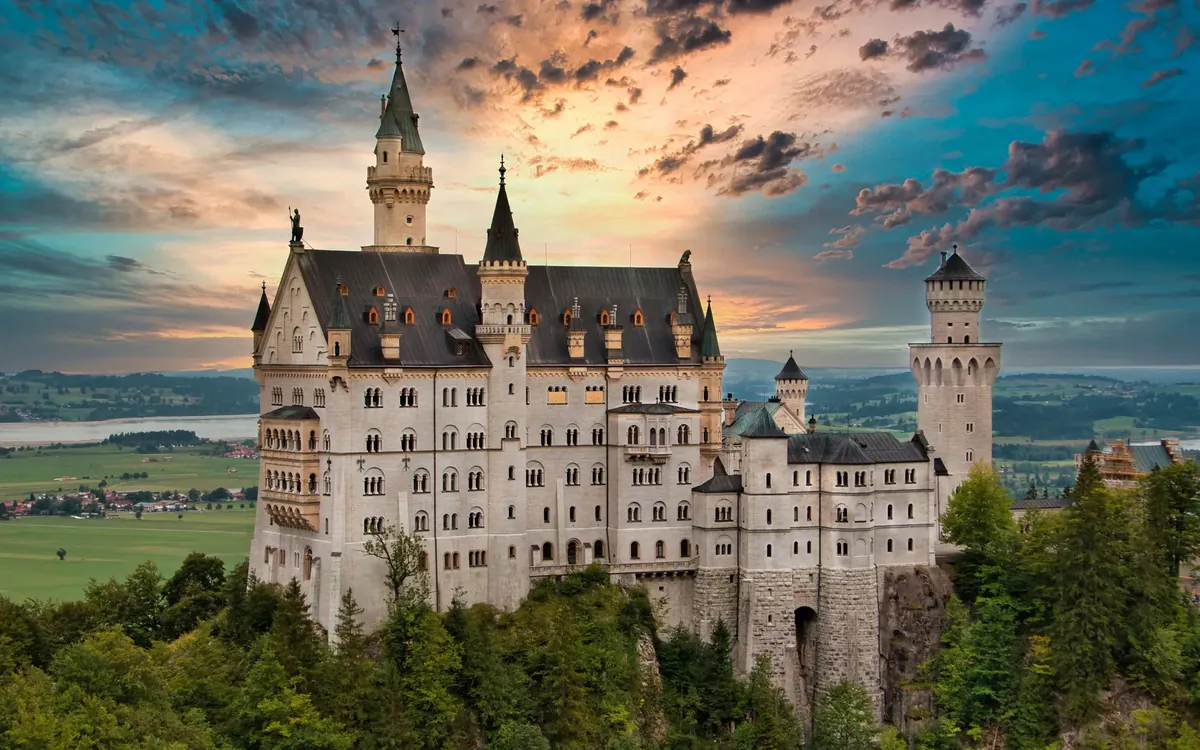
Neuschwanstein, on a forested hilltop above Hohenschwangau in the southern Allgäu, is the Romantic-era fantasy castle Ludwig II commissioned in 1869 and never finished. Construction was incomplete at his death in June 1886, and the castle never functioned as a meaningful royal residence. The design borrows directly from Ludwig's reading of Wagnerian opera (Lohengrin, Tannhäuser, Tristan) and from the medieval Wartburg in Thuringia. The Throne Hall, the Singers' Hall and the Grotto of Venus are the canonical interiors.[2] Robert Taylor's academic survey places Neuschwanstein alongside the Brandenburg Gate and Marksburg as one of the three best-known architectural symbols of Germany abroad.[4]
The Disney Sleeping Beauty Castle silhouette is widely understood to derive from Neuschwanstein. The castle was inscribed on the UNESCO World Heritage list in 2025 as part of the Royal Castles of King Ludwig II of Bavaria. The state-rooms restoration was largely completed in 2024, and the Throne Hall and Venus Grotto reopened the same year.[2]
Practical: open daily 09:00 to 18:00 (28 March to 15 October), 10:00 to 16:00 (16 October to 27 March); closed 1 January, 24, 25 and 31 December. Visit by guided tour only with timed admission; pre-booking essential. Adult €21, concession €20, under 18 free; King's Ticket (Neuschwanstein plus Hohenschwangau) €31; online booking adds a €2.50 service fee per ticket. From Munich Hauptbahnhof, regional train to Füssen (~2 hours, hourly), then bus 73 or 78 to Hohenschwangau (~10 minutes), then a 30 to 40 minute uphill walk or shuttle bus (€3 up / €2 down) or horse-drawn carriage (€8 up / €4 down). Plan your visit.[2]
2. Schloss Linderhof
~95 km ~1 hr 30 Daily, year-round Ludwig II's villa Map
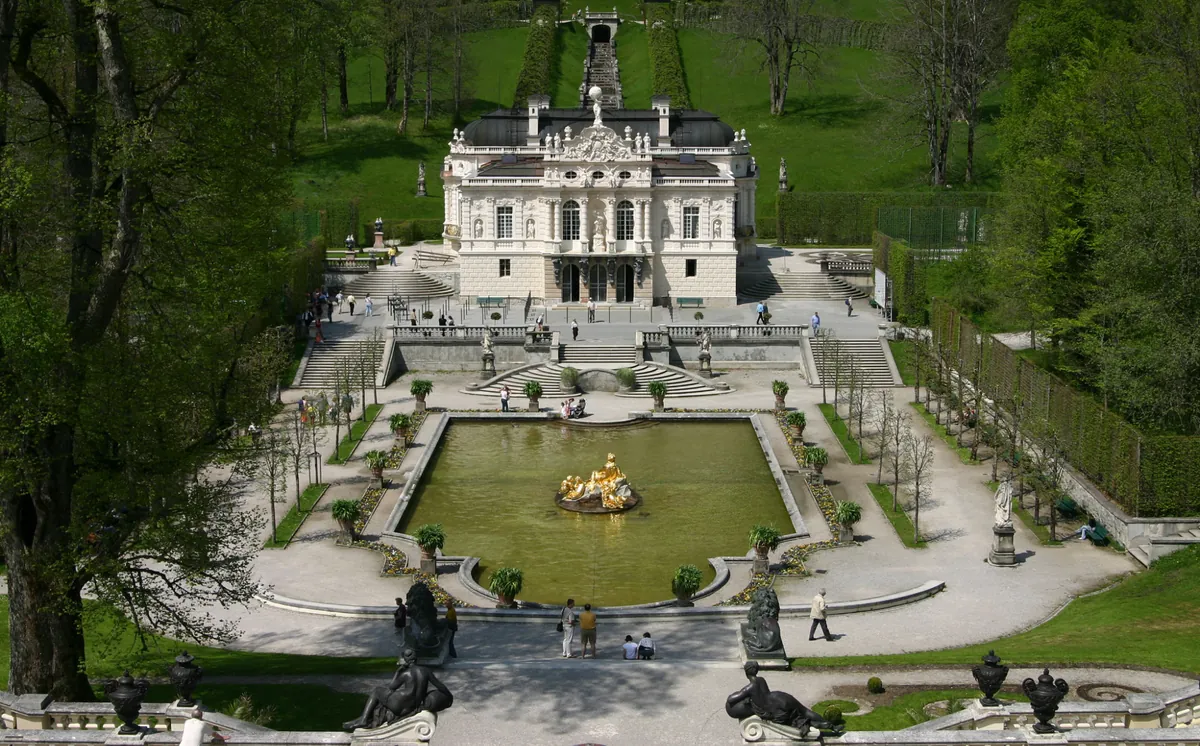
Linderhof, in a wooded valley below the Ettal monastery, is the only one of Ludwig II's three palaces he ever finished. Built between 1869 and 1886 on the site of a small royal hunting lodge, the building is markedly more intimate than Neuschwanstein, modelled on Versailles in its formal gardens and on the Petit Trianon in its scale. The Hall of Mirrors and the Bedroom of Louis XIV are the principal interiors, and Ludwig's attachment to the cult of the Sun King is explicit throughout.
The Venus Grotto in the grounds is the building that gives Linderhof its theatrical signature: an artificial cave with stalactites, an underground lake, early electric lighting, and a small swan-prowed boat in which the king was rowed across the water while listening to private performances of Wagner's Tannhäuser. The 2025 Bilanz records 417,692 visitors at Linderhof, up 18% on 2024 and the second-most-visited Bavarian state palace after Neuschwanstein.[1] The grotto reopened in 2024 after a multi-year restoration.
Practical: open daily, 09:00 to 18:00 (15 April to 15 October), 10:00 to 16:30 (16 October to 14 April); closed 1 January, Shrove Tuesday, 24, 25 and 31 December; Venus Grotto closed in winter. Castle adult €11, concession €10, under 18 free; combination ticket (Castle + Venus Grotto, summer only) €18 / €16; Königshäuschen €2 / €1. From Munich, train to Oberammergau (change at Murnau, ~2 hours), then bus 9622 to Schloss Linderhof (~25 to 30 minutes); by car, ~95 km south-west via the A95. Plan your visit.[5]
3. Schloss Herrenchiemsee
~80 km ~1 hr 15 + boat Daily; tour-only New Palace Ludwig II's Versailles Map
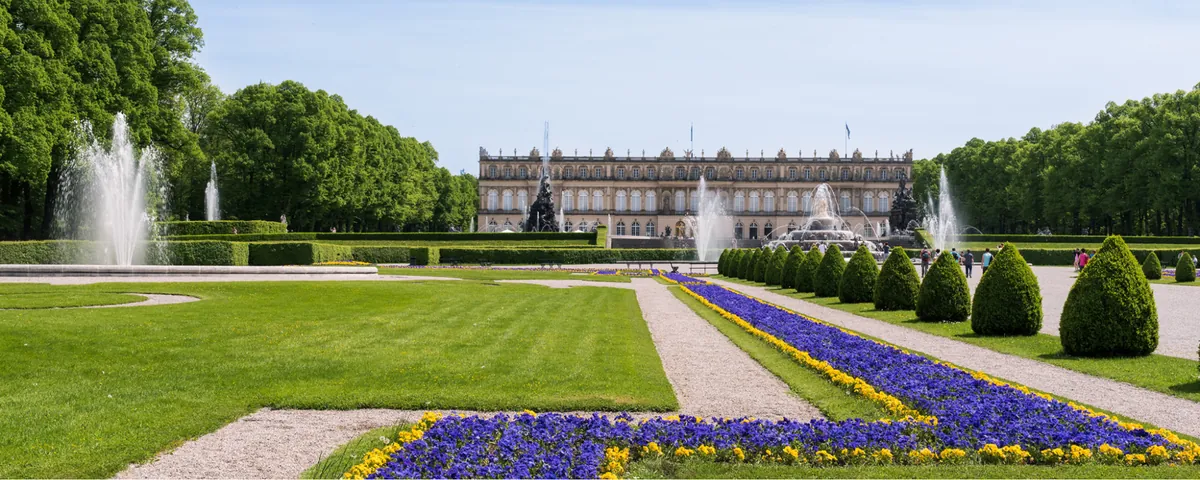
Herrenchiemsee, on Herreninsel in the Chiemsee, is Ludwig II's incomplete attempt at a full-scale Versailles replica. Construction began in 1878 on an island Ludwig bought to keep the project away from public scrutiny; the central section, Hall of Mirrors and State Bedroom were direct architectural quotations from the original Louis XIV palace. Work stopped at Ludwig's death in 1886 with only the central pavilion completed, and the long northern and southern wings were never built. The result is the most expensive of his three palaces: a working Versailles homage stranded on a south-Bavarian lake island.
The visit covers the New Palace by guided tour, the King Ludwig II Museum, and the Augustinian Monastery (the older Herreninsel building, where the constitutional convention that drafted West Germany's Grundgesetz met in 1948). The 2025 Bilanz records 309,353 visitors, essentially flat on 2024.[1] A special exhibition, Could You Still? Art and Democracy, runs 18 May to 18 October 2026 and raises the combined ticket price for that window.[6]
Practical: open daily, 09:00 to 18:00 (April to 24 October), 10:00 to 16:45 (25 October to March); closed 1 January, Shrove Tuesday, 24, 25 and 31 December. Combination Ticket (New Palace tour + Ludwig II Museum + Augustinian Monastery) adult €11, concession €10, under 18 free; combined ticket with the special exhibition (18 May to 18 October 2026) €14 / €13. From Munich, train to Prien am Chiemsee (~1 hour), then 15 to 20 minute boat from Prien to Herreninsel. Plan your visit.[6]
4. Schloss Hohenschwangau
~120 km ~2 hr Timed guided tour Ludwig II's boyhood home Map
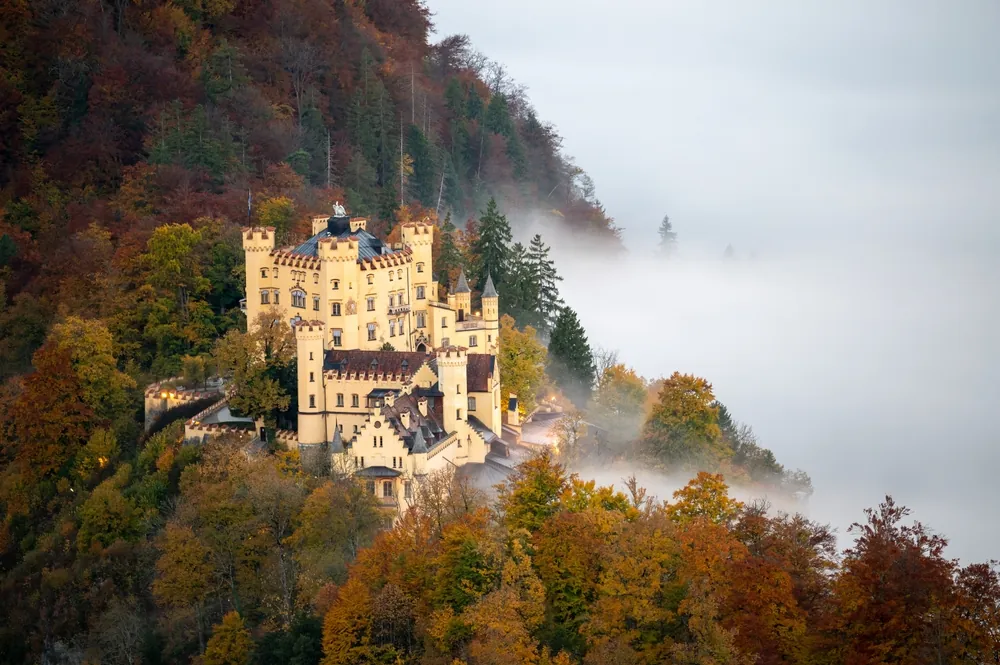
Hohenschwangau sits on the smaller hilltop opposite Neuschwanstein. The site was a 12th-century medieval castle that fell into ruin and was rebuilt between 1832 and 1837 by Crown Prince Maximilian (later King Maximilian II of Bavaria), Ludwig II's father, in a Romantic Gothic Revival style. Ludwig spent much of his childhood here, and the rooms preserve the neo-medieval interiors he grew up with, with murals from German legend cycles (Lohengrin, Parsifal) that arguably planted the obsessions later realised at Neuschwanstein.
The view from the terrace across the Alpsee to Neuschwanstein is one of the canonical Bavarian images. Hohenschwangau is run by the Wittelsbacher Ausgleichsfonds, separately from state-run Neuschwanstein, but uses the same shared ticket centre in the village.
Practical: open daily for guided tours at fixed entry times: roughly 09:00 to 17:00 in summer, 10:00 to 16:00 in winter; closed 24, 25, 31 December and 1 January. Adult €21, concession €20 (65+ and students), under 18 free; King's Ticket (Hohenschwangau plus Neuschwanstein) €31; online booking adds €2.50 per ticket. Tickets are valid only for the day of issue. Same access as Neuschwanstein: train to Füssen, bus 73 or 78 to Hohenschwangau, then walk up. Plan your visit.[7]
5. Nymphenburg Palace
~5 km ~20 min Daily, year-round Bavaria's Versailles Map
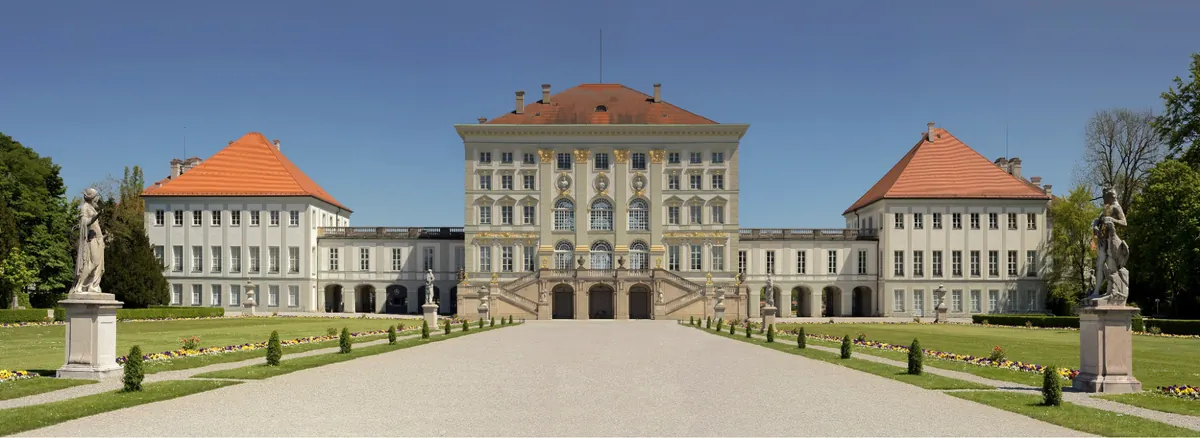
Nymphenburg is the Wittelsbach summer palace inside Munich, in the Schwabing-West district about 5 km from the centre. Construction began in 1675 by Elector Ferdinand Maria of Bavaria as a gift for his wife Henriette Adelaide of Savoy on the birth of their son and heir, the future Elector Max Emanuel. Successive electors and the first kings of Bavaria substantially extended the palace through the 17th and 18th centuries; the long pavilion-and-wing massing reads today as a single 200-metre garden façade.
The signature interior is the Schönheitengalerie, King Ludwig I's 36-portrait gallery of women he considered the most beautiful of his time, painted by Joseph Stieler between 1827 and 1850. The Marstallmuseum in the south wing displays the royal coaches and sleighs of the Bavarian court. Four small park palaces (Amalienburg, Badenburg, Pagodenburg, Magdalenenklause) sit across the formal gardens; Amalienburg's Hall of Mirrors is widely regarded as one of the finest rococo interiors in Europe. Nymphenburg also functions as an active Wittelsbach residence: Duke Franz of Bavaria lives in a private wing.
Practical: open daily, 09:00 to 18:00 (April to 15 October), 10:00 to 16:00 (16 October to March); closed 1 January, Shrove Tuesday, 24, 25 and 31 December. Park palaces closed 16 October to March. Combination ticket (palace + museums + park palaces) summer adult €20, concession €18; winter €16 / €14; palace only €10 / €9. Under 18 free. Tram 17 from central Munich directly to Schloss Nymphenburg. Plan your visit.[8]
6. Schleissheim Palace
~15 km ~20 min Closed Mondays Bavarian Versailles Map
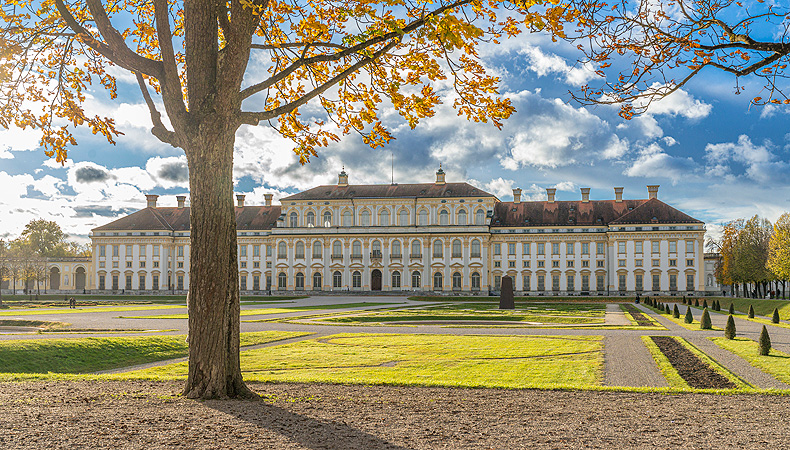
The Schleissheim complex in Oberschleißheim, 15 km north of Munich, is three palaces on a single estate: the Old Palace (1623), the New Palace (1701 to 1726, the principal baroque palace) and Lustheim Palace (1684 to 1688, the summer house at the eastern end of the formal canal). The New Palace was Elector Max Emanuel's project, modelled on Versailles and Vienna and never quite finished to the original design after his exile during the War of the Spanish Succession. The Italian baroque interiors of the staircase and Festsaal are among the finest of their kind north of the Alps.
The estate is one of the few large palace complexes near Munich that does not draw heavy crowds: a working baroque ensemble, a 1.5 km canal axis between the New Palace and Lustheim, and the porcelain collection of the Meissen Stiftung in Lustheim. The Hofgarten is free.
Practical: open daily 09:00 to 18:00 (April to September), 10:00 to 16:00 (October to March); closed Mondays; closed 1 January, Shrove Tuesday, 24, 25 and 31 December. New Palace adult €6, concession €5; Old Palace €4.50 / €3.50; Lustheim €5 / €4; combination ticket (all three palaces) €11 / €9; under 18 free. From Munich Hauptbahnhof, S-Bahn S1 to Oberschleißheim (~20 min), then a 15-minute walk. Plan your visit.[9]
7. Blutenburg Castle
~10 km ~30 min Daily, free for under 18s Castle library of children's books Map
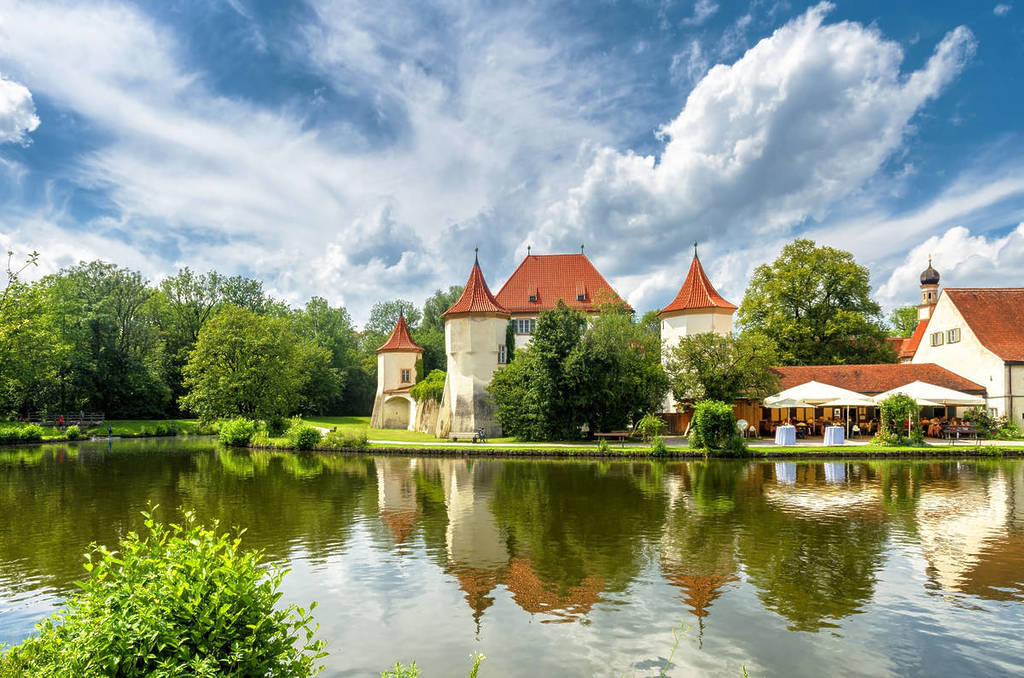
Blutenburg is a small late-medieval moated castle on the River Würm in the Obermenzing district of western Munich. It was built in the 14th and 15th centuries as a hunting lodge for the Wittelsbach dukes; the Late Gothic chapel of 1488 is the principal surviving structure and retains its original stained-glass cycle, one of the few Late Gothic glass programmes still in situ in Bavaria. The chapel sits at the heart of the inner courtyard.
The castle today houses the Internationale Jugendbibliothek, the world's largest library of international children's and youth literature, founded by Jella Lepman in 1949. The combination (a moated late-Gothic castle that doubles as a working children's-book research library) gives Blutenburg an unusual dual identity. The chapel and small castle exhibitions are open to the general public.
Practical: open daily, Monday to Friday 10:00 to 16:00, Saturday and Sunday 14:00 to 17:00; closed public holidays. Combined exhibitions adult €3, concession €2, children and youth under 18 free. From central Munich, S-Bahn to Pasing or Obermenzing then a short walk; or tram and bus connections from the city centre, ~30 minutes. Plan your visit.[10]
8. Burg zu Burghausen
~110 km ~2 hr Daily, year-round Longest castle in the world Map
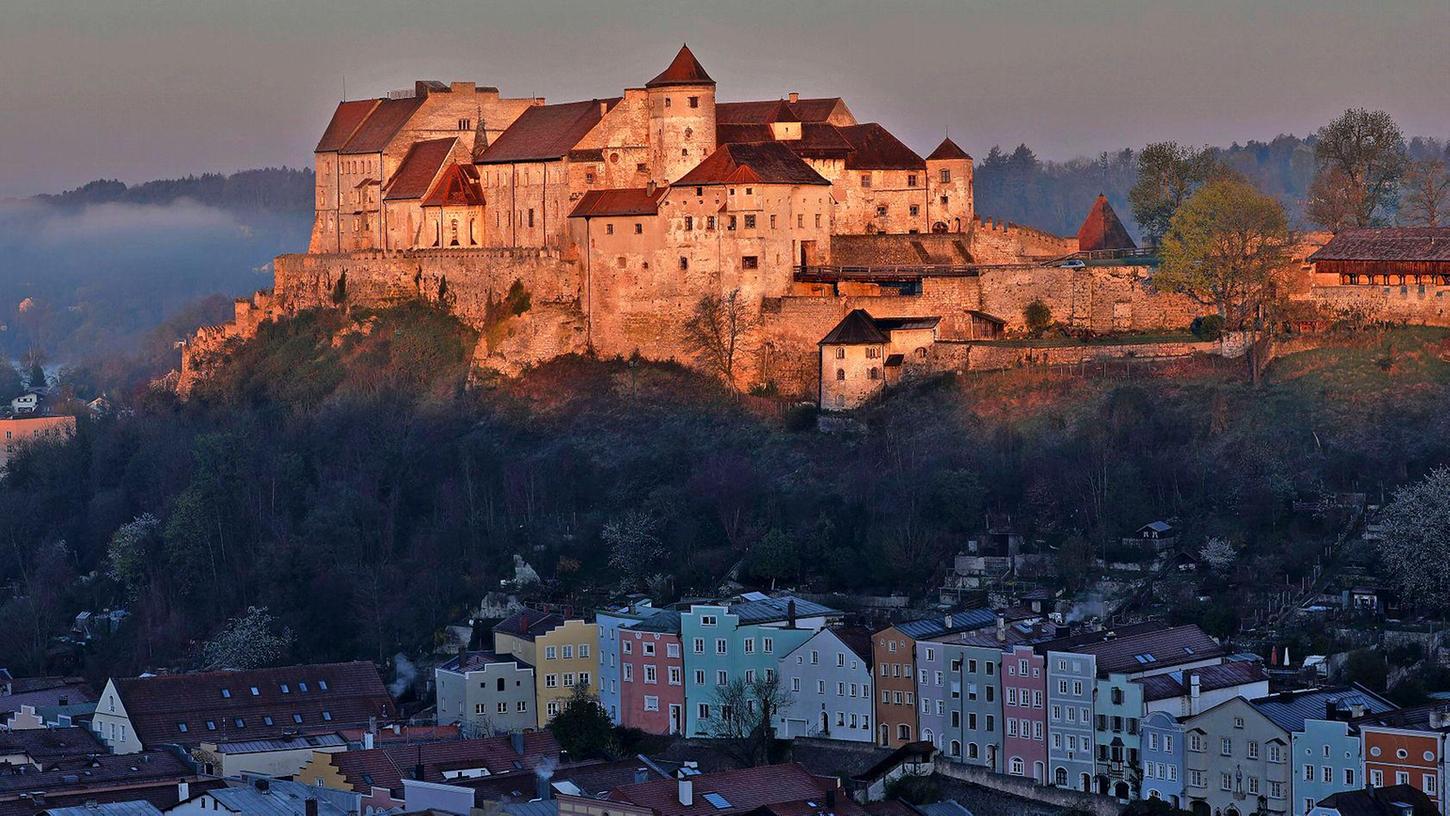
Burghausen, on a narrow ridge above the Salzach river on the Austrian border, holds the Guinness World Records designation as the longest castle complex in the world at 1,051 metres. Six successive courtyards run along the ridge, separated by gatehouses and dry moats, with the central main castle (Hauptburg) at one end and the outer fortifications at the other. The site has been fortified since the 11th century, and the surviving fabric is largely 13th to 16th century. Burghausen served as the second residence of the Wittelsbach Dukes of Bavaria-Landshut through the late medieval period and was the principal eastern Bavarian fortress against Habsburg Austria.[11]
The visit walks the full ridge from the town up: the Bavarian State Castle Museum and the State Gallery in the main castle, plus several side museums in the outer courtyards, with the long view east over the Salzach into Austria. The Bayerische Schlösserverwaltung's 2025 Bilanz records 81,090 visitors, well ahead of most regional Bavarian residences.[1] The grounds and ramparts are always freely accessible outside special events; only the museums are ticketed.
Practical: State Castle Museum and State Gallery open daily, 09:00 to 18:00 (28 March to September), 10:00 to 16:00 (October to 27 March); closed 1 January, Shrove Tuesday, 24, 25 and 31 December. Combined ticket (museum + gallery) adult €6, concession €5, under 18 free. Castle grounds always free. From Munich, train via Mühldorf to Burghausen (~2 hours), or by car ~110 km via the A94. Plan your visit.[11]
9. Walhalla Donaustauf
~130 km ~1 hr 45 Daily, year-round Bavarian hall of fame Map
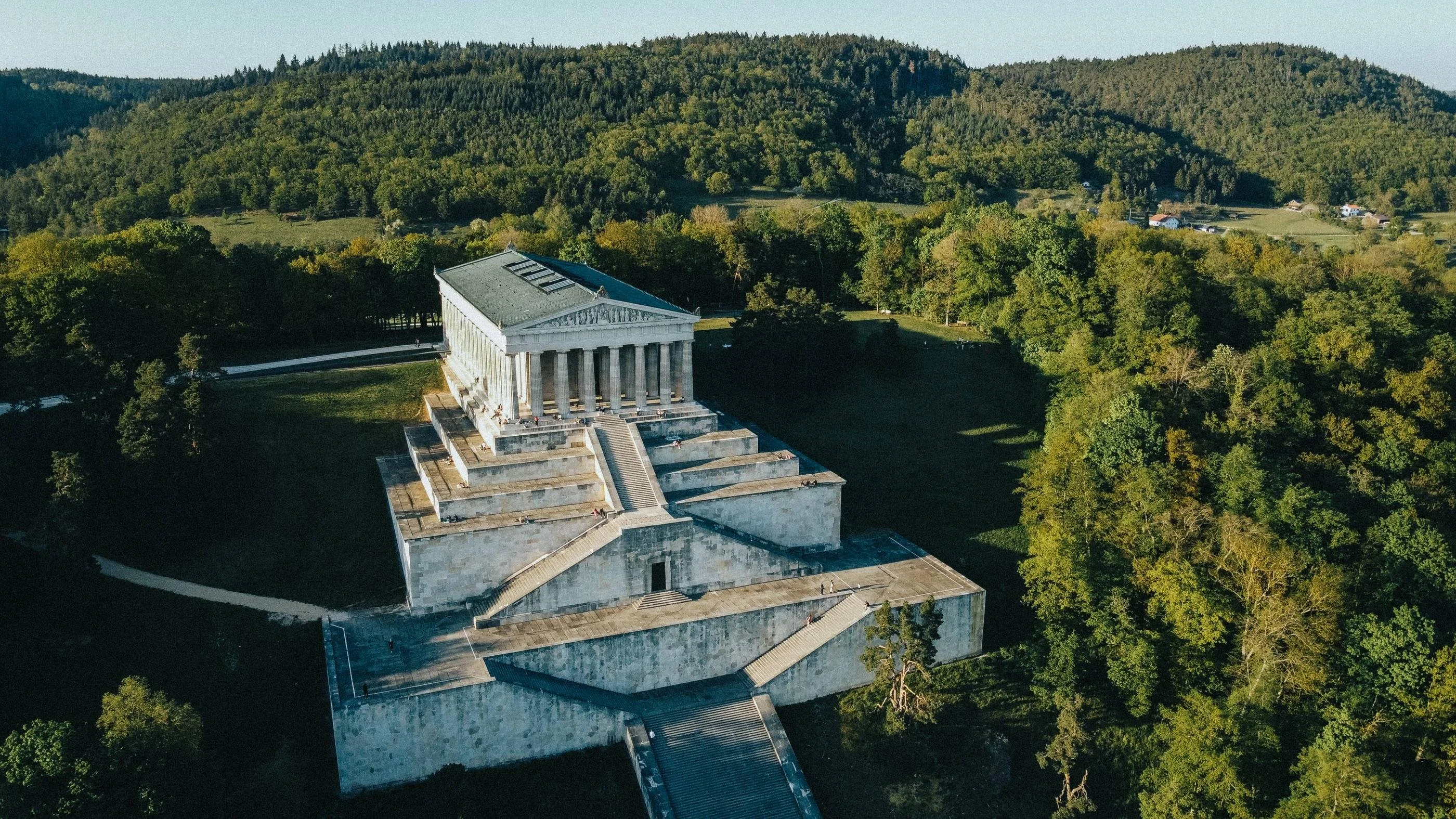
Walhalla, on a wooded hill above Donaustauf 10 km east of Regensburg, is the most ambitious 19th-century neoclassical project in Bavaria. King Ludwig I commissioned the marble Doric temple from the architect Leo von Klenze in 1830 to honour distinguished German speakers; construction ran from 1830 to 1842. The interior holds 130 marble busts and 65 commemorative plaques of German-speaking historical figures (Goethe, Schiller, Bach, Mozart, Einstein and others). New busts are added every few years by the Bavarian state. Walhalla is run by the Bayerische Schlösserverwaltung.[1]
The Parthenon resemblance, the climb from the Danube and the view from the colonnade across the river make this a dramatic half-day. The 2025 Bilanz records 203,056 visitors, up 11.2% on 2024.[1] It pairs naturally with Regensburg as a day from Munich, with combined tickets available alongside the Befreiungshalle in Kelheim and Burg Prunn upstream.
Practical: open daily 09:00 to 18:00 (April to October); 10:00 to 12:00 and 13:00 to 16:00 with a midday closure (November to March); closed 1 January, Shrove Tuesday, 24, 25 and 31 December. Adult €5, concession €4, under 18 free. Combined ticket (Walhalla + Befreiungshalle Kelheim + Burg Prunn) €13 / €11. From Munich, train to Regensburg Hauptbahnhof (~1h 30), then bus to Donaustauf, or seasonal Danube boat from Regensburg. Plan your visit.[12]
10. Befreiungshalle Kelheim
~120 km ~1 hr 30 Daily, year-round Klenze's victory rotunda Map
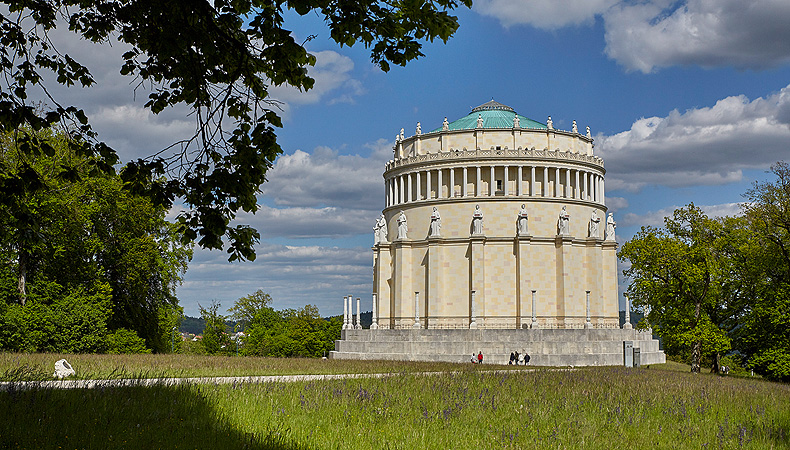
The Befreiungshalle (Hall of Liberation) on the Michelsberg above Kelheim is the second of Ludwig I's two Klenze-designed neoclassical monuments on the Danube. It was commissioned in 1842 to mark the 25th anniversary of the German victory over Napoleon at the Battle of Leipzig and completed in 1863. The building is a circular drum capped with a dome, ringed inside by 18 winged Victory figures in Carrara marble holding hands in a continuous chorus, and lit by a single oculus high in the dome. The architectural model is Hadrian's Mausoleum in Rome, refracted through Klenze's German-Greek Revival vocabulary.
The site is harder-edged than Walhalla and worth pairing on the same Danube run. The 2025 Bilanz records 121,361 visitors, up 2.8% year on year.[1] The Donaudurchbruch (the narrow Danube gorge below the Michelsberg, with the medieval Burg Prunn upstream) is one of the canonical Bavarian river landscapes.
Practical: open daily 09:00 to 18:00 (April to October), 10:00 to 16:00 (November to March); closed 1 January, Shrove Tuesday, 24, 25 and 31 December. Adult €5, concession €4, under 18 free. Combined ticket (Befreiungshalle + Burg Prunn) €9 / €8; three-site combo (Befreiungshalle + Prunn + Walhalla) €13 / €10. From Munich, train via Saal (Donau) plus bus, or by car ~120 km via the A93. Seasonal Danube boats run from Regensburg. Plan your visit.[13]
At a glance
| Castle | Distance | How to get there | |
|---|---|---|---|
| Schloss NeuschwansteinFairy-tale castle | ~120 km | ~2 hr |
| Schloss LinderhofLudwig II's villa | ~95 km | ~1 hr 30 |
| Schloss HerrenchiemseeLudwig II's Versailles | ~80 km | ~1 hr 15 + boat |
| Schloss HohenschwangauLudwig II's boyhood home | ~120 km | ~2 hr |
| Nymphenburg PalaceBavaria's Versailles | ~5 km | ~20 min |
| Schleissheim PalaceBavarian Versailles | ~15 km | ~20 min |
| Blutenburg CastleCastle library of children's books | ~10 km | ~30 min |
| Burg zu BurghausenLongest castle in the world | ~110 km | ~2 hr |
| Walhalla DonaustaufBavarian hall of fame | ~130 km | ~1 hr 45 |
| Befreiungshalle KelheimKlenze's victory rotunda | ~120 km | ~1 hr 30 |
How many castles are near Munich?
The Bayerische Schlösserverwaltung directly manages over 45 palaces, castles and gardens across Bavaria, with a heavy concentration in upper Bavaria within day-trip range of Munich.[1] Add in privately-owned and municipally-owned Schlösser and the working figure rises into the low hundreds. The 2025 Bilanz confirms the headline visitor split: Linderhof 417,692, Herrenchiemsee 309,353, Walhalla 203,056, Befreiungshalle Kelheim 121,361, Burg zu Burghausen 81,090, plus the separately tracked Neuschwanstein at around 1.07 million.[1][2]
For a traveller, the practical number is the 10 above plus three or four obvious additions: the Munich Residenz (the Wittelsbach city palace), Burg Trausnitz in Landshut (~75 minutes north-east, 45,813 visitors in 2025), Cadolzburg in Middle Franconia, and the Veste Coburg further north. Three days covers the Munich-region spine: Day 1 the in-city circuit (Nymphenburg, Blutenburg, Residenz), Day 2 the Royal Castles tour (Neuschwanstein, Hohenschwangau, Linderhof), Day 3 the eastern arc (Herrenchiemsee plus Burghausen).
Famous, medieval, Gothic and largest
Famous. Neuschwanstein carries the bulk of international search demand, both as Ludwig II's signature commission and as the widely cited model for Disney's Sleeping Beauty Castle.[4] Linderhof and Herrenchiemsee complete the Ludwig II set. Nymphenburg is the principal in-Munich palace.
Medieval. Burg zu Burghausen is the largest medieval fortress within day-trip range, with 13th to 16th-century fabric across six successive courtyards.[11] Blutenburg's Late Gothic chapel of 1488 is the most accessible medieval survival inside the city, with a rare in-situ Late Gothic glass cycle. Burg Trausnitz in Landshut, ~75 minutes north-east, is a further Wittelsbach medieval seat. The medieval Stadtmauer at Nördlingen is one of the most completely preserved town-wall circuits in Germany.[14]
Gothic. True Gothic survival is thin: most Bavarian castle Gothic was rebuilt in 19th-century Romantic mode, including the Gothic Revival massing of Hohenschwangau and Neuschwanstein. The Late Gothic chapel at Blutenburg (1488) is the strongest unreconstructed Gothic survival on this list.
Largest. Burg zu Burghausen, at 1,051 metres along the ridge, holds the Guinness World Records designation as the longest castle complex in the world.[11] Nymphenburg's 200-metre garden façade makes it the largest in-Munich palace by frontage. Herrenchiemsee was Ludwig II's most expensive single commission and would have been the largest of the three had work continued past his death.
If you're looking to buy
Bavaria, and southern Bavaria specifically, is Germany's deepest castle market and Munich its principal urban anchor. Christie's State of Luxury 2025 outlook places Munich as Germany's top-tier prime residential market: the RIEDEL/Christie's Munich affiliate reported a 30% rise in $1M+ property sales in 2024, concentrated in Bogenhausen, Lehel and Nymphenburg, with sustainable and energy-efficient features in highest demand.[15] Most of the headline royal palaces are state-owned and inalienable: Bayerische Schlösserverwaltung holdings cannot be bought at any price. The active market is in private Schlösser across upper Bavaria and Franconia, mid-restoration country houses, and small fortified manors. For current listings see castles for sale in Germany, tracked against Castle Collector's Castle Price Index.[16] Foreign buyers face no purchase restrictions in Germany; transaction costs add roughly 6% to 10% (notary, Grunderwerbsteuer land transfer tax at 3.5% in Bavaria, agent fees split). For the operational side, see our guide to buying a castle.
Sources
1. Bayerische Verwaltung der staatlichen Schlösser, Gärten und Seen, Besucherbilanz 2025.
2. Bayerische Schlösserverwaltung, Schloss Neuschwanstein official site (hours, ticket prices, transport).
3. Bayerische Schlösserverwaltung 2024 visitor announcement (Neuschwanstein attendance, ~1.07 million in 2024).
4. Taylor, R. R. Castles of the Rhine: Recreating the Middle Ages in Modern Germany. Wilfrid Laurier University Press, 1998; p. 340 (notes to Chapter 14): "along with the Brandenburg Gate in Berlin and Castle Neuschwanstein of the 'mad' King Ludwig of Bavaria, it probably is the best-known architectural symbol of Germany on this continent."
5. Bayerische Schlösserverwaltung, Schloss Linderhof official site.
6. Bayerische Schlösserverwaltung, Schloss Herrenchiemsee official site (hours, ticket prices, 2026 special exhibition).
7. Wittelsbacher Ausgleichsfonds, Schloss Hohenschwangau official site.
8. Bayerische Schlösserverwaltung, Schloss Nymphenburg official site.
9. Bayerische Schlösserverwaltung, Schloss- und Gartenanlage Schleißheim official site.
10. Schloss Blutenburg / Internationale Jugendbibliothek official site.
11. Bayerische Schlösserverwaltung, Burg zu Burghausen official site (longest castle complex, opening hours, tickets).
12. Bayerische Schlösserverwaltung, Walhalla official page.
13. Bayerische Schlösserverwaltung, Befreiungshalle Kelheim official page.
14. Lepage, J-D. G.G. Castles and Fortified Cities of Medieval Europe: An Illustrated History. McFarland & Company, 2002; p. 321.
15. Christie's International Real Estate, The State of Luxury: 2025 Regional Market Outlook. Munich market commentary p. 12 (RIEDEL Munich affiliate).
16. Castle Collector, Castle Price Index, March 2026 edition.