
Which Country Has the Most Castles?
France has the most castles of any country, at around 45,000. Globally there are roughly 80,000–100,000 surviving castles. Germany is second at 25,000.
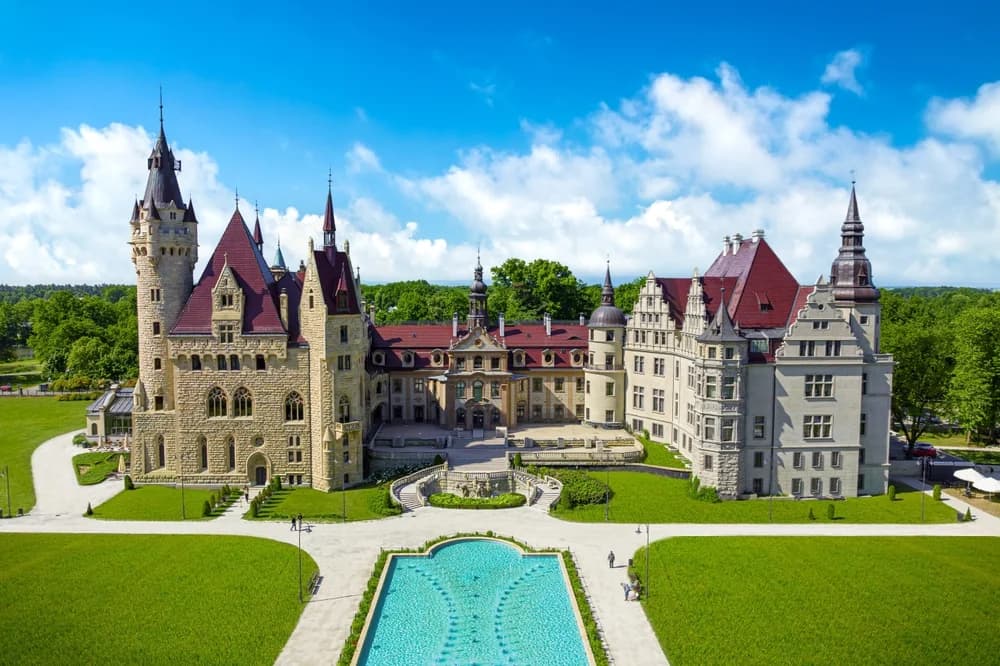
France has the most castles out of any country in the world. It is estimated that France has around 45,000 castles across the various types and styles. 'Chateau' is a broad term which technically means 'castle' but also includes buildings that resemble more of a villa or manor house style instead of the classic medieval castle you might be imagining, which is why they are so commonplace in France. Around half of all the castles in the world can be found in France.
How many castles are there in the world?
While no official survey has been conducted on the total number of castles in the world, each European country has their own estimates, so adding these separate estimates together, there may be around 80,000 to 100,000 surviving castles today. These figures are based on a very loose definition of the word 'castle.'
We can find a more definitionally accurate figure by looking at the heritage protected castle-properties in Europe, of which there are around 46,000. And again, France holds the largest share, with around 19,122 strict heritage protected properties.[1]
The biggest issue we've found when searching government heritage databases is that there are various classifications for castle properties which don't match from country to country. A few different property types get grouped together and mislabeled and that makes it incredibly hard to figure out what's actually a castle. A tower house or villa will be grouped in with a manor house or historic farmhouse – with little information on which is which.
Countries with the most castles
After France, Germany has the second most castles in Europe and the world, with an estimated 25,000 including palaces and Schlösser. While Ireland technically has more castles than Germany, with 30,000, we've placed Ireland in third place, since a lot of their fortified structures are mostly tower houses which aren't considered "castles" across Europe, they are more like compact fortified homes.
| Country | Estimate | Methodology / source |
|---|---|---|
| France | 45,000 (all definitions) / 19,122 protected / 6,500–7,000 Monument Historique | Mérimée + national heritage register |
| Germany | 25,000 (broad) / 5,000 protected | EBIDAT + state Denkmalämter aggregated |
| Ireland | 30,000+ (incl tower houses) / fragmented protected count | National Monuments Service |
| Italy | 20,000 (broad) / 3,000–8,600 protected | Ministero della Cultura (filtered) |
| Spain | 10,000+ (broad) / 2,550 protected BIC | Ministerio de Cultura |
| Poland | 5,224 protected (zamki + pałace + dwory) | NID, Narodowy Instytut Dziedzictwa |
| Scotland | 3,000+ surviving / 1,103 protected | Historic Environment Scotland |
| Czech Republic | 3,000+ NPÚ register | National Heritage Institute |
| Belgium | 3,000+ surviving | Regional registers (Flanders, Wallonia, Brussels) |
| England | 1,712 protected (NHLE strict) / ~3,000 broad | Historic England |
| Austria | 1,507 protected | BDA provincial CSVs |
| Hungary | ~700+ (estimated) | Multiple regional registers |
| Wales | 600 (incl ruins, mottes, fortified mansions) / 293 protected | Cadw |
| Romania | 500 protected (LMI proxy) | LMI strict count ~493 |
| Switzerland | 500 recognised | Schweizerischer Burgenverein |
| Portugal | 310 protected | DGPC heritage portal |
| Slovakia | 180+ surviving castles | Multiple sources |
| Denmark | 168 protected castle-type | Slots- og Kulturstyrelsen |
| Luxembourg | ~76 castle ruins | INPA (national heritage authority) |
| Lithuania | ~30 surviving | Cultural Heritage Department |
Why country counts diverge so widely
You've probably noticed that there are big differences between the broad estimates and the strict-protected counts from the government. The 5-10x spread is because of categorisation and definitional choices. Each European government has their own system and each country has a different idea of what a castle is. For example in Ireland, a tower house might be considered a castle, but that's not the case in Germany. The issue is that there's not one enforced definition across Europe.
France's heritage register organises château, manoir and palais in separate categories. The 19,122 figure for the protected tier excludes generic estate buildings. The broader 45,000 includes anything describing itself as château, which can range from working military castles to 19th-century country residences with no defensive history at all, identical to a manor house in England.
Germany's Burg (medieval military fortress), Schloss (post-medieval palatial seat) and Festung (post-medieval star-fortress) are distinct categories that aggregate differently across the federal states. The EBIDAT (European Castle Database at Philipps-Universität Marburg) records 8,500 medieval castle sites in the strict tier. Broader definitions including post-medieval Schlösser and substantial fortified manors push to 25,000 and beyond.
Italy distinguishes castello, rocca, torre, fortezza, cittadella and palazzo fortificato as separate heritage categories. The broad survey would count all of the buildings in these separate categories as a total castle figure instead of just castello.
Ireland's situation is the most distinctive. T. E. McNeill's foundational survey of Irish castles documents the Anglo-Norman tower-house tradition that produced over 7,000 surviving tower houses across the island. That is the densest concentration of late-medieval defensive residential architecture in Europe.[2] Most of these would not be classified as "castles" under European definitions but since they function as a castle in the Irish context they are considered so. Constance Louisa Adams's 1904 survey of Irish castle ruins sets out the broader 30,000+ figure when surviving fortified estate ruins are counted alongside the strict tower-house total.[3]
John Goodall's The Castle: A History (Yale University Press, 2022) gives the modern definition of what counts as a castle in the English tradition: a fortified residence with both defensive and seigneurial function. That sets it apart from purely military fortifications (which are fortresses) and from purely residential country houses (which are country houses or manors).[4] Hubert Fenwick's earlier survey of French châteaux runs a parallel definition for the French tradition. He treats the château as covering both medieval defensive forms and post-medieval courtly residences.[5]
Outside Europe: Japan, India and the US
There were an estimated 5,000 castles in Japan before the Meiji-era demolition campaigns began, now only around 60 have survived. In this period Japan underwent an intense and brutal cultural shift from an isolated feudal society to an industrialised nation state. Castles were military strongholds for feudal warlords and represented the class-system industrial Japan wanted to leave in the past, therefore they were dismantled and destroyed. Himeji-jō (UNESCO 1993) and Matsumoto-jō are the most-visited castles surviving in Japan today. The tenshu (donjon) tradition is structurally different from European castle architecture but functionally serves the same combined defensive-and-seigneurial purpose.
China carries hundreds of fortified palatial and military complexes: the Forbidden City in Beijing, walled Pingyao in Shanxi, the Great Wall watchtowers along its 21,196-km length, and provincial capitals' city walls. These map imperfectly onto the European castle category, which is why most working castle counts exclude the Chinese stock entirely. Functionally several Chinese complexes (particularly the Mongol-era and Ming-era walled cities) operate at the same defensive-and-seigneurial intersection that defines European castles.
India has Mughal-era and Rajput-era forts including Mehrangarh in Jodhpur (founded 1459, 1,200-acre estate), Chittorgarh in Rajasthan (~700 acres, the largest fort in India), and Amer Fort outside Jaipur. These share strong functional overlap with European castles (fortified residences of regional rulers), and a significant subset are now run as private heritage hotels, many under the Taj Hotels and Oberoi groups.
The United States carries approximately 700 castellated properties. Most are Gilded Age industrialist castles built between 1880 and 1925: Hearst Castle in California, the Biltmore Estate in North Carolina, Boldt Castle in New York. Spanish colonial fortifications (Castillo de San Marcos in St. Augustine, El Morro in Puerto Rico) add a smaller secondary tier. Hawaiian royal palaces (Iolani Palace in Honolulu) sit in their own category.
Sources
1. Castle Collector, Castle Price Index, March 2026.
2. McNeill, T. E. Castles in Ireland: Feudal Power in a Gaelic World. Routledge, 1997.
3. Adams, C. L. Castles of Ireland: Some Fortress Histories and Legends. Elliot Stock, London, 1904. Internet Archive.
4. Goodall, J. The Castle: A History. Yale University Press, 2022.
5. Fenwick, H. The Chateaux of France. Robert Hale, London, 1976.