
11 Irish castles steeped in ruin, legend, and family history
Blarney for the stone, the Rock of Cashel for medieval Ireland, Ashford for the 5-star stay: 11 famous Irish castles among 7,000 tower houses.
Ireland's castle landscape runs to the thousands once you fold in the late-medieval tower houses. Eleven castles, from a 1446 keep with the Stone of Eloquence to a cliff-edge MacDonnell ruin on the Antrim coast.
Ireland holds roughly 3,000 standing castles, and several thousand more once the surviving Anglo-Norman tower houses are folded in. The archaeologist T. E. McNeill, in his foundational Castles in Ireland: Feudal Power in a Gaelic World, records that Harold Leask "guessed at about 3,000" surviving castles, of which around 350 are mottes; the great majority of the rest are or were tower houses.[1] Leask's earlier survey lists roughly 3,000 tower houses on Ordnance Survey maps alone, before allowing for older destruction or omissions.[1]
The castles a traveller actually visits cluster in three broad bands. The Norman-keep tier (Trim, Carrickfergus, Kilkenny) marks the 12th- and 13th-century English colonisation that pushed inland from the Pale. The tower-house tier (Blarney, Bunratty, Cahir, Donegal) is the dense 15th- and 16th-century late-medieval form, much of it built under the 1429 Statute of Henry VI subsidy that shaped the landscape around Dublin. The hospitality tier sits on top of the rest, anchored by Ashford in County Mayo, the country's leading 5-star castle hotel. Add the Rock of Cashel for ecclesiastical scale, Dunluce for the Antrim coast, and Malahide as a Dublin day-trip.
The eleven below are the castles that warrant the day. Each entry covers what to see, when to go, what it costs, and how to get there.
1. Blarney Castle
Cork Daily, year-round Stone of Eloquence Map
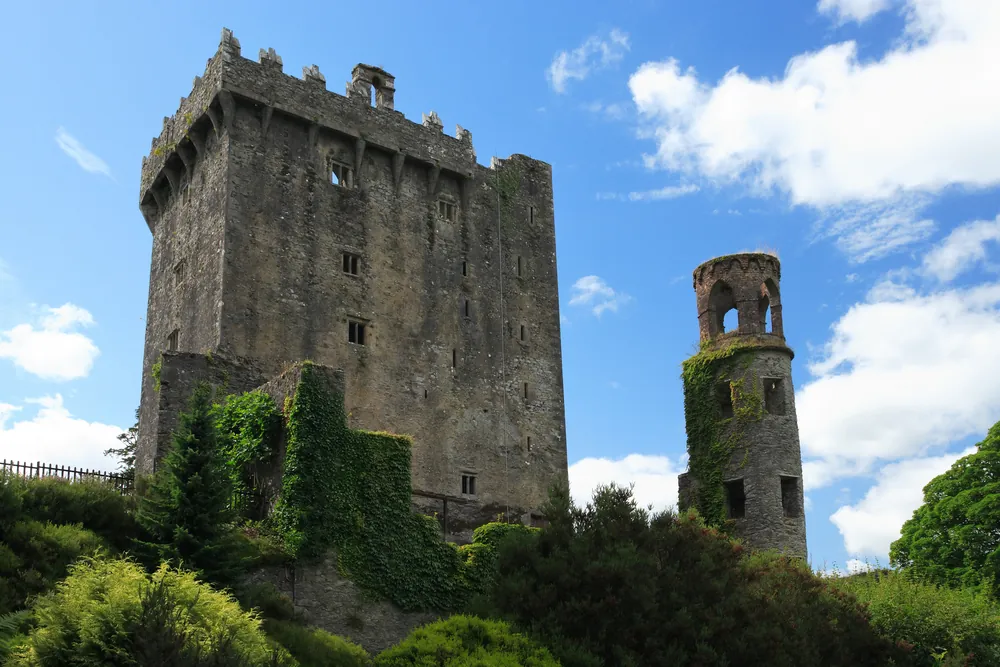
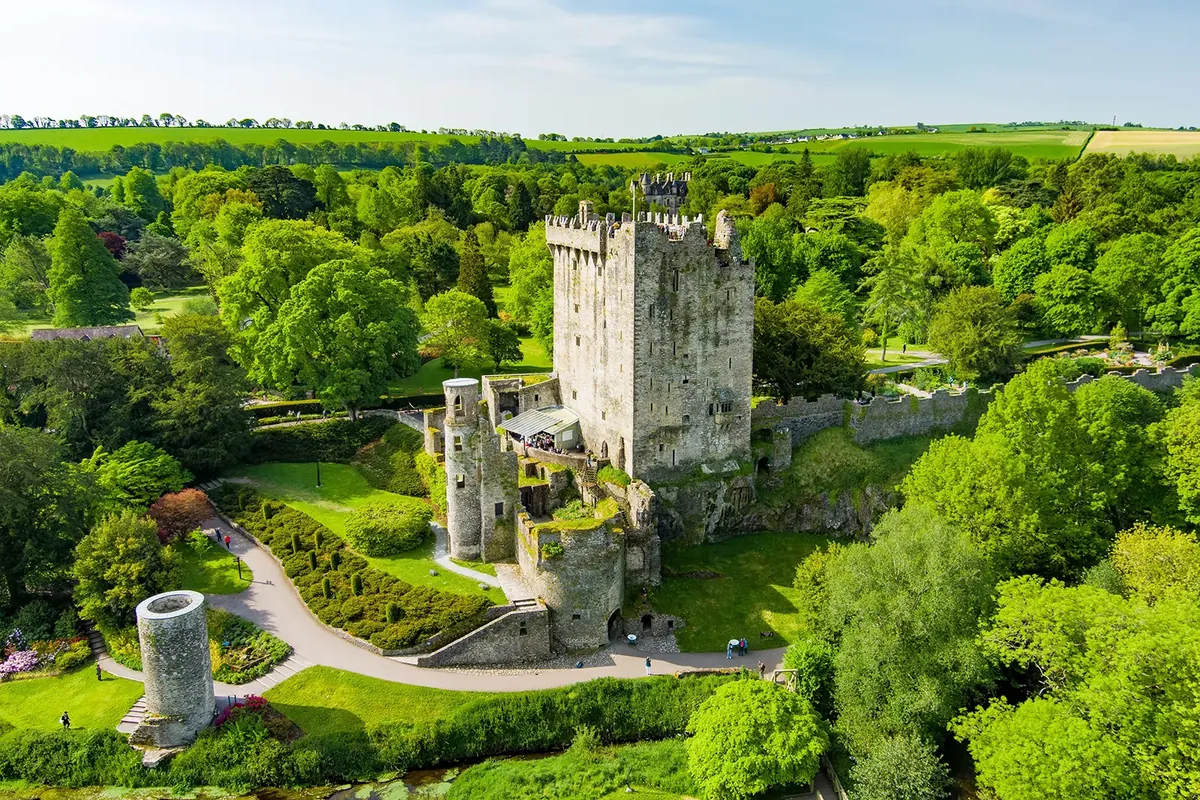
The Blarney keep was built by the MacCarthy of Muskerry dynasty in 1446, the date recorded on a stone built into the south parapet that reads Cormac M'Carthy, Fortis Me Fieri Facit, A.D. 1446.[2] The Adams 1904 survey describes a roughly 120-foot tower, with the rectangular upper structure measuring about 60 by 36 feet in plan and a smaller projecting peel of 18 by 12 feet at the north-west corner.[2] The machicolated parapets on the south and east sides rest on fourteen corbels with a corresponding number of crenelles above, and the great banqueting hall on the fourth floor still carries a fireplace twelve feet wide.[2]
The Stone of Eloquence, set into the parapet, is the visit. Visitors lie on their back and lean over the drop to kiss the stone, in exchange for the gift of the gab. Beyond the keep, the Colthurst family's gardens cover several themed walks, including the Poison Garden and the Rock Close, which most visitors miss in favour of queueing for the stone.
Practical: open daily, year-round; May to September 09:00 to 18:00, with shorter winter hours of 09:00 to 17:00. Closed 24 and 25 December. Adult €24, concession €19, child (6 to 16) €12, family (2 adults + 2 children) €65. From Cork city, Bus Éireann 215 or N20 by car, around eight kilometres north-west. Plan your visit.[3]
2. Bunratty Castle
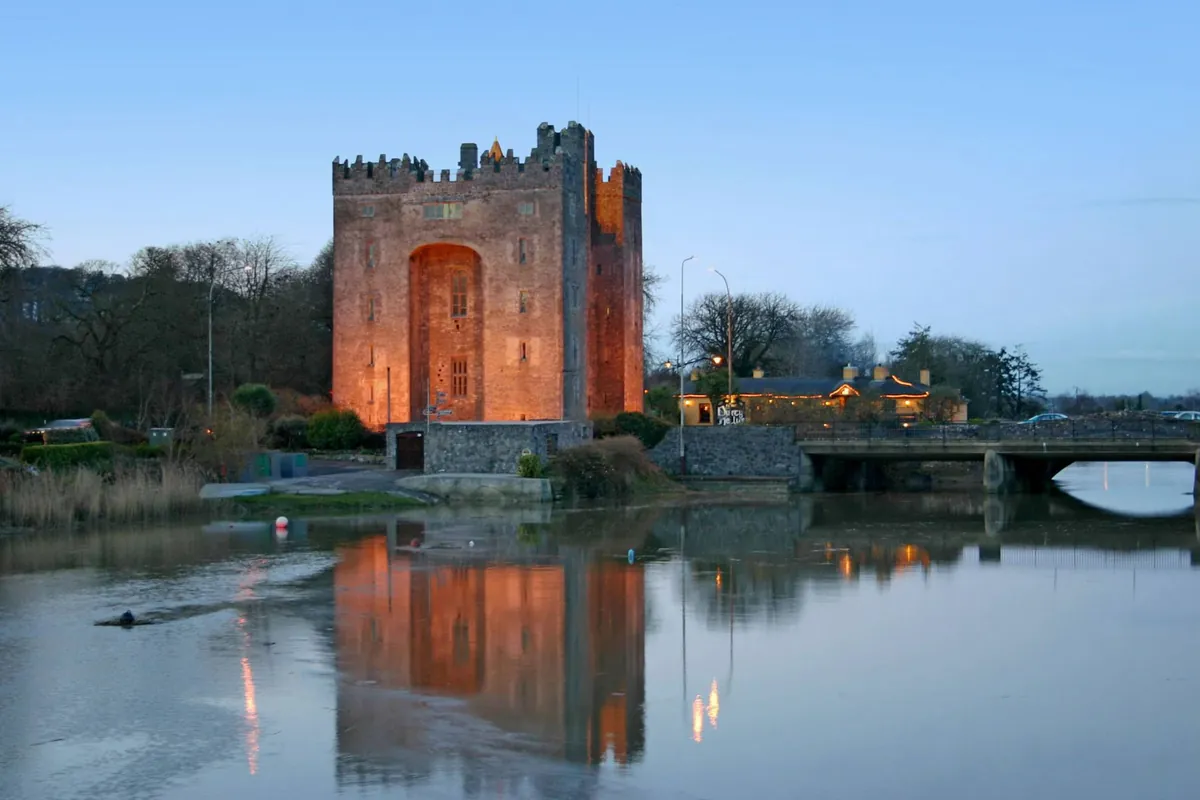
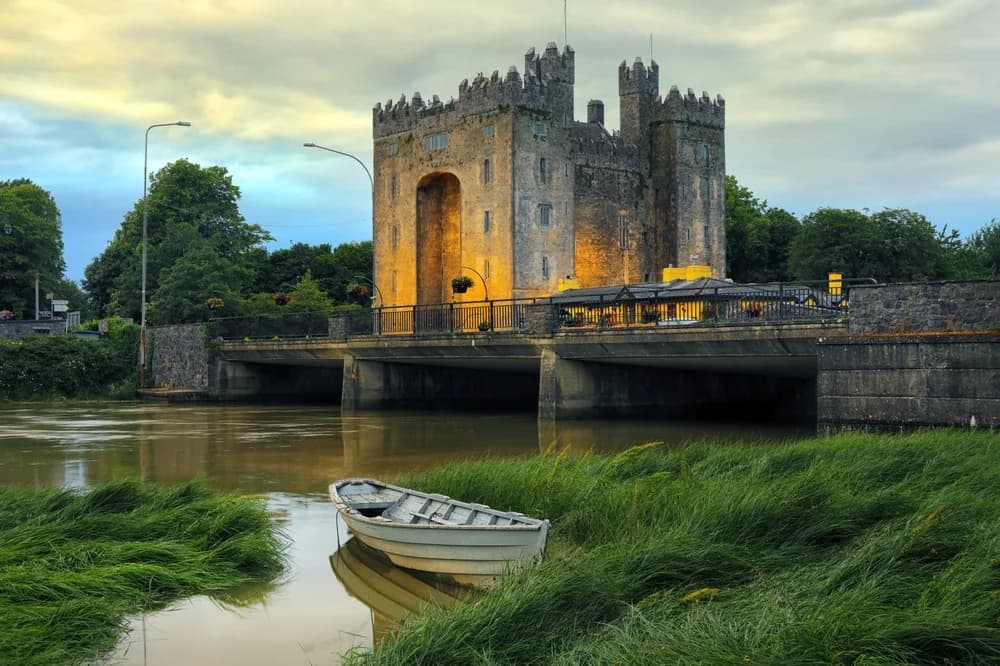
Clare Daily, year-round Medieval feasts Map
A stone at the summit of the present castle states it was built by O'Brien in 1397, on a site already fortified by Robert de Muscegros, who was granted two years' rent remission by Henry III in 1251 to enable him to fortify Bunratty.[2] The current tower-house form is the fourth castle on the site. Shannon Heritage runs it as the most-visited tower-house in the country, paired with the adjacent Folk Park, a recreated 19th-century rural village.
The Folk Park doubles the visit and is included in the standard ticket. The medieval banquet, the long-running evening programme of harp music, mead and a mock-feudal dinner in the great hall, runs separately year-round and has been the castle's signature draw for decades.
Practical: open daily, June to August 09:00 to 18:00; shoulder seasons 09:00 to 17:30; winter 09:30 to 17:30. Closed Good Friday and 24 to 26 December. Combined castle and folk park ticket from €10 adult, €8 child (4 to 18). Off the N18 between Limerick and Ennis, ten minutes from Shannon Airport, with bus 343 from Limerick. Plan your visit.[4]
3. Rock of Cashel
Tipperary Open daily, all year Mythic seat of Munster kings Map
The Rock is a limestone outcrop above the Tipperary plain that served as the seat of the Kings of Munster from the 4th century. The surviving complex of round tower, Romanesque chapel, Gothic cathedral and Hall of the Vicars Choral was built across the 12th and 13th centuries after Muirchertach Ua Briain donated the Rock to the Church in 1101. Cormac's Chapel, built between 1127 and 1134 for King Cormac MacCarthy, is the most coherent surviving piece of Hiberno-Romanesque architecture in Ireland.
The site is OPW-managed, day-ticketed, and walkable end to end in two hours. Cormac's Chapel itself is accessed only by guided tour, with limited daily slots booked on arrival; book early in the day if it's a priority. The hilltop view across the Golden Vale, especially in late afternoon, is the secondary reason to come.
Practical: open daily, year-round, except 24 to 26 December. Summer (17 March to 15 October) 09:00 to 17:30; winter (16 October to 16 March) 09:00 to 16:30. Adult €8, senior €6, student/child €4, family €20. Bus Éireann X8 from Dublin or Cork; nearest station Thurles, 19 km away. Plan your visit.[5]
4. Trim Castle
Meath Daily, year-round Norman keep, Braveheart filming castle Map
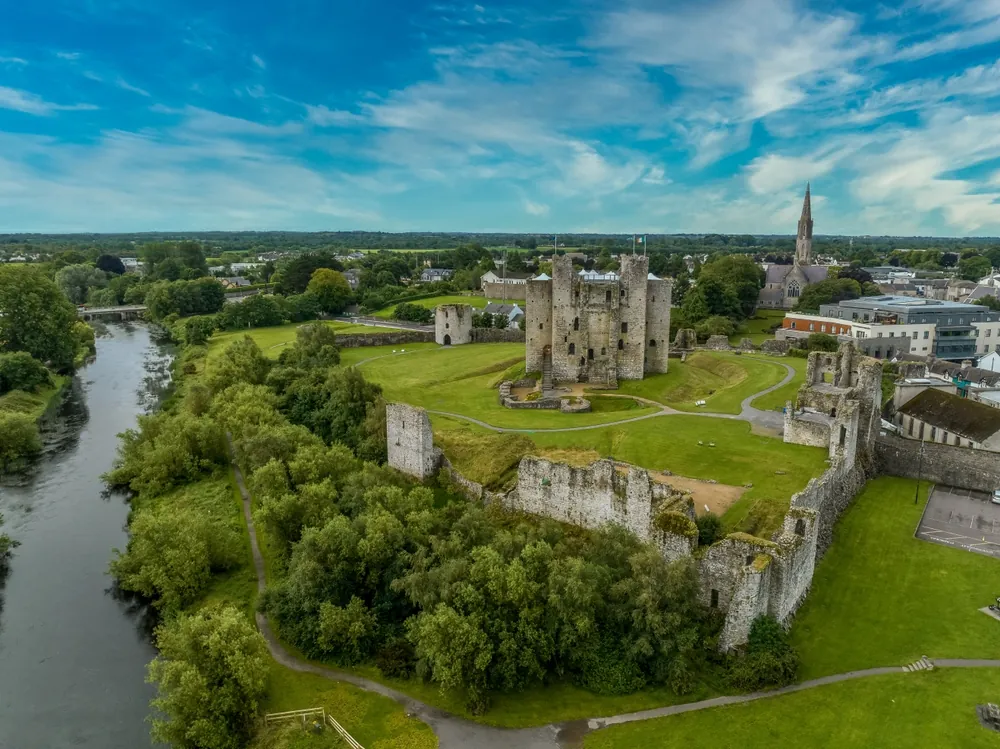
McNeill's survey calls Trim "Ireland's largest and finest castle", with a towered curtain wall, two gate towers and a hall complex against the north wall, all enclosing the massive cruciform great tower at the centre.[1] Construction began in 1173 under Hugh de Lacy, the Norman lord granted the Liberty of Meath by Henry II, and continued in stone phases across the late 12th and 13th centuries. The keep was used as the principal filming location for Mel Gibson's Braveheart (1995).
Trim's keep is accessed by guided tour only, and the architectural historian John Goodall (in The Castle: A History) notes that the OPW restoration of the 12th-century roof and floors with deliberately modern materials is "misjudged" compared with the lighter touch at sites like Farleigh Hungerford.[6] The grounds surrounding the curtain wall are free year-round.
Practical: keep accessed by guided tour only; grounds free. Summer (17 March to 30 September) 10:00 to 17:00 daily; winter hours reduced (October daily 09:00 to 16:00; November to January weekends only). Closed 25, 26, 31 December and 1 January. Adult €5, concession €4, child €3, family €13. About 50 km north-west of Dublin via the N3; Bus Éireann 109 or 111. Plan your visit.[7]
5. Kilkenny Castle
Kilkenny Daily, year-round Butler dynasty seat Map
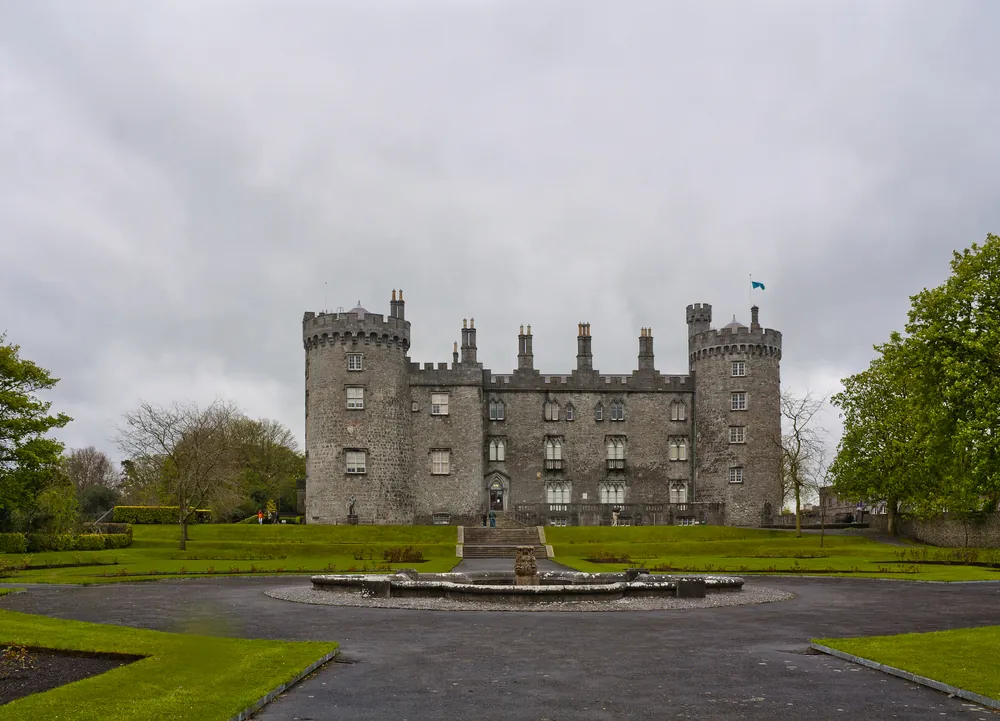
Kilkenny was the seat of the Butler family, Earls and later Dukes of Ormond, for almost 600 years from 1391 until the family sold it to the city for £50 in 1967. The Adams survey records that the present entrance, a handsome gatehouse of Caen stone brought up the River Nore by boat, was erected by the 2nd Duke of Ormond after he succeeded in 1688, at a cost of £1,500.[2] The Long Gallery, hung with the Butler family portraits, and the gardens running down to the river are the visit.
The OPW operates a self-guided format alongside scheduled guided tours of the principal apartments. The grounds, free to enter, frame much of central Kilkenny and link to the city's medieval mile of Hightown.
Practical: open daily year-round; April to September 09:15 to 17:30; October to March 09:30 to 17:00. Closed 25 to 27 December. Self-guided adult €8, concession €6, child (12 to 17) €4, under 12 free, family (2 adults + 3 children) €20. Guided tour adult €12. From Dublin, Iarnród Éireann from Heuston to Kilkenny MacDonagh (~90 min) or M9 by car. Plan your visit.[8]
6. Cahir Castle
Tipperary Daily, year-round One of Ireland's largest medieval castles Map
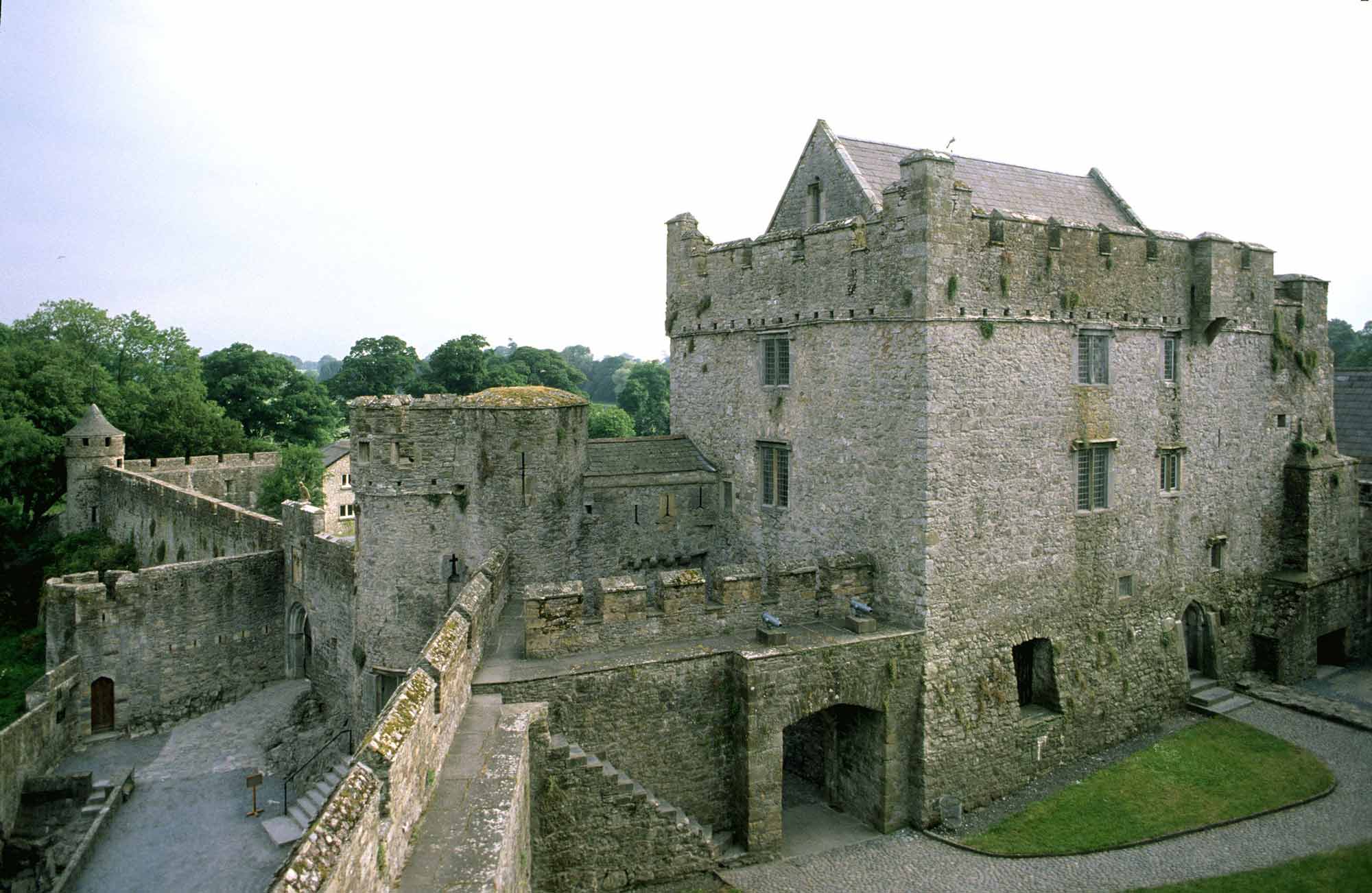
Cahir sits on a rocky island in the River Suir and survives as one of the largest and best-preserved medieval castles in Ireland. The Butler family of Cahir held it from 1375. The triple-walled enclosure (outer ward, middle ward, inner ward), the working portcullis and the keep-tower are the visit, and the castle's preservation through to the modern day owes something to its surrender to the Earl of Essex in 1599 without serious damage. The set has been used for several screen productions, including Excalibur (1981) and The Tudors.
The OPW operates the site as part of the Heritage Ireland network. The riverside walk and the path through the town to Cahir Cottage and the Swiss Cottage at Kilcommon are the obvious add-ons.
Practical: open daily, year-round, except 24 to 30 December. Summer (26 May to August) 09:00 to 18:30; winter 09:30 to 16:30. Adult €5, senior €4, student/child €3, family €13. Castle Street, Cahir, on the Dublin to Cork rail line; nearest station Cahir. Plan your visit.[9]
7. Donegal Castle
Donegal Daily, year-round Red Hugh O'Donnell stronghold Map
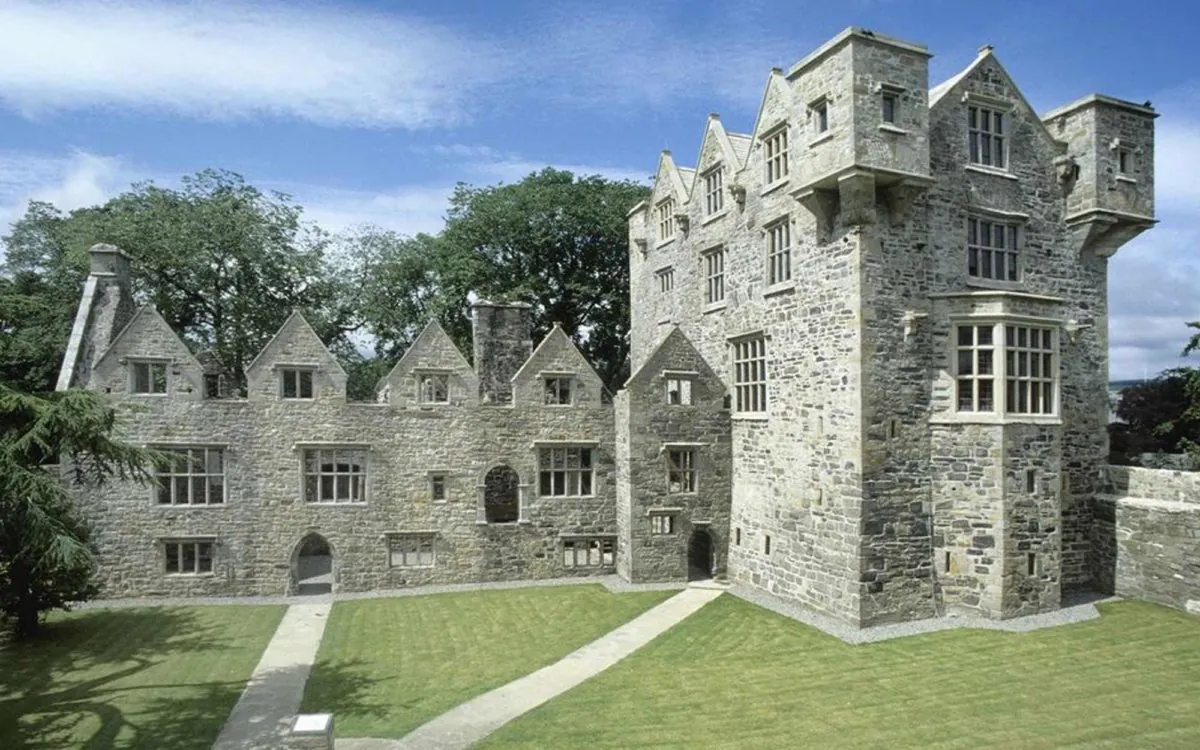
A 15th-century O'Donnell tower house with a 17th-century Jacobean manor extension wrapped around it, Donegal is the canonical example of the Irish castle's transition from late-medieval Gaelic to early-modern Plantation form. Red Hugh O'Donnell held it as the principal seat of Tír Conaill until he burned it in 1595 to deny it to English forces; Sir Basil Brooke, who was granted the castle after the Flight of the Earls in 1607, rebuilt the tower house and added the Jacobean wing.
The interior is largely a careful late-20th-century OPW restoration after centuries of partial ruin. The great fireplace, carved with the Brooke arms, and the restored tower interior are the principal stops; the river setting on the Eske gives the castle its postcard view.
Practical: open daily 09:00 to 17:00 (last admission 16:15). Adult €5, senior €4, student/child €3, family €13. In the centre of Donegal Town, served by Bus Éireann Expressway from Dublin and Galway; no rail. Plan your visit.[10]
8. Ashford Castle
Mayo Tours by booking 5-star hotel and falconry school Map
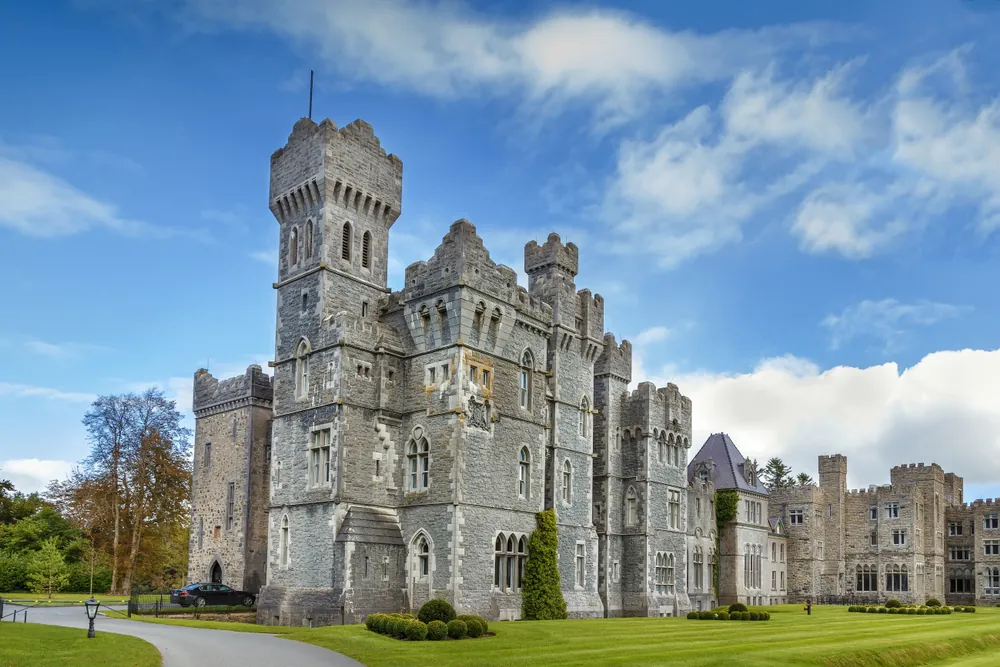
The original Ashford was a 13th-century de Burgo castle on the shores of Lough Corrib. The Guinness family acquired the estate in 1852 and extended it across the second half of the 19th century into the neo-Gothic country house that defines the visible building today. Red Carnation Hotels has operated it as a 5-star country-house hotel since 2013, after a multi-year renovation. The estate also runs Ireland's oldest school of falconry, founded on site in 1982, and hosts hawk walks daily for non-residents.
Ashford is not a heritage day-visit attraction in the OPW sense. The interior is generally restricted to hotel residents, but a historic castle tour can be booked by non-residents at around €15, and the grounds, restaurants and falconry are open to bookings outside of guest stays.
Practical: the hotel operates year-round; the historic castle tour is around €15 by booking, with falconry, lake cruise and other estate experiences priced separately. Cong, County Mayo, on the Mayo to Galway border; about an hour by car from Galway, with shuttles from Ireland West Airport at Knock. Castle interior access for non-residents is not guaranteed and has tightened in recent years. Plan your visit.[11]
9. Carrickfergus Castle
Antrim (Northern Ireland) Closed Mondays Norman Ulster anchor Map
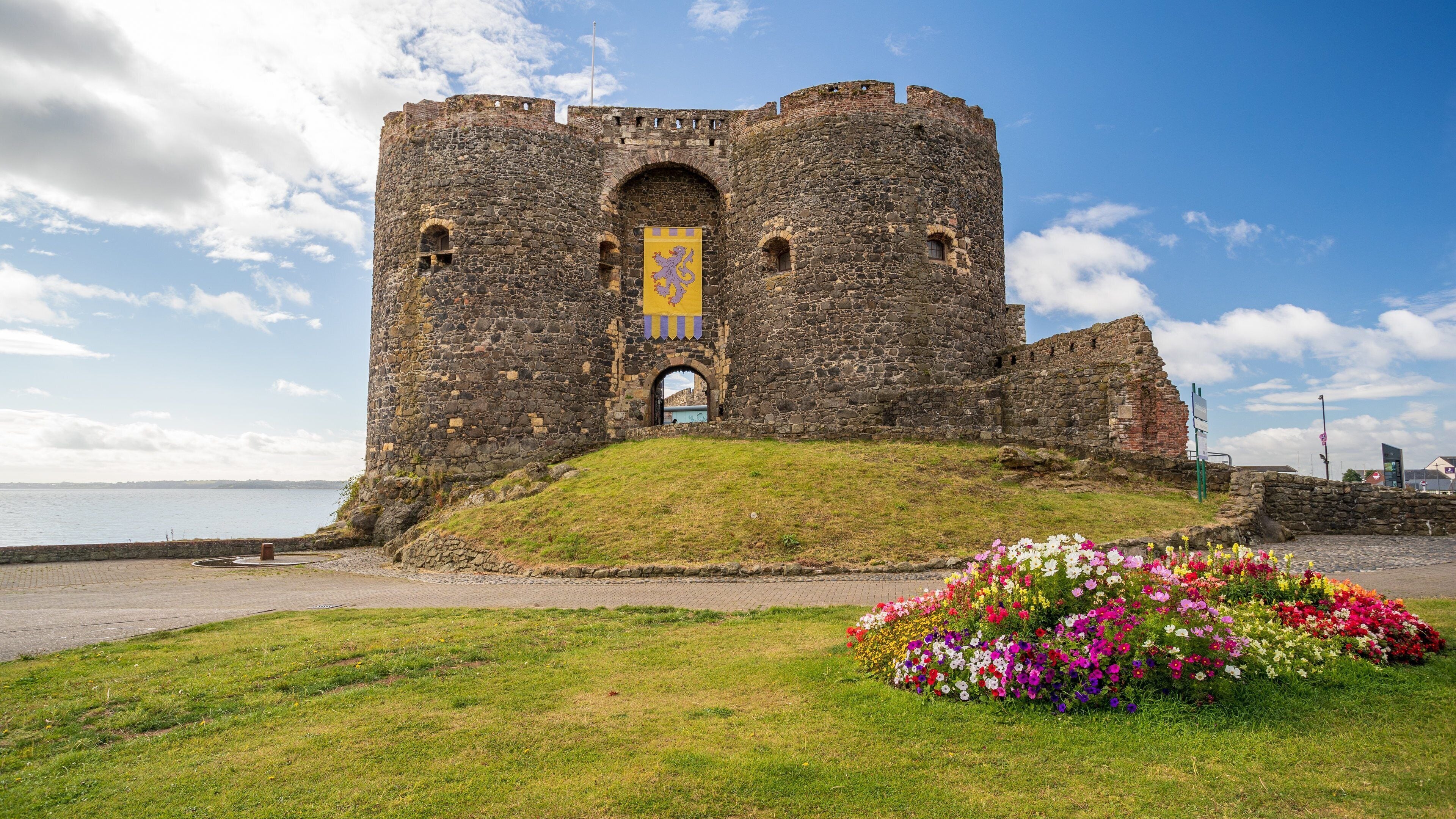
The Adams 1904 survey records the keep at Carrickfergus as "90 feet high, and divided into five storeys", with the large room on the third storey, called Fergus's Dining-room, measuring 40 feet long by 38 feet wide and over 25 feet high.[2] John de Courcy, the Anglo-Norman invader of Ulster, began the castle around 1177 on a basalt promontory jutting into Belfast Lough; it served as the principal English stronghold in the north for the next 800 years and is the best-preserved Anglo-Norman castle in Ireland under continuous management.
The Northern Ireland Department for Communities operates the site, with the Great Hall, the keep, the gatehouse and the curtain-wall walk forming the visit. The castle runs a sensory-friendly quiet hour every Sunday morning from 09:30 to 11:00.
Practical: open Tuesday to Sunday 09:30 to 17:00, last admission around 16:30; closed Mondays. Adult £6, concession £4.50, child (5 to 17) £4, family £18 (up to 5, max 3 adults). Tickets on-site only. From Belfast Great Victoria Street, NI Railways to Carrickfergus (~30 min) plus a 10-minute walk. Plan your visit.[12]
10. Dunluce Castle
Antrim (Northern Ireland) Daily, year-round Cliff-edge MacDonnell ruin Map
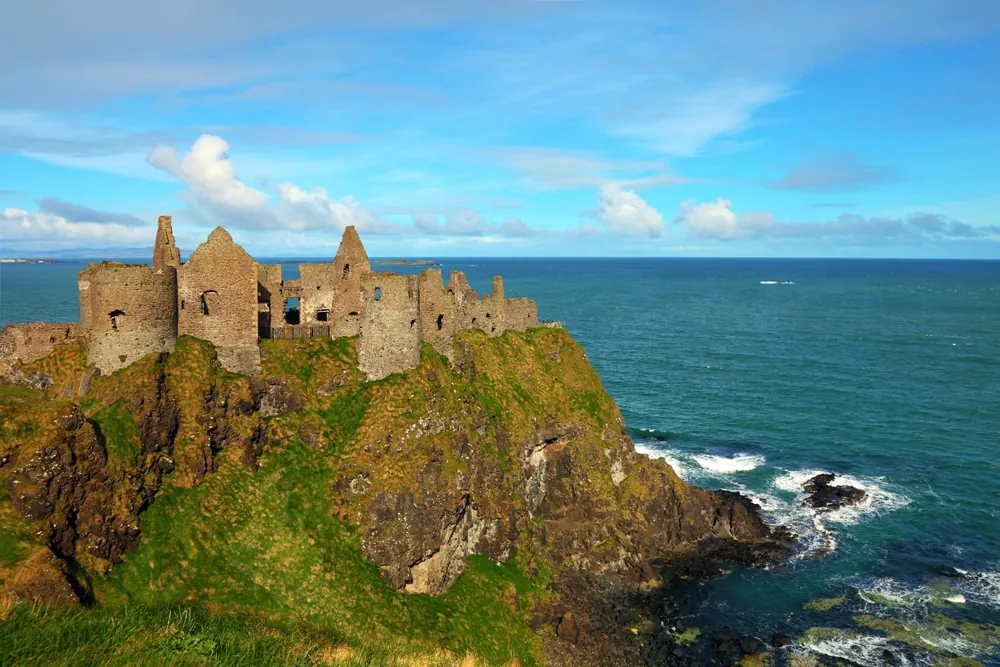
Dunluce sits on a basalt outcrop above the Antrim coast, between Portrush and Bushmills, with sheer drops on three sides. The 13th-century keep belonged to the de Mandevilles, and the castle passed to the MacDonnell Earls of Antrim in the 16th century. The McDonnell-era kitchen famously fell into the sea in 1639, taking several servants with it. The HBO production Game of Thrones used Dunluce as the exterior of the Greyjoy stronghold of Pyke.
The site is a roofless cliff-top ruin, walked end to end in 60 to 90 minutes. The visitor centre at the top of the path, the gatehouse, the Great Hall and the inner ward terraces are the visit. The cliff path along the Causeway Coast, ending at the Giant's Causeway six miles east, makes Dunluce a natural anchor for a day on the north coast.
Practical: open daily; February to November 09:30 to 17:00; December to January 09:30 to 16:00, with last entry 30 minutes before close. Adult £6, concession £4.50, child (5 to 17) £4, family £18. On-site ticket purchase only; no online booking. By car on the A2 Causeway Coast Route, or Translink Causeway Rambler bus 402. Plan your visit.[13]
11. Malahide Castle
Dublin Daily, year-round 800 years of Talbot family residence Map
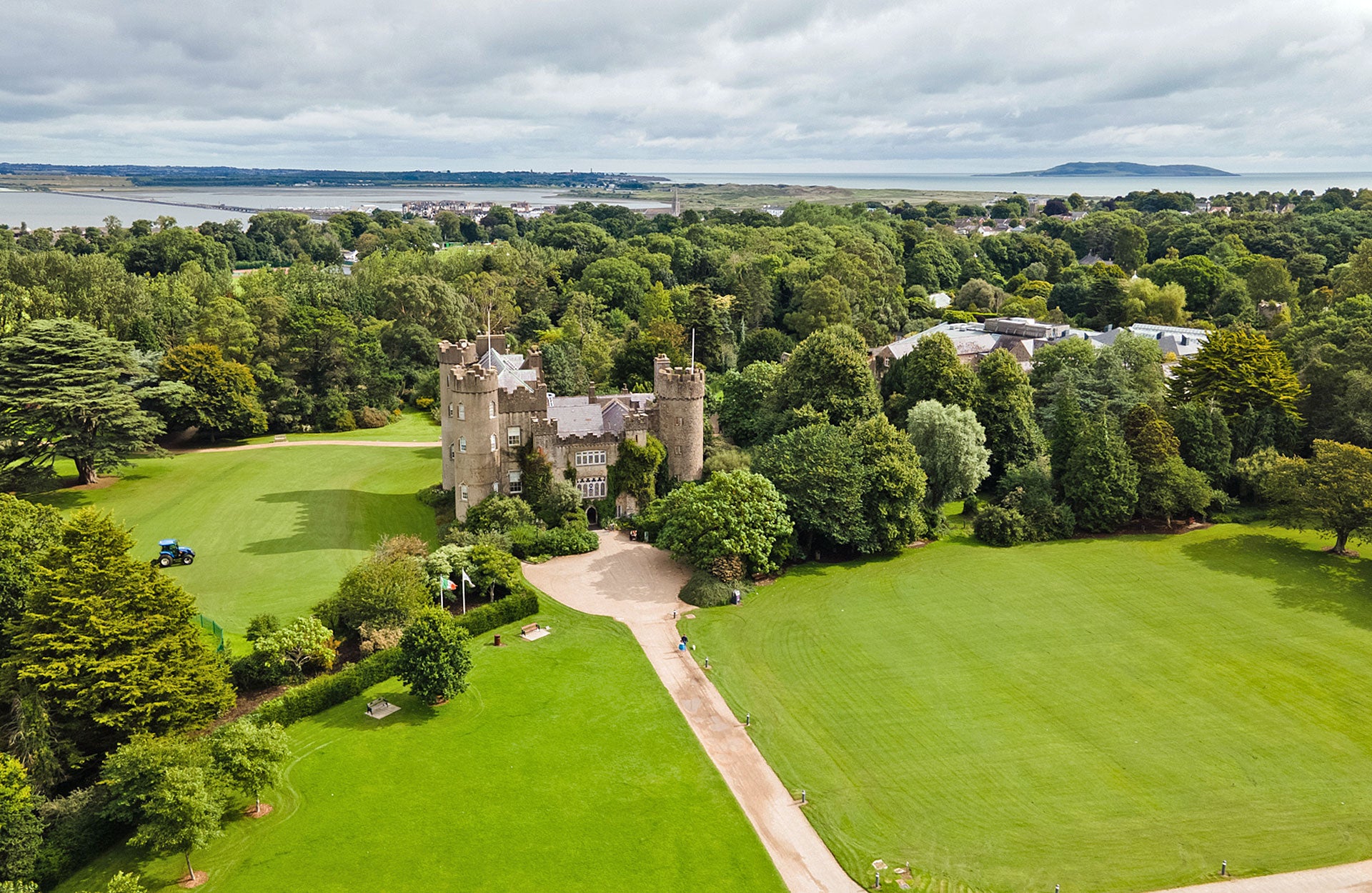
The Talbot family held Malahide for nearly 800 years, from Richard Talbot's grant of the lands and harbour by Henry II in 1185 until the death of the seventh Lord Talbot in 1973. The medieval core, the 15th-century Great Hall and the 19th-century neo-Gothic additions sit alongside one another in a single visited building, with a 260-acre estate that includes the historic walled gardens and the Talbot Botanic Gardens. Fingal County Council and Shannon Heritage run the site.
The castle interior is accessed by tour and includes the family portraits, the Oak Room and the Great Hall, with the gardens, butterfly house and avoca shop adding most of a day's worth of attractions. From central Dublin, the DART line makes it the easiest castle day-trip in the country.
Practical: grounds open daily 09:30 to 17:30; castle tours scheduled across the day. Combined castle tour and gardens from €16 adult, with family and senior options via online booking. From Dublin, DART to Malahide (~25 min) plus a 10-minute walk, or bus 42 from the city centre; about 15 km north of central Dublin. Plan your visit.[14]
At a glance
| Castle | Region | When to go | |
|---|---|---|---|
| Blarney CastleStone of Eloquence | Cork | Daily, year-round |
| Bunratty CastleMedieval feasts | Clare | Daily, year-round |
| Rock of CashelMythic seat of Munster kings | Tipperary | Open daily, all year |
| Trim CastleNorman keep, Braveheart filming castle | Meath | Daily, year-round |
| Kilkenny CastleButler dynasty seat | Kilkenny | Daily, year-round |
| Cahir CastleOne of Ireland's largest medieval castles | Tipperary | Daily, year-round |
| Donegal CastleRed Hugh O'Donnell stronghold | Donegal | Daily, year-round |
| Ashford Castle5-star hotel and falconry school | Mayo | Tours by booking |
| Carrickfergus CastleNorman Ulster anchor | Antrim (Northern Ireland) | Closed Mondays |
| Dunluce CastleCliff-edge MacDonnell ruin | Antrim (Northern Ireland) | Daily, year-round |
| Malahide Castle800 years of Talbot family residence | Dublin | Daily, year-round |
How many castles are in Ireland?
The figure most often cited is around 3,000 standing castles, after Harold Leask's working baseline that McNeill's Castles in Ireland corroborates: of those, roughly 350 are mottes, and the great majority of the remainder are or were tower houses.[1] McNeill points out that contemporary 15th- to 17th-century documents called these tower-house structures simply castles, with the term tower house being modern.[1] Tower-house construction was widespread across Anglo-Norman, Old English and Gaelic Irish lordships, and McNeill notes that tower houses were also built by richer townsmen and parish priests, not only by lords.[1]
Public access is much narrower. The Office of Public Works runs the largest paid heritage circuit on the Republic side: the Rock of Cashel, Kilkenny, Cahir, Trim and Donegal sit at the front of that list. The Northern Ireland Department for Communities manages Carrickfergus, Dunluce and the wider Historic Environment Division portfolio. The Irish Heritage Trust adds Fota House Cork, Strokestown Park Roscommon and Johnstown Castle Wexford to the public-access list, with a 2024 annual operating surplus of €718,945 and net assets of €7.93 million.[15] The remainder, the bulk of the surviving stock, sits in private ownership across Ireland's 32 counties.
Famous, medieval, Gothic and largest
Famous. The eleven above account for the bulk of search demand. Blarney leads on visitor recognition through the Stone of Eloquence; the Rock of Cashel and Bunratty follow on heritage and event programming; Ashford on hospitality. Dunluce closes the list as the most photographed Northern Irish ruin.
Medieval. Trim, Carrickfergus and Cahir are the strongest survivors of the 12th- to 13th-century Norman tier as standalone visits. Tower-house Ireland, the late-medieval form, is best read at Bunratty (1397), Blarney (1446) and Donegal. McNeill's record of the broad social uptake of tower-houses, extending from Anglo-Norman lords to townsmen and parish priests, explains the density.[1]
Gothic. Ashford's 1879 neo-Gothic exterior is the canonical 19th-century romantic-revival example among Irish castles open to visitors, with Adare Manor (a 19th-century manor rather than a medieval castle) as the closest peer. Malahide's neo-Gothic outer fabric sits over the medieval core. The earlier Gothic survives in ecclesiastical fragments rather than secular castles, with the 13th-century Gothic cathedral on the Rock of Cashel the strongest case.
Largest. McNeill records Trim Castle as Ireland's largest and finest castle, with the towered curtain wall enclosing the massive great tower and a hall complex.[1] Cahir is among the largest by enclosure area among medieval Irish castles. Of the inhabited modern-format properties, Ashford's estate spreads across about 350 acres on the shores of Lough Corrib.
If you're looking to buy
Ireland is among the highest castle €/m² markets in Europe. Castle Collector's Castle Price Index (March 2026) records a median asking around €2,000,000 for typical properties and an Irish per-square-metre figure of around €3,358/m², well above continental medians, with a wide bid-ask spread driven by a thin transaction count.[16] The premium reflects scarcity: under 200 active for-sale-tier properties nationally, against persistent international buyer demand from the Irish diaspora and the broader European heritage-property market.
The mortgage market is reasonably accessible: Irish banks lend to non-residents at LTVs of 50 to 70% on legally compliant properties. Stamp duty is 1%, the lowest in Western Europe for this asset class, plus solicitor and registration fees of around 1 to 2%. Foreign buyers face no purchase restrictions. The Built Heritage Investment Scheme can fund 50 to 80% of eligible work on Protected Structures, and Section 482 tax relief covers maintenance and repair costs for approved buildings opened to the public. See the castles for sale in Ireland page for current listings, and the guide to buying a castle for the operational side.
Sources
1. McNeill, T. E. Castles in Ireland: Feudal Power in a Gaelic World. Routledge, London and New York, 1997; pp. 30, 220, 221, 222, 250, 257.
2. Adams, C. L. Castles of Ireland: Some Fortress Histories and Legends. Sealy, Bryers & Walker / Elliot Stock, London, 1904 (digital reprint via Project Gutenberg).
3. Blarney Castle, official site.
4. Bunratty Castle and Folk Park, Shannon Heritage.
5. Rock of Cashel, Office of Public Works, Heritage Ireland.
6. Goodall, J. The Castle: A History. Yale University Press, 2022; p. 333.
7. Trim Castle, Office of Public Works, Heritage Ireland.
8. Kilkenny Castle, Office of Public Works.
9. Cahir Castle, Office of Public Works, Heritage Ireland.
10. Donegal Castle, Office of Public Works, Heritage Ireland.
11. Ashford Castle, Red Carnation Hotels.
12. Carrickfergus Castle, Department for Communities (Northern Ireland).
13. Dunluce Castle, Discover Northern Ireland (Northern Ireland Tourist Board) / Department for Communities Historic Environment Division.
14. Malahide Castle and Gardens, official site.
15. Irish Heritage Trust Annual Report 2024.
16. Castle Collector, Castle Price Index, March 2026 edition.