
Castles in Switzerland: 12 alpine castles to visit, from Chillon to Bellinzona
Switzerland has approximately 500 recognised castles. Château de Chillon (~391,000 visitors), the three Bellinzona castles (UNESCO 2000) — Castelgrande, Montebello, Sasso Corbaro — Gruyères and Hallwyl anchor the heritage.
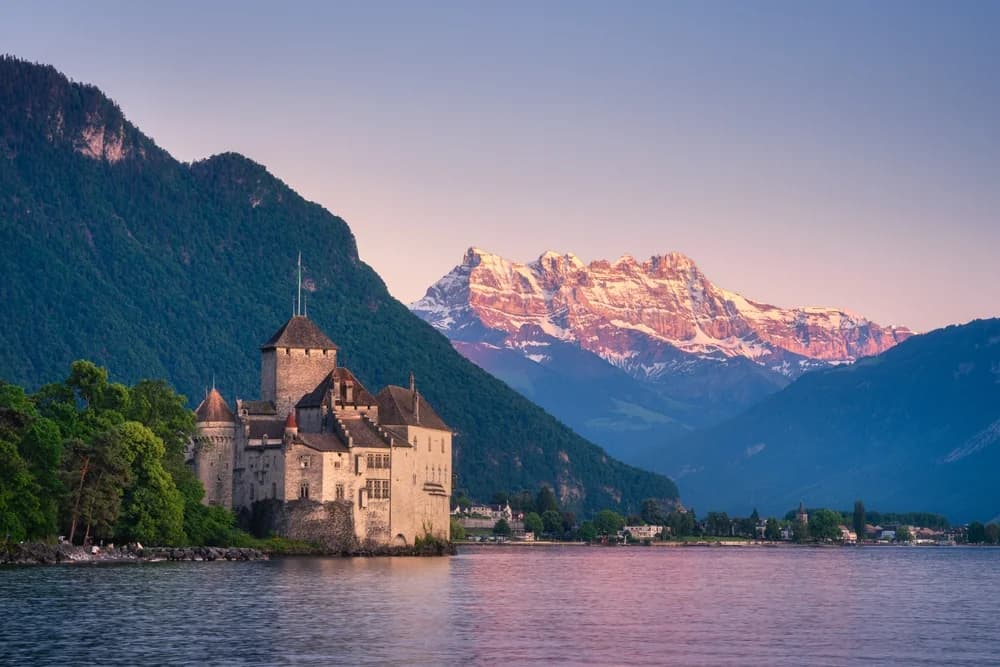
A small country with around 500 recognised castles spread across 26 cantons. From a Savoy island fortress on Lake Geneva to a UNESCO triple defensive system above the St. Gotthard pass, twelve castles that warrant the day.
Switzerland has roughly 500 recognised castles, registered with the Schweizerischer Burgenverein (Swiss Castle Association), distributed across the 26 cantons that govern their own heritage statutes.[1] The Swiss medieval castle tradition is structurally distinct from the broader Western European pattern: it was driven by alpine pass control rather than territorial-frontier defence, which produced a denser concentration of small to mid-sized fortifications guarding river crossings, valley narrows and the southern approaches to the major Alpine passes.[2]
The castles that anchor a traveller's itinerary cluster in three regions. The Lake Geneva and Fribourg arc holds the most-visited Swiss castle (Château de Chillon) and the Counts of Gruyères' 13th-century seat. The Ticino, Switzerland's southernmost canton, holds the country's only UNESCO castle inscription: the integrated Castelgrande, Castello di Montebello and Sasso Corbaro defensive system at Bellinzona, listed in 2000. The northern cantons of Aargau and Bern hold the Habsburg- and Zähringer-era castles (Lenzburg, Hallwyl, Burgdorf, Thun) that form the heart of the German-speaking Swiss heritage circuit.
The twelve below are the ones that warrant the day. Each entry covers what to see, when to go, what it costs, and how to get there.
1. Château de Chillon
Vaud (Lake Geneva) Daily, year-round Lake Geneva's island fortress Map
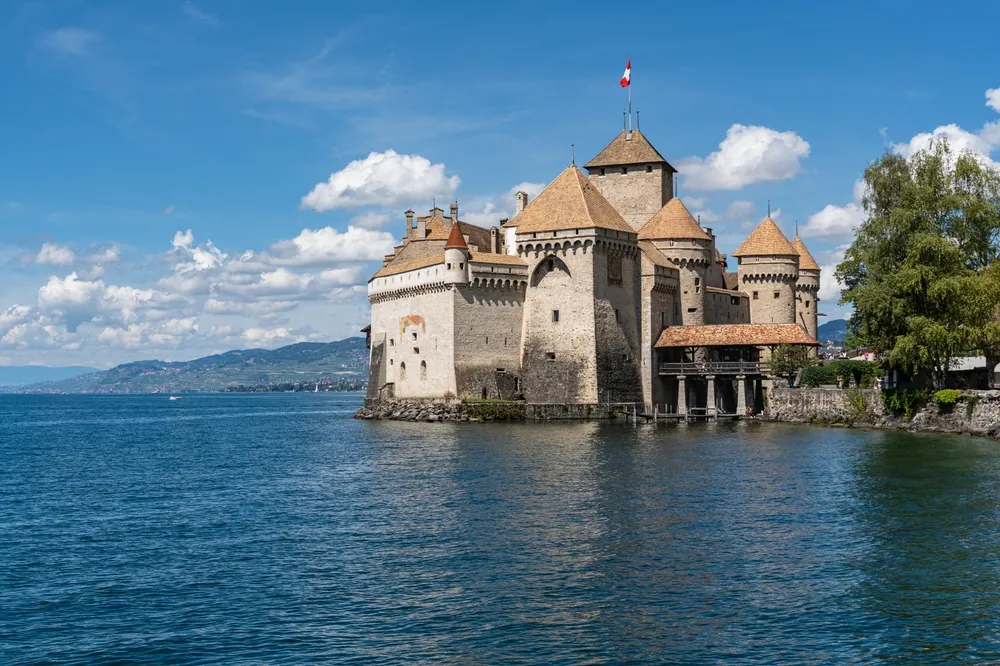
Chillon sits on a small rocky island at the eastern end of Lake Geneva, near Montreux, joined to the mainland by a short wooden bridge. The castle began as an 11th-century square donjon belonging to the Bishop of Sion and was rebuilt in roughly its present form around 1150 by the Counts of Savoy, who used it as one of their residences and as a customs post on the road from Italy to Burgundy.[3] The Bernese took the castle in 1536 and held it until 1798. It is now operated by the Fondation des Châteaux de Chillon and is, by visitor numbers, the most-visited Swiss castle (around 391,000 admissions in 2023).[4]
Lord Byron's Prisoner of Chillon (1816) carried the castle into the European literary imagination, dramatising the imprisonment of the Genevan reformer François Bonivard in the dungeons between 1530 and 1536. Byron carved his name on a pillar in the lower vault during the same visit; the carving is still visible. The Savoy-era aula, the chapel of St George, the lakeside tower and the dungeons are the canonical visit.
Practical: open daily, year-round; closed 25 December and 1 January. Apr–Sep 09:00–19:00 (last entry 18:00); Mar and Oct 09:30–18:00; Nov–Feb 10:00–17:00. Adult CHF 15, concession CHF 12.50, child (6–15) CHF 7; family (2 adults plus 1–5 children) CHF 35; free with the Swiss Travel Pass. From Lausanne or Geneva, train to Veytaux-Chillon halt, or CGN lake boat from either city. Plan your visit.[4]
2. Castelgrande, Bellinzona
Ticino (Bellinzona) Daily, year-round UNESCO triple castles Map
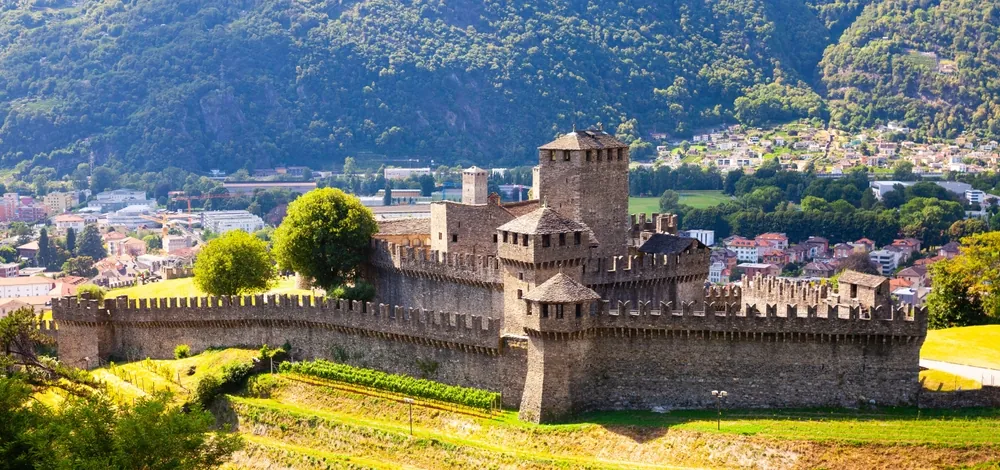
Castelgrande sits on a rocky outcrop in the centre of Bellinzona, the lowest of the three castles that step up the hillside above the modern town. The Visconti of Milan rebuilt it in the 13th century on the foundations of an earlier fortress that had controlled the southern approaches to the St. Gotthard, San Bernardino and Lukmanier passes since at least the Roman period.[5] The two main towers, the Torre Bianca and the Torre Nera, plus the curtain walls and the lower courtyard survive substantially intact.
The 2000 UNESCO inscription recognises the three Bellinzona castles plus the surviving city walls (the murata) as a unified medieval defensive system, distinct from a single-castle inscription because the three function as one integrated whole.[6] Castelgrande is the only one of the three open year-round; the other two close for the winter.
Practical: open daily 10:00–18:00 (28 Mar to 11 Nov 2026); 10:30–16:00 in winter (Castelgrande only). Adult CHF 15 single ticket; Fortezza Pass CHF 28 covers all three Bellinzona castles plus temporary exhibitions; free with the Swiss Travel Pass. From the SBB train station at Bellinzona, around 10 minutes on foot, or take the lift from Piazza del Sole. Plan your visit.[7]
3. Castello di Montebello
Ticino (Bellinzona) Mid-Mar to early Jan UNESCO Bellinzona fortress Map
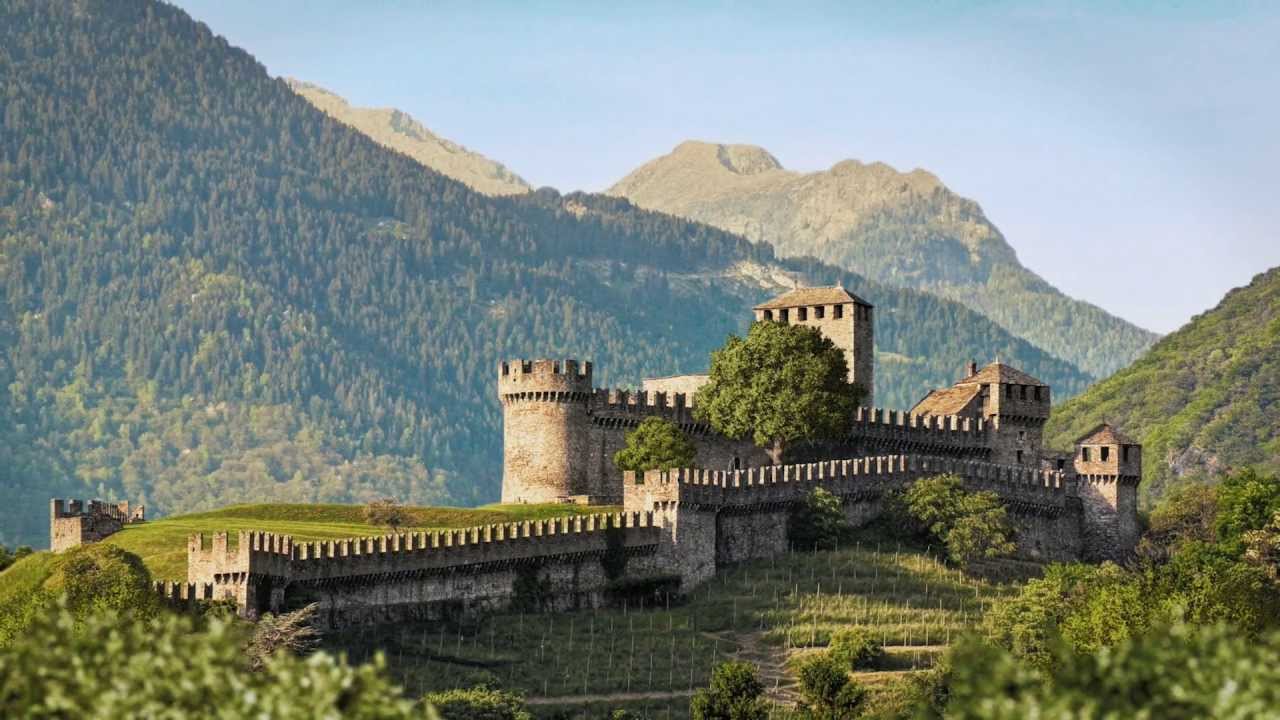
Castello di Montebello stands on the hill above the eastern flank of Bellinzona, the middle castle of the three. It dates from the late 13th century in its earliest fabric, with later expansion through the 14th and 15th centuries; it began as the residence of the Rusca family of Como before passing to Milanese (Visconti, then Sforza) control in the 14th century. The pentagonal keep, the long curtain walls and the Archaeological Museum housed in the upper enclosure are the visit. A covered wooden walkway runs along the north flank with a view down onto Castelgrande and across the Ticino valley.
The castle is part of the same UNESCO 2000 inscription as Castelgrande and Sasso Corbaro, and shares the Fortezza Pass.
Practical: mid-March to late October 10:00–18:00 daily; November to early January 10:30–16:00 (courtyards only); closed January to mid-March. Adult CHF 5, concession CHF 2.50; under the Fortezza Pass at CHF 28 alongside Castelgrande and Sasso Corbaro; free with the Swiss Travel Pass. From the old town, around 10 minutes' walk uphill. Plan your visit.[7]
4. Sasso Corbaro
Ticino (Bellinzona) Mar to Nov Highest UNESCO castle Map
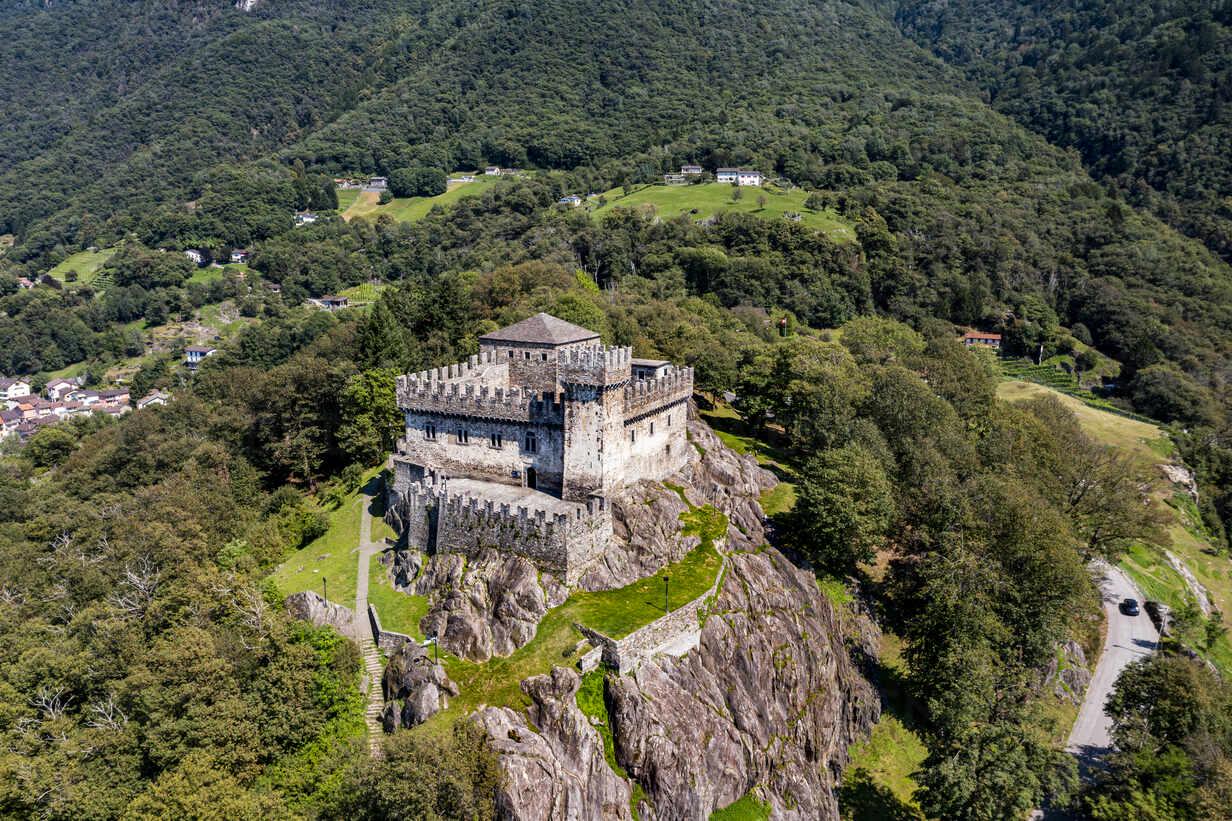
Sasso Corbaro is the highest and last-built of the three, a tight square fortification erected in 1479 for Duke Galeazzo Maria Sforza of Milan as a final defensive layer above the older castles below. It was the last fortification added before the Swiss conquest of 1500 took Bellinzona out of Milanese hands, and the architectural simplicity (a single square keep with corner towers and a small courtyard) is a contrast to the more elaborate medieval fabric of Castelgrande and Montebello. The terrace gives a panoramic view across the Magadino plain and out toward Lake Maggiore.
Like Montebello, Sasso Corbaro is closed to interior visits in winter; only the courtyards remain accessible.
Practical: daily 10:00–18:00 (28 Mar to 11 Nov 2026); courtyards only in winter. Adult CHF 15 single ticket; covered by the Fortezza Pass CHF 28 alongside Castelgrande and Montebello; free with the Swiss Travel Pass. From Bellinzona station, AutoPostale bus 4 to Artore plus a short walk, or a steep 3 km walk uphill. Plan your visit.[7]
5. Château de Gruyères
Fribourg Daily, year-round 13th-century counts' seat Map
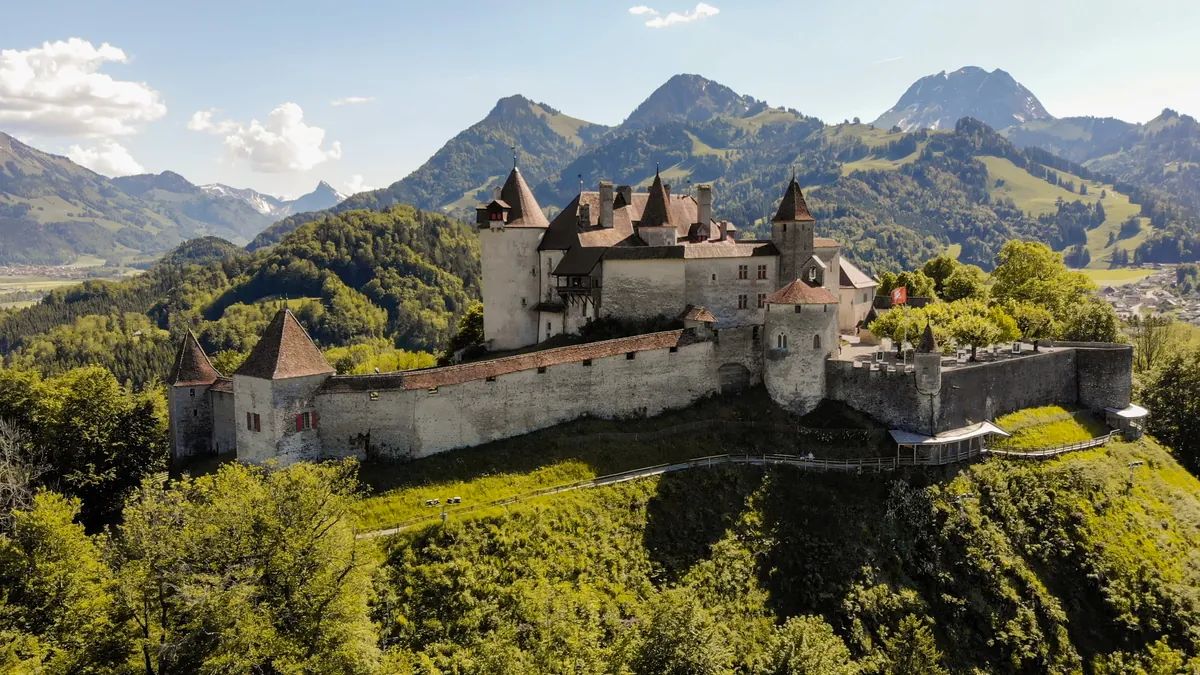
The Château de Gruyères crowns the small hilltop village of the same name in the Fribourg pre-Alps. The original 13th-century castle was the seat of the Counts of Gruyères, who held the surrounding territory until the dynasty's bankruptcy in 1554, after which the cantons of Bern and Fribourg divided the estate. Bailiffs of Fribourg held the castle until 1798, and the Bovy and Balland families bought and substantially restored it in the 19th century. It has been a public foundation since 1938 and now holds a strong collection of late-medieval and Renaissance painting.
The walled village outside the castle (closed to motor traffic) is a useful counterpart to the visit. Compounding the draw, the surrounding region produces Gruyère AOP and the Maison du Gruyère cheese factory and the H. R. Giger Museum sit within the village complex, packaging castle, cheese and contemporary art into a single day.
Practical: open daily, year-round (including holidays). Apr–Oct 09:00–18:00; Nov–Mar 10:00–17:00; last entry 45 minutes before close. Adult CHF 13, concession CHF 9, child (6–15) CHF 5; family (2 adults plus up to 3 children) CHF 29; under 6 free. From Bern or Lausanne, train change at Bulle; the village station Gruyères-Ville is 5 to 10 minutes on foot from the castle. Plan your visit.[8]
6. Lenzburg Castle
Aargau Apr–Nov, closed Mondays Knights and dragons castle Map
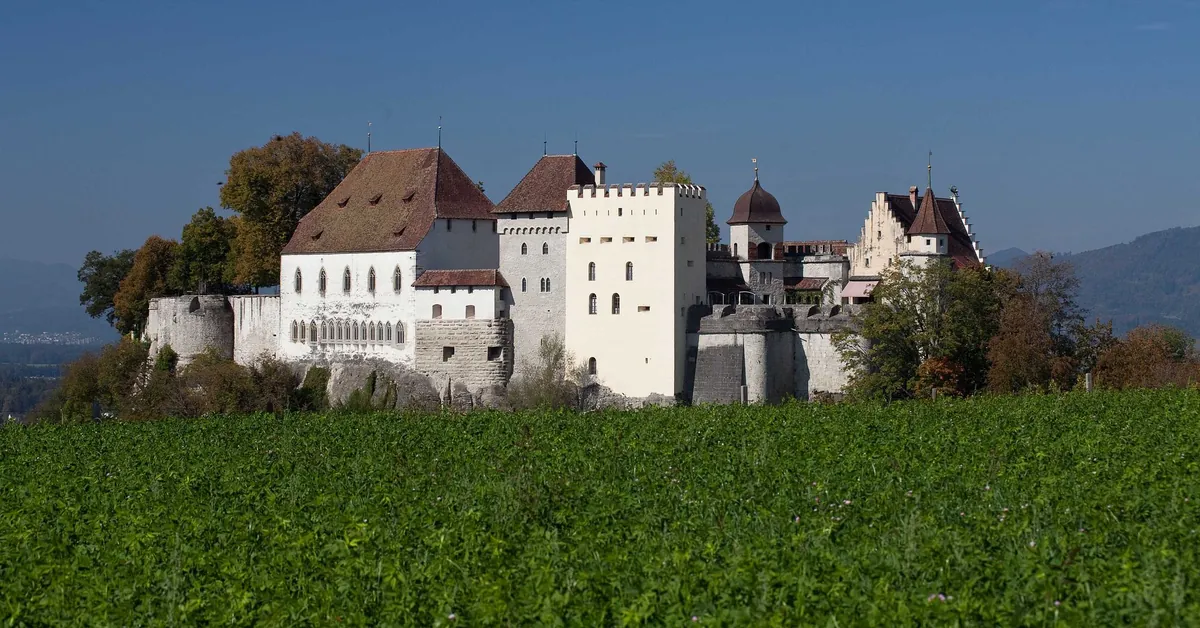
Lenzburg crowns a wooded hill above the Aargau market town of the same name, founded in the 11th century by the Counts of Lenzburg and held in succession by the Kyburg, Habsburg and Bernese houses through to 1798. The Habsburgs used it as one of their administrative centres in the 12th and 13th centuries, before the family's centre of gravity moved east to Austria. The 19th-century American writer Edward Wadsworth bought and restored the castle in the 1890s, donating it to the canton in 1956; Aargau opened it as a museum in 1986.
Lenzburg now operates as a museum of the canton's medieval and early-modern history and runs a strong children's programme around its dragon legend, which makes it the busiest family destination in the regional Schlösserpass circuit (Lenzburg, Hallwyl and Wildegg are jointly ticketed).
Practical: 1 April to 1 November 2026, Tue–Sun and public holidays 10:00–17:00; closed Mondays and the second Friday in July; closed November to March. Adult CHF 14, concession CHF 10, child (6–15) CHF 8, under 6 free; family (two adults) CHF 35. From Zürich, around 30 minutes by train to Lenzburg, then a 20-minute uphill walk or postbus to the castle. Plan your visit.[9]
7. Schloss Hallwyl
Aargau Tue–Sun Apr–Nov Moated Aargau jewel Map
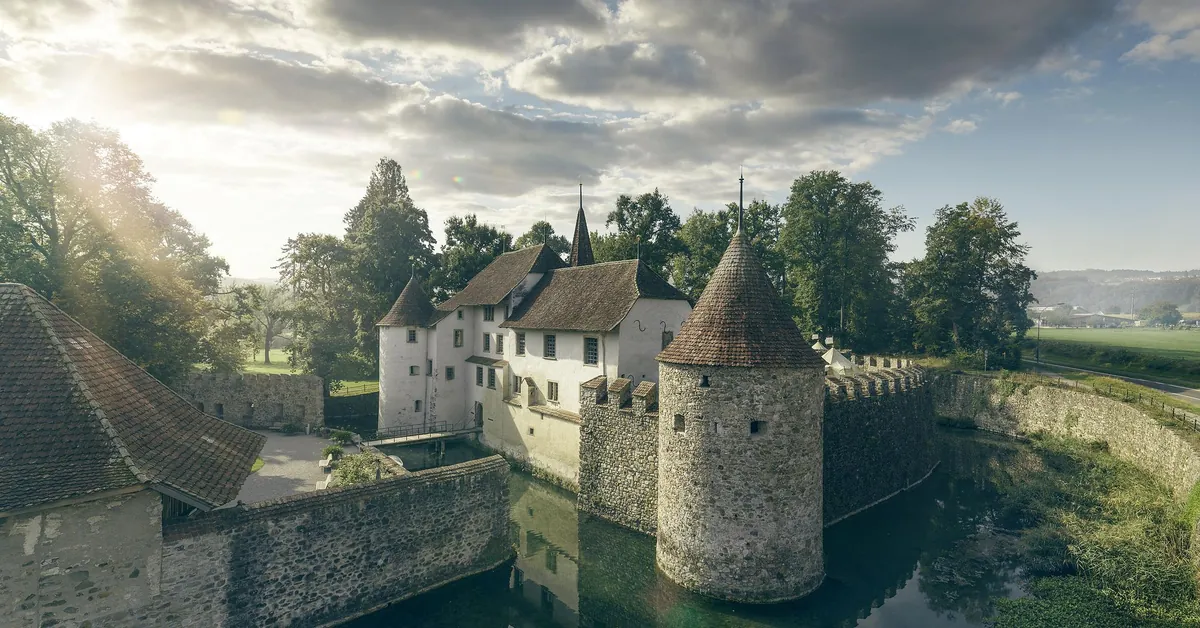
Schloss Hallwyl is one of the rare moated water-castles to survive the modernisation of the 17th to 19th centuries with its plan intact. It sits on two artificial islands in the River Aabach near the northern shore of the Hallwilersee, in the canton of Aargau. The Habsburg ministerial family of Hallwyl held it from the 13th century through to 1925, when Wilhelmina von Hallwyl bequeathed the castle to the cantonal government on the condition that it be conserved rather than restored to a single phase. The result is one of the more legible composite buildings in Switzerland: 13th-century round towers, 14th-century residential ranges and 16th-century reconstructions all visibly distinct in the fabric.
The two-island plan, with its bridge between the residence and the agricultural island, reads as a museum piece of late-medieval moated planning. The interiors carry the original Hallwyl family furniture and the family's archive.
Practical: 1 April to 1 November 2026, Tue–Sun 10:00–17:00; closed Mondays and during winter. Adult CHF 14, concession CHF 10, child (6–15) CHF 8. From Zürich or Lucerne, train to Boniswil, then Postauto bus to "Seengen, Schloss Hallwyl"; small car park nearby. Plan your visit.[10]
8. Schloss Burgdorf
Bern (Emmental) Daily Apr–Oct Zähringer keep and hostel Map
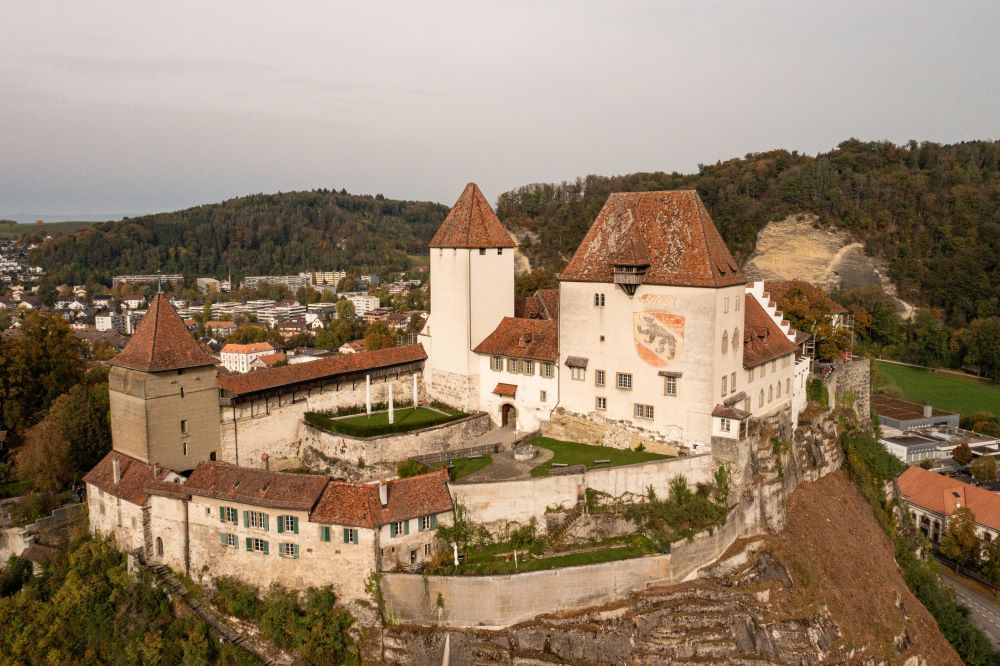
Schloss Burgdorf stands on a sandstone spur above the small town at the gateway to the Emmental, around 22 minutes by train from Bern. The castle was first documented as Burtorf in 1175, and as castellum Burgdorf in 1210, and was built in roughly its present form around 1200 by Duke Bertold V von Zähringen.[11] After the Zähringen line died out in 1218 the castle passed to the Counts of Kyburg and then, in 1384, to the city of Bern, which used it as a regional administrative seat until 1798. Excavations from 2018 to 2020 confirmed the construction chronology by dendrochronology: timbers in the palas floors give felling dates clustered on autumn and winter 1200/1201; bergfried scaffolding timbers radiocarbon to 1178 to 1219.[11]
Burgdorf is also the earliest known castle in the Swiss region built in fired-brick masonry on a stone plinth, with bricks roughly 30 to 32 cm long laid face-visible rather than plastered. The slender six-storey bergfried on an 8.5 by 8.5 m footprint, 23.5 m high, retains its original crenellation and a high entry on the courtyard side 7.7 m above the present yard. The castle now houses a regional museum, a restaurant and a youth hostel.
Practical: April to October daily 10:00–18:00; November to March Wed–Sun 10:00–18:00; closed 25 January to 12 February 2027. Adult CHF 14, concession CHF 10, child (6–16) CHF 6; Swiss Museum Pass holders free. From Bern, around 22 minutes by train to Burgdorf, then a 10-minute uphill walk. Plan your visit.[12]
9. Schloss Thun
Bern Year-round, reduced winter Zähringen four-tower keep Map
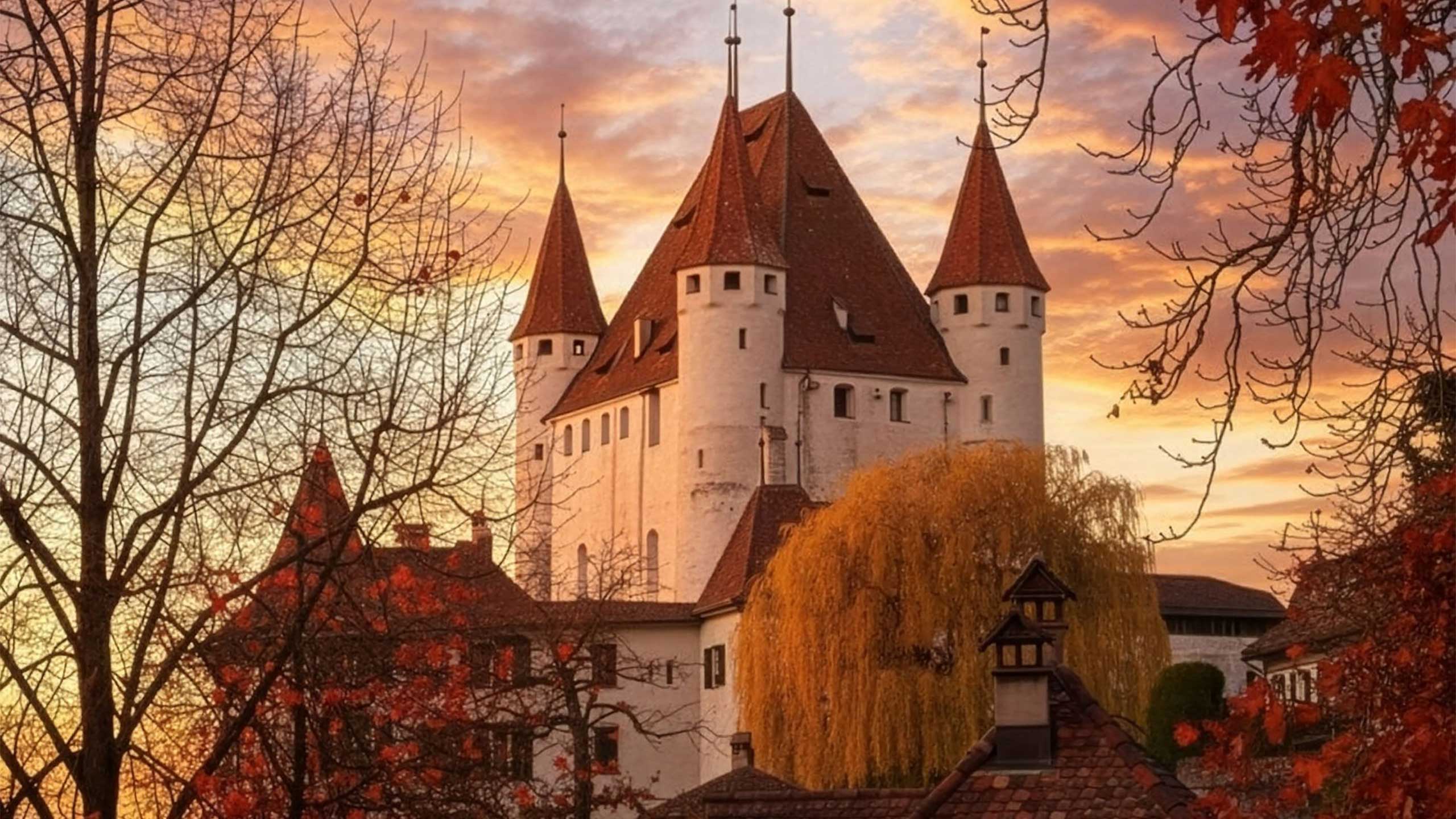
Schloss Thun sits on the Schlossberg above the town of Thun at the western end of the Thunersee, a Zähringer foundation of the late 12th century around a tall square keep flanked by four corner towers. After the Zähringer line died out in 1218 the castle passed to the Counts of Kyburg and then, like Burgdorf, to the city of Bern. The keep's Rittersaal on the first floor (a long hall with a pitched timber roof) is one of the few surviving 12th-century great halls in central Europe, and the small museum laid out across the keep's four floors covers the local history of Thun and the Bernese Oberland.
The four-tower silhouette, viewed from the Aare bridges below, is the photographed image of Thun. Together with Schloss Spiez further along the lake, the castle anchors a Bernese Oberland circuit that pairs well with the Lakes Thun–Brienz cruise routes.
Practical: open daily April to October 10:00–17:00 (July–August 09:30–17:30); November to January Sundays only 13:00–16:00; February to March daily 13:00–16:00. Adult CHF 10, concession CHF 8, child (6–16) CHF 3, under 6 free (confirm at booking). From Bern, around 30 minutes by train to Thun, then a 5-minute uphill walk. Plan your visit.[13]
10. Schloss Spiez
Bern May to October only Lake Thun knights' hall Map
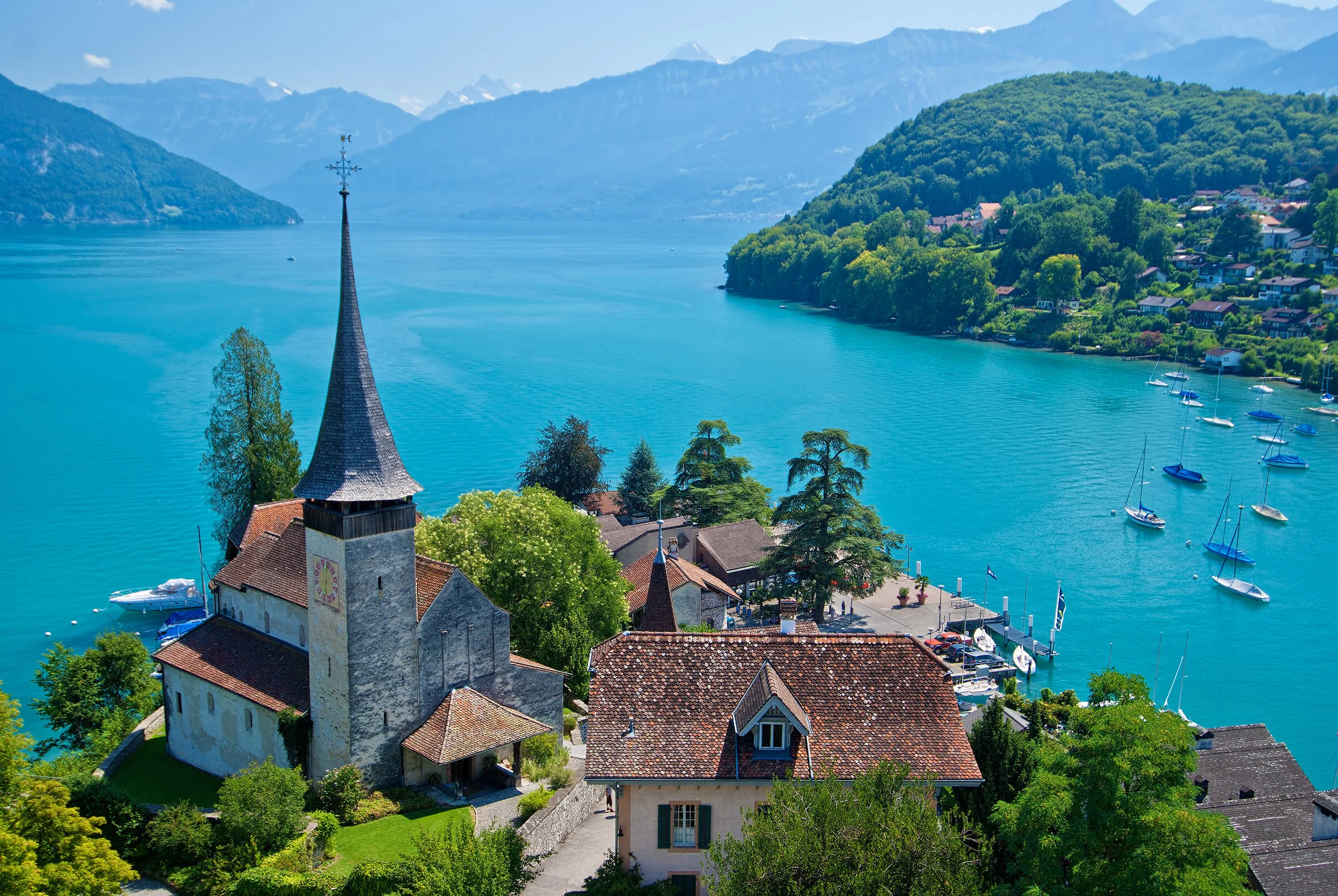
Schloss Spiez sits on a small promontory at the south-western corner of the Thunersee, surrounded by the vineyards of the Spiez parish. The castle is one of the older Bernese Oberland sites, with a 10th-century keep that grew through the medieval period under the Strättligen and Bubenberg families, and the present complex (keep, knights' hall, chapel and surrounding gardens) packs an unusually wide range of phases into a small footprint. The 10th-century Romanesque chapel beside the castle is the highlight; the Rittersaal (knights' hall) carries 16th-century painted ceilings.
The castle operates seasonally, May to October only. Together with Schloss Thun a short ride along the lake, it forms a useful pair for a Bernese Oberland day excursion combined with the lake-boat circuit.
Practical: May 1 to October 31 only; closed November to April. Tue–Sun 10:00–17:00, Mon 14:00–17:00; July–August extended to 18:00. Pricing not currently published on the official site; check before travel. From Bern, around 35 minutes by train to Spiez, then a short walk or bus from the station. Plan your visit.[14]
11. Schloss Aarwangen
Bern Wed–Sun Cultural meeting castle Map
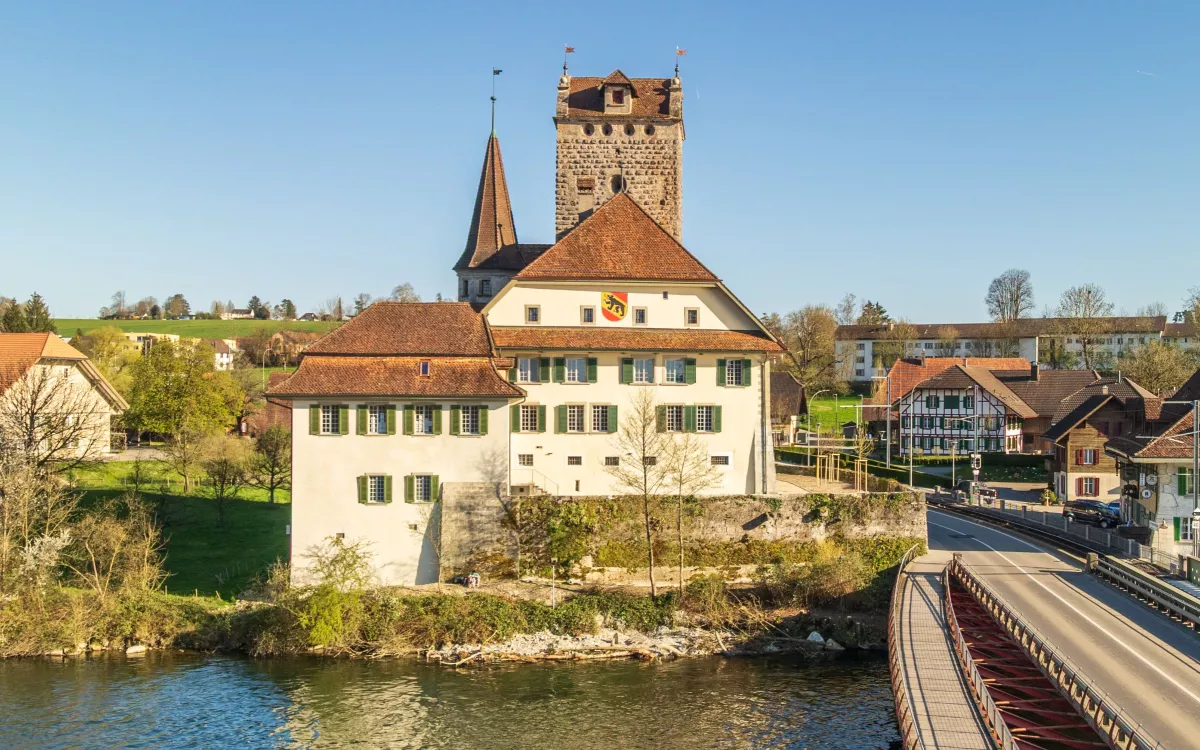
Schloss Aarwangen sits on an Aare crossing in the canton of Bern, a small but well-documented sequence of medieval phases: the castle was built shortly after 1250, the bergfried completed in 1265, and the present palas erected in 1373 under the Herren von Grünenberg.[15] From 1432 the castle served as a Bernese Amtssitz (regional administrative seat), a function it held in some form for almost 600 years. After centuries of state-administrative use, Aarwangen reopened in spring 2025 as a Kulturzentrum following an adaptive-reuse conversion, and now runs a programme of exhibitions plus a children's castle ("Kinder-Schloss") that uses the keep and the lower halls.
The castle is a useful current example of how Swiss heritage castles transition into community-oriented cultural facilities rather than private residences.
Practical: Wed–Fri 14:00–17:00; Sat–Sun 10:00–17:00; closed Mondays and Tuesdays. Adult CHF 13 (exhibition plus children's castle), concession CHF 8 (students, AHV/IV, Kultur-Legi), child (from 6) CHF 5. From Bern, around 50 minutes by train to Aarwangen via Langenthal. Plan your visit.[16]
12. Burgruine Friesenberg
Zürich Free open-access ruin Uetliberg viewpoint ruin Map
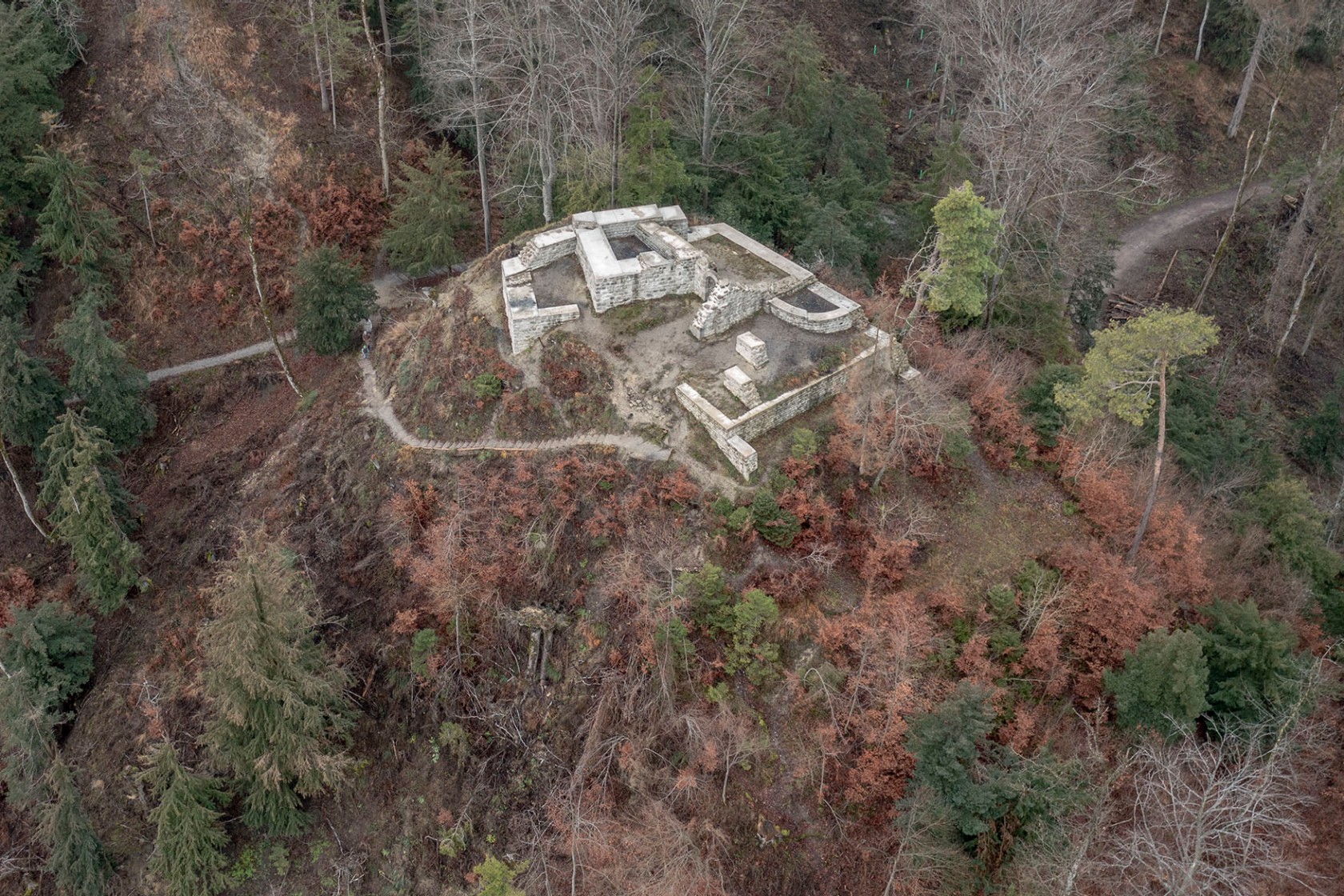
Burgruine Friesenberg sits on the Goldbrunnenegg molasse spur in Zürich-Wiedikon, around 4 km south-west of central Zürich, on a forested slope of the Uetliberg. The ruin was first documented in 1210/1218 as Frisonburch in a property index of the Kirche St Peter, and belonged to the Mülner family of Zurich (ministerials of the Fraumünster abbey). After the male Mülner line died out in 1386 the Burgstall was sold to the Zurich citizen Johannes Aeppli, one of the earliest dated castle-ownership transfers in the Swiss municipal record.[17] The plateau core measures roughly 19 by 17 m and includes a possible 6.5 by 7 m square keep with 1.5 m wall thickness; round water-supply remains 2 m in diameter survive on the lowest terrace.[17]
Stadtarchäologie Zürich completed a comprehensive sanation of the ruin in 2020 and 2021, the first full intervention since the 1920s reconstruction, and confirmed that the medieval masonry core was largely intact. The site reopened in May 2021 as a free open-access ruin in the city forest.
Practical: open access, year-round, daylight hours; no admission charge. From Zürich Hauptbahnhof, S10 Uetlibergbahn to Uetliberg plus a 30 to 40-minute walk on signed forest trails, or tram 9 or 14 to Friesenberg and a steep walk uphill. Sturdy footwear advised. Site information.[18]
At a glance
| Castle | Region | When to go | |
|---|---|---|---|
| Château de ChillonLake Geneva's island fortress | Vaud (Lake Geneva) | Daily, year-round |
| Castelgrande, BellinzonaUNESCO triple castles | Ticino (Bellinzona) | Daily, year-round |
| Castello di MontebelloUNESCO Bellinzona fortress | Ticino (Bellinzona) | Mid-Mar to early Jan |
| Sasso CorbaroHighest UNESCO castle | Ticino (Bellinzona) | Mar to Nov |
| Château de Gruyères13th-century counts' seat | Fribourg | Daily, year-round |
| Lenzburg CastleKnights and dragons castle | Aargau | Apr–Nov, closed Mondays |
| Schloss HallwylMoated Aargau jewel | Aargau | Tue–Sun Apr–Nov |
| Schloss BurgdorfZähringer keep and hostel | Bern (Emmental) | Daily Apr–Oct |
| Schloss ThunZähringen four-tower keep | Bern | Year-round, reduced winter |
| Schloss SpiezLake Thun knights' hall | Bern | May to October only |
| Schloss AarwangenCultural meeting castle | Bern | Wed–Sun |
| Burgruine FriesenbergUetliberg viewpoint ruin | Zürich | Free open-access ruin |
How many castles are in Switzerland?
The Schweizerischer Burgenverein (Swiss Castle Association) keeps the umbrella register of around 500 recognised castles distributed across the 26 cantons.[1] The category mixes daily-operating museum castles, foundation-run heritage sites, ruined and free-access Burgstellen, and a smaller subset of privately occupied family castles. Each canton runs its own heritage statute and consent process, which is one reason ticketing, hours and conservation funding can look noticeably different from one castle to the next.
Public access is strong by European standards. Aargau's cantonal museum body (Museum Aargau) operates Lenzburg, Hallwyl and Wildegg as a coordinated circuit; the Centre des Châteaux de Chillon foundation runs Chillon; Schloss Thun and Schloss Spiez are independent foundations; and the three Bellinzona castles run as a single Fortezza ticketing system. The recent peer-reviewed archaeology in the Burgenverein's quarterly journal Mittelalter has expanded the documentation of named castles like Burgdorf, Friesenberg and Aarwangen, with verified construction dates pinned to the year (Burgdorf's palas timbers cluster on autumn/winter 1200/1201 by dendrochronology).[11][17]
Famous, medieval, Gothic and largest
Famous. The twelve above account for the bulk of search demand. Chillon leads on visitor numbers (around 391,000 in 2023) and on literary celebrity, thanks to Byron's Prisoner of Chillon. The three Bellinzona castles share the country's only UNESCO castle inscription. Gruyères pairs with the Gruyère AOP cheese region for the highest combined day-trip pull in the western pre-Alps.
Medieval. Castelgrande is the most legible 13th-century castle in the country; Burgdorf is the earliest surviving Zähringer foundation built in fired-brick masonry; Lenzburg, Thun and Hallwyl complete the medieval-only itinerary in the German-speaking cantons. Among ruins, the Friesenberg Burgstall on the Uetliberg gives the most accessible view of a 13th-century plateau-castle plan above Zurich.
Gothic. The keep and chapel of Chillon, rebuilt by the Counts of Savoy from around 1150, are the canonical Swiss late-medieval Gothic survivors; the aula (the great hall on the lake side) is a textbook example. Sasso Corbaro at Bellinzona, built in 1479, is a late Gothic-into-Renaissance transition example, simpler in plan than its older siblings and more austere in its cut stonework.
Largest. The integrated Bellinzona defensive system (the three castles plus the murata curtain walls) is the largest medieval fortified ensemble in Switzerland by enclosed perimeter, the reason UNESCO inscribed it as a unified site rather than as three separate castles.[6] Among standalone sites, Chillon's island plan is the most elaborate by floor area, with around 25 distinct interior spaces across four storeys.
If you're looking to buy
The Swiss private-castle market sits at the top of the European price spectrum. Castle Collector's Castle Price Index (March 2026) tracks Swiss castles at a median asking of around €19,551 per square metre, almost 8× the French median of €2,285/m².[19] Two factors compound the premium: Swiss alpine cantons (Geneva, Vaud, Ticino, Zurich, Zug) sit at the top of European general residential prices because of land scarcity, and the Lex Koller statute (Bundesgesetz über den Erwerb von Grundstücken durch Personen im Ausland, BewG) requires non-resident foreign buyers to obtain cantonal permission for residential acquisitions, with annual quotas per canton and many cantons restricting approvals to designated tourism zones.
If you're seriously looking, the castles for sale in Switzerland page tracks current listings against this benchmark. EU and EFTA citizens with a Swiss B or C permit buy on the same terms as Swiss nationals; transaction costs run roughly 1.5 to 6% in total (transfer tax 0.2 to 3.3% by canton, plus 1 to 2.5% in notary and registry fees). For the operational side see our guide to buying a castle in Europe as a foreigner.
Sources
1. Schweizerischer Burgenverein (Swiss Castle Association).
2. Lepage, J.-D. G. G. Castles and Fortified Cities of Medieval Europe: An Illustrated History. McFarland, 2002 (Alpine region chapter).
3. Lepage, op. cit., p. 165 (Chillon construction chronology).
4. Fondation des Châteaux de Chillon, official site.
5. Lepage, op. cit. (Bellinzona controls the southern approaches to the St. Gotthard, San Bernardino and Lukmanier passes).
6. UNESCO World Heritage List, ref. 884, Three Castles, Defensive Wall and Ramparts of the Market-Town of Bellinzona.
7. Fortezza di Bellinzona, official site.
8. Château de Gruyères, official site, information.
9. Museum Aargau, Lenzburg Castle opening hours and entrance fees.
10. Museum Aargau, Schloss Hallwyl.
11. Baeriswyl, A. "Schloss Burgdorf, neue Erkenntnisse zur Bau- und Nutzungsgeschichte der zähringischen Burg." Mittelalter: Zeitschrift des Schweizerischen Burgenvereins, 28. Jg. 2023/4 (Dezember 2023), pp. 145–161.
12. Schloss Burgdorf, official site, opening hours and prices.
13. Schloss Thun, official site.
14. Schloss Spiez, official site.
15. Mittelalter: Zeitschrift des Schweizerischen Burgenvereins, 30. Jg. 2025/1 (März 2025), Kurzbericht: "Schloss Aarwangen, zur Rekonstruktion einer Adelsburg," p. 32.
16. Schloss Aarwangen, official site.
17. Zürcher, M. "Die Burgruine Friesenberg in Zürich-Wiedikon." Mittelalter: Zeitschrift des Schweizerischen Burgenvereins, 30. Jg. 2025/1 (März 2025), pp. 1–21.
18. Stadt Zürich, Stadtarchäologie, Friesenberg site.
19. Castle Collector, Castle Price Index, March 2026 edition.