
Castles in France: 8 châteaux to visit, from Versailles to Vaux-le-Vicomte
Versailles, Chambord, Chenonceau and Mont-Saint-Michel headline France's 19,122 protected castles, the deepest castle landscape in Europe.
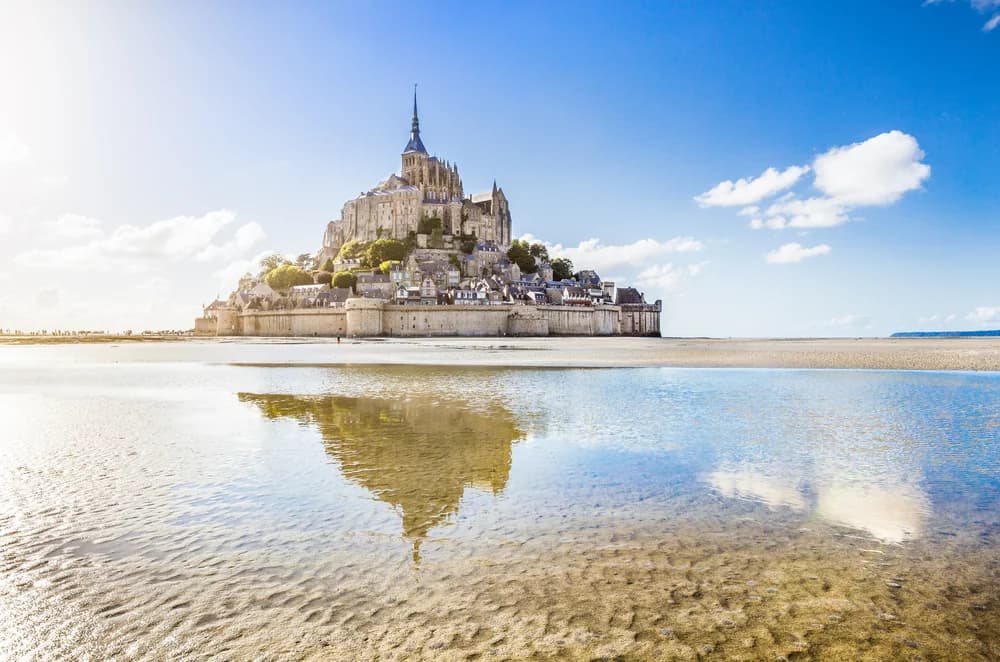
France has more castles than any other country. From a tidal abbey on the Norman coast to a Renaissance pleasure-palace built over a river, eight châteaux that anchor a serious itinerary.
France carries the densest castle landscape in Europe. The specialist surveyor Hubert Fenwick estimated in 1976 that "well over 5,000 châteaux" stood across the country, of which nearly 1,000 were open to the public.[1] The number has since grown. The French Ministry of Culture's Inventaire général du patrimoine culturel now lists over 19,000 protected heritage properties classified as châteaux, though most are private.[2]
The châteaux that define a traveller's itinerary cluster in three regions. The Loire Valley, where the French monarchy summered between Charles VII and Henry III, holds the densest concentration of Renaissance pleasure-palaces. The Île-de-France, ringing Paris, holds the working royal residences (Versailles, Fontainebleau, Vaux-le-Vicomte). The south, from Carcassonne to Avignon, holds the medieval walled cities and crusader-era strongholds that pre-date the Loire fashion by 300 years.
The eight below are the ones that warrant the day. Each entry covers what to see, when to go, what it costs, and how to get there from Paris.
1. Château de Versailles
Île-de-France Closed Mondays Sun King's seat Map
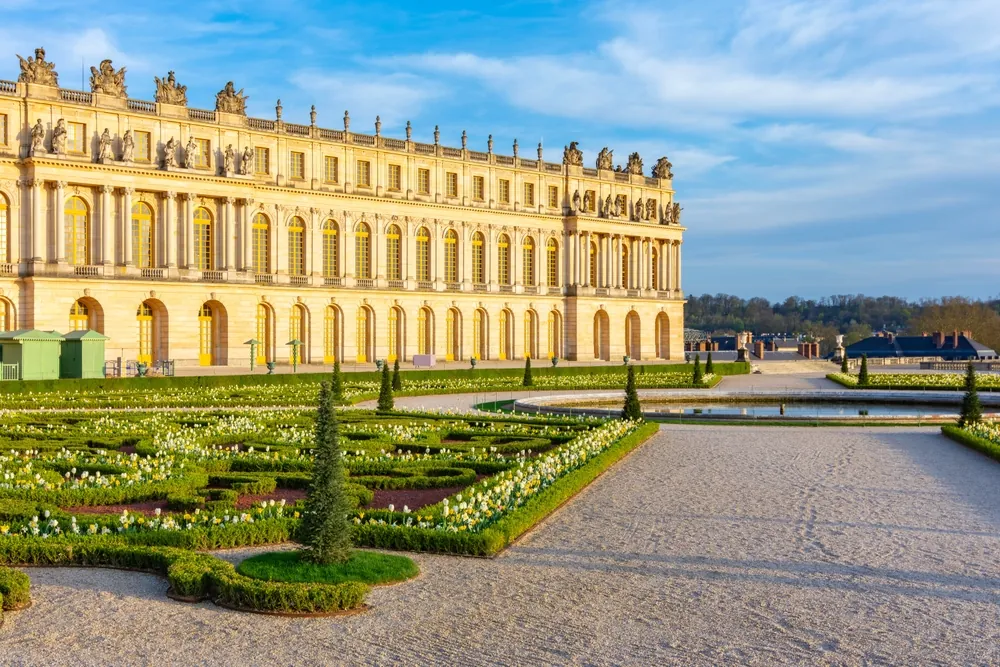
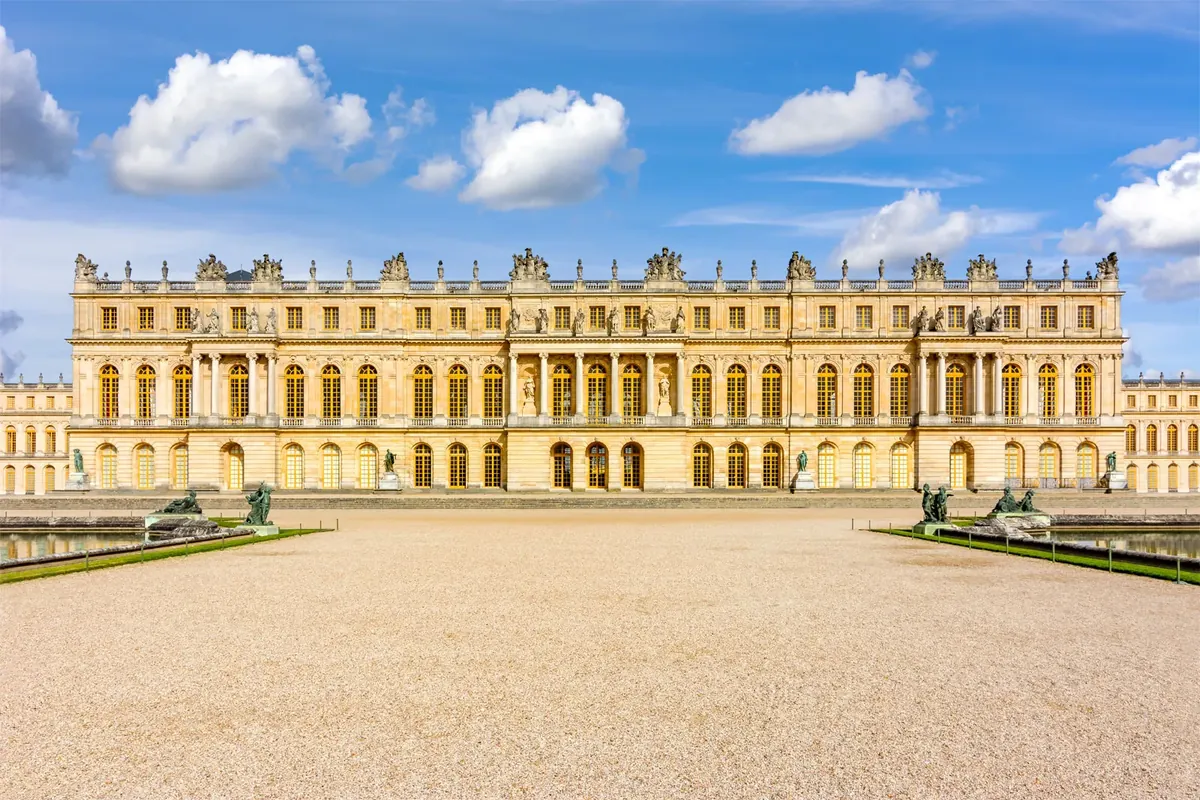
Versailles is the residence Louis XIV transformed from his father's hunting lodge between 1661 and 1715, recruiting the architect Louis Le Vau, the painter Charles Le Brun and the gardener André Le Nôtre, the same trio Fouquet had hired for Vaux-le-Vicomte three years earlier. The Hall of Mirrors, the King's State Apartments, and the formal gardens beyond are the canonical visit. The Estate spreads over more than 800 hectares and includes the Trianon palaces and Marie-Antoinette's hamlet, both worth a half-day of their own.[17]
It is also the most visited château in Europe: 8.4 million visitors in 2024 according to the official rapport annuel, with 4.4 million through the palace itself.[3] Under French heritage law (Article L621-36 of the Code du patrimoine), Versailles is one of the domaines nationaux, state property that is inalienable and cannot be sold under any circumstance.[4]
Practical: open Tuesday to Sunday 09:00–18:30, closed Mondays. Passport ticket (full estate) €35 / €32 for EEA residents; Trianon-only €15. Free for under 18 and EEA residents under 26. From central Paris, RER C to Versailles Château–Rive Gauche, ~40 minutes. Plan your visit.[3]
2. Mont-Saint-Michel
Normandy Daily, year-round Pilgrim's tidal island Map
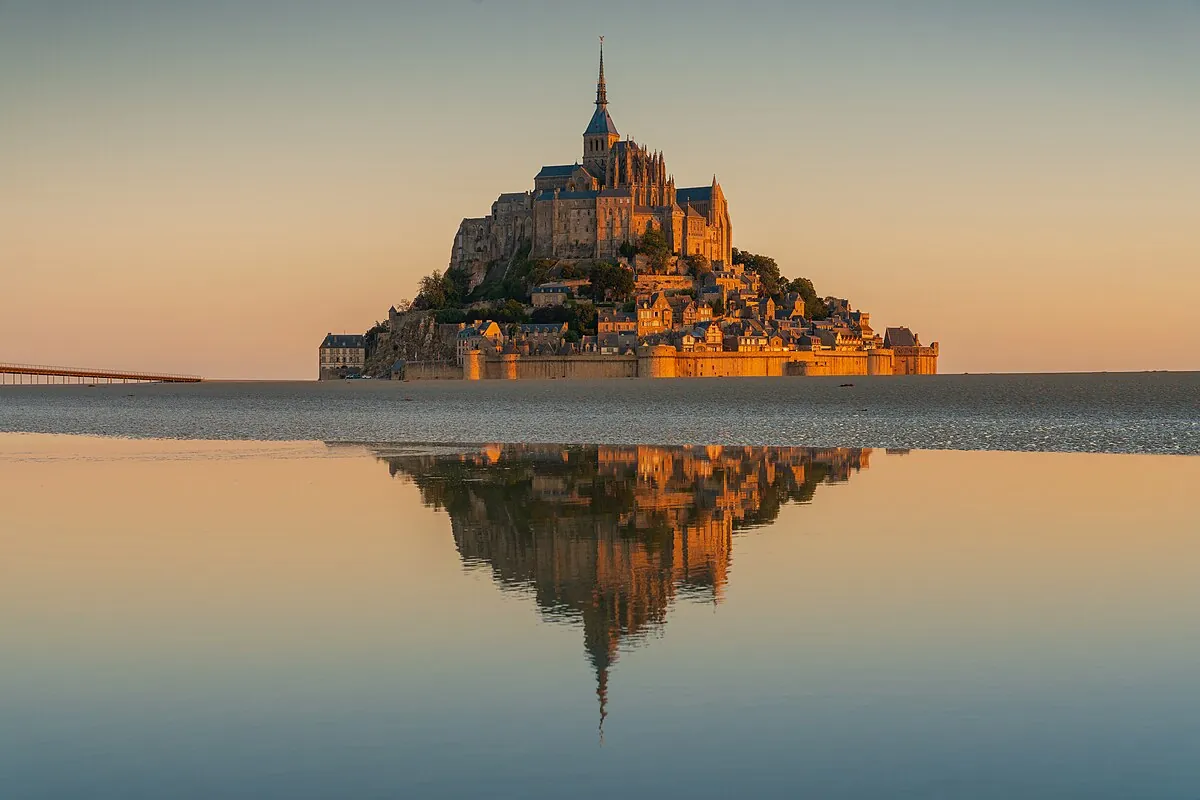
The granite islet rising off the Norman coast was a place of Christian pilgrimage from the 8th century, when Bishop Aubert of Avranches founded the original sanctuary. The Romanesque abbey church and Gothic Merveille monastic buildings were added between the 11th and 13th centuries. Tides isolate the Mount from the mainland twice daily, which gave it a defensive role through the Hundred Years' War: English forces besieged it repeatedly between 1424 and 1434 and never took it.
The visit climbs the Grande Rue (a steep medieval street lined with shops and restaurants) to the abbey at the summit. The abbey church, the Knights' Hall, the cloister and the refectory are the key interiors. The walk back down at low tide, with the bay opening to the horizon, is the experience that makes the trip.
Practical: abbey open daily, year-round (closed 1 Jan, 1 May, 25 Dec). Adult €13, free under 18 and EEA 18–25. The town and ramparts are free; only the abbey is ticketed. From Paris, TGV Montparnasse to Rennes (~2h), then connecting bus or train to the Mount; allow a full day. Abbey official site.[5]
3. Château de Chambord
Loire Valley Daily, year-round Loire Valley jewel Map
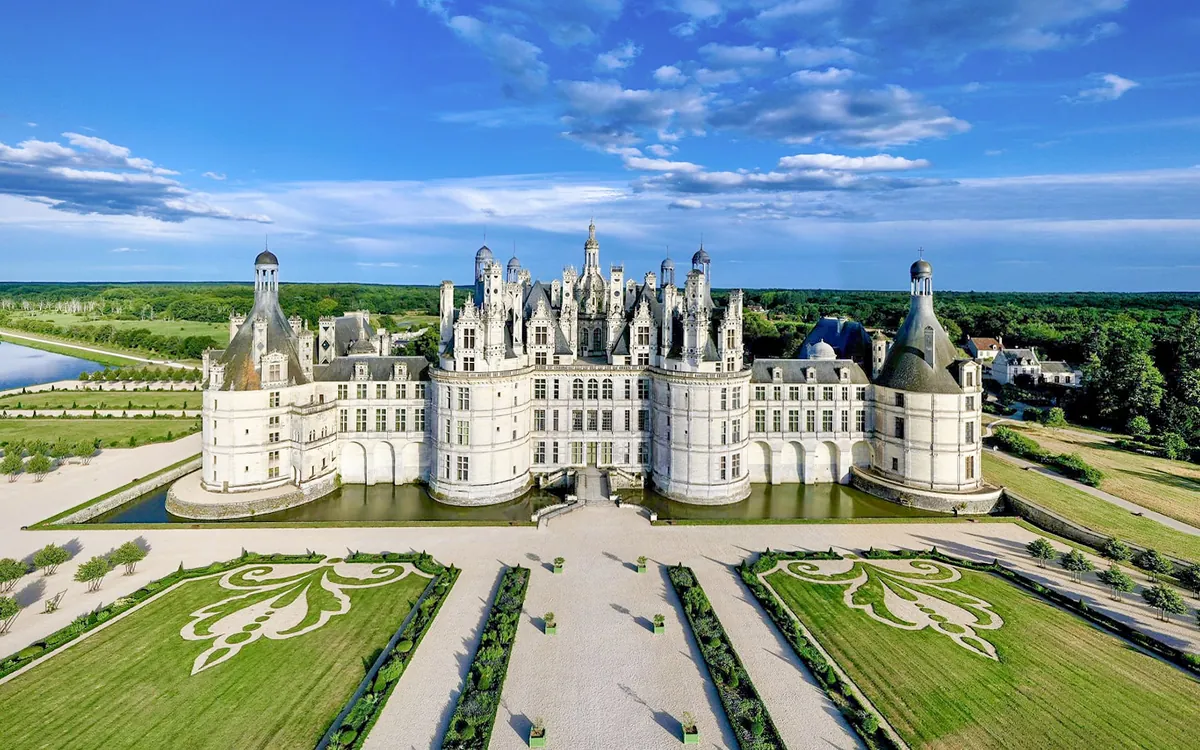
The largest château in the Loire Valley and the architectural high-water mark of François I's reign. Construction began under François I in 1519 and continued for decades.[7] The principal architect was Pierre Nepveu, working from a brief that included a famous double-revolution central staircase at the heart of the building, often (without firm evidence) credited to Leonardo da Vinci. Leonardo had lived nearby at the Clos Lucé in Amboise for the last three years of his life, dying in May 1519.[6]
The hunting reserve surrounding the château, the Domaine national de Chambord, covers 54 square kilometres, the largest enclosed forest park in Europe.[7] Stags, wild boar and roe deer roam an estate the size of central Paris. Like Versailles, Chambord is a domaine national and cannot be sold.[4]
Practical: open daily, year-round, 09:00–17:00 (winter) / 09:00–18:00 (summer). Adult €16, free under 18 and EEA 18–25. From Paris, TGV from Austerlitz or Montparnasse to Blois-Chambord, then shuttle bus or taxi to the château (about 18 km from Blois). The wider Domaine is free to enter. Plan your visit.[7]
4. Château de Chenonceau
Loire Valley (Indre-et-Loire) Daily, year-round Renaissance ladies' château Map
Built in 1515 by Thomas Bohier, finance minister of Normandy under François I, Chenonceau bridges the River Cher: the building "is moored like a ship in the rapidly running Cher", with the river flowing under its foundations and through arches that double as a moat.[6] The structure was extended over the river in 1556–1559 by Diane de Poitiers (mistress of Henri II), then taken back and finished by Catherine de' Medici after Henri's death: the reason it is known as the château des dames, the ladies' château.
The bridging gallery on two levels, the Renaissance gardens of Diane and Catherine on either side of the river, and the formal kitchens in the bridge piers are the visit. Chenonceau served as a military hospital during the First World War and as an escape route across the demarcation line during the Second; the gallery sat on the boundary between Vichy France and German-occupied territory.
Practical: open daily, all year. Adult €16; child (7–18) €13; under 7 free. Audio-guide €5 extra. From Paris, TGV Montparnasse to Tours (~1h15), then TER train to Chenonceaux station (180 m walk). Plan your visit.[8]
5. Cité de Carcassonne
Languedoc (Aude) Daily, year-round Medieval walled stronghold Map
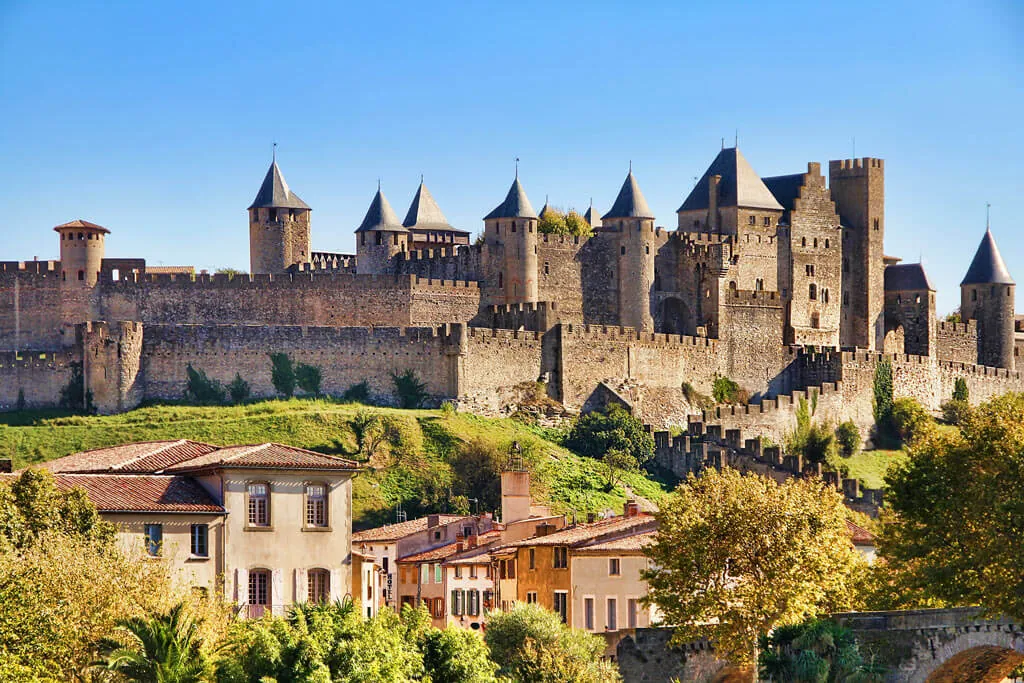
The double-walled medieval citadel above the modern town of Carcassonne is the largest fortified city in Europe: around 52 towers across two concentric ramparts spanning roughly 3 km. The site was a Roman castrum before the Cathar wars; under Louis IX (Saint Louis) and his son Philippe III, the inner walls and the Comtal Castle were rebuilt as a southern bulwark of the kingdom. The 19th-century architect Eugène Viollet-le-Duc led the restoration that gave the towers their now-iconic conical roofs, a reconstruction that some heritage purists still argue with.[9]
The Cité is a living town: about 50 residents, plus shops, hotels and restaurants inside the walls. The Comtal Castle and the ramparts walk are ticketed; the streets, the basilica and the views over the lower town are free.
Practical: Comtal Castle open daily 09:30–17:00 (Oct–Mar) / 10:00–18:30 (Apr–Sep), closed 1 Jan, 1 May, 1 Nov, 11 Nov, 25 Dec. Adult €13, free under 18 and EEA 18–25. From Paris, TGV from Gare de Lyon to Carcassonne (~5h30 direct or via Montpellier). Official site.[10]
6. Château d'Amboise
Loire Valley (Indre-et-Loire) Daily, year-round Royal Loire stronghold Map
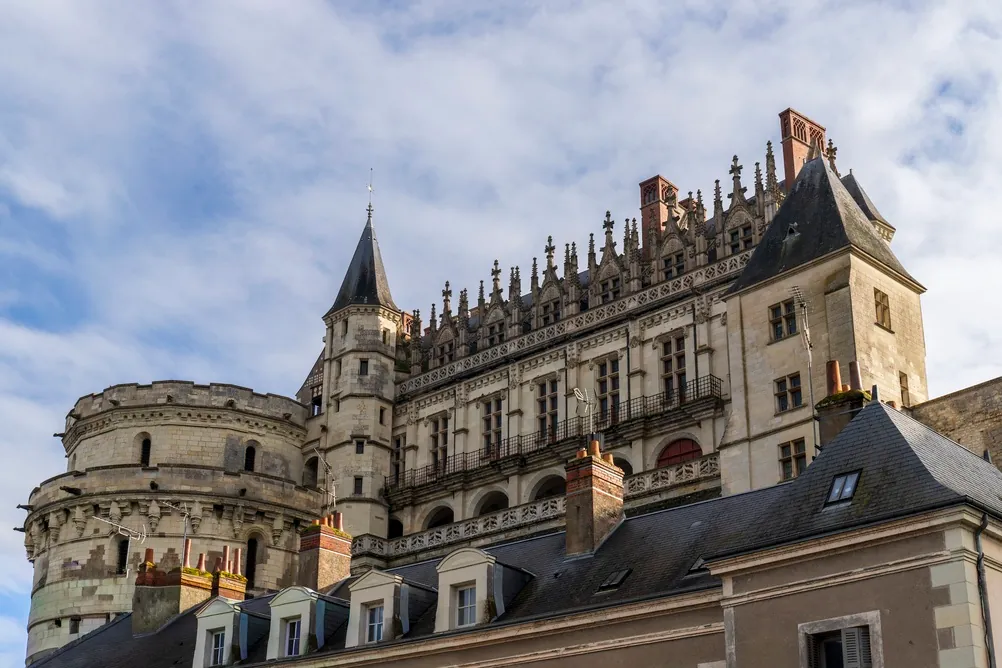
Amboise existed as the Roman Ambatia in the 4th century. Charles VII brought it under the French Crown in 1434; Charles VIII was born here and died here in 1498, striking his head on a low door lintel. François I spent his childhood at Amboise and later invited Leonardo da Vinci to nearby Clos Lucé in 1516; Leonardo is buried in the Saint-Hubert chapel within the castle grounds.[6]
The royal apartments, the Chapel of Saint-Hubert with Leonardo's tomb, and the round Tour des Minimes (wide enough for a horseman to ride to the top) are the canonical visit. The terraces above the Loire give the long view downstream toward Tours.
Practical: open daily, year-round. Adult €17; child (7–18) €11; under 7 free. From Paris, TGV from Gare Montparnasse to Saint-Pierre-des-Corps (1h05), TER connection to Amboise (15 min). Plan your visit.[11]
7. Château de Fontainebleau
Île-de-France (Seine-et-Marne) Closed Tuesdays Royal residence to 8 dynasties Map
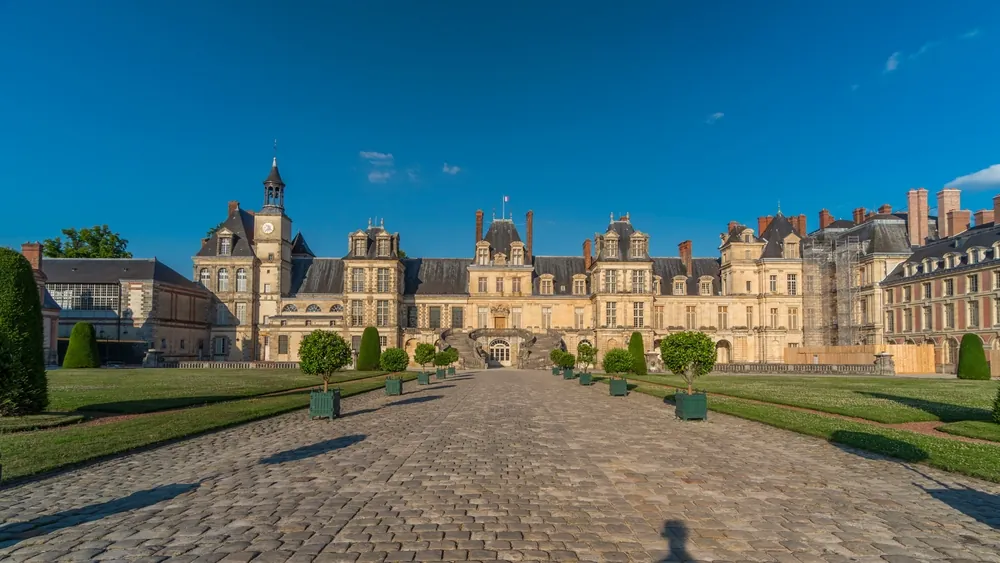
The official site frames Fontainebleau as "900 years of history" as a royal residence: a 1,500-room château built up across centuries by successive monarchs and added to UNESCO World Heritage in 1981.[12] The medieval keep survives at the core; François I added the Renaissance galleries in the 1530s, Henri IV the courtyards, Louis XV the apartments, and Napoleon I the Throne Room and the courtyard where he abdicated in 1814. The cumulative effect is a single building documenting nine centuries of French royal taste.
The Grands Appartements, the Galerie François I, the Napoleon I Museum and the courtyards are the visit. The 130-hectare park is free and open from dawn, a useful early-morning lap before the château opens.
Practical: open Wednesday–Monday, closed Tuesdays. Apr–Sep 09:30–18:00; Oct–Mar 09:30–17:00. Closed 1 Jan, 1 May, 25 Dec. Adult €17, concession €15. Free under 18 and EEA 18–25. From Paris, SNCF Transilien R from Gare de Lyon to Fontainebleau-Avon (~40 min), then bus 1 to the château. Plan your visit.[12]
8. Château de Vaux-le-Vicomte
Île-de-France (Maincy, Seine-et-Marne) Mid-Mar to Nov Inspiration for Versailles Map
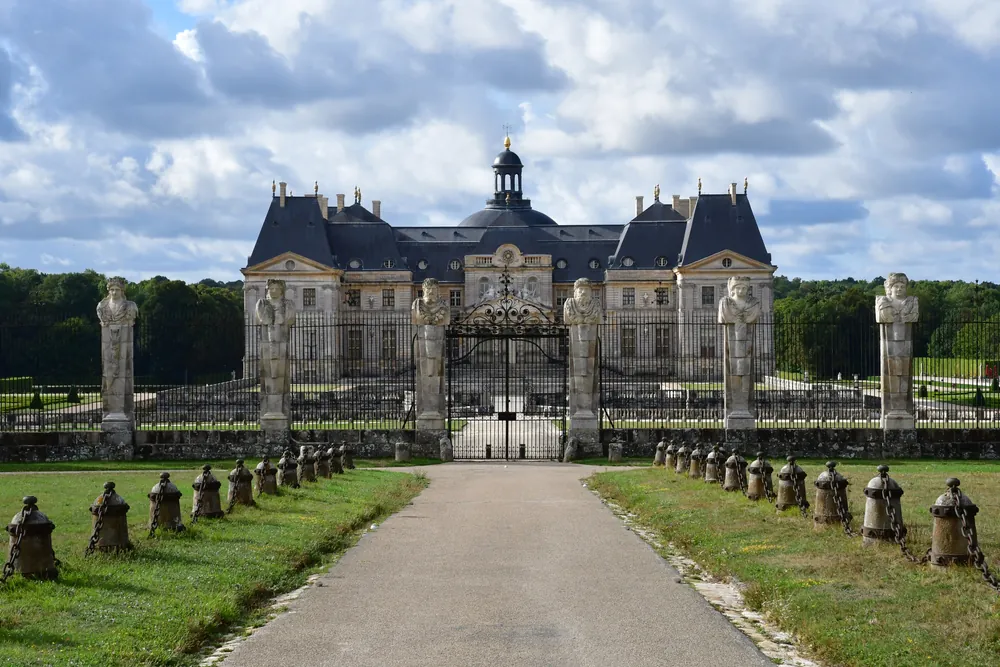
Built between 1658 and 1661 for Nicolas Fouquet, Louis XIV's superintendent of finances, by the architect Louis Le Vau, the painter Charles Le Brun and the gardener André Le Nôtre. Fouquet hosted Louis XIV at the inaugural fête in August 1661; within three weeks the king arrested him for embezzlement, imprisoned him for life, and recruited the same three artists to build Versailles. Vaux-le-Vicomte is, in literal terms, the prototype.
The château is privately owned (the Comte Patrice de Vogüé family has held it since 1875) and runs a season of evening events that the state-owned châteaux rarely match. The candlelit Saturday openings, May to September, light the rooms with 2,000 candles and the gardens with thousands more; widely regarded as the single best evening experience in any French château.[13]
Practical: open mid-March to early November, daily 10:00–17:30. Closed in winter. Adult €18, concession €14.50, gardens-only €13.50, family (2 adults + 2–3 kids) €59. Candlelit evenings €22. From Paris, SNCF R from Gare de Lyon to Melun (~25 min), then Châteaubus shuttle or taxi (~10 min) to the château. Plan your visit.[14]
At a glance
| Castle | Region | When to go | |
|---|---|---|---|
| Château de VersaillesSun King's seat | Île-de-France | Closed Mondays |
| Mont-Saint-MichelPilgrim's tidal island | Normandy | Daily, year-round |
| Château de ChambordLoire Valley jewel | Loire Valley | Daily, year-round |
| Château de ChenonceauRenaissance ladies' château | Loire Valley (Indre-et-Loire) | Daily, year-round |
| Cité de CarcassonneMedieval walled stronghold | Languedoc (Aude) | Daily, year-round |
| Château d'AmboiseRoyal Loire stronghold | Loire Valley (Indre-et-Loire) | Daily, year-round |
| Château de FontainebleauRoyal residence to 8 dynasties | Île-de-France (Seine-et-Marne) | Closed Tuesdays |
| Château de Vaux-le-VicomteInspiration for Versailles | Île-de-France (Maincy, Seine-et-Marne) | Mid-Mar to Nov |
How many castles are in France?
The widely cited figure is over 19,000 protected châteaux, drawn from the Ministry of Culture's Inventaire général du patrimoine culturel, a national heritage register that classifies and inscribes castles, manor houses and historic estates.[2] Some carry the Monument historique (MH) designation, the higher protection class that brings preservation obligations and tax-deductibility for restoration spend.
Public access is the smaller question. The Demeure Historique, the umbrella body for privately-owned châteaux open to visitors, lists more than 400 properties.[1] Several hundred more are state- or municipally-operated and ticketed daily. The remainder are private homes: sometimes ruined, sometimes inhabited, very rarely open. Fenwick's 1976 estimate of "well over 5,000" châteaux still tracks if you exclude minor manor houses; the upper figure of 19,000 reflects the broader heritage definition.[1]
Famous, medieval, Gothic and largest
Famous. The eight above account for the bulk of search demand. Versailles, Mont-Saint-Michel and Chambord lead by visitor numbers; Carcassonne, Chenonceau and Fontainebleau follow. Vaux-le-Vicomte is less crowded than its peers and the better evening experience.
Medieval. Mont-Saint-Michel, Carcassonne and the Cité de Carcassonne's Comtal Castle are the strongest survivors of the medieval era as standalone visits. Château de Vincennes, in the eastern suburbs of Paris, holds "the best-preserved and tallest keep in Europe", built by Philippe VI of Valois in the 14th century, and where the Auld Alliance between France and Scotland was formally signed in 1326.[15] The castles of Loches, Saumur and Angers, all in the Loire region, complete a medieval-only itinerary.
Gothic. The Merveille of Mont-Saint-Michel (the 13th-century three-storey Gothic monastic complex on the north flank of the abbey) is the canonical example. Pierrefonds in Picardy, restored by Viollet-le-Duc for Napoleon III in the 1850s–80s, is a 19th-century reimagining of a Gothic fortress and reads as such; opinions on the restoration are mixed.
Largest. Chambord is the largest château in the Loire Valley. Carcassonne is the largest fortified medieval city in Europe, with around 3 km of double walls. The Versailles Estate spreads over more than 800 hectares, making it the largest royal estate in Europe by area.[17]
If you're looking to buy
The French private-château market is the deepest in Europe. Castle Collector's Castle Price Index (March 2026) tracks 945 verified listings with confirmed price and floor area: a median of €1.7m for the typical asking and €2,285 per square metre at country level.[16] Two factors make this number misleading at the entry tier. Most buyers spend more on restoration than on purchase, and the size discount is steep: properties over 5,000 m² index at €515/m², roughly one-fifth the rate of the under-500 m² band.
If you're seriously looking, the castles for sale in France page tracks current listings against this benchmark. Transaction costs add 7–8% (notary fees, transfer tax, stamp duty); foreign buyers face no restrictions; closing typically runs three to six months. For the operational side (surveys, restoration budgeting, foreign-buyer mechanics) see our guide to buying a castle.
Sources
1. Fenwick, H. The Chateaux of France. Robert Hale & Company, 1976; pp. 2, 19, 42.
2. French Ministry of Culture, Inventaire général du patrimoine culturel.
3. Versailles Rapport Annuel 2024 (PDF).
4. Code du patrimoine, Partie législative, Articles L621-36, L621-41 (consolidated text). Légifrance / Journal officiel.
5. Mont-Saint-Michel, Centre des monuments nationaux official site.
6. Mansfield, M. F. Castles and Châteaux of Old Touraine and the Loire Country. L. C. Page & Company, Boston, 1906 (archive.org).
7. Domaine national de Chambord, official site.
8. Château de Chenonceau, official site.
9. Cité de Carcassonne / Remparts, Centre des monuments nationaux.
10. Centre des monuments nationaux, Carcassonne tickets and hours.
11. Château Royal d'Amboise, official site.
12. Château de Fontainebleau, official site. Heritage framing ("900 years of history", 1,500-room château, UNESCO 1981) at
13. Vaux-le-Vicomte official site, events.
14. Vaux-le-Vicomte official site, visitor information.
15. Fenwick, op. cit., p. 290.
16. Castle Collector, Castle Price Index, March 2026 edition.
17. Château de Versailles official site, Discover the Estate.