
What Are the Most Beautiful Castles in France? 15 Châteaux Worth Visiting
Renaissance pleasure palaces. Medieval fortresses. Cathar mountain strongholds. France claims 45,000 châteaux. These fifteen stand apart.
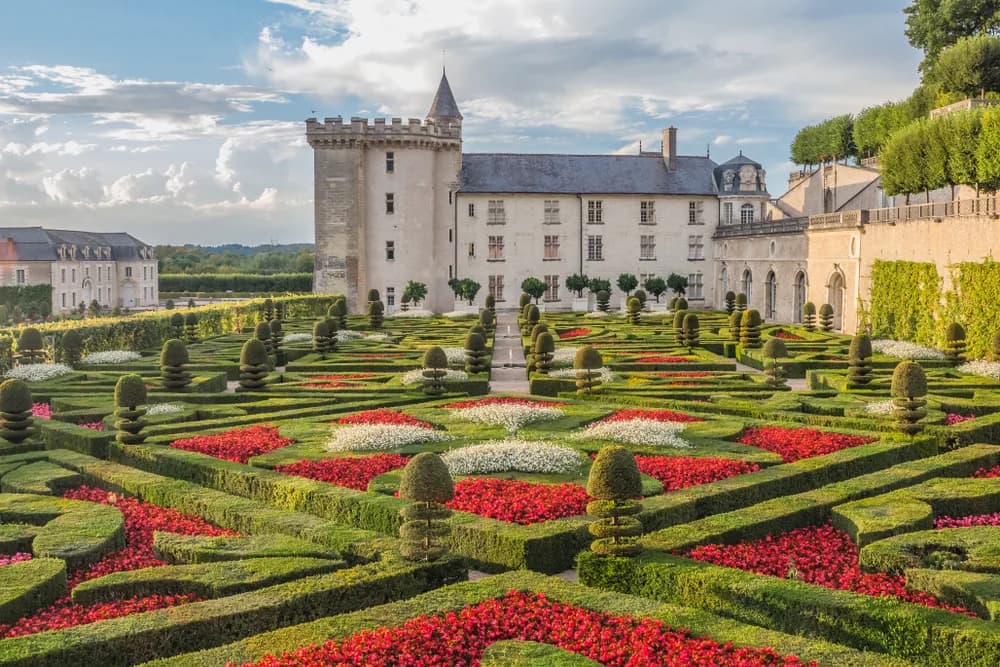
France claims more châteaux than any nation in Europe - approximately 45,000 across its regions, from fortified medieval strongholds to Renaissance masterworks designed for pleasure rather than defence.
The Loire Valley alone holds over 300, a concentration unmatched anywhere in the world. Renaissance kings shaped this landscape: François I commissioned Chambord with 440 rooms; Catherine de Medici extended Chenonceau across the River Cher. In the south, Cathar fortresses occupy Pyrenean ridgelines where medieval conflicts determined the fate of entire cultures. Near Paris, Versailles remains the definitive expression of royal ambition.
What follows are 15 French châteaux of particular distinction - from state-owned UNESCO landmarks receiving millions of visitors annually to clifftop ruins accessible only by foot.
1. Château de Chambord
Location:
Chambord, Loir-et-Cher, Centre-Val de Loire
| Built:
1519–1547
| Visitors:
1.2 million annually (2024)
| Entry:
€13
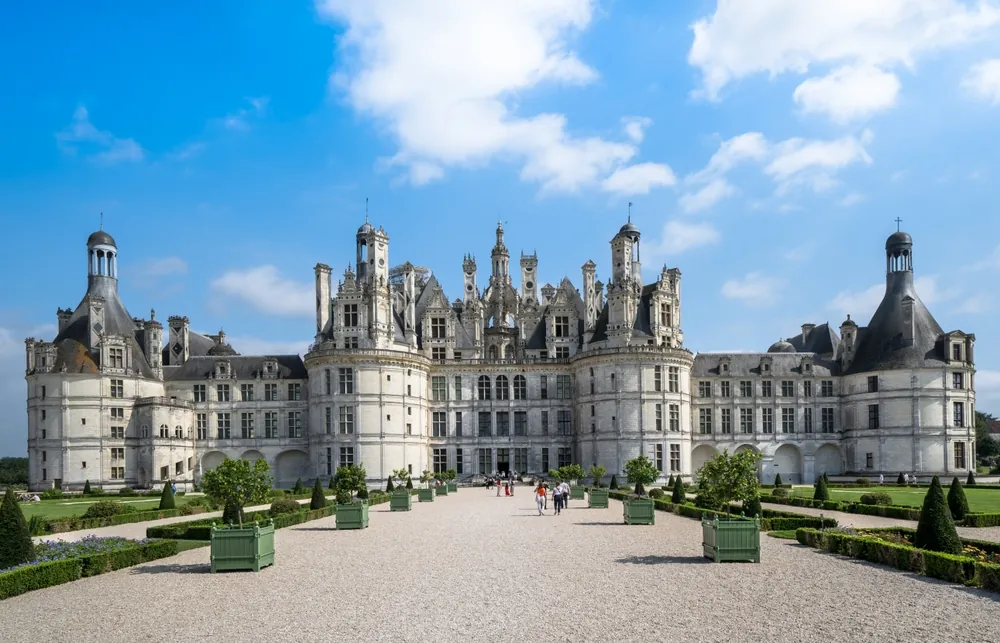
Chambord is the largest and most ambitious Loire Valley château, featuring 440 rooms, 365 fireplaces, and a double-helix staircase attributed to Leonardo da Vinci's influence.
The Château de Chambord stands as the largest and most ambitious of the Loire Valley châteaux, commissioned by François I as a royal hunting lodge yet constructed on a scale rivaling any European palace. The statistics alone convey its magnitude: 440 rooms, 365 fireplaces, 84 staircases, and a surrounding estate of 5,440 hectares enclosed by a 32-kilometer wall.
The château's architectural centerpiece remains its double-helix staircase, an engineering marvel attributed to Leonardo da Vinci's influence. Two intertwined spirals allow individuals ascending and descending to glimpse one another through openings yet never cross paths. François I invited Leonardo to France in 1516, and though the artist died in 1519 before construction began, his notebooks contain designs for similar staircases.
Despite its grandeur, François I spent only 72 days at Chambord during his entire reign. The château's roofscape, featuring 11 types of towers and three distinct chimney designs, was conceived as an architectural spectacle visible from the surrounding forest. Construction required 1,800 workers and 220,000 tons of stone over nearly three decades.
Chambord achieved UNESCO World Heritage status in 1981 and surpassed one million annual visitors for the first time in 2017. The château remains state property, administered by a public establishment since 2005.
2. Château de Chenonceau (Château des Dames)
Location:
Chenonceaux, Indre-et-Loire, Centre-Val de Loire
| Built:
1514–1576
| Visitors:
900,000 annually
| Entry:
€15
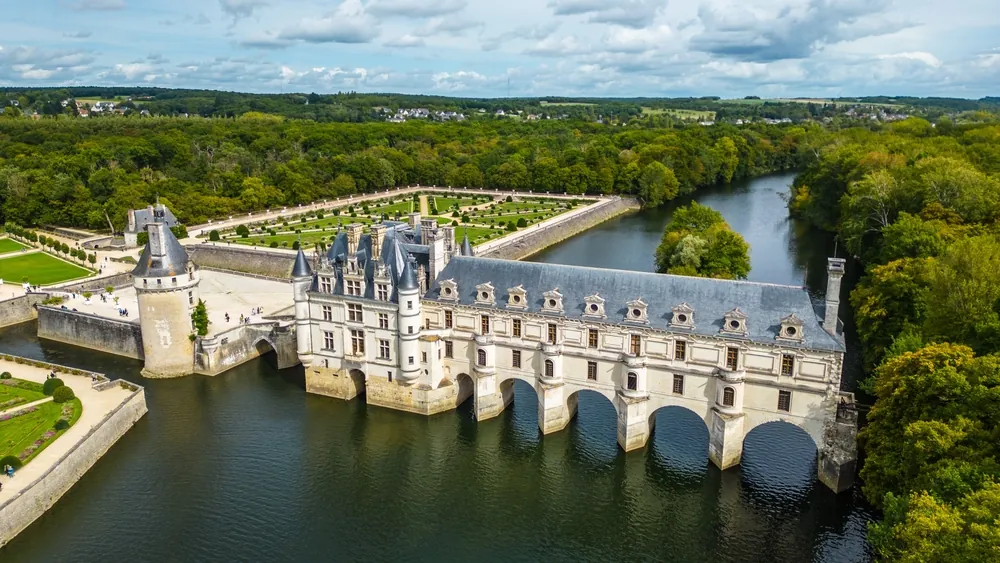
Chenonceau earned this title through its succession of influential female owners, including Diane de Poitiers and Catherine de Medici, who shaped its distinctive architecture spanning the River Cher.
Known as the "Château des Dames" for its succession of influential female owners, Chenonceau presents one of France's most recognizable silhouettes: a Renaissance château spanning the River Cher on a series of graceful arches. After Versailles, it ranks as the most visited château in France.
The original structure was built between 1514 and 1522 by Katherine Briçonnet on the foundations of a former mill. Diane de Poitiers, mistress of Henri II, later commissioned Philibert de l'Orme to design the bridge spanning the river (1556–1559), while Catherine de Medici added the two-storey gallery along its length following Diane's forced departure. This gallery, 60 meters long with 18 windows, remains Chenonceau's defining architectural feature.
The château's position over the river proved consequential during the French Revolution, when its owner Louise Dupin convinced revolutionary authorities to spare the building by arguing it served as the only bridge across the Cher for many leagues. During both World Wars, the gallery functioned as a hospital and, during the Occupation, as an escape route: the south door opened into Vichy France, the north into German-occupied territory.
The Menier family, of chocolate manufacturing fortune, has owned Chenonceau since 1913. It remains privately held and entirely self-financing. A dedicated floral workshop creates fresh arrangements for every room throughout the year.
3. Palace of Versailles
Location:
Versailles, Yvelines, Île-de-France
| Built:
Late 17th century
| Visitors:
8.4 million annually (
2024)
| Entry:
€32 (rising to €35 for non-EU visitors, January 2026)
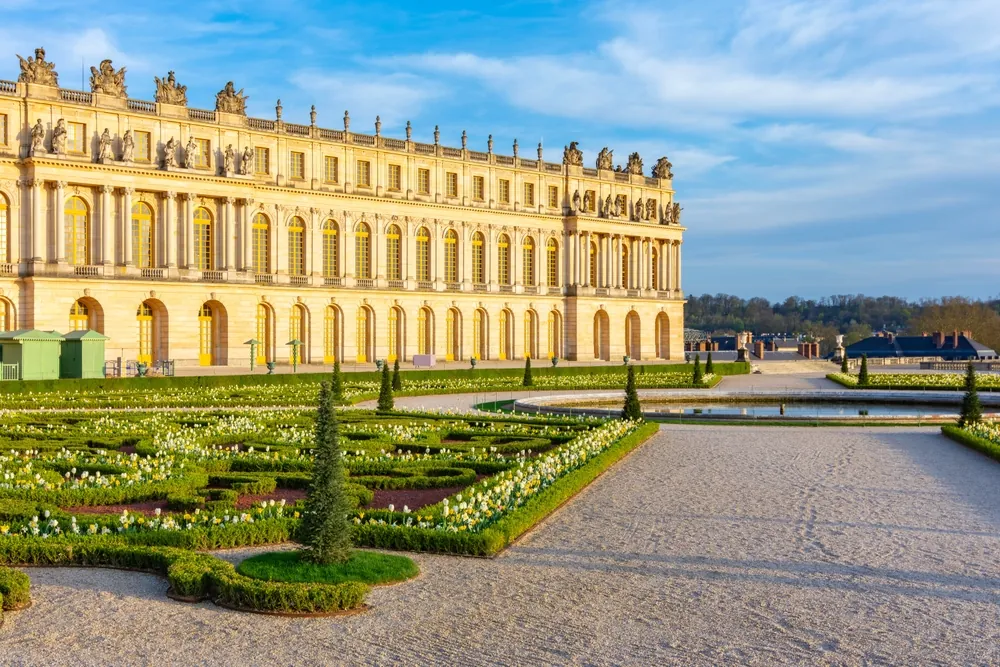
Versailles remains France's most visited château at 8.4 million visitors annually, and the Hall of Mirrors, 800-hectare gardens, and Marie Antoinette's Petit Trianon justify the admission price of €32.
The Palace of Versailles transcends the category of château to represent the architectural embodiment of absolute monarchy. What began as Louis XIII's hunting lodge was transformed by his son, Louis XIV, into an 800-hectare estate that housed the French court from 1682 until the Revolution of 1789.
The Hall of Mirrors remains the palace's most celebrated interior: 357 mirrors arranged opposite 17 arched windows overlooking the gardens, illuminated by chandeliers holding thousands of candles during the ancien régime. The Treaty of Versailles, ending the First World War, was signed here in 1919.
Marie Antoinette's Petit Trianon and accompanying Hameau (hamlet) offer insight into the queen's attempts to escape court protocol. The miniature Norman village, complete with working farm, provided a retreat where she could assume the guise of a simple shepherdess.
The gardens, designed by André Le Nôtre, extend across 800 hectares and include 50 fountains, the Grand Canal, and meticulously geometric parterres. John D. Rockefeller Jr. funded significant restoration work between 1925 and 1928, contributing $2.166 million (approximately $38 million in 2024 values).
Versailles welcomes approximately 30,000 visitors daily during peak season, with 83% of visitors arriving from abroad. American visitors constitute 15% of foreign attendance, followed by Chinese and Italian tourists at 6% each.
4. Villandry's Gardens
Location:
Villandry, Indre-et-Loire, Centre-Val de Loire
| Built:
Early 16th century
| Visitors:
330,000 annually
| Entry:
€11 (château and gardens), €7 (gardens only)
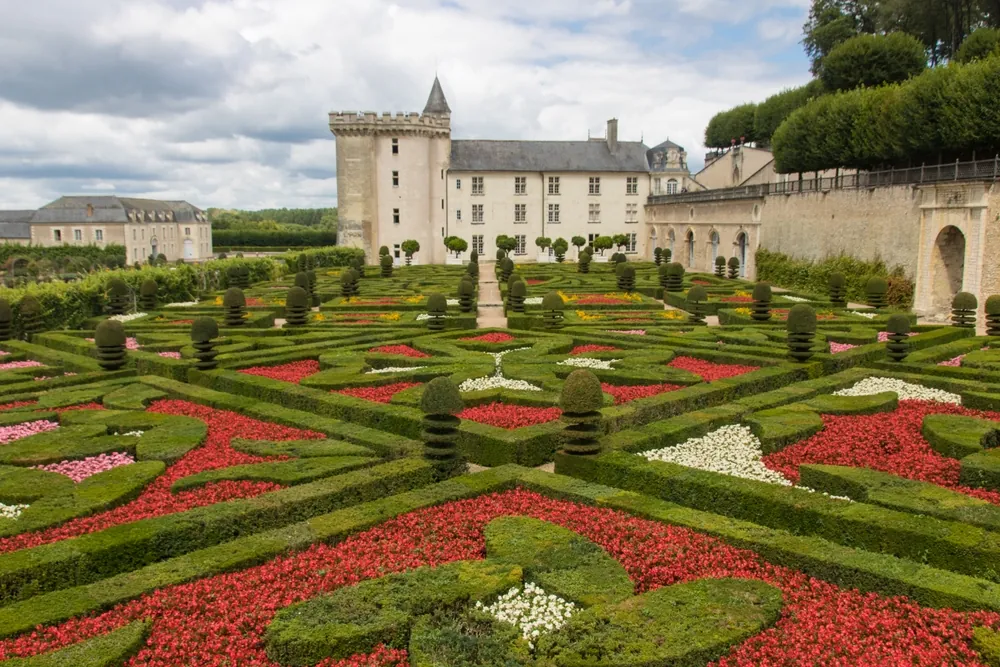
Villandry is renowned for its six distinct Renaissance-style gardens covering nine hectares, including the Ornamental Garden with geometric hedges symbolizing four forms of love and a Kitchen Garden following medieval monastic traditions.
Villandry represents the last of the great Renaissance châteaux constructed in the Loire Valley, yet its international reputation derives primarily from its extraordinary gardens, restored and reimagined in the early 20th century.
The château was built around 1532 by Jean Le Breton, François I's finance minister. By the early 1900s, however, the property had declined significantly. In 1906, Joachim Carvallo, a Spanish medical researcher, and his wife Ann Coleman, an American heiress, purchased the estate and dedicated their lives to restoring its gardens according to Renaissance principles.
Six distinct garden areas now cover nine hectares. The Ornamental Garden presents geometric box hedges arranged to symbolize four forms of love: passionate, tender, fickle, and tragic. The Kitchen Garden, organized in nine equal squares, follows medieval monastic traditions where vegetables held symbolic meanings. The Water Garden centers on a Louis XV-style pond, while the Sun Garden uses yellow and orange plantings around a star-shaped fountain.
Ten gardeners maintain Villandry using entirely organic methods. The estate holds certification from the Ligue pour la Protection des Oiseaux (League for Bird Protection) as a nature refuge. The on-site restaurant, La Doulce Terrasse, incorporates produce from the kitchen garden.
5. Château Royal de Blois
Location:
Blois, Loir-et-Cher, Centre-Val de Loire
| Built:
13th–17th centuries
| Visitors:
280,000 annually
| Entry:
€14
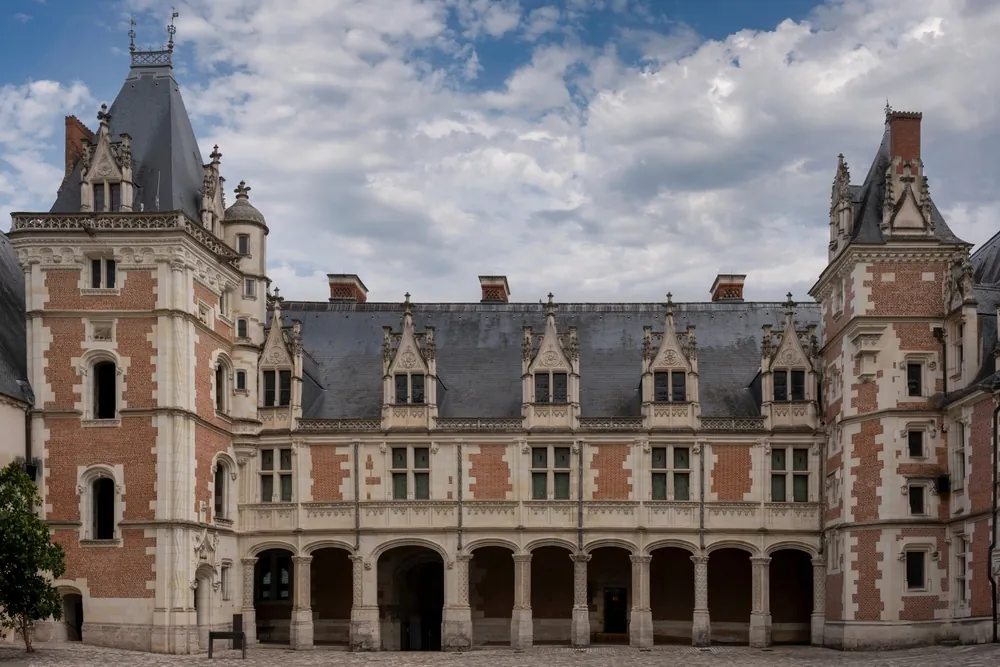
Blois presents four distinct wings from four different eras—medieval, Gothic, Renaissance, and Classical—because seven kings and ten queens resided here across four centuries, each adding to the complex.
The Château Royal de Blois presents a singular architectural education: four distinct wings surrounding a central courtyard, each representing a different era of French architecture. Medieval remains from the 13th century adjoin the Gothic wing of Louis XII, the Renaissance masterwork of François I, and the Classical addition of Gaston d'Orléans.
Seven kings and ten queens of France resided at Blois, and the château witnessed some of the most dramatic events in French history. In 1588, Henri III ordered the assassination of his rival Henri, Duke of Guise, within these walls. In 1619, Marie de Medici escaped from her imprisonment here by climbing from a window, a scene recreated annually in the château's sound and light show.
The François I wing features an ornamental spiral staircase projecting into the courtyard, designed to allow the king and court to display themselves while ascending. Joan of Arc received a blessing at Blois in 1429 before departing to relieve the siege of Orléans.
Classified as a historic monument since 1845, Blois was among the first French buildings to receive such protection. The château now houses the Musée des Beaux-Arts, with works by Rubens, Ingres, and Boucher. HistoPad tablets provide augmented reality experiences throughout the visit.
6. Château d'Amboise
Location:
Amboise, Indre-et-Loire, Centre-Val de Loire
| Built:
15th century
| Entry:
€12
Leonardo da Vinci is buried at the Chapel of Saint-Hubert within Château d'Amboise. He spent his final years nearby at Clos Lucé as a guest of François I and died on 2 May 1519.
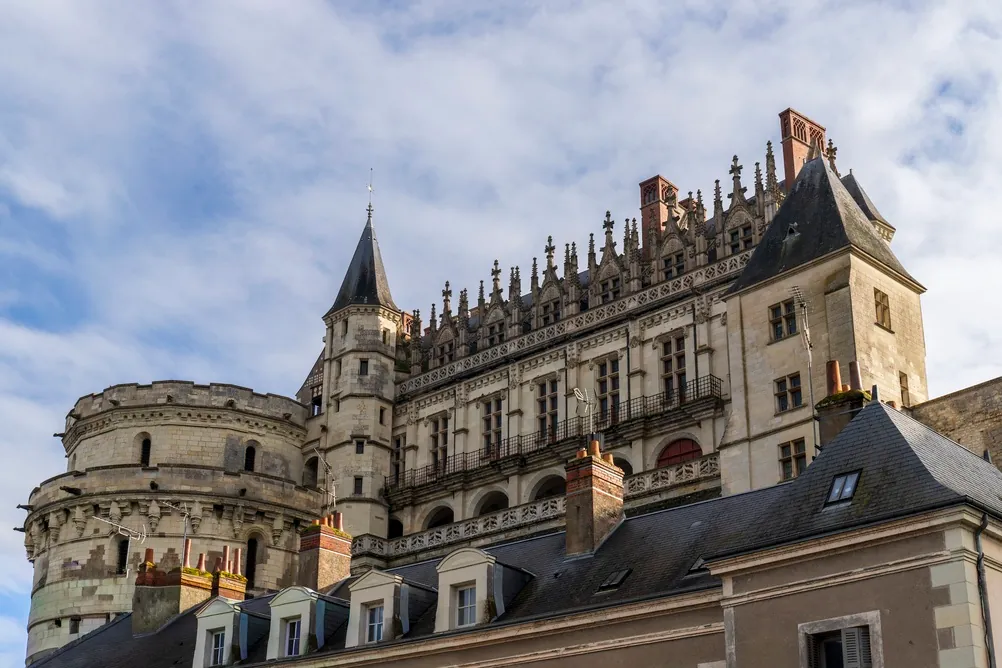
The Château d'Amboise occupies a commanding position above the Loire, its medieval and Renaissance structures rising from a rocky promontory that has been fortified since Roman times. François I spent his childhood here, and the château served as the primary royal residence before the court's eventual move to Blois and later Versailles.
The Chapel of Saint-Hubert, a jewel of Flamboyant Gothic architecture, contains the presumed tomb of Leonardo da Vinci. The Italian master spent his final years at the nearby manor of Clos Lucé as a guest of François I, connected to Amboise by an underground passage. Leonardo died on 2 May 1519, and while his original burial site was destroyed during the Revolution, remains believed to be his were transferred to Saint-Hubert in 1863.
The château's history includes tragedy: Charles VIII died here in 1498 after striking his head on a door lintel while rushing to watch a tennis match. The Amboise conspiracy of 1560, an attempted Protestant coup against the young François II, resulted in mass executions from the château's balconies and iron hooks.
7. Clos Lucé
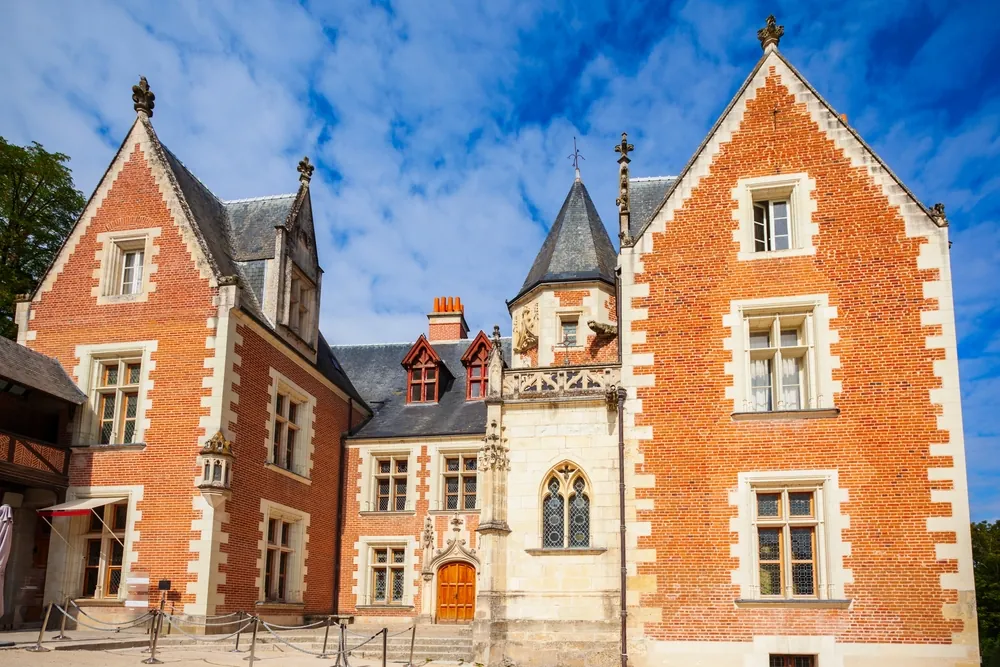
Clos Lucé, where Leonardo da Vinci lived from 1516 until his death in 1519, welcomes 450,000 visitors annually. The seven-hectare park contains full-scale models of his inventions that visitors can operate.
This intimate pink brick manor served as Leonardo da Vinci's final residence from 1516 until his death in 1519. François I granted the property to Leonardo along with an annual pension of 700 gold écus and the title "Premier Painter, Engineer and Architect of the King."
Leonardo arrived in France at age 64, accompanied by his pupil Francesco Melzi, his servant Battista de Villanis, and three paintings he could not bear to part with: the Mona Lisa, the Virgin and Child with Saint Anne, and Saint John the Baptist. All three now hang in the Louvre.
The seven-hectare park contains full-scale models of Leonardo's inventions, including his designs for a tank, a helicopter, and a paddle boat.
Visitors can operate many of these machines, providing tangible connection to the inventor's imagination. The manor house displays period-furnished rooms and reproductions of Leonardo's anatomical drawings and engineering sketches.
8. Château de Chantilly
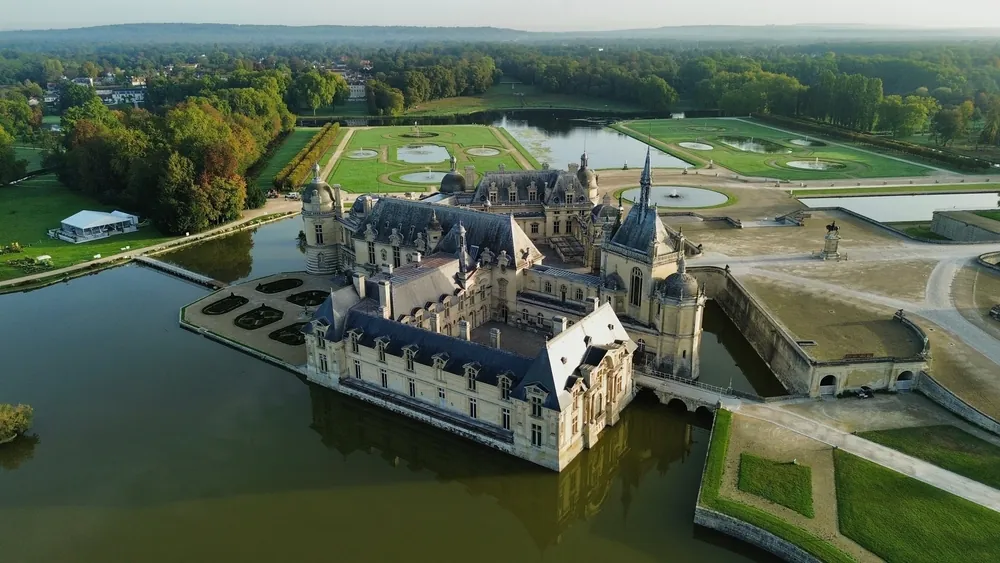
Château de Chantilly houses the Musée Condé with 800 works by Raphael, Botticelli, Poussin, and others—France's second-largest collection of antique paintings. The Duke of Aumale's will forbids loaning any works to other institutions.
Situated 50 kilometers north of Paris, Chantilly houses the Musée Condé, France's second-largest collection of antique paintings after the Louvre. The 800 works include masterpieces by Raphael, Botticelli, Poussin, Watteau, and Ingres, displayed according to the precise specifications laid down by Henri d'Orléans, Duke of Aumale, who bequeathed the estate to the Institut de France in 1889.
The Duke's will contains strict conditions: the collection may never be loaned to other institutions, and the arrangement of works must remain unchanged. This legal constraint means Chantilly's galleries retain their 19th-century salon-style hanging, with paintings arranged by decorative effect rather than chronological or geographical organisation.
The library holds 1,500 manuscripts, including the Très Riches Heures du Duc de Berry, the most celebrated illuminated manuscript of the Middle Ages. The 115-hectare park, designed by André Le Nôtre, includes a Hameau (hamlet) that inspired Marie Antoinette's retreat at Versailles.
The Grandes Écuries (Great Stables), built in 1719 for Louis Henri, Duke of Bourbon, who believed he would be reincarnated as a horse, now house the Living Museum of the Horse with daily equestrian demonstrations. The Aga Khan donated €40 million in 2008 toward ongoing restoration, part of an estimated €70 million required for the estate's preservation.
9. Cité de Carcassonne
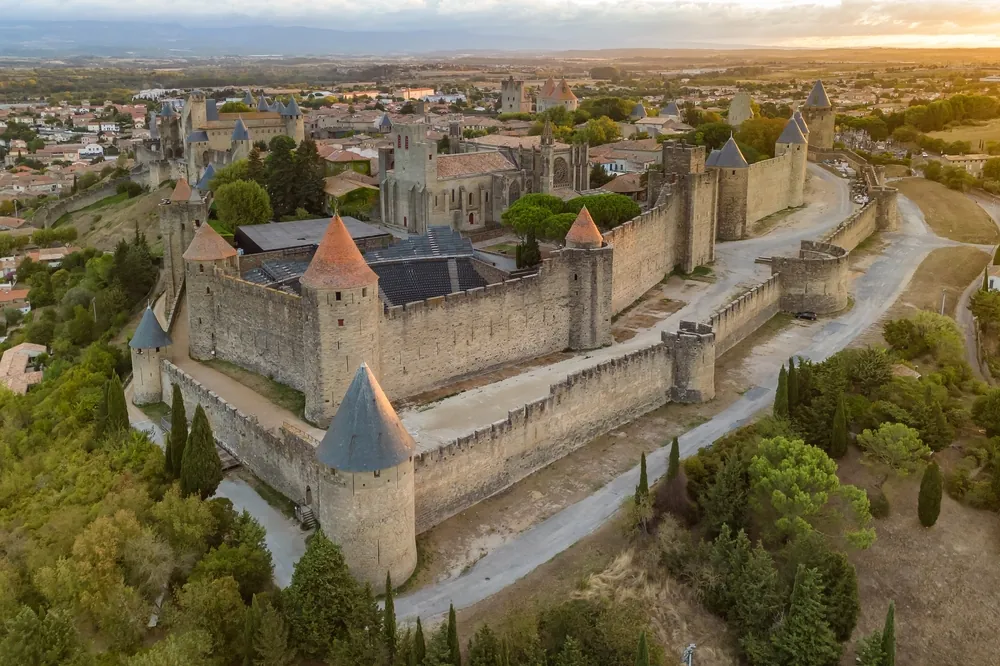
The Cité de Carcassonne is the largest surviving medieval fortress complex in Europe, with double walls extending three kilometers enclosing 52 watchtowers and the Château Comtal. It welcomes 4 million visitors annually.
The fortified city of Carcassonne represents the largest surviving medieval fortress complex in Europe. Double walls extending three kilometers enclose 52 watchtowers, the Château Comtal, and the Basilica of Saint-Nazaire with its Romanesque nave and Gothic choir.
The site's strategic importance stretches to antiquity: Romans fortified the hilltop in 100 BC. The Visigoths, Saracens, and Frankish kings successively controlled the citadel before it became seat of the Viscounts of Trencavel. Following the Albigensian Crusade against the Cathars, Louis IX and Philip III significantly expanded the fortifications between 1247 and 1280.
By the 19th century, Carcassonne had declined into a poor quarter slated for demolition. The architect Eugène Viollet-le-Duc began restoration in 1853, a project continuing until 1911. His work proved controversial: the slate roofs he installed differed from the original terracotta, and his reconstructions sometimes prioritized theatrical effect over historical accuracy. Nevertheless, his intervention preserved what would otherwise have been lost entirely.
UNESCO inscribed Carcassonne as a World Heritage Site in 1997. Only approximately 50 residents live within the walls today. The citadel hosts medieval events, jousting tournaments, and historical re-enactments throughout the summer months.
10. Château des Baux-de-Provence
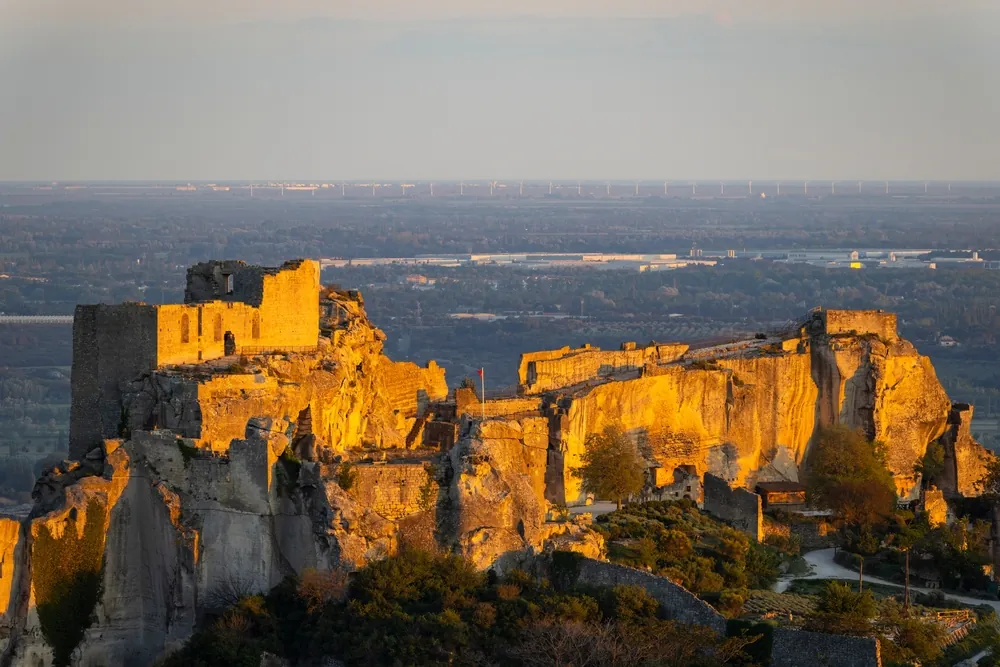
The Château des Baux-de-Provence, perched on a rocky spur in the Alpilles, commands panoramic views from Mont Sainte-Victoire to the Camargue marshlands. The Lords of Baux once ruled 79 towns from this dramatic seat.
Perched on a rocky spur in the Alpilles, the ruined fortress of Les Baux commands panoramic views from Mont Sainte-Victoire to the Camargue marshlands. The Lords of Baux, claiming descent from the Magi king Balthazar, ruled 79 towns and strongholds across Provence from this dramatic seat.
At its peak in the 13th century, Les Baux sheltered 3,000 inhabitants. The House of Baux waged the "Baussenque wars" from 1145 to 1162, establishing their dominance across southern Provence. When Princess Alix, last of the bloodline, died in the 15th century, the territory passed to the French crown.
Louis XIII ordered the castle demolished in 1633 during the Wars of Religion, leaving the evocative ruins visible today. The 13th-century donjon, the Saracen and Paravelle towers, and troglodyte rooms carved into the living rock survive in various states of preservation.
The château displays full-scale reconstructions of medieval siege weapons, including a trebuchet claimed to be the largest in Europe. Demonstrations occur between April and September.
11. Château de Peyrepertuse
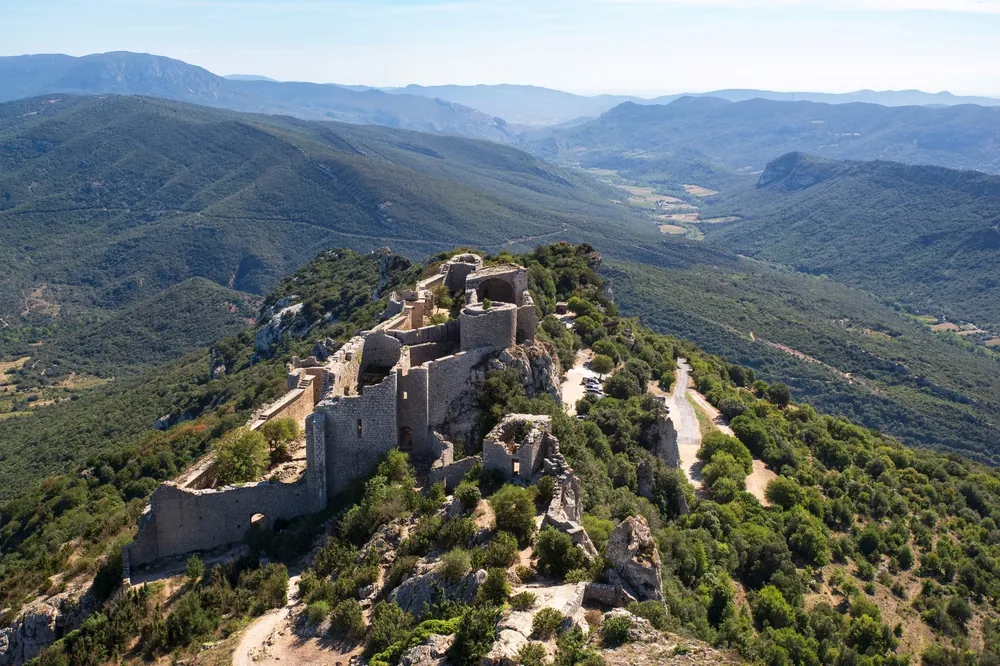
Château de Peyrepertuse, known as the "Celestial Carcassonne," sprawls along a limestone ridge at nearly 800 meters altitude. It surrendered in 1255, eleven years after Montségur fell.
Known as the "Celestial Carcassonne," Peyrepertuse sprawls along a limestone ridge at nearly 800 meters altitude, its ruins extending 300 meters along the clifftop. The castle ranks among the "Five Sons of Carcassonne," the chain of royal fortresses that defended the medieval border between France and Aragon.
The oldest sections date to the 11th century, when the castle belonged to the Counts of Barcelona. Following the Albigensian Crusade, Guillaume de Peyrepertuse reluctantly submitted to French authority in 1240. Louis IX (Saint Louis) commissioned significant expansions between 1242 and 1251, including the Sant Jordi dungeon reached by a vertiginous staircase carved into the rock.
The Treaty of the Pyrenees in 1659 rendered the fortress strategically obsolete by moving the Spanish border southward. Unlike most Cathar castles, Peyrepertuse maintained a small garrison until the Revolution in 1789. The ruins were classified as a historic monument in 1907.
The hike from the car park takes approximately 15 to 20 minutes. Visits are discouraged during storms or high winds due to lightning risk and the precipitous paths.
12. Château de Quéribus
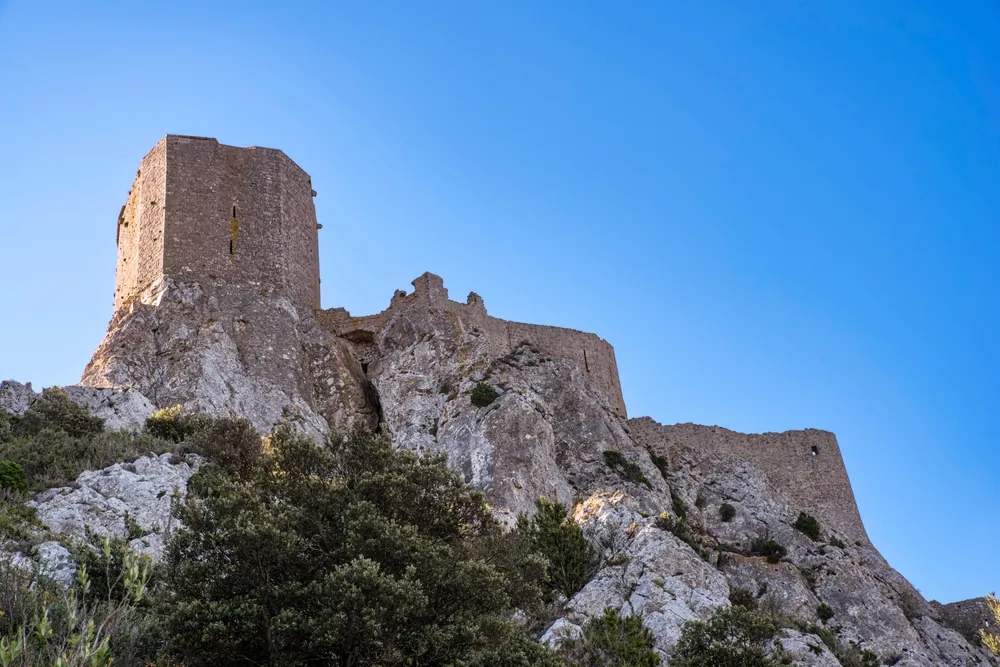
Château de Quéribus, perching on a 728-meter peak overlooking Corbières vineyards, earned the name “Citadel of Vertigo” for its dramatic position. It was the last Cathar stronghold to fall, surrendering in 1255.
Quéribus, the "Citadelle du Vertige" (Citadel of Vertigo), perches on a 728-meter peak overlooking the vineyards of Corbières. It holds the distinction of being the last Cathar stronghold to fall, surrendering in 1255, eleven years after the fall of Montségur.
The castle served as refuge for Cathars fleeing persecution, protected by the knight Chabert de Barbaira. Following capture, Quéribus became another of the "Five Sons of Carcassonne," its existing fortifications reinforced to guard the French frontier.
The interior preserves a remarkable "hall of columns," where a single Gothic pillar supports the polygonal vault. The pillar is positioned to align with a window such that on the summer solstice, sunlight strikes its center directly.
The village of Cucugnan below the castle offers wine tasting and traditional Languedoc cuisine. The château is visible from neighboring Peyrepertuse, and many visitors combine both in a single excursion.
13. Châteaux de Lastours
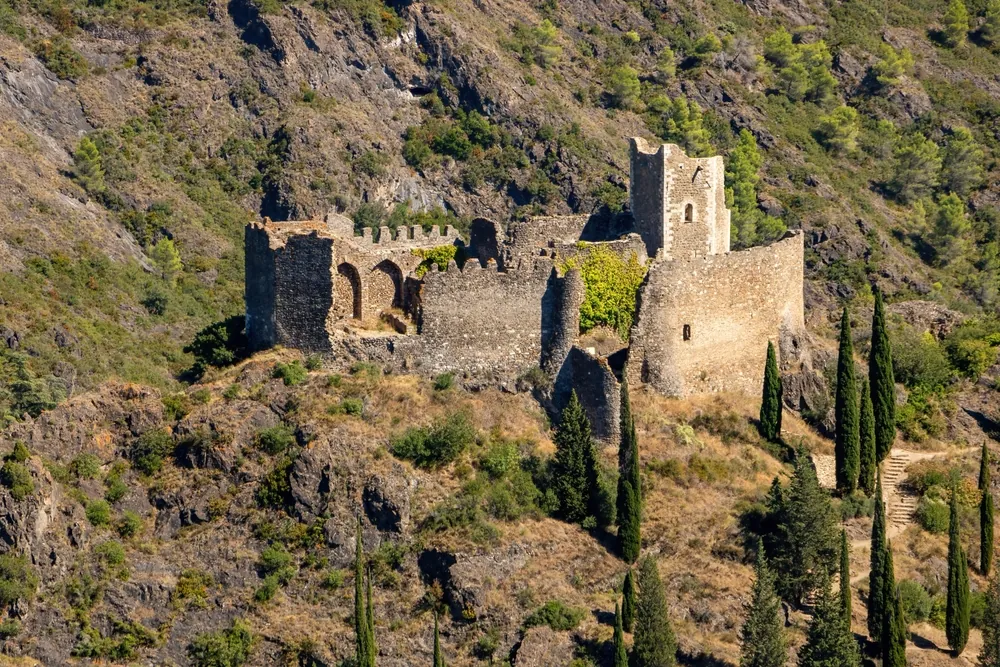
The Châteaux de Lastours comprise four ruined castles on a single rocky spur: Cabaret, Surdespine, Quertinheux, and Tour Régine. The belvedere viewpoint offers a dramatic perspective across all four.
Four ruined castles crown a single rocky spur above the village of Lastours: Cabaret, Surdespine, Quertinheux, and Tour Régine. Together they formed a layered defensive complex, each fortress positioned to support the others against assault.
Cabaret, the largest and oldest, gave its name to the local lords who resisted Simon de Montfort's crusade. The fortresses changed hands multiple times during the Albigensian Crusade before finally falling under French royal control. Tour Régine, the newest of the four, was built by the French crown in the 13th century to cement their authority.
The belvedere viewpoint offers the most dramatic perspective across all four castles. A hiking trail descends into the valley and passes each ruin in succession, though the terrain is challenging.
14. Château de Fontainebleau
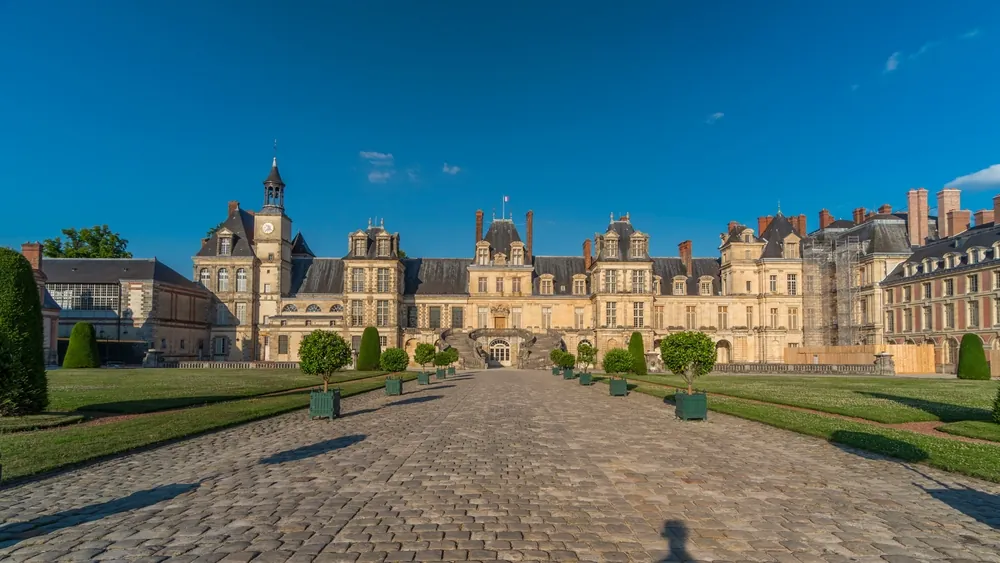
Château de Fontainebleau served as a royal residence from the medieval Capetians through Napoleon III. Napoleon called it "the true home of kings" and signed his first abdication here in 1814.
Fontainebleau served as a royal residence for eight centuries, from the medieval Capetians through Napoleon III. Unlike Versailles, built to a single master plan, Fontainebleau accrued organically, its 1,500 rooms reflecting successive monarchs' tastes across Gothic, Renaissance, and Classical periods.
François I imported Italian artists to create the Galerie François I, introducing Mannerist aesthetics to France. Napoleon held particular affection for Fontainebleau, calling it "the true home of kings." He signed his first abdication here in 1814 and bade farewell to his Old Guard in the Cour des Adieux (Courtyard of Goodbyes).
The gardens extend across 130 hectares, including a formal parterre, an English garden, and a carp pond where visitors can feed fish said to be centuries old. The forest of Fontainebleau surrounding the estate covers 25,000 hectares, attracting rock climbers to its famous sandstone boulders.
UNESCO inscribed Fontainebleau as a World Heritage Site in 1981, alongside Versailles and the medieval trade fair town of Provins.
15. Vaux-le-Vicomte
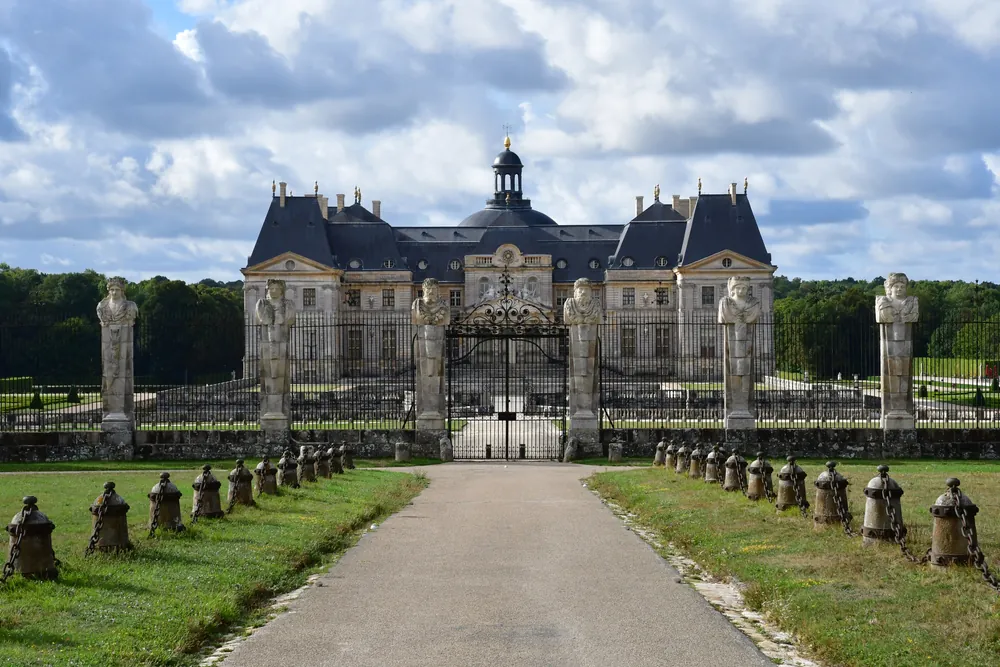
Vaux-le-Vicomte directly inspired Versailles. Louis XIV was so impressed—and threatened—by finance minister Nicolas Fouquet's château that he arrested Fouquet and appropriated his artistic team to build Versailles.
Vaux-le-Vicomte occupies a singular position in architectural history as the direct precursor to Versailles. Nicolas Fouquet, finance minister to Louis XIV, commissioned the château, assembling the team that would later transform Versailles: architect Louis Le Vau, painter Charles Le Brun, and landscape designer André Le Nôtre.
The château's completion in 1661 proved Fouquet's undoing. He hosted an extravagant fête for the young king, displaying wealth that aroused royal suspicion. Within weeks, Fouquet was arrested on charges of embezzlement and imprisoned for the remainder of his life. Louis XIV appropriated the artistic team and much of Vaux's furnishings for his own grander project at Versailles.
The château remains privately owned by the Vogüé family, who have operated it as a visitor attraction since 1968. Candlelit evenings on summer Saturdays illuminate the château and gardens with 2,000 candles, recreating the atmosphere of Fouquet's fateful celebration.
Why Is the Loire Valley Called France's Château Heartland?
The Loire Valley contains over 300 châteaux within a single UNESCO World Heritage-designated stretch - the highest concentration of heritage properties anywhere in France.
Centuries of royal patronage shaped this landscape. French kings preferred the Loire's temperate climate and abundant game to the tensions of Paris. François I alone commissioned Chambord, expanded Blois, and maintained residences at Amboise. The result: an unparalleled concentration of Renaissance architecture across 280 kilometers of river valley.
UNESCO inscribed the central Loire between Sully-sur-Loire and Chalonnes as a World Heritage Site in 2000. Today, 3.3 million visitors arrive annually.
Beyond the famous names, dozens of privately held châteaux offer tours, accommodation, and wine tastings. The Loire's viticultural heritage - Sancerre, Vouvray, Chinon, Muscadet - complements its architectural legacy.
For prospective buyers, this remains the most active market in France. Properties range from manor houses requiring restoration to turnkey estates with established tourism operations.
What Makes Southern France's Castles Different?
Southern France preserves fortifications built for survival, not display. The Cathar castles of the Languedoc occupy mountain positions chosen for defense during the Albigensian Crusade (1209–1229), not for aesthetics.
The crusade devastated the region, destroying the independent culture of Occitania and establishing French royal authority. The castles that survived - whether as Cathar refuges or subsequent French fortifications - bear witness to this violent history.
The "Five Sons of Carcassonne" (Peyrepertuse, Quéribus, Puilaurens, Termes, and Aguilar) formed the medieval border defense against Aragon. The Treaty of the Pyrenees rendered them obsolete in 1659. Today they reward visitors willing to hike for spectacular ruins and unobstructed views.
Provence offers different heritage again. Medieval villages perchés cluster around ruined fortresses like Les Baux. Roman monuments at Nîmes, Arles, and Orange recall earlier civilizations entirely.
The property market here commands premium prices - particularly for restored mas and bastides with vineyard potential.
Explore French Châteaux with Castle Collector
Castle Collector maintains a curated selection of French heritage properties, from Loire Valley landmarks to Provençal estates. Our network connects discerning buyers with châteaux offered through trusted estate agents, family offices, and private sellers.
Each listing is selected for its historical significance, architectural integrity, or investment potential. Whether seeking a restored residence or a restoration project, our team provides discreet guidance through the acquisition process.