
Castles in Spain: 10 castles to visit, from the Alhambra to Coca
Granada's Alhambra draws 2.7M visitors a year. Coca's Mudéjar towers, Loarre's Romanesque walls and the Royal Alcázar of Seville complete the Spanish list.
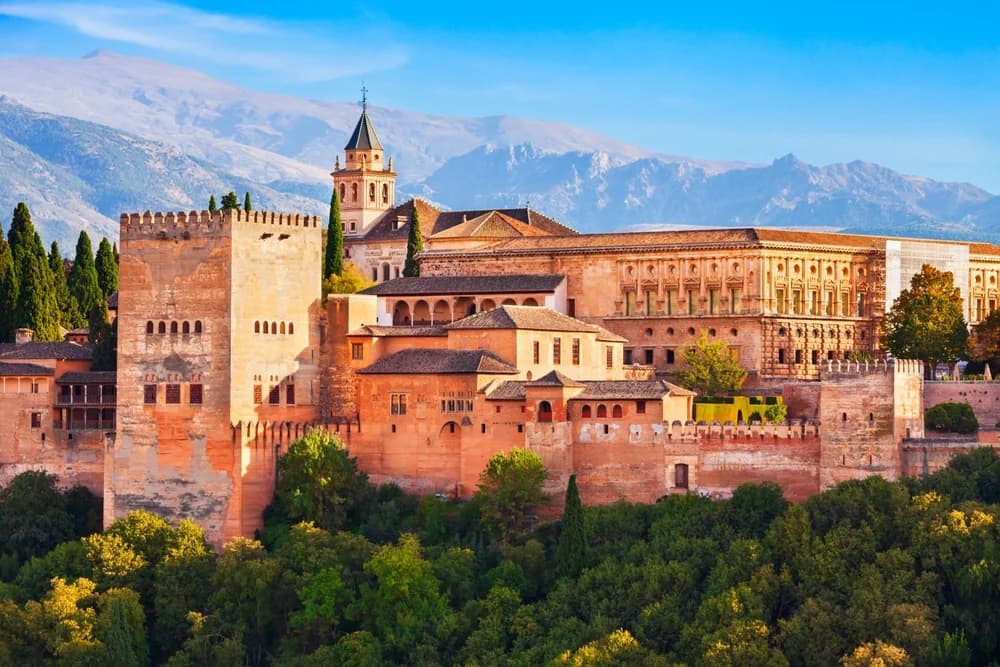
Eight centuries of Christian-Muslim frontier left Spain with one of the densest castle landscapes in Europe. From a Nasrid palace city above Granada to a Mudéjar brick masterpiece on the Castilian plateau, ten castles that warrant the day.
Spain carries roughly 2,550 castles on the official BIC (Bien de Interés Cultural) protected register, the legacy of an eight-century Reconquista that ran from the Asturian rebellion of the 720s to the fall of Granada in 1492.[1] The Spanish Ministry of Culture's heritage system, anchored on the 1985 Ley del Patrimonio Histórico Español, delegates day-to-day management to the 17 autonomous communities, which is why ticketing, hours and conservation funding can look different from one region to the next.[2]
The castles that define a traveller's itinerary cluster in three regions. Andalusia, in the south, holds the great Hispano-Islamic palace-fortresses (the Alhambra, the Royal Alcázar of Seville, the Aljafería in nearby Aragon). Castile and León, the historic Reconquista heartland, holds the Mudéjar military castles built in the late 15th century from local brick (Coca, Castillo de la Mota). Aragon and the Pyrenean foothills hold the Romanesque survivors (Loarre is the European reference point) and the Catalan group runs from inland Cardona to the star-shaped Sant Ferran above Figueres.
The ten below are the ones that warrant the day. Each entry covers what to see, when to go, what it costs, and how to get there.
1. Alhambra
Andalusia (Granada) Daily, advance booking Nasrid palace city Map
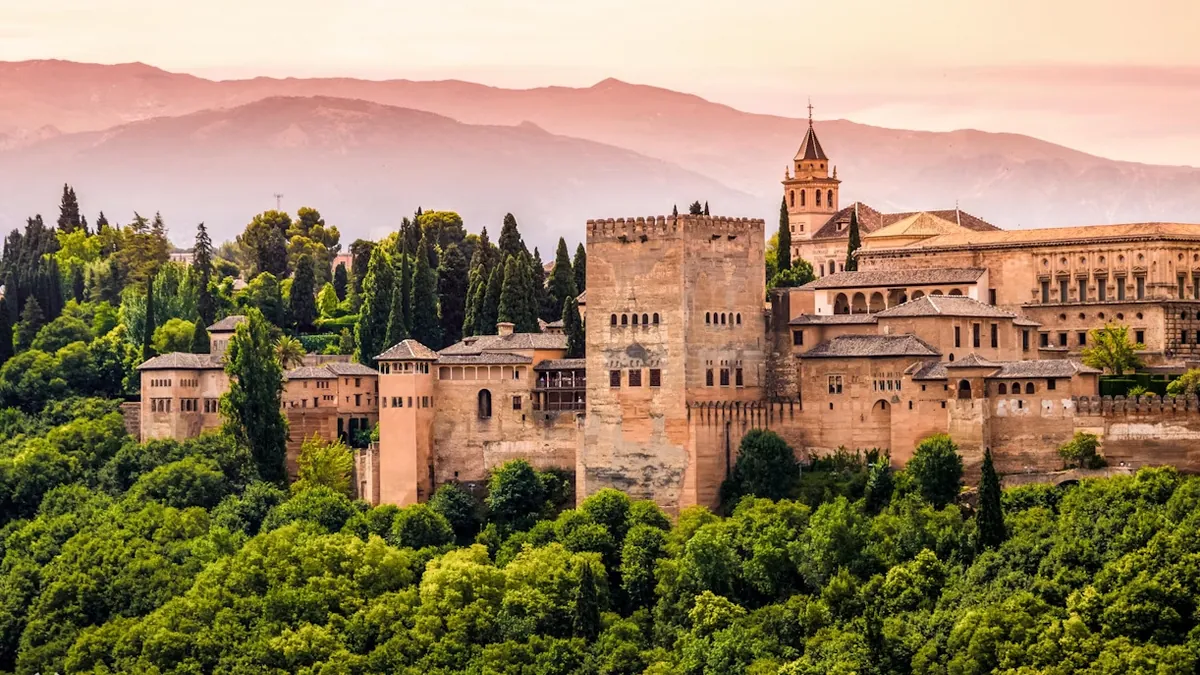
The Alhambra is a fortified palace city that grew across four phases on the Sabika hill above Granada: the 9th-century Alcazaba military citadel, the 13th and 14th-century Nasrid Palaces (the artistic core, built under Yusuf I and Muhammad V), the post-Reconquista Charles V Palace begun in 1527, and the Generalife summer gardens above. UNESCO inscribed the Alhambra alongside the Generalife and the Albayzín quarter of Granada in 1984, with the inscription extended in 1994.
It is also Spain's most-visited heritage monument. The Patronato de la Alhambra y Generalife recorded around 2.7 million tickets in its 2024 annual report.[3] The Patronato caps daily admissions to manage conservation pressure on the Nasrid Palaces specifically, which is the reason every ticket carries a fixed half-hour entry slot for that part of the visit. Tickets sell out weeks ahead in summer; book direct through the Patronato.
Practical: open daily 08:30–20:00 (Apr–Oct) / 08:30–18:00 (Nov–Mar); closed 25 December and 1 January. General admission (full monument including Nasrid Palaces) from €19.09 adult, free under 12, reduced for EU citizens 18–25. Gardens-and-Generalife only €10. From central Granada, city buses C30 or C32 from Plaza Isabel la Católica, or 15 to 20 minutes uphill on foot from Plaza Nueva. Plan your visit.[4]
2. Royal Alcázar of Seville
Andalusia Daily, year-round Mudéjar royal palace Map
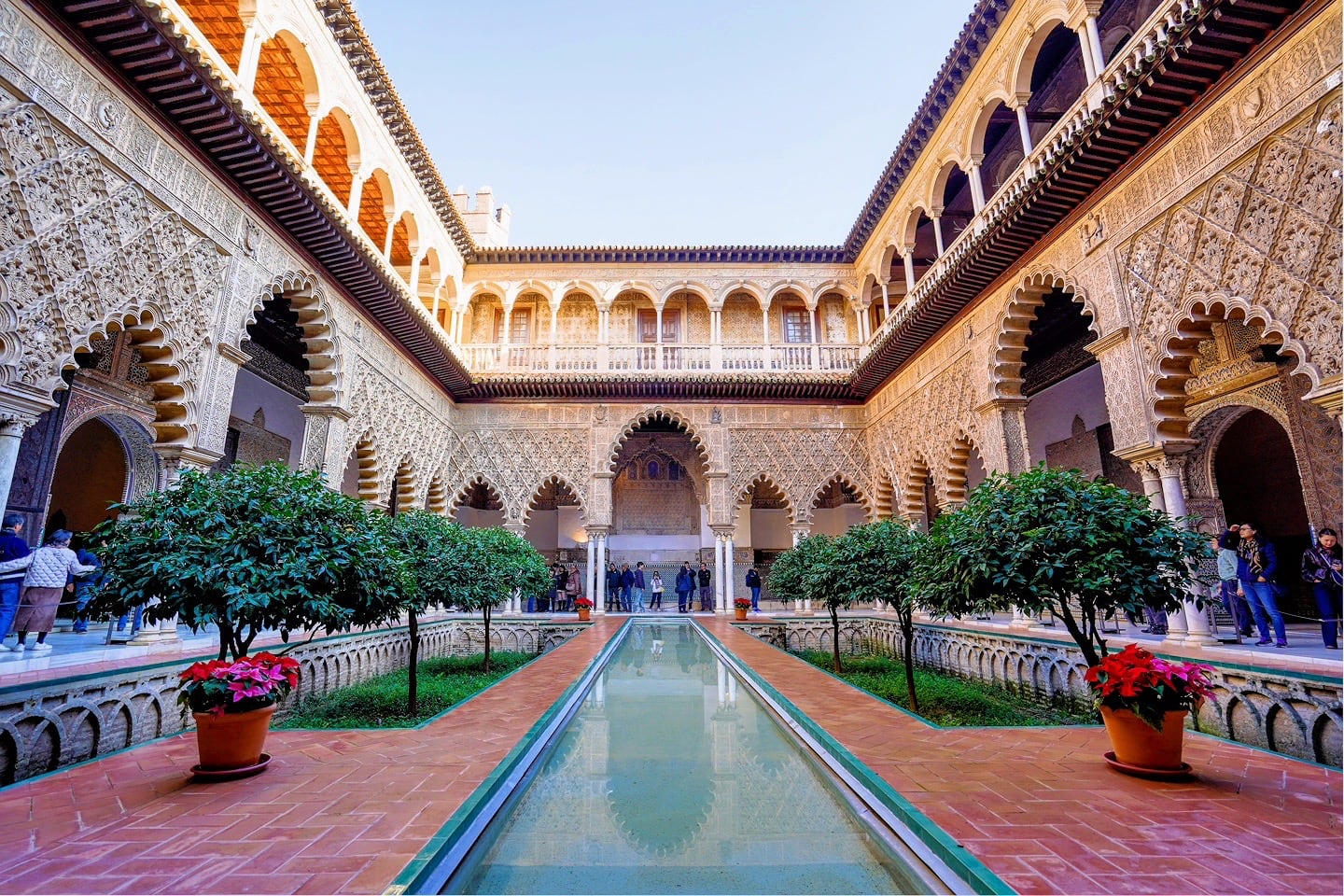
The Royal Alcázar grew on the site of the Umayyad fortress founded in 913, was rebuilt as a palace under Almohad rule, and was reshaped again by Pedro I of Castile between 1364 and 1366 in the Mudéjar style that gives the site its present character. The Spanish royal family still uses the upper floors when in Seville, which makes it the oldest royal palace in active use in Europe; UNESCO inscribed it in 1987 alongside the Cathedral and the Archivo de Indias.
The Patio de las Doncellas, the Salón de Embajadores under its golden cupola, and the gardens stepping down from the Pedro I palace are the canonical visit. The Alcázar has also doubled as a major filming location, including for the Game of Thrones Water Gardens of Dorne in seasons five and six, which has measurably raised attendance.
Practical: open daily, year-round. Apr–Sep 09:30–19:00; Oct–Mar 09:30–17:00. Adult from €15.50; Seville-born and Seville residents free with ID. Upper Royal Quarter (Cuarto Real Alto) €5.50 extra. Central Seville location, walking distance from the cathedral; nearest tram stop Archivo de Indias. Plan your visit.[5]
3. Castle of Loarre
Aragon Tue–Sun Best-preserved 11th-century Romanesque Map
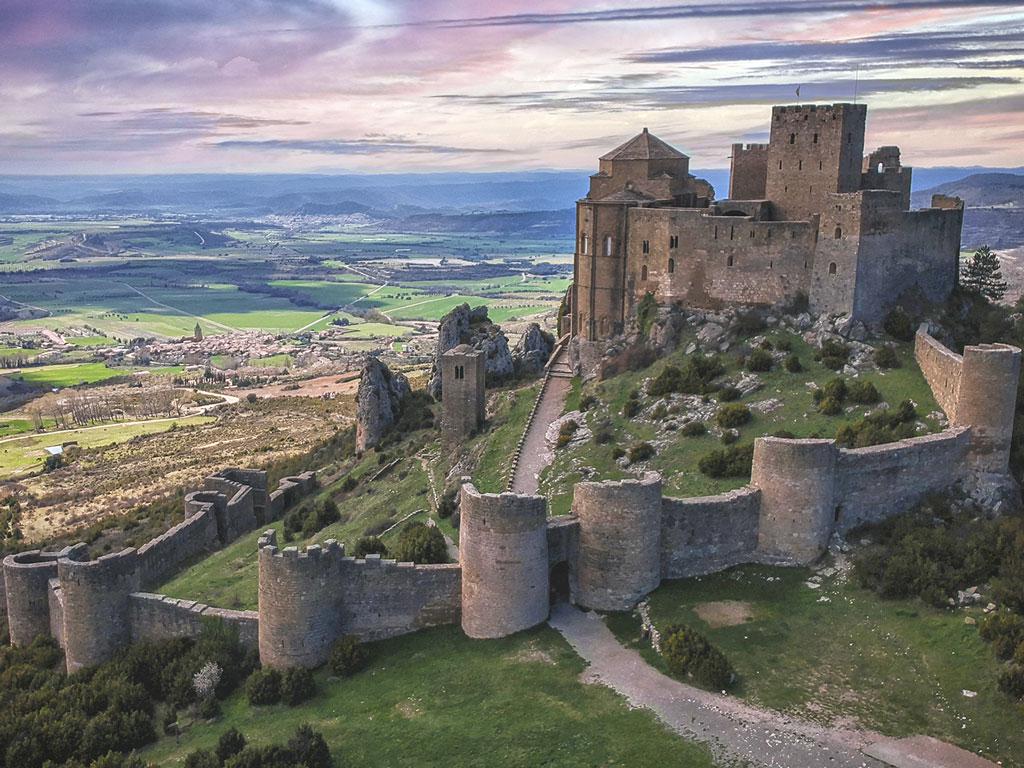
Loarre sits 1,070 metres up on a Pyrenean foothill above the Hoya de Huesca, a square-towered Romanesque military castle begun by Sancho III of Navarre in the early 11th century and extended under Sancho Ramírez of Aragon after 1067. It is widely cited as the best-preserved 11th-century Romanesque castle in Europe and sits on Spain's UNESCO World Heritage tentative list.[6] The chapel of San Pedro inside the curtain wall is a complete Romanesque church, with a barrel vault and a small crypt underneath.
The castle served as the primary filming location for Ridley Scott's Kingdom of Heaven (2005), which used the unrestored fabric to stand in for the crusader strongholds of the Levant. The result is one of the most legible medieval interiors anywhere in Spain: the great hall, the queen's chamber, the watchtower and the chapel survive in their original layout.
Practical: open Tuesday to Sunday, year-round, with extended summer hours and reduced winter hours; closed Mondays except holidays and bridge days. Adult €6 self-guided / €8 guided; concessions €5.50 / €7. From Huesca, 35 km by road to Loarre village, then a short drive uphill to the castle (no rail link). Plan your visit.[7]
4. Castle of Coca
Castile and León Daily, reserve ahead Mudéjar brick masterpiece Map
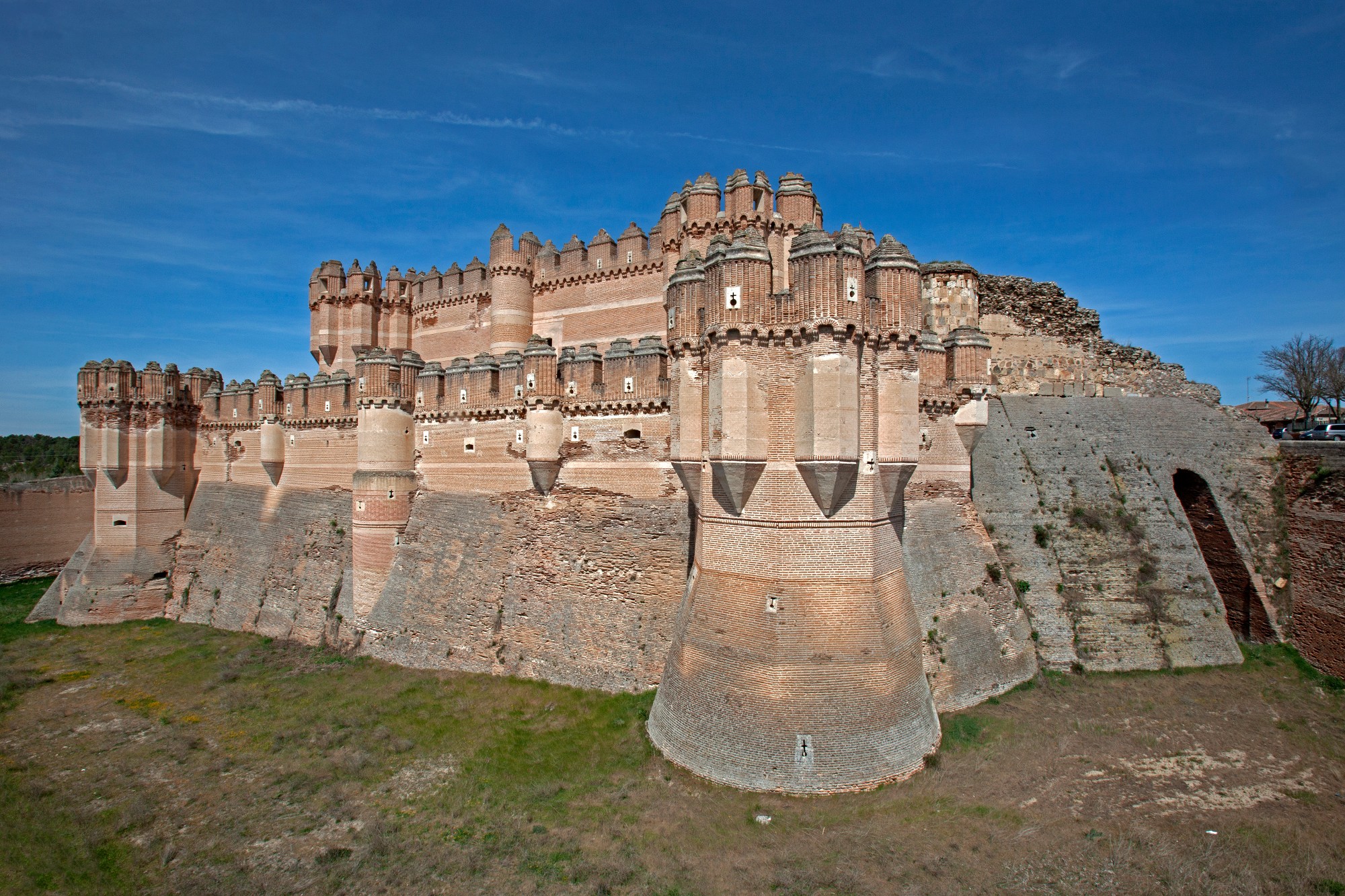
The Castle of Coca, built between 1473 and 1493 for Alonso de Fonseca y Quijada (Bishop of Ávila and later Archbishop of Seville), is the masterpiece of late-medieval Mudéjar military architecture. The brick construction (rather than the stone used in most contemporaneous Castilian castles) and the geometric brickwork on the towers make it the most distinctive surviving Spanish castle by typology, and a textbook example of how Reconquista-era Christian patrons employed Muslim master masons. The deep dry moat hewn from the local clay survives intact.
The site is owned by the House of Alba and operated under cession to the Junta de Castilla y León. Visits are by reservation only, by phone or email, which keeps daily numbers low and makes the experience uncrowded.
Practical: daily, with closure on the first Tuesday of each month. Summer (6 Apr to 24 Oct) 11:00–13:00 and 16:30–19:00; winter (26 Oct to 5 Apr) 11:00–13:00 and 16:30–18:00. Adult €3, concession €2.50. Reservation required (+34 921 586 622). Coca is around 50 km north-west of Segovia; reach by car on the CL-601 or by regional bus from Segovia. Plan your visit.[8]
5. Olite Castle (Royal Palace of Olite)
Navarre Open daily Navarre's most-visited monument Map
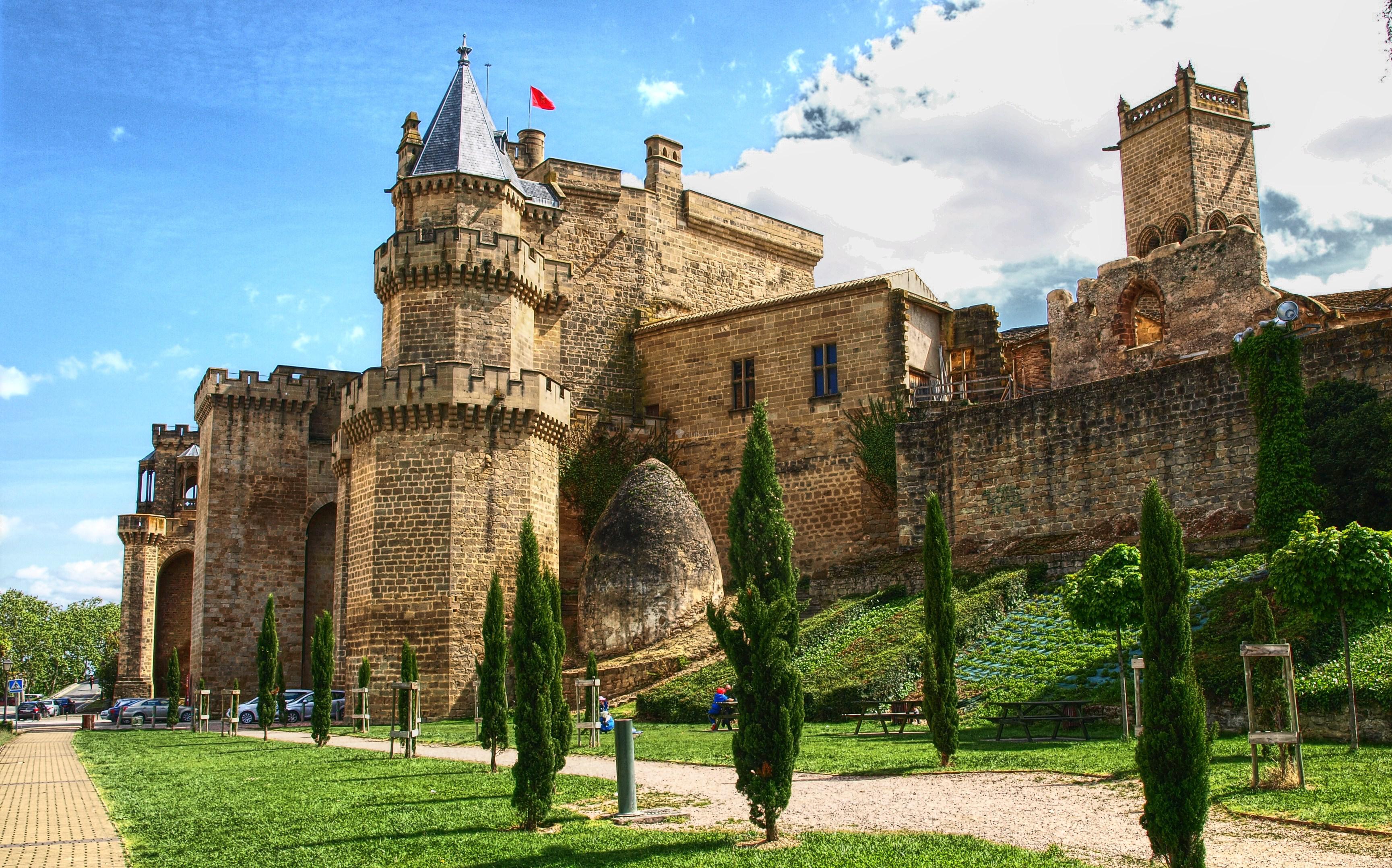
The Royal Palace of Olite was rebuilt as a Gothic court castle by Charles III of Navarre between 1387 and 1419, the centrepiece of the small kingdom's late-medieval flowering. Carlos III imported French Gothic models and added what contemporary chroniclers described as gardens with caged lions, exotic birds and a menagerie that drew visitors from across Christendom. The palace was burned in 1813 to deny it to the French during the Peninsular War; the substantial restoration of the 1937–67 period rebuilt the towers and the Galería del Rey using the original masonry where it survived.
The castle is Navarre's most-visited monument and a working day trip from Pamplona. The two-tower silhouette, the climb up the Torre del Vigía for the views over the Ribera, and the underground ice-house chambers are the canonical visit. Self-guided and guided tours run separately.
Practical: open daily, year-round. Spring and summer roughly 10:00–19:00 (Fri–Sat to 20:00); autumn and winter 10:00–18:00 typical. Self-guided: adult €4.40, concession €2.50, under-6 free. Guided tour: adult €7.50, concession €5.50. From Pamplona, around 40 minutes by car or by La Tafallesa bus; nearest rail station Tafalla. Plan your visit.[9]
6. Bellver Castle
Mallorca Tue–Sun, free Sundays Round Gothic royal castle Map
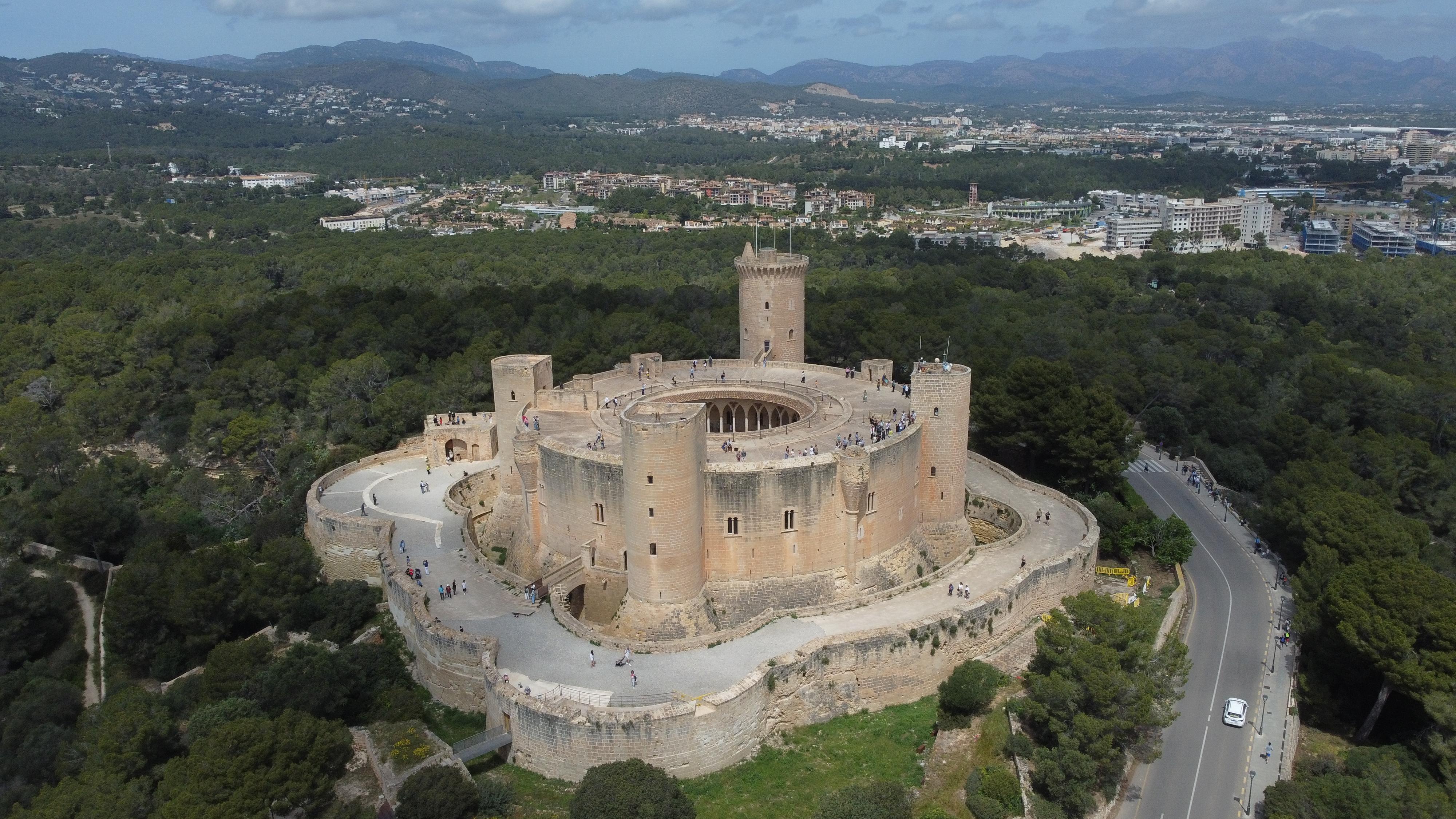
Bellver Castle, built between 1300 and 1311 for James II of Mallorca by the architect Pere Salvà, is one of only four circular castles in Europe and the earliest of them. The Gothic plan is unusual: a circular curtain wall punctuated by three semi-circular flanking towers and a fourth, taller round keep (the Torre del Homenaje) detached from the main body and joined by a high arch. The site sits 112 metres above the bay of Palma, roughly 3 km west of the old town, with a 360-degree view across the Mediterranean.
Bellver served as a state prison from the late 17th century through the Peninsular War and on into the 19th century, and the cells, gun terraces and cisterns survive intact.[10] The castle now houses the Municipal History Museum of Palma, with a permanent display on the city's classical, medieval and modern phases.
Practical: Tuesday to Saturday 10:00–19:00 (summer) / 10:00–18:00 (winter); Sundays and holidays 10:00–15:00; closed Mondays, 25 December, 1 January, 1 May and Easter Sunday. Adult €4, concession €2, under 14 free; free for everyone on Sundays 10:00–15:00. From central Palma, walk uphill from Plaza Gomila or take EMT bus 50. Plan your visit.[11]
7. Castillo de la Mota
Castile and León (Medina del Campo) Daily, free outer area Isabel the Catholic's bastion Map
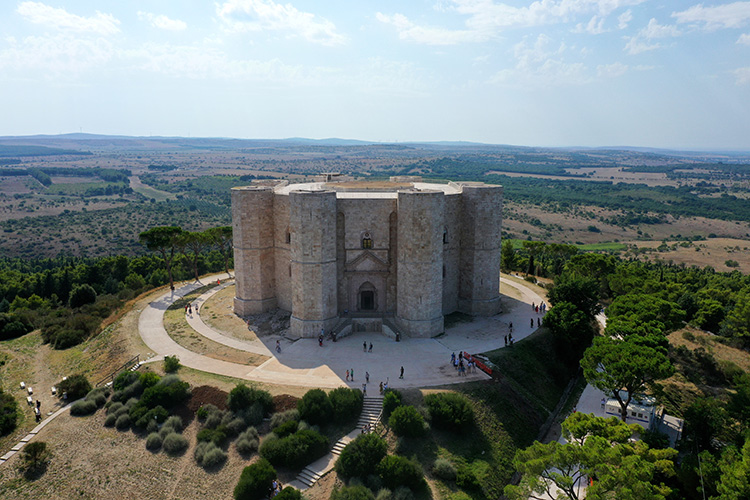
The Castillo de la Mota stands on a knoll above Medina del Campo in Valladolid province, a Mudéjar-influenced brick fortress built in the 15th century on Almoravid foundations. Isabel I of Castile (Isabel the Catholic) used it as one of her primary residences and her treasury during the consolidation of the Crown of Castile in the 1470s and 1480s. Her daughter Joanna of Castile, known to history as Juana la Loca, was confined here before her transfer to Tordesillas. Cesare Borgia was also imprisoned at La Mota in 1504 to 1506, escaping by lowering himself from a tower window.
The outer parade ground, the chapel and the Juan de la Cosa room are accessible free of charge year-round; the keep and inner halls are ticketed.
Practical: open year-round. Oct–Mar mornings 11:00–14:00; Apr–Sep extended hours including afternoons. Adult €4, concession €3 (groups of 20+, over-65, under-26, unemployed, large families), child €2.50; ground floor free. From Valladolid, regional rail to Medina del Campo (around 30 minutes on the Madrid line) plus a 15-minute walk. Plan your visit.[12]
8. Aljafería
Aragon (Zaragoza) Free Sundays Moorish palace and parliament Map
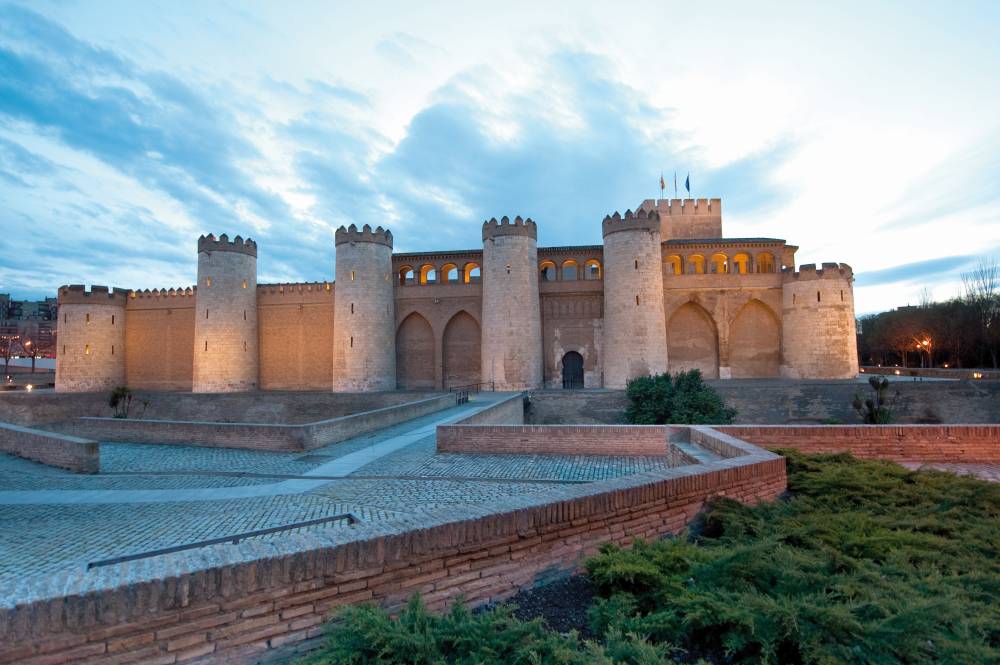
The Aljafería is the major Hispano-Islamic palace north of Andalusia, built in the second half of the 11th century as the pleasure-palace of the Banu Hud emirs of the Taifa of Zaragoza. The Christian conquest of 1118 turned it into a residence for the kings of Aragon; Pedro IV added the Mudéjar throne room in the 14th century, and the Catholic Monarchs (Ferdinand and Isabella) commissioned a further floor in the late 15th. The complex spans three architectural phases (Taifa, Mudéjar, Habsburg) inside a single fortified perimeter, and the inner Taifa courtyard with its filigree arcades is one of the finest surviving Hispano-Islamic interiors anywhere in Europe.
The Aljafería is also the active seat of the Cortes de Aragón (the regional parliament), which restricts visitor access on parliamentary sitting mornings. Outside those hours the palace is fully open and well below the visitor pressure of comparable Andalusian sites.
Practical: Apr–Oct daily 10:00–14:00 and 16:00–20:00; Nov–Mar Mon–Sat 10:00–14:00 and 16:00–18:30, Sun 10:00–14:00. Closed Thursday and Friday mornings during parliamentary sittings (except January, July and August). Adult €5, concession €1, under 12 free; free for everyone on Sundays. From Zaragoza-Delicias rail station, 10 to 15 minutes on foot, or city bus 33 or 36. Plan your visit.[13]
9. Castell de Cardona
Catalonia Tue–Sun, guided weekends Catalan salt-rock fortress Map
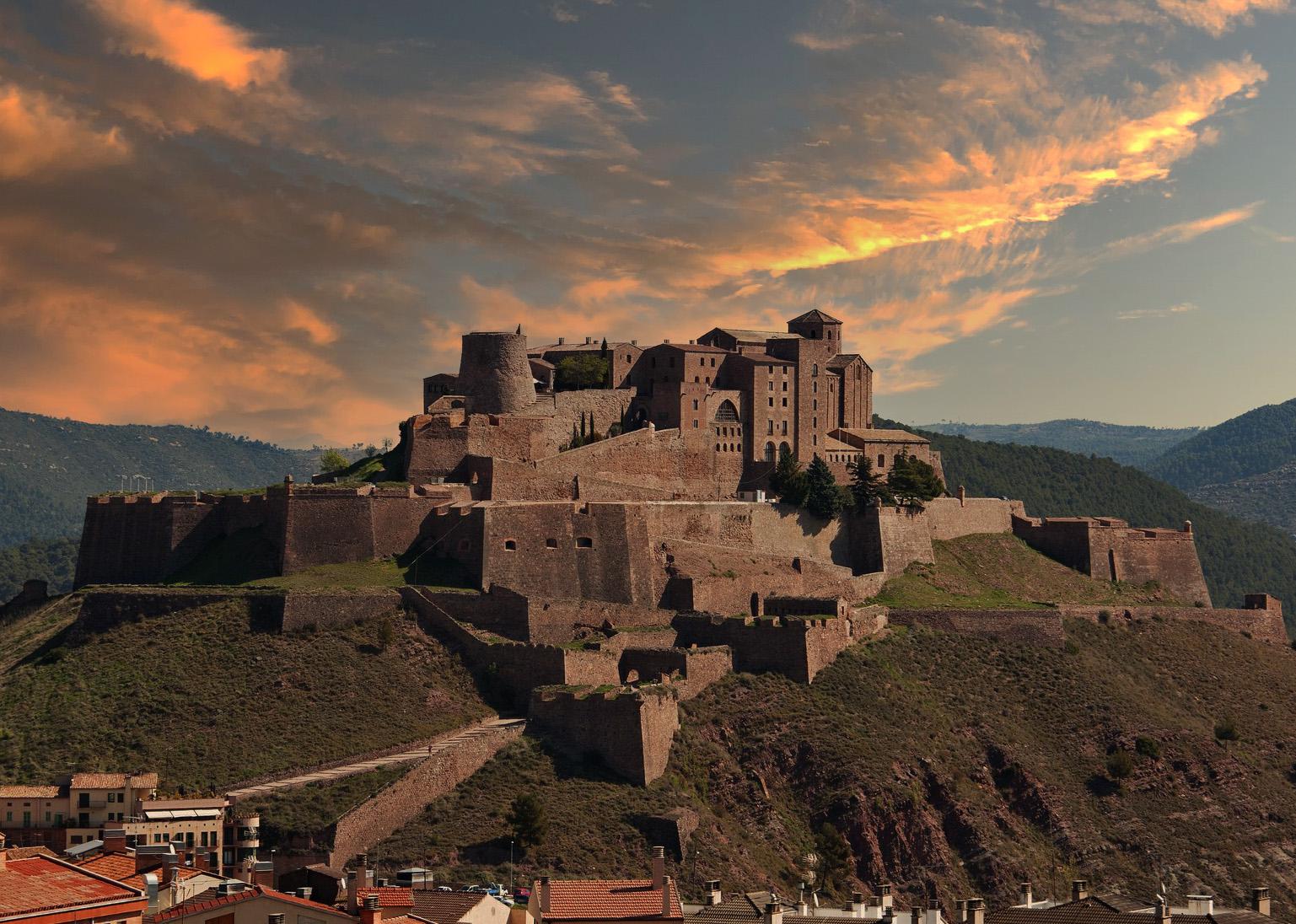
The Castell de Cardona crowns a hill above the Cardener river, around 90 km north of Barcelona, looking out over the unique Cardona salt mountain. The site has been continuously fortified since the 9th century, when the Frankish counts of Barcelona reinforced the Iberian castrum against Andalusian raiding parties, and was rebuilt in the 11th century by the Folc de Cardona dynasty whose direct descendants held it for nearly 800 years. Cardona is the only Catalan castle to have withstood the Bourbon armies of the War of Spanish Succession (1714); the Romanesque collegiate church of Sant Vicenç inside the walls is one of the earliest surviving Catalan Romanesque buildings.
The castle is operated jointly by the Generalitat de Catalunya and Cardona Turisme, and shares the complex with the Parador de Cardona hotel inside the medieval walls.
Practical: Tue–Sun 10:00–19:30 (Jun–Sep) / 10:00–17:30 (Oct–May); closed Mondays except holidays, plus 1 and 6 January and 25 and 26 December. Adult €5, concession €3 (under 16, seniors). Guided theatrical tours available at weekends with extra charge. From Barcelona, around 90 km by car or Alsa bus; nearest rail station Manresa, then connecting bus. Plan your visit.[14]
10. Castell de Sant Ferran
Catalonia (Figueres) Modular tours Europe's largest 18th-century star fort Map
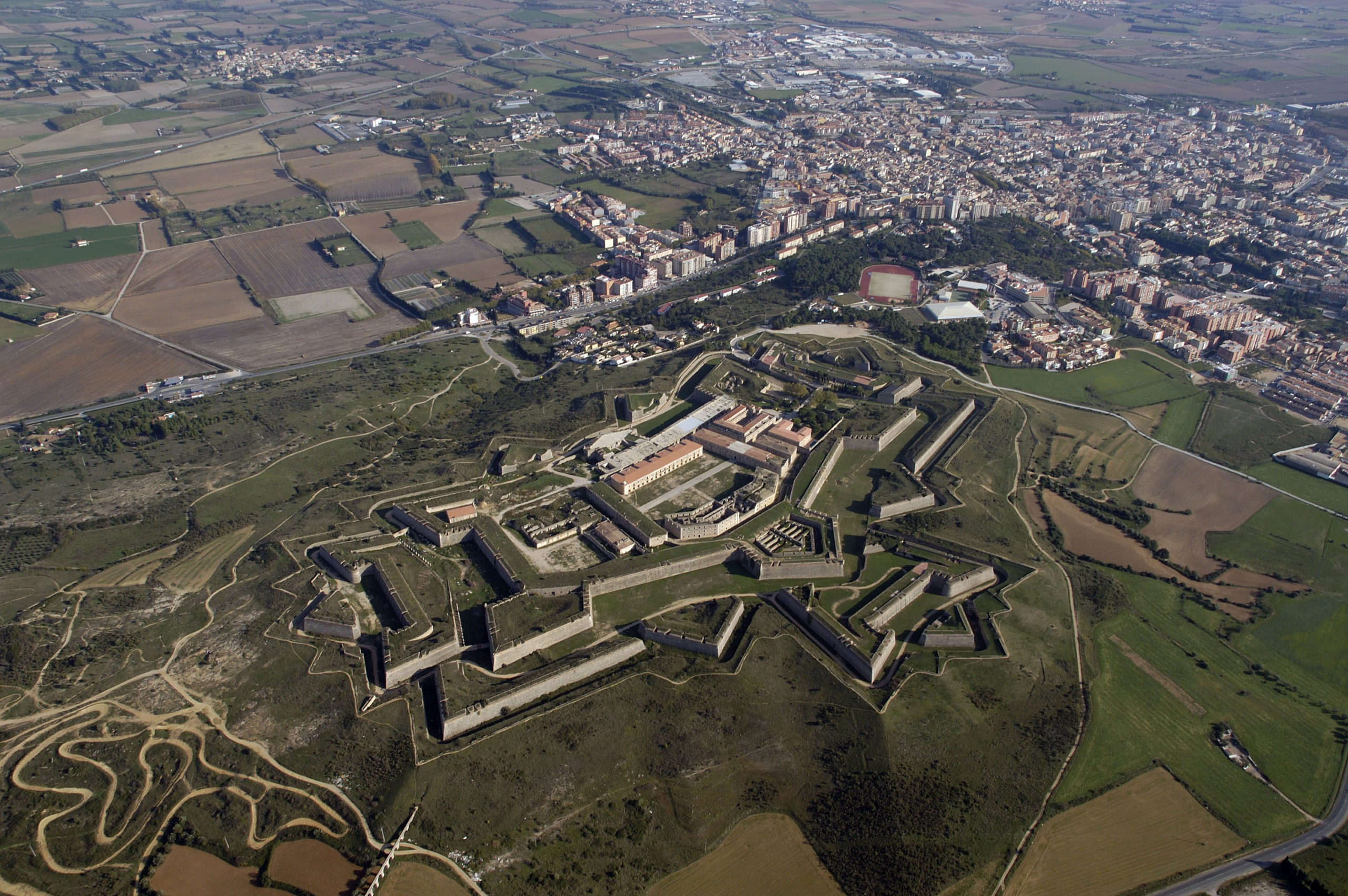
The Castell de Sant Ferran, on the hill above Figueres in the Empordà, is a star-shaped bastioned fortress completed between 1753 and 1792 to defend the northern approach to Catalonia from a French invasion that, when it came in 1808, took the fort by guile rather than siege. The enclosed perimeter runs to roughly 3.1 km and the total bastioned area is around 32 hectares, giving Sant Ferran the distinction of the largest 18th-century star fort still standing in Europe. The underground water cisterns, fed by the surrounding ditches, hold up to 9 million litres.
Sant Ferran is more citadel than medieval castle, but the scale of the Vauban-school engineering (six bastions, two ravelins, hornworks on the north and south flanks) makes it a useful counterpoint to the medieval sites elsewhere in Spain. Specialist tours include a self-guided audioguide visit, a 90-minute guided walking tour and an inflatable-boat tour through the flooded lower cisterns.
Practical: daily July, August and Easter 10:00–20:00; September to October and April to June Tue–Sun 10:00–18:00; November to March Tue–Sun 10:00–16:00; closed 25 to 26 December and 1 to 6 January. Adult from €3 self-guided (audioguide included); guided and boat tours priced separately. From Barcelona, AVE or RENFE to Figueres-Vilafant, then 1 km uphill walk. Plan your visit.[15]
At a glance
| Castle | Region | When to go | |
|---|---|---|---|
| AlhambraNasrid palace city | Andalusia (Granada) | Daily, advance booking |
| Royal Alcázar of SevilleMudéjar royal palace | Andalusia | Daily, year-round |
| Castle of LoarreBest-preserved 11th-century Romanesque | Aragon | Tue–Sun |
| Castle of CocaMudéjar brick masterpiece | Castile and León | Daily, reserve ahead |
| Olite Castle (Royal Palace of Olite)Navarre's most-visited monument | Navarre | Open daily |
| Bellver CastleRound Gothic royal castle | Mallorca | Tue–Sun, free Sundays |
| Castillo de la MotaIsabel the Catholic's bastion | Castile and León (Medina del Campo) | Daily, free outer area |
| AljaferíaMoorish palace and parliament | Aragon (Zaragoza) | Free Sundays |
| Castell de CardonaCatalan salt-rock fortress | Catalonia | Tue–Sun, guided weekends |
| Castell de Sant FerranEurope's largest 18th-century star fort | Catalonia (Figueres) | Modular tours |
How many castles are in Spain?
The widely cited figure is around 2,550 castles on the BIC register, the Bien de Interés Cultural tier of the Spanish heritage system established by the foundational Ley 16/1985, de 25 de junio, del Patrimonio Histórico Español.[2] The 1985 statute automatically reclassified every castle and fortress previously protected under earlier histórico-artístico decrees, which is why the BIC count concentrates almost the entire pre-1900 standing castle stock in a single register.
Public access is the smaller question. The Spanish system delegates day-to-day operation to the 17 autonomous communities; some castles operate as state museums (the Alhambra is the headline example), some as foundations or municipal museums, some as privately owned country residences or paradores. The broader heritage register, which includes watchtowers, atalayas and minor frontier fortifications, runs into the tens of thousands once the regional inventories are aggregated. Emilio Navarro Martínez's regional survey of the Middle Guadalquivir Valley alone documents more than 100 fortified sites within a single river system, which gives a sense of how concentrated the surviving stock can be in former military borderlands.[16]
Famous, medieval, Gothic and largest
Famous. The ten above account for the bulk of search demand. The Alhambra and the Royal Alcázar of Seville lead by visitor numbers; Coca and Loarre lead on architectural distinctiveness; Olite and Bellver lead on regional anchor status. The Castle of Manzanares El Real (the Mendoza family's late-15th-century brick palace north of Madrid) was historically a top-tier visitor draw and remains a major destination, though it has been closed to the public since 6 January 2025 while administrative licences are negotiated with the Casa Ducal del Infantado; reopening is pending as of early 2026.[17]
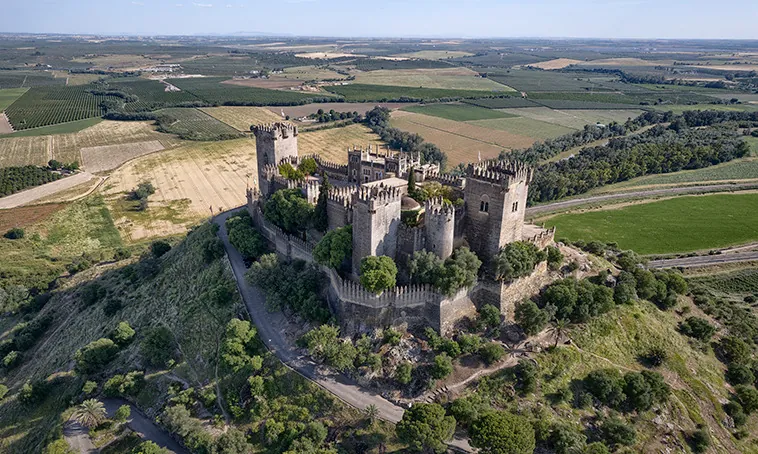
Medieval. The Castle of Loarre is the European reference point for an intact 11th-century Romanesque military castle. The Aljafería in Zaragoza, the inner Alcazaba of the Alhambra, and Cardona in Catalonia complete a pure-medieval itinerary. Castillo de Almodóvar del Río in Córdoba province sits 250 metres above the Córdoba-Seville road and was, by its own historiography, never taken by force.[16]
Gothic. Olite is the canonical Spanish Gothic palace-castle, with the French-influenced Gothic of Carlos III's late-14th-century court. Bellver Castle on Mallorca is a Gothic departure from the Castilian model: circular plan, three flanking towers, detached round keep. The Castell de Cardona's collegiate church of Sant Vicenç, though Romanesque rather than Gothic, sits inside walls extended through the medieval and early modern periods.
Largest. The Castell de Sant Ferran is the largest 18th-century star fort surviving in Europe, with around 32 hectares of bastioned perimeter. Among medieval-style castles, the Alhambra's monumental zone covers approximately 142,000 m², a palace city rather than a single building.
If you're looking to buy
The Spanish private-castle market is the deepest in Mediterranean Europe. Castle Collector's Castle Price Index (March 2026) tracks 61 verified Spanish listings with confirmed price and floor area: a median asking of €2,300,000 for around 1,052 m², and €2,368 per square metre at country level, modestly above the European median of €2,250/m².[18] The size discount is steep; large derelict properties over 5,000 m² index well below €1,000/m², while restored Mediterranean coastal stock can clear €5,000/m² and above.
If you're seriously looking, the castles for sale in Spain page tracks current listings against this benchmark. Foreign buyers face no purchase restrictions but need an NIE (Número de Identidad de Extranjero) and a Spanish bank account; transaction costs add roughly 10% (ITP transfer tax 6 to 10% by autonomous community, plus around 1% notarial and 1% registration fees); closing typically runs three to six months. BIC-classified properties are entitled to a 20% IRPF income-tax deduction on qualifying restoration spend, capped at 30% of taxable income.[2] For the operational side see our guide to buying a castle.
Sources
1. Ministerio de Cultura, Bienes Culturales Protegidos (BIC database).
2. Jefatura del Estado (España), Ley 16/1985, de 25 de junio, del Patrimonio Histórico Español (consolidated text). Articles 69, 70, 73; Disposiciones adicionales primera y segunda.
3. Patronato de la Alhambra y Generalife, Memoria 2024, p. 117 (visitor totals).
4. Alhambra-Patronato official site, opening hours and prices.
5. Real Alcázar de Sevilla, official site, prepare your visit.
6. Spanish Tentative List, UNESCO World Heritage Centre.
7. Castillo de Loarre, official site, guided visits.
8. Turismo de Castilla y León, Castle of Coca.
9. Palacio Real de Olite, official site.
10. Lepage, J.-D. G. G. Castles and Fortified Cities of Medieval Europe: An Illustrated History. McFarland, 2002, p. 203.
11. Castell de Bellver, Ajuntament de Palma official site, opening hours and prices.
12. Castillo de la Mota, official site, opening times.
13. Cortes de Aragón, Aljafería visitor information.
14. Cardona Turisme, Cardona Castle.
15. Castell de Sant Ferran, official site, visits.
16. Navarro Martínez, E. J. Castillos y Fortalezas del Valle Medio del Guadalquivir. Universidad de Córdoba / Diputación de Córdoba, 2015.
17. Castillomanzanareselreal.com, closure announcement.
18. Castle Collector, Castle Price Index, March 2026 edition.