
Castles near London: 10 royal palaces and day-trip castles, from the Tower to Windsor
Tower of London by Underground, Windsor in 50 minutes by train, Hampton Court in 30, plus Hever, Warwick, Leeds and Bodiam: 8 castles within day-trip range.
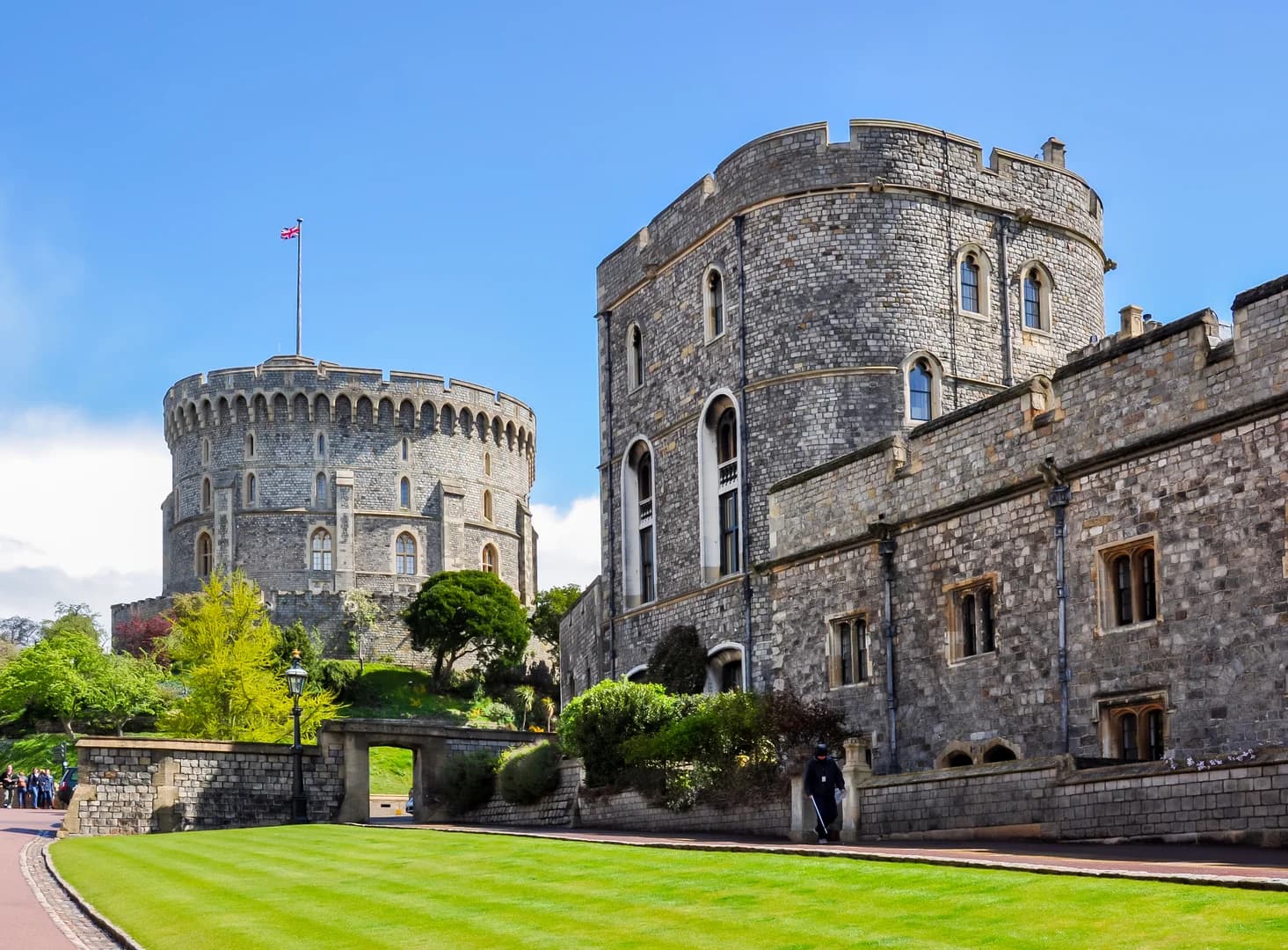
The Tower draws around 2.9 million visitors a year and Windsor sits 30 minutes up the Great Western. Ten castles and royal palaces within day-trip range of central London, with 2026 hours, prices and the active renovation closures (Hampton Court Great Gatehouse, Mantegna Gallery, Tower Middle Tower) that will reroute your visit.
London carries more accessible heritage castles within a 90-minute travel window than any other European capital. The Tower sits inside the City itself and pulled around 2.9 million visitors in 2024, the most-visited paid attraction in England.[1] Windsor, just outside the M25 in Berkshire, was founded around 1070 by William the Conqueror and has been a royal residence ever since.[2] Hampton Court is on a direct SWR service from Waterloo. Buckingham Palace State Rooms open ten weeks each summer while the King is at Balmoral. Kensington, Kew and the Banqueting House complete the inner-London royal-palace circuit; Hever, Leeds, Warwick, Bodiam and Dover sit in the day-trip ring beyond the M25.
Two important 2026 caveats. Hampton Court's Great Gatehouse is closed for conservation until June 2026 (entry rerouted via Seymour Gate), and the Mantegna Gallery is closed throughout 2026, reopening Spring 2027.[3] The Middle Tower at the Tower of London is closed for conservation until mid-June 2026.[1] Windsor's Semi-State Rooms reopen in autumn 2026.[2] Each entry below covers what to see, when to go, what it costs, and how to get there.
1. Tower of London
City of London, 5 min walk from Tower Hill Daily, year-round Crown Jewels and ravens Map
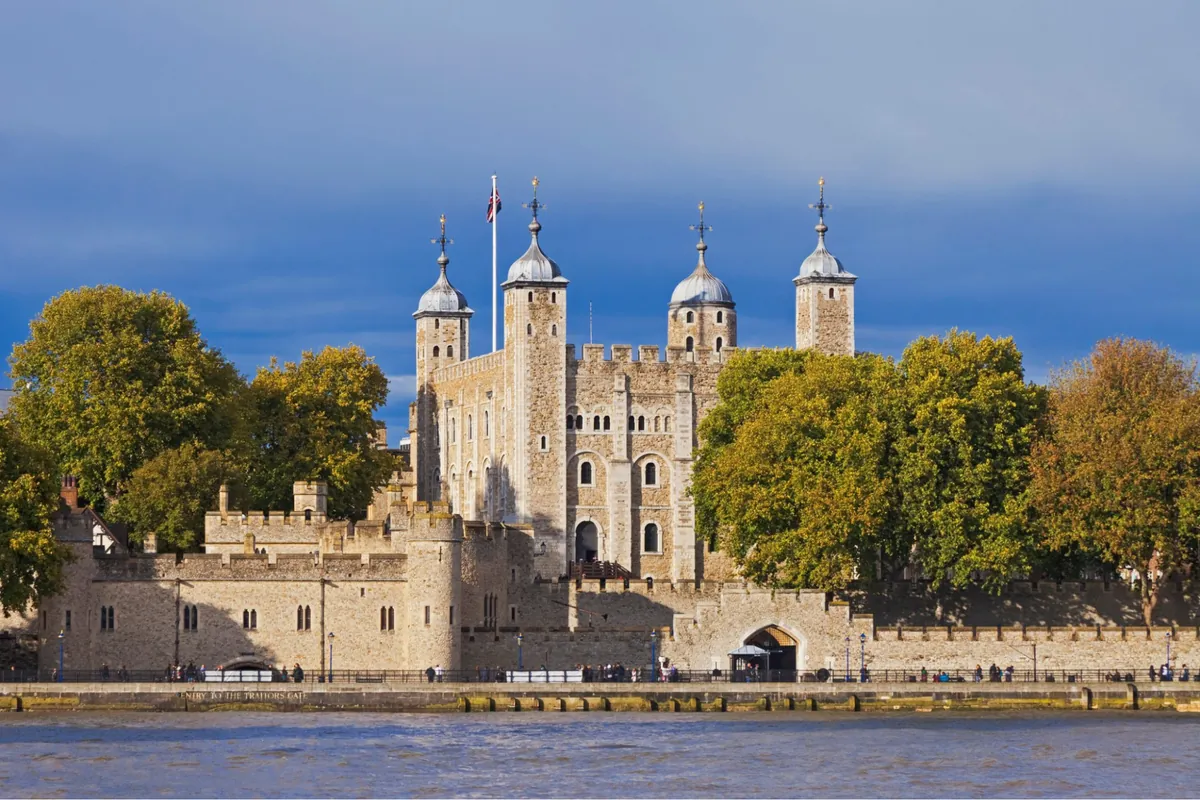
The White Tower, the central keep, was built under William the Conqueror and completed around 1078. The outer walls and moat were added by Richard the Lionheart, Henry III and Edward I across the 12th and 13th centuries. The Tower is inscribed on the UNESCO World Heritage List (1988) and is the most-visited paid attraction in England, with around 2.9 million visitors in 2024 per the Association of Leading Visitor Attractions.[1] Historic Royal Palaces runs it as an independent charity, with no UK government grant for normal operations.[4]
The canonical visit covers the Crown Jewels in the Jewel House, the White Tower (with the Royal Armouries display), the resident ravens, and a Yeoman Warder ("Beefeater") tour, included with admission and run every 30 minutes. Allow at least three hours; the Crown Jewels queue alone can run 30 to 60 minutes in peak season.
Practical: open daily from 09:00, last admission 15:30; closed 24 to 26 December and 1 January. The Middle Tower is closed for conservation until mid-June 2026.[1] Adult from £34.80 advance online, with concession (student/60+) £27.80, child (5 to 15) £17.40, under 5 free; family £96.50.[1] HRP also runs a £1 ticket scheme for visitors on certain UK benefits. Tube to Tower Hill (District/Circle), DLR to Tower Gateway. Plan your visit.[1]
2. Windsor Castle
~40 km, 30 to 55 min by train Open Thu to Mon Oldest occupied castle Map
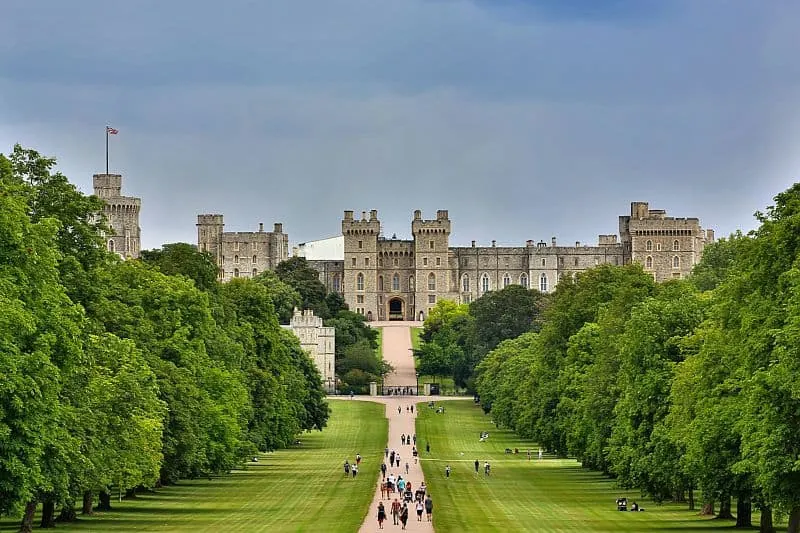
Windsor is the oldest occupied castle in the world. William the Conqueror founded it around 1070 on a chalk ridge above the Thames, and the royal family has been in residence in some form ever since.[5] Henry II rebuilt the keep in stone in the 1170s, Edward III rebuilt much of the interior in the 14th century to host the Order of the Garter (which still meets in St George's Chapel), and the Georgian and Victorian monarchs added the Long Walk and the State Apartments.
The 1992 fire was the last major event in the castle's structural history. It burned for 15 hours, damaged 115 rooms, and triggered a five-year, £37 million restoration involving 1,500 contractors, with 70% of the cost raised by opening Buckingham Palace to the public for the first time.[6] Windsor is also one of the canonical royal-event venues: the wedding of Prince Harry and Meghan Markle (May 2018) and the funeral of Queen Elizabeth II (September 2022) were both held in St George's Chapel.
Practical: open Thursday to Monday year-round, closed Tuesday and Wednesday. Hours vary by season; check the Royal Collection Trust before booking. Semi-State Rooms reopen autumn 2026.[2] Adult from £21 advance / £25 on-the-day; under-5s free; £1 ticket scheme for UK benefit recipients (up to 6 per household).[7] From central London, South Western Railway from Waterloo to Windsor & Eton Riverside (~55 min), or GWR from Paddington via Slough to Windsor & Eton Central (~30 to 40 min). Plan your visit.[2]
3. Hampton Court Palace
~25 km, 35 min by SWR train Daily, year-round Henry VIII's Tudor seat Map
Hampton Court was built by Cardinal Thomas Wolsey from 1515 as the grandest private house in Tudor England. Wolsey gifted it to Henry VIII in 1529 in a failed bid to keep his position, and Henry VIII enlarged it as his primary out-of-London residence. The Great Hall, the Tudor kitchens, the Royal Chapel and the brick Astronomical Clock are the most coherent pieces of Tudor palace architecture in the country. William III and Mary II later commissioned Sir Christopher Wren to add the Baroque east-facing State Apartments, which is why the building reads as two palaces grafted together. The Hampton Court maze (planted around 1700) is the oldest surviving hedge maze in Britain.
Two active 2026 closures matter. The Great Gatehouse is closed for conservation until June 2026, with entry rerouted via the Seymour Gate; and the Mantegna Gallery is closed throughout 2026 and reopens Spring 2027.[3] The Mantegna Gallery houses Andrea Mantegna's Triumphs of Caesar (acquired by Charles I in 1629); if they are the reason for your visit, postpone.
Practical: open daily, year-round. 26 March to 29 October 10:00 to 17:30; 30 October to 25 March 10:00 to 16:30. Last admission one hour before close. Closed 24 to 26 December.[3] Adult from £29 advance off-peak; child (5 to 15) £14.50, under 5 free; concessions and family options available; HRP members free.[3] SWR train from Waterloo to Hampton Court (~35 min), then 5 min walk across the bridge. Plan your visit.[3]
4. Buckingham Palace
Central London, 5 min from Green Park Tube 9 Jul to 27 Sep 2026 only Sovereign's London home Map
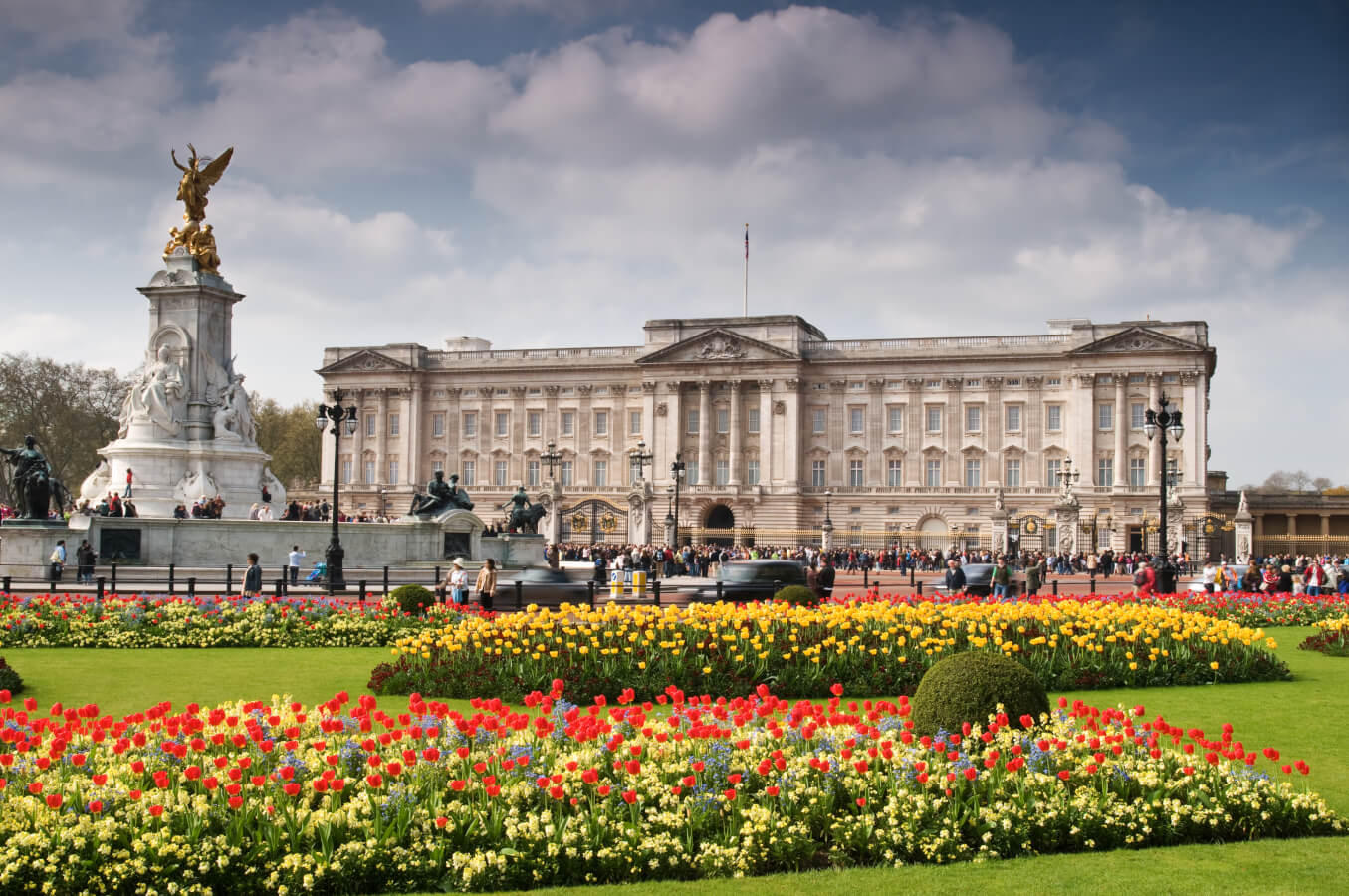
Buckingham Palace is the Sovereign's official London residence and a working palace; the State Rooms open to the public for around ten weeks each summer while the King is at Balmoral. The 19 State Rooms used for diplomatic and ceremonial functions are the visit: the Throne Room, the State Dining Room, the Music Room and the Picture Gallery (with Royal Collection works by Rembrandt, Rubens, Vermeer and Canaletto). The building was originally Buckingham House (1703), bought by George III in 1761, and enlarged by John Nash and later Edward Blore into the residence we recognise today.
Functionally a palace rather than a castle, it sits at the centre of any London royal-heritage itinerary, and the summer window is the only time the State Rooms are accessible. The Royal Mews and the King's Gallery operate on longer year-round schedules with separate ticketing.
Practical: State Rooms open 9 July to 27 September 2026 only.[8] 9 July to 31 August 09:30 to 19:30 (last entry 17:30); 1 to 27 September Thursday to Monday 09:30 to 18:30 (last entry 16:30), closed Tuesday and Wednesday. Adult from £33 (advance booking strongly advised); 18 to 24 from £21.50; child (5 to 17) £16.50, under-5s free (ticket required). On-the-day booking carries a £2 to £4 surcharge.[8] Tube to Green Park (5 min walk) or Victoria (10 min). Plan your visit.[8]
5. Kensington Palace
Central London, 5 min from Queensway Tube Wed to Sun Royal birthplace of Queen Victoria Map
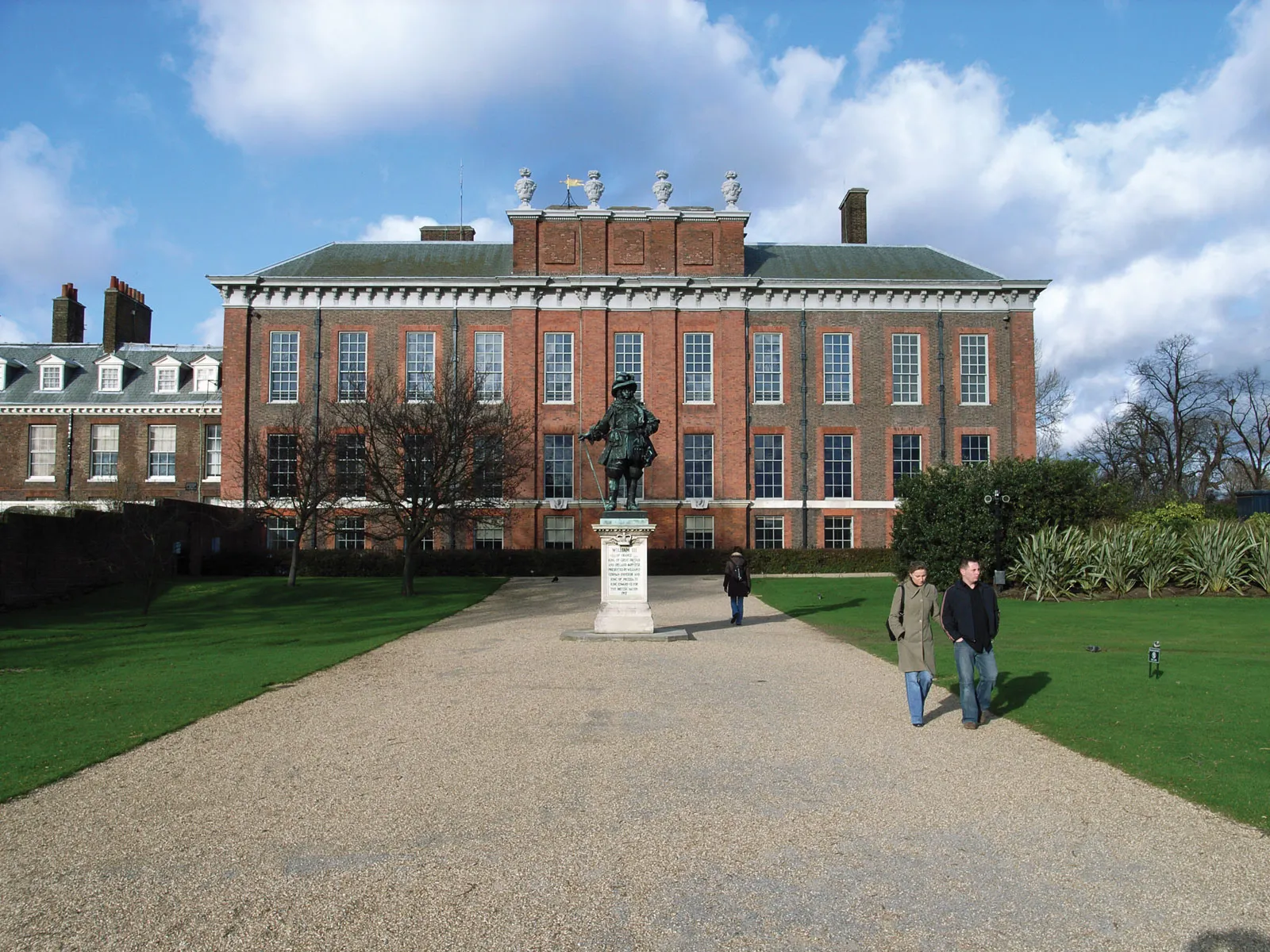
Kensington Palace was acquired by William III and Mary II in 1689 as a country alternative to Whitehall (William was asthmatic and the Whitehall air did not suit him). Sir Christopher Wren remodelled the building, and successive monarchs through to George II used it as their primary London residence. Queen Victoria was born and grew up here; she received word of her accession in the King's Drawing Room on 20 June 1837. Today the State Apartments are the public visit; the working royal apartments (the Prince and Princess of Wales's London residence) remain private.
The visit threads through the King's State Apartments (with the Tijou ironwork staircase), the Queen's State Apartments, the Pigott Galleries (Royal Ceremonial Dress, including Princess Diana's wedding dress), and the Sunken Garden, which was Queen Elizabeth II's favourite. Pair with a walk through Kensington Gardens to the Albert Memorial.
Practical: Wednesday to Sunday, closed Monday and Tuesday. March to October 10:00 to 18:00 (last entry 17:00); November to February 10:00 to 16:00 (last entry 15:00). Adult from £20; under 5 free; £1 ticket scheme for UK benefit recipients; HRP members free.[9] Tube to Queensway, Bayswater (Central) or High Street Kensington (District/Circle). Plan your visit.[9]
6. Kew Palace
Central London, ~30 min by Tube Apr to Sep only George III's family home Map
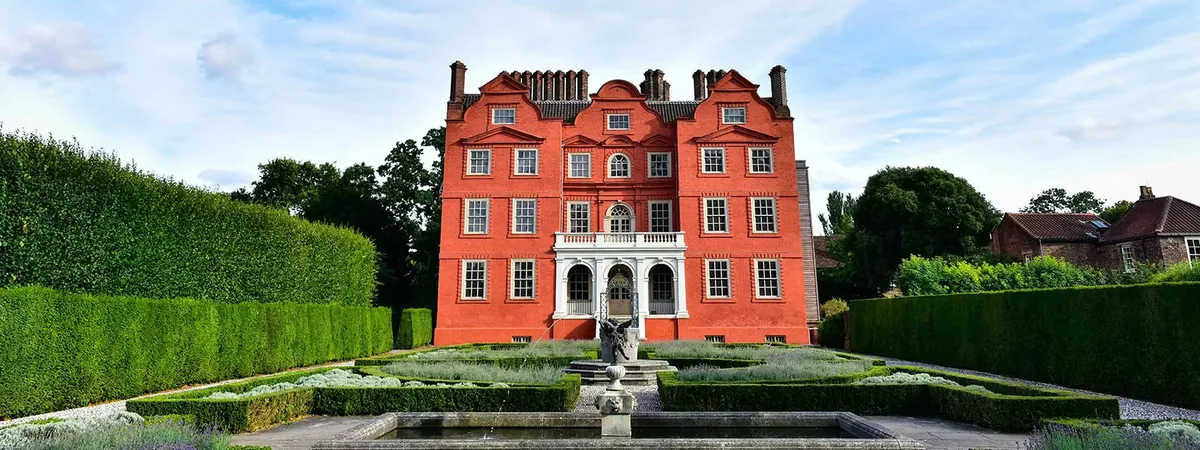
Kew Palace is the smallest of the working royal residences, a four-storey red-brick Dutch-gabled house built in 1631 by a London merchant. It became royal property under George II and George III, who used it as a quiet family residence; George III spent some of his final illness here, and Queen Charlotte died at Kew in 1818. The intimate scale (a domestic royal house, not a state palace) is the reason to visit, set among the Royal Botanic Gardens.
Access is by Royal Botanic Gardens ticket only; once inside the Gardens, entry to the Palace is included free. Open seasonally April to September.
Practical: April to September only, daily 11:00 to 17:00 (within Gardens hours); closed October to March.[10] Kew Gardens entry from £23.50 (peak adult); concessions available; child (4 to 15) £6, under 4 free. HRP members get 10% off the Gardens ticket and free entry to Kew Palace inside. District Line or London Overground to Kew Gardens station; SWR Waterloo to Kew Bridge. Plan your visit.[10]
7. Banqueting House Whitehall
Central London, 5 min from Westminster Tube Open Days plus summer season Rubens ceiling, Inigo Jones Map
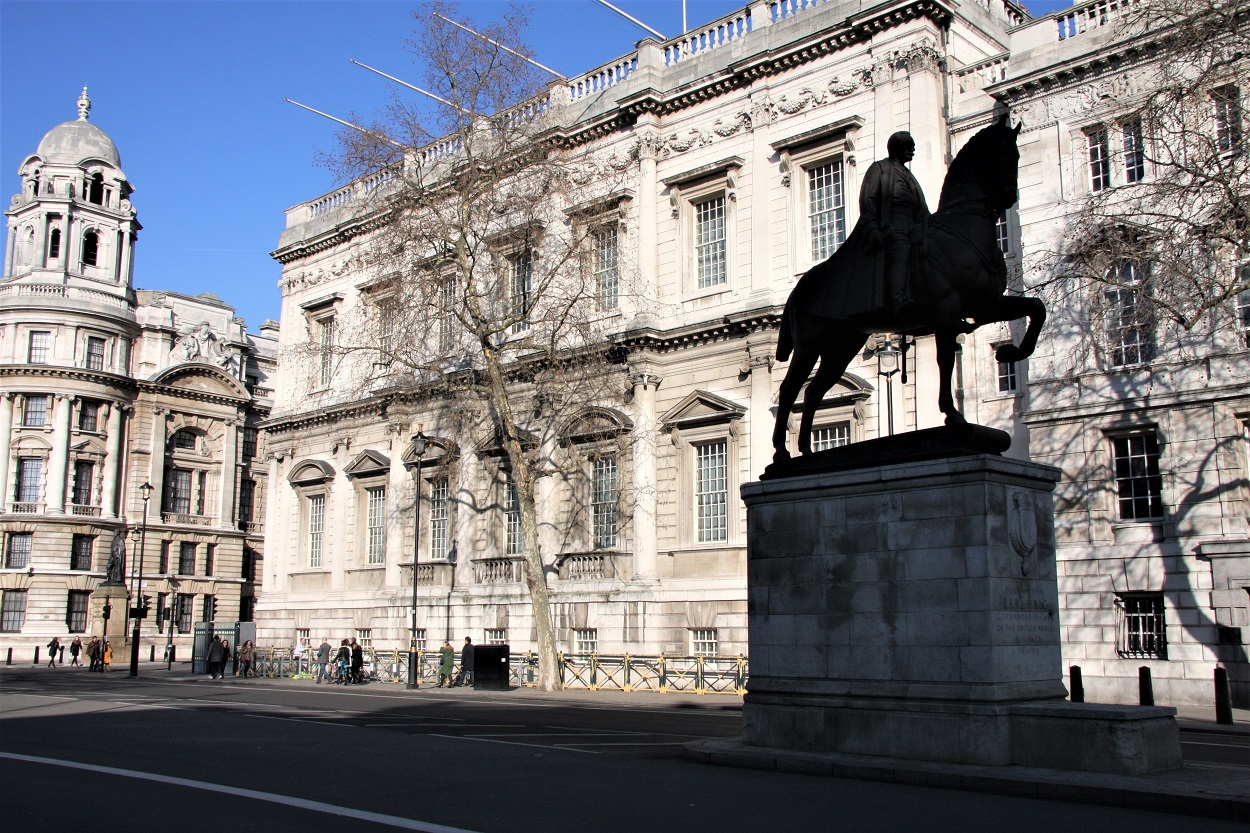
Inigo Jones designed the Banqueting House for James I in 1622, the first fully Palladian building in England and the surviving fragment of the otherwise-destroyed Palace of Whitehall (which burned in 1698). The Rubens ceiling, The Apotheosis of James I, was commissioned by Charles I and installed in 1636, the only surviving in-situ Rubens ceiling in the world. Charles I was executed on a scaffold outside the first-floor window on 30 January 1649.
Most London royal-palace itineraries skip the Banqueting House because it is one room rather than a complex. That is also what makes it worth the hour: a single, near-perfect Renaissance interior with the Rubens overhead.
Practical: opening pattern is limited. 2026 Open Days: 1 May, 29 May, 26 June. Summer season 3 August to 20 September 2026, Thursday to Monday 10:00 to 16:00 (last entry 15:00).[11] Pricing not currently extractable from the operator's site; HRP members free. Tube to Westminster or Charing Cross. Plan your visit.[11]
8. Hever Castle
~50 km, 60 to 75 min by train Daily, mid-Feb to mid-Nov Anne Boleyn's childhood home Map
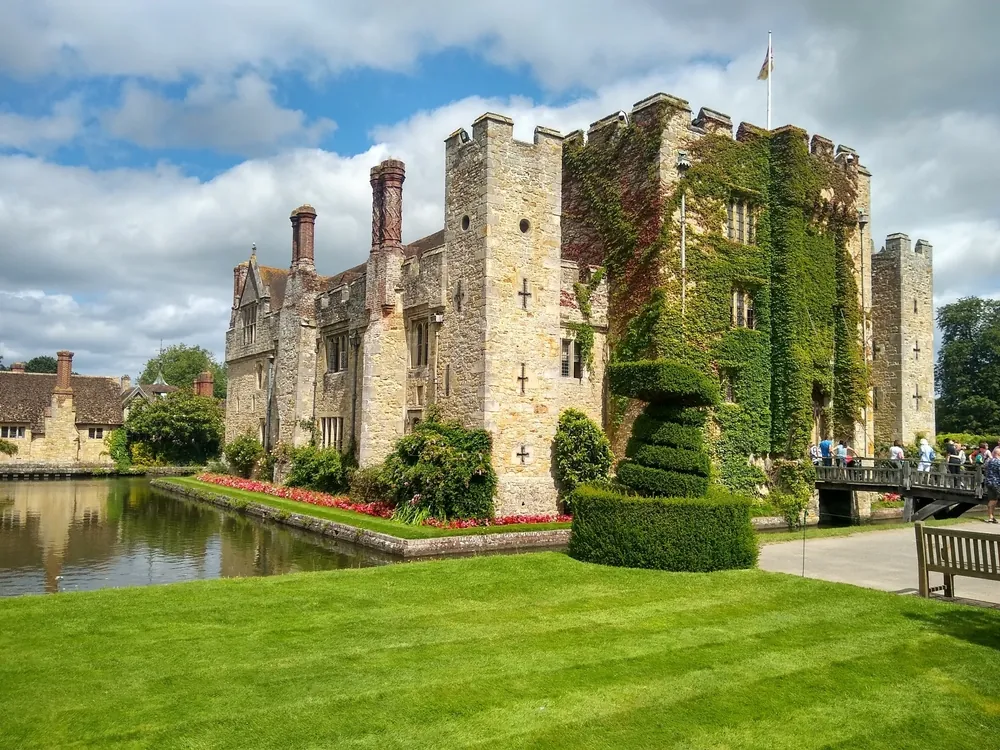
Hever was the childhood home of Anne Boleyn, second wife of Henry VIII. The moated medieval manor at the core dates from the 13th century, with Tudor additions made by Anne's grandfather Sir Geoffrey Bullen. The castle then ran through several owners (including Anne of Cleves, who received it as part of her divorce settlement from Henry VIII in 1540) before falling into decline. It was rescued in 1903 by the American newspaper baron William Waldorf Astor, who bought it and restored and extended it "at almost limitless expense, so he could live out his medieval fantasies, in Edwardian comfort", per Cannadine's Decline and Fall of the British Aristocracy.[12] Astor added the mock-Tudor village, the Italian Garden, the lake and the formal yew maze.
The visit covers the Tudor manor (with Anne Boleyn's prayer books and a portrait collection), the Astor Wing, the gardens, lake, yew maze and rose garden. Allow three to four hours.
Practical: open daily 11 February to 19 November 2026. Gardens from 10:30, castle from 12:00; last entry 16:30 (summer) / close 16:30 (winter). Adult castle and gardens £25.50 advance / £28.40 on-the-day; senior/student £22.60 / £25.10; child £14.05 / £15.60; family £66.60 advance.[13] From London, train from London Bridge or Victoria to Hever station (~75 min), then a 1 mile walk. Plan your visit.[13]
9. Leeds Castle
~70 km, 60 min by train + shuttle bus Daily, year-round Pay once, return all year Map
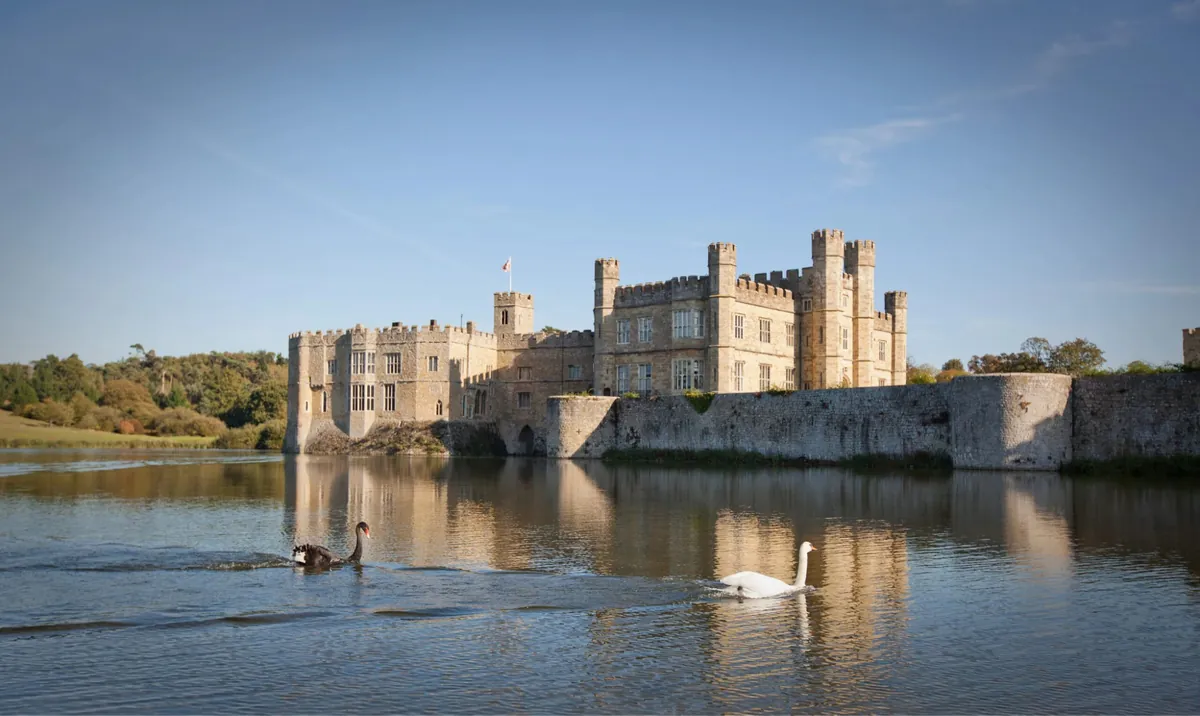
Leeds Castle stands on two small islands in the River Len in Kent, a 12th-century Norman fortification that became a 13th-century royal palace under Edward I and was used by six medieval queens of England. Henry VIII gave it to Catherine of Aragon. Lady Olive Baillie (the Anglo-American heiress who bought it in 1926) bequeathed it in 1974 to the Leeds Castle Foundation, which has run it privately since.[14] Country Life (1939) famously called it "the loveliest castle in the world".
The visit covers the medieval castle (with the Maiden's Tower, Heraldry Room and Lady Baillie's 1930s bedroom suite), the maze and grotto, the falconry, the gardens and 500 acres of grounds. Every standard adult day ticket converts into a one-year return pass.
Practical: open daily year-round; closed 25 December and during the Leeds Castle Concert (11 July 2026).[14] 1 April to 30 September: grounds 10:00 to 18:00 (last entry 16:00), castle 10:30 to 17:00. Winter: grounds 10:00 to 17:00, castle 10:30 to 15:30.[14] Adult £24.50 online / £25.50 walk-up; child (4 to 15) from £16.50; family Annual Pass £70 online (2 adults + 4 children); 20% off for visitors arriving by train, bus or bike.[14] Southeastern train from London Victoria to Bearsted (~60 min), then shuttle bus to the castle. Plan your visit.[14]
10. Warwick Castle
~165 km, 90 min by train Daily, year-round Jousts and trebuchet Map
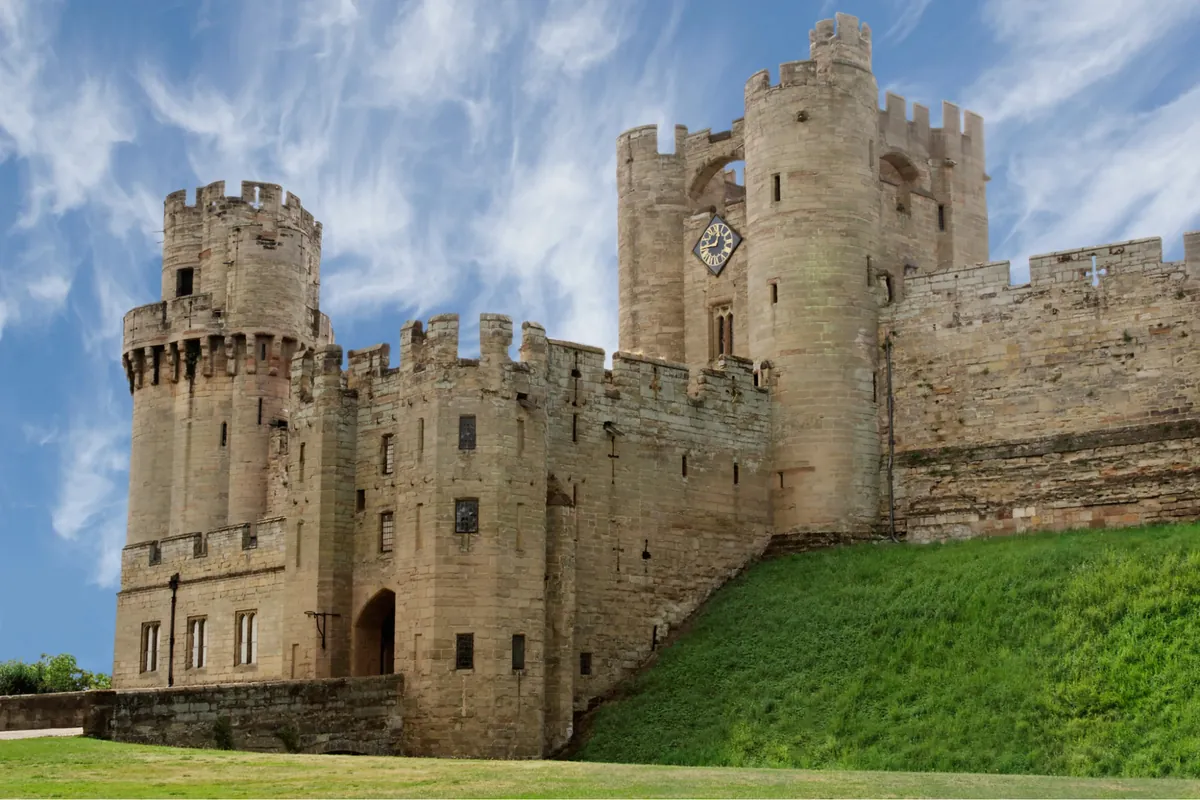
Warwick is on the upper Avon, founded in 1068 by William the Conqueror as a motte-and-bailey and rebuilt in stone in the 12th century. The Beauchamp and Greville families held it across most of the medieval and early-modern era; Caesar's Tower and Guy's Tower (both 14th century) are among the finest surviving examples of English military architecture from the period. Merlin Entertainments has run it since 2007 as a heritage-and-events attraction, with daily jousting, the State Rooms, the Great Hall, the Mound (the 11th-century motte) and the world's largest working trebuchet.
The format is more theme-park than purist heritage: the Castle Dungeon, bird-of-prey shows and period-costume actors are part of the offer. As a full-day from London by train, it works well.
Practical: open daily; April to October typically 10:00 to 17:00 (extended on event days); November to March typically 10:00 to 16:00.[15] Closed 25 December; closed/reduced days possible, check the daily calendar. Adult day ticket from £26 advance online; under 2 free; family/group tickets available; Annual Pass from £49.[15] Chiltern Railways from London Marylebone to Warwick (~90 min direct), then 15 min walk to the castle. Plan your visit.[15]
11. Bodiam Castle
~95 km, 90 min by train + bus Daily, year-round Moat-ringed medieval icon Map
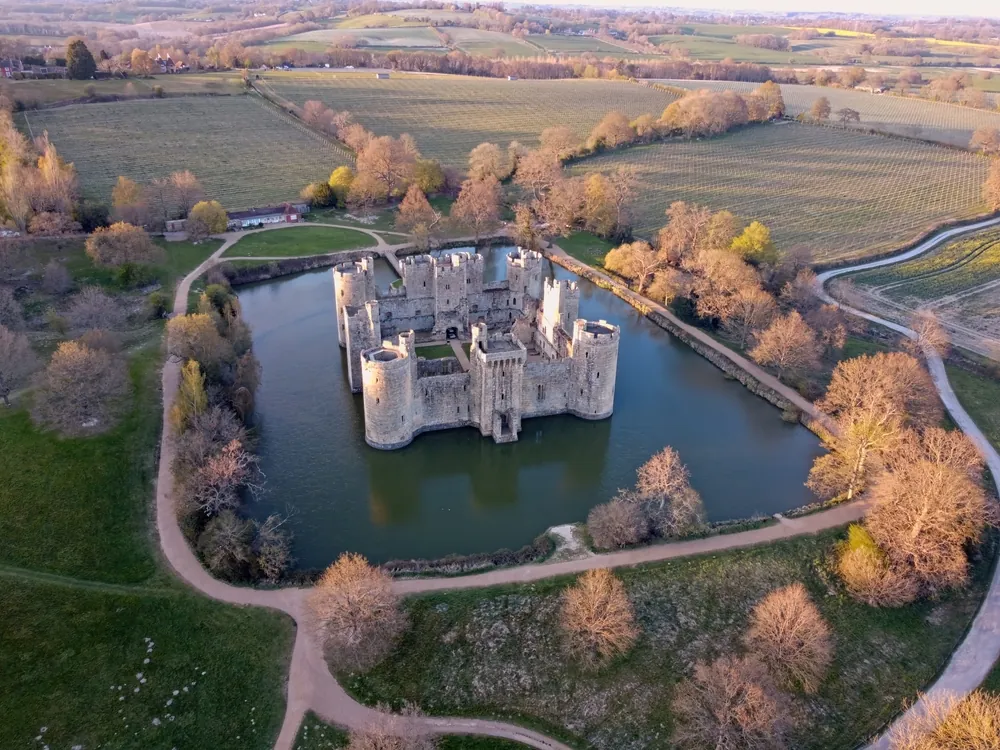
Bodiam was built in 1385 by Sir Edward Dallingridge, a knight who served in the French wars under the Black Prince, ostensibly to defend the Sussex coast against French raids. The result is the most photographically perfect surviving moated medieval castle in England: a square plan with round corner towers, all four sides reflected in the broad water-filled moat. Lord Curzon bought the ruin in 1916 and led a research-based restoration in 1919 to 1921; the architectural historian John Goodall describes the project as involving "a year of research and excavations with a staff of around twenty-five men" under the architect William Weir.[6] Curzon bequeathed the castle to the National Trust in 1925.
The interior is roofless (the building was slighted in the English Civil War) but the towers, gatehouse, portcullis and curtain walls are largely intact and walkable.
Practical: open daily 10:00 to 17:00, year-round (last entry 30 minutes before close). Peak prices apply 23 July to 2 September.[16] Adult from £13 standard / £14.30 with Gift Aid; child from £6.50; family (2 adults + 3 children) from £32.50; National Trust members free.[16] From London, Southeastern train to Robertsbridge (~90 min via Tunbridge Wells), then Stagecoach 349 bus, or seasonal Kent and East Sussex Railway steam train from Tenterden. Plan your visit.[16]
12. Dover Castle
~125 km, 75 min by High Speed 1 Daily Apr to Oct Secret wartime tunnels Map
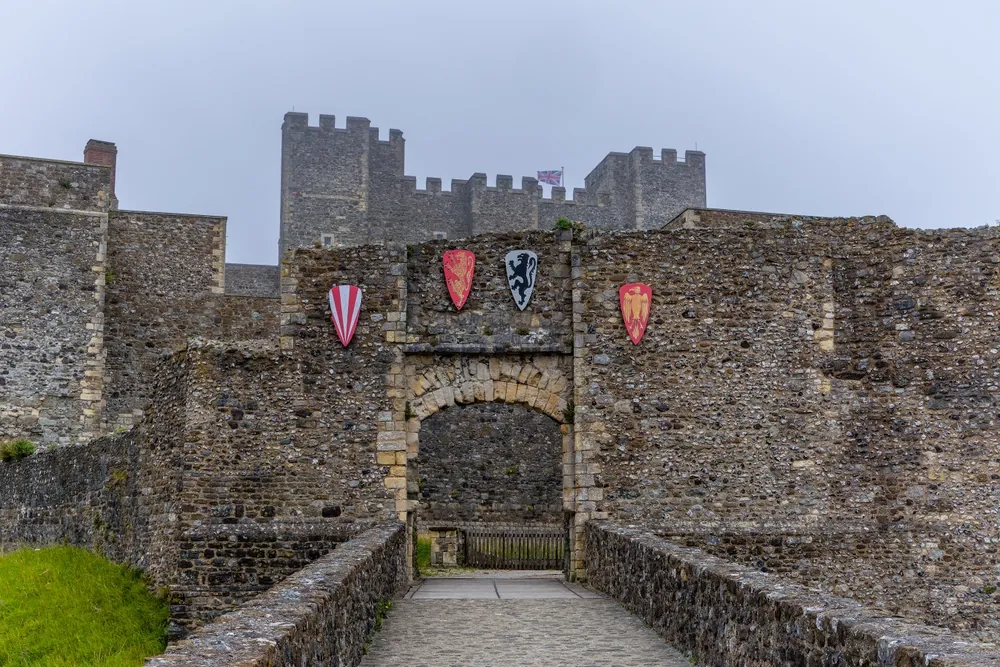
Dover is the largest English castle by extent. The Roman pharos within the inner bailey dates to the 2nd century AD; Henry II built the great keep and inner curtain wall between 1180 and 1185, and successive monarchs added the outer walls. Its modern significance comes from beneath: the Dover Castle tunnels, cut into the chalk cliff in the Napoleonic period and extended in the Second World War, served as the underground command centre for Operation Dynamo, the Dunkirk evacuation of May to June 1940.[17] Vice-Admiral Bertram Ramsay commanded from a deep tunnel office; the war-cabinet briefing room is preserved.
The tunnels are the headline draw, but the Henry II keep, with its Romanesque chapel and reconstructed Great Tower interiors, is the heritage centrepiece. Allow a full day; the tunnels alone need 60 to 90 minutes.
Practical: 28 March to 24 October daily 10:00 to 17:00 (last entry 16:00); reduced winter hours and weekend-only periods between November and December.[17] Closed 24 to 26 December. Adult from ~£23.60 walk-up (advance saves around 15%); senior, student, child and family tiers available; English Heritage members free.[17] Southeastern High Speed 1 from London St Pancras to Dover Priory (~75 min), then 15 min walk or short taxi. Plan your visit.[17]
At a glance
| Castle | Distance | How to get there | |
|---|---|---|---|
| Tower of LondonCrown Jewels and ravens | City of London, 5 min walk from Tower Hill | — |
| Windsor CastleOldest occupied castle | ~40 km, 30 to 55 min by train | — |
| Hampton Court PalaceHenry VIII's Tudor seat | ~25 km, 35 min by SWR train | — |
| Buckingham PalaceSovereign's London home | Central London, 5 min from Green Park Tube | — |
| Kensington PalaceRoyal birthplace of Queen Victoria | Central London, 5 min from Queensway Tube | — |
| Kew PalaceGeorge III's family home | Central London, ~30 min by Tube | — |
| Banqueting House WhitehallRubens ceiling, Inigo Jones | Central London, 5 min from Westminster Tube | — |
| Hever CastleAnne Boleyn's childhood home | ~50 km, 60 to 75 min by train | — |
| Leeds CastlePay once, return all year | ~70 km, 60 min by train + shuttle bus | — |
| Warwick CastleJousts and trebuchet | ~165 km, 90 min by train | — |
| Bodiam CastleMoat-ringed medieval icon | ~95 km, 90 min by train + bus | — |
| Dover CastleSecret wartime tunnels | ~125 km, 75 min by High Speed 1 | — |
Two further inner-London options sit just outside the standard royal-palace circuit. Eltham Palace in southeast London (English Heritage) pairs a surviving medieval royal great hall with a 1930s Stephen and Virginia Courtauld Art Deco mansion: open daily 10:00 to 17:00, adult from £15.38 off-peak Super Saver / £19.29 peak, with a tiered dynamic-pricing model.[18] Fulham Palace, the former Bishops of London residence in southwest London, is open daily 10:30 to 16:00 with free admission to the museum, gardens and historic rooms.[19]
How many castles near London?
There is no single tally, but the major operating bodies between them run roughly two dozen ticketed heritage castles and royal palaces within day-trip range of central London. Historic Royal Palaces runs five (Tower, Hampton Court, Kensington, Banqueting House, Kew), self-funded with no UK government grant for normal operations.[4] The Royal Collection Trust runs Windsor and the Buckingham Palace State Rooms, with admissions of £29.5 million at Windsor and £25.3 million across the London RCT sites in 2024/25.[7] English Heritage runs Dover, Eltham and several smaller fortifications inside the M25; the National Trust runs Bodiam. Privately operated castles (Hever, Leeds, Warwick) complete the day-trip ring. Marc Morris records that within decades of 1066, William the Conqueror and his lords had constructed several hundred motte-and-bailey castles across England, many later rebuilt in stone, which is why the south-east cluster is so dense.[20]
The Tower of London is the only fully intact medieval castle inside the City of London itself. That is the simple answer to the most-asked question about castles inside London proper.
Famous, medieval, Gothic and largest
Famous. The Tower of London leads, with around 2.9 million visitors a year.[1] Windsor and Hampton Court are the next two. Buckingham Palace is famous as a residence rather than a visitor attraction (open only ten weeks a year). Warwick is the most visited of the day-trip-by-train options.
Medieval. The Tower (11th to 13th century) is the canonical example. Bodiam (1385) is the most photographically perfect surviving moated castle in England.[16] Dover's Henry II keep (1180s) is the largest piece of Norman-Plantagenet military architecture in the south-east. Leeds Castle's 12th-century core, still on its two islands in the River Len, is the most picturesque of the day-trip medieval survivors.
Gothic. Most of the working royal palaces are post-medieval. The Chapel Royal at the Tower retains medieval Gothic fabric; St George's Chapel at Windsor (rebuilt by Edward IV from 1475) is the most substantial Perpendicular Gothic interior in any English royal palace. Eltham Palace's surviving medieval great hall is a 15th-century hammer-beam Gothic interior tucked into a 1930s Art Deco shell.[18]
Largest. Windsor is the largest inhabited castle in the world by floor area.[2] Dover is the largest English castle by extent.[17] Hampton Court is the largest of the Tudor royal palaces. Warwick has the largest working trebuchet in the world.[15]
If you're looking to buy
Christie's State of Luxury 2025 describes London as "the hub of Europe's luxury real estate market", retaining global primacy in their broker network's assessment even after recent regulatory headwinds.[21] The historic context is older: Cannadine and Tinniswood document the Anglo-American buyer pattern at Hever (William Waldorf Astor, 1903) and the 50% death duty regime applied to estates over £2 million by the late 1920s, the structural driver of 20th-century country-house ownership transitions.[12] [22] Castle Collector's Castle Price Index (March 2026) tracks the current UK median listing; the south-east of England (Kent, Sussex, Surrey, Berkshire) carries the strongest concentration of fortified-manor and moated-house listings within day-trip range. If you're seriously looking, the castles for sale in England page tracks current listings, and our guide to buying a castle covers transaction costs (~5 to 7%, including stamp duty land tax), foreign-buyer mechanics and restoration budgeting.
Sources
1. Tower of London, Historic Royal Palaces.
2. Windsor Castle, Royal Collection Trust.
3. Hampton Court Palace, Historic Royal Palaces.
4. Historic Royal Palaces, Annual Review 2024-25.
5. Lepage, Jean-Denis G.G. Castles and Fortified Cities of Medieval Europe: An Illustrated History. McFarland & Company, 2002; p. 176.
6. Goodall, John. The Castle: A History. Yale University Press, 2022; pp. 328, 350-352.
7. Royal Collection Trust, Annual Review 2024-25.
8. Buckingham Palace, Royal Collection Trust.
9. Kensington Palace, Historic Royal Palaces.
10. Kew Palace, Historic Royal Palaces.
11. Banqueting House, Historic Royal Palaces.
12. Cannadine, David. The Decline and Fall of the British Aristocracy. Yale University Press, 1990 (Vintage paperback 1999); pp. 80-90, 358, 645.
13. Hever Castle, official site.
14. Leeds Castle, Leeds Castle Foundation.
15. Warwick Castle, official site (Merlin Entertainments).
16. Bodiam Castle, National Trust.
17. Dover Castle, English Heritage.
18. Eltham Palace and Gardens, English Heritage.
19. Fulham Palace, official site.
20. Morris, Marc. Castles: Their History and Evolution in Medieval Britain. Pan Macmillan, 2003; pp. 50-90.
21. Christie's International Real Estate, The State of Luxury: 2025 Regional Market Outlook. p. 12.
22. Tinniswood, Adrian. Noble Ambitions: The Fall and Rise of the English Country House After World War II. Basic Books, 2021; chapters 22, 26 and 28.