
Castles near Aberdeen: 10 Aberdeenshire castles, from Dunnottar to Balmoral
Craigievar's pink-rendered tower inspired Disney; Dunnottar hid Scotland's Crown Jewels in 1651. Plus Castle Fraser, Crathes, Drum and 3 more in Aberdeenshire.
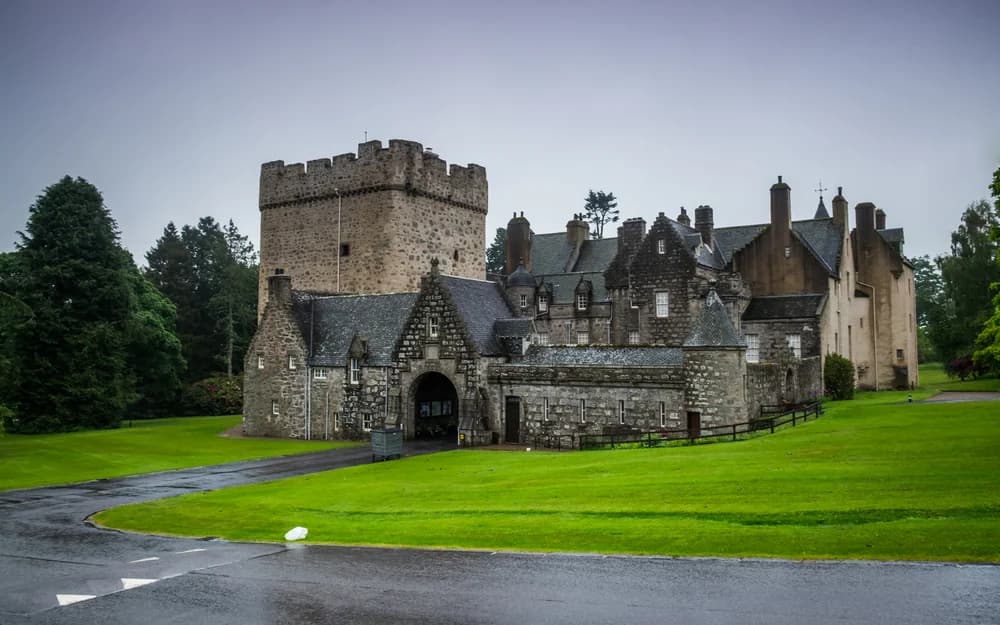
Aberdeenshire holds the densest cluster of intact tower houses in Scotland. Ten castles within ninety minutes of the city: a sea-cliff Crown Jewels hideaway, a pink-harled fairytale silhouette, and the Royal Family's private Highland retreat.
Aberdeen sits at the centre of a castle landscape that has no real parallel anywhere else in Britain. The Victorian architectural survey by MacGibbon and Ross, still the foundational reference for Scottish castle architecture, singled out Aberdeenshire as the region where the local corbelling style was "most profusely ornamented" of anywhere in Scotland.[1] Hubert Fenwick's 1976 survey Scotland's Castles reads the same shire as the densest concentration of intact 16th and 17th century tower houses in the country, naming Craigievar, Crathes, Craigston, Delgatie, Corgarff, Tolquhon and Dunnottar as the surviving cluster.[2]
The reason is medieval clan geography. Most of these properties were built by four families across an overlapping 14th-to-17th-century stretch: the Gordons around Huntly, the Forbes at Craigievar and Tolquhon, the Burnetts of Leys at Crathes, and the Irvines at Drum. Drum has the deepest pedigree of the four. Robert the Bruce gave William de Irwyn the lands in 1323 as personal reward for service at Bannockburn, and the Irvine family held it without interruption until the property passed to the National Trust for Scotland in 1976: 653 years of continuous family ownership.
The ten below cover the spread, from the National Trust trio closest to the city (Drum, Crathes, Craigievar) to Dunnottar's sea-cliff drama south of Stonehaven, the Historic Environment Scotland properties at Huntly and Tolquhon, and the 90-minute run west on Royal Deeside to Balmoral. Each entry covers what to see, when to go, what it costs, and how to get there from Aberdeen.
1. Dunnottar Castle
27 km 30 min Open daily, all year Crown Jewels stronghold Map
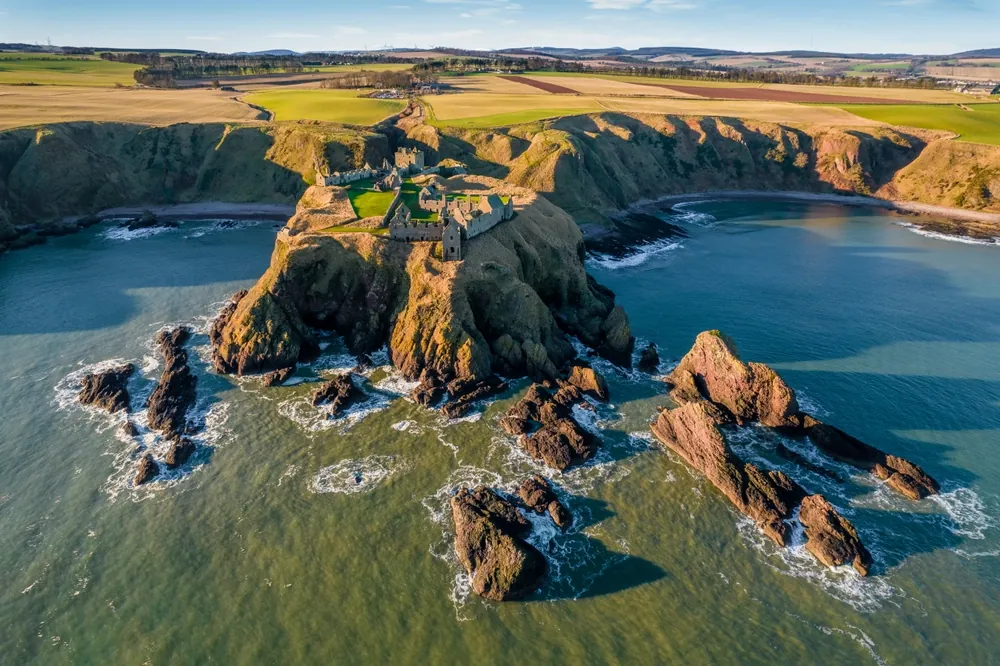
Dunnottar rises on a cliff promontory above the North Sea about a mile and a half south of Stonehaven. The site has been fortified since at least the 5th century; the surviving castle dates to the 14th century onwards under the Keith family, hereditary Earls Marischal of Scotland. The single episode that draws most visitors is the Crown Jewels story. In September 1651, with Cromwell's army threatening Edinburgh, the Honours of Scotland (the Scottish crown, sceptre and sword of state) were smuggled to Dunnottar. The castle then survived an eight-month English siege; the regalia were eventually slipped out under the skirts of a parish minister's wife and buried under the floor of Kinneff Old Kirk a few miles down the coast, where they stayed until the 1660 Restoration.[3]
The Whigs' Vault is the other set-piece. In 1685, 167 Covenanters were imprisoned in a single cellar through a long summer, with deaths from disease and torture. The vault is still visible. Beyond the dramatic history, the cliff path down to the entrance and the gulls wheeling off the headland are the reason photographers come at sunrise and sunset.
Practical: open daily year-round (closed 17 December, 25–26 December, 1–2 January). Hours vary seasonally: 09:00–18:00 April–September; 10:00–17:00 in October dropping to 10:00–15:00 through the depths of winter. Adult £13, concession £11.50, child £6, family (2 adults, 2 children) £32. Card payment only. May close in adverse weather. From Aberdeen by car, 30 minutes south on the A92; the castle sits 1.6 miles south of Stonehaven on the coastal trail. Stonehaven railway station is the closest. Plan your visit.[3]
2. Drum Castle
16 km 25 min Tours, varied days 13th-century tower of Irvines Map
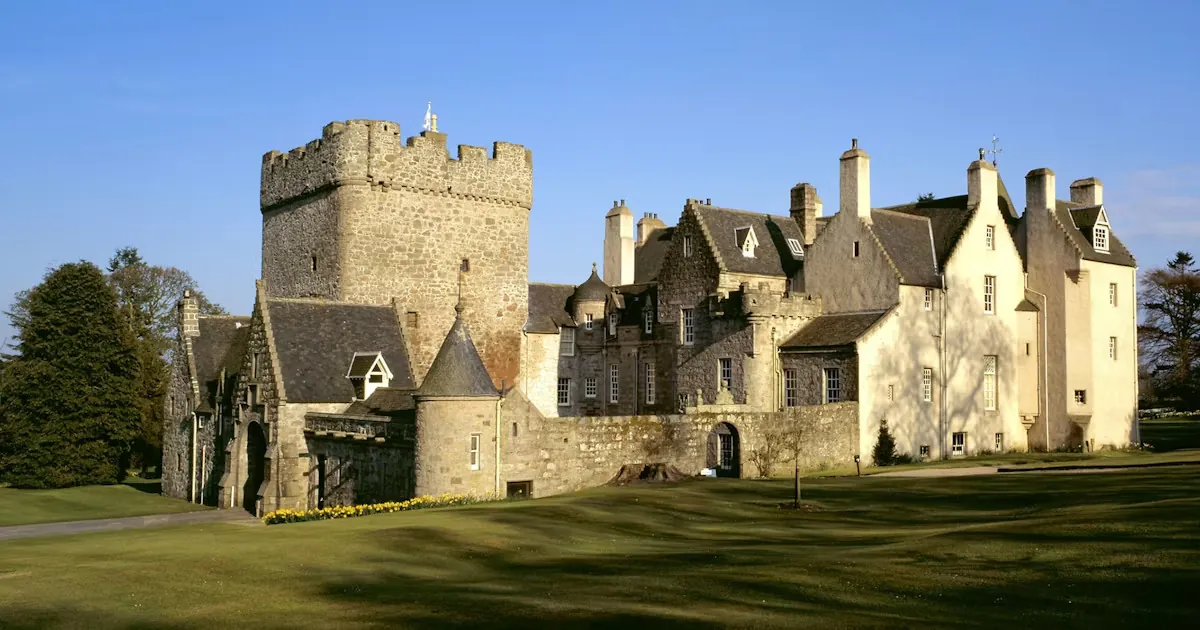
The keep at Drum was built in the 14th century and described in the MacGibbon and Ross survey as "the keep of this castle has already been described along with the other castles of the fourteenth century"; the Jacobean mansion was added "in the beginning of the seventeenth century" along the east and south sides of the courtyard.[1] Two distinct periods of Scottish castle architecture coexist in a single stone shell. The lands came to the Irvine family in 1323 as a personal grant from Robert the Bruce, in reward for service at Bannockburn nine years earlier; the family held the property continuously until 1976.
The walled garden is one of the finest in Scotland, laid out in four separate "rooms" that document garden design from the 17th to the 20th century, and the historic-rose collection within is internationally regarded. The Old Wood of Drum, surrounding the castle, is a surviving fragment of the great Caledonian forest, with red squirrels, roe deer and red kites in residence.
Practical: open by guided tour, daily 1 June–30 August (10:30–16:30, last tour 15:15); reduced days through spring and autumn; closed in deep winter. Adult around £14.50; NTS members free. Family pricing not confirmed via primary source. From Aberdeen by car, 25 minutes west on the A93 to Drumoak. Plan your visit.[4]
3. Crathes Castle
24 km 30 min Daily Apr–Oct Painted ceilings, Garden of the year Map
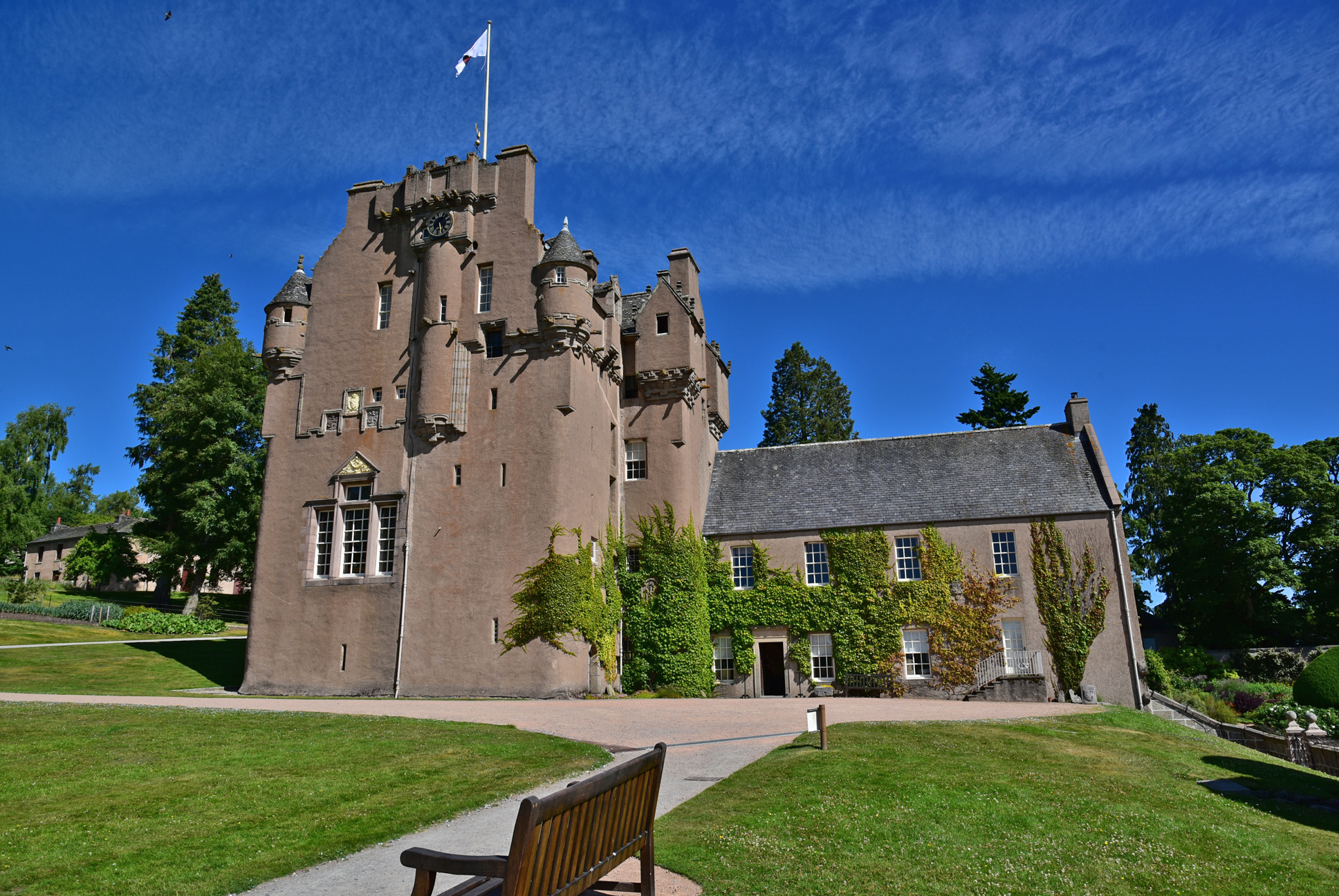
Crathes has been the Burnett of Leys family seat since 1596, built by Alexander Burnett of Leys and completed by his son. The Jacobean painted ceilings, dating to 1599–1602, are among the finest surviving in Scotland, depicting biblical scenes alongside the Nine Worthies, the Nine Muses and the Seven Cardinal Virtues. The MacGibbon and Ross architectural survey treats Crathes (1553 in their dating of the original tower) and Craigievar (1626) as the two canonical surviving examples of the Scottish-Renaissance tower house.[1]
The walled garden was planted in 1702. Ancient yew hedges divide the layout into eight themed garden "rooms", and the structure has barely changed in 320 years. The ivory Horn of Leys, in the Great Hall, is by family tradition the original token of the 1323 grant from Robert the Bruce that gave the Burnetts their land. Crathes tends to win Garden of the Year prizes more often than any other Scottish property.
Practical: castle open daily April–October 10:30–16:45; Thursday–Sunday in winter 10:30–15:45 (closed Monday–Wednesday); closed late December–early January. Adult £18, concession £15, child £12; NTS members free. From Aberdeen by car, 25 minutes west on the A93; Stagecoach 201/202 from the city stops at Crathes. Plan your visit.[4]
4. Craigievar Castle
42 km 50 min Guided tour only Pink fairytale tower house Map
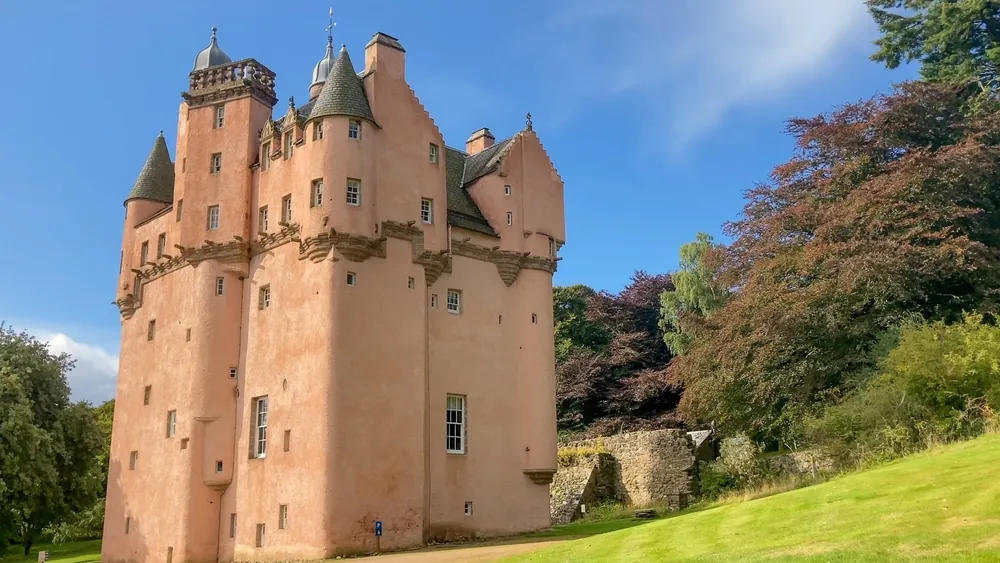
Craigievar is the architectural standout of the Aberdeenshire towers. William Forbes had it finished in 1626; MacGibbon and Ross described its setting as "delightfully situated amidst old woods in the quiet glen of the Leochel Burn, about half way between Lumphanan and Alford" and called it "one of the best preserved and characteristic examples of the mansion-house of the Fourth Period".[1] The seven storeys, the pink harling, and the upper-floor riot of corbelled turrets and cupolas produce what is widely regarded as the most photogenic silhouette in Scotland. The "fairy-tale castle" vocabulary in 20th-century popular culture is often credited to Craigievar's outline, though the documentary connection is anecdotal rather than firmly established.
Almost 400 years on, very little of the structure has changed. The upper floors of the castle are kept free of artificial light to preserve the historic atmosphere. Visits run by guided tour only, capped at ten people per slot at roughly 45-minute intervals on a first-come basis.
Practical: open seasonally on guided-tour basis. June–August daily 10:00–16:15; Friday–Monday only in spring and early autumn shoulder months; weekends only late September to late October; closed November–March. Adult £13, concession £10, family rates from £25; NTS members free. From Aberdeen by car, 50 minutes west via the A944 and A980 to a point about six miles south of Alford, on the Castle Trail. Plan your visit.[4]
5. Castle Fraser
26 km 40 min Seasonal, NTS Z-plan tower house Map
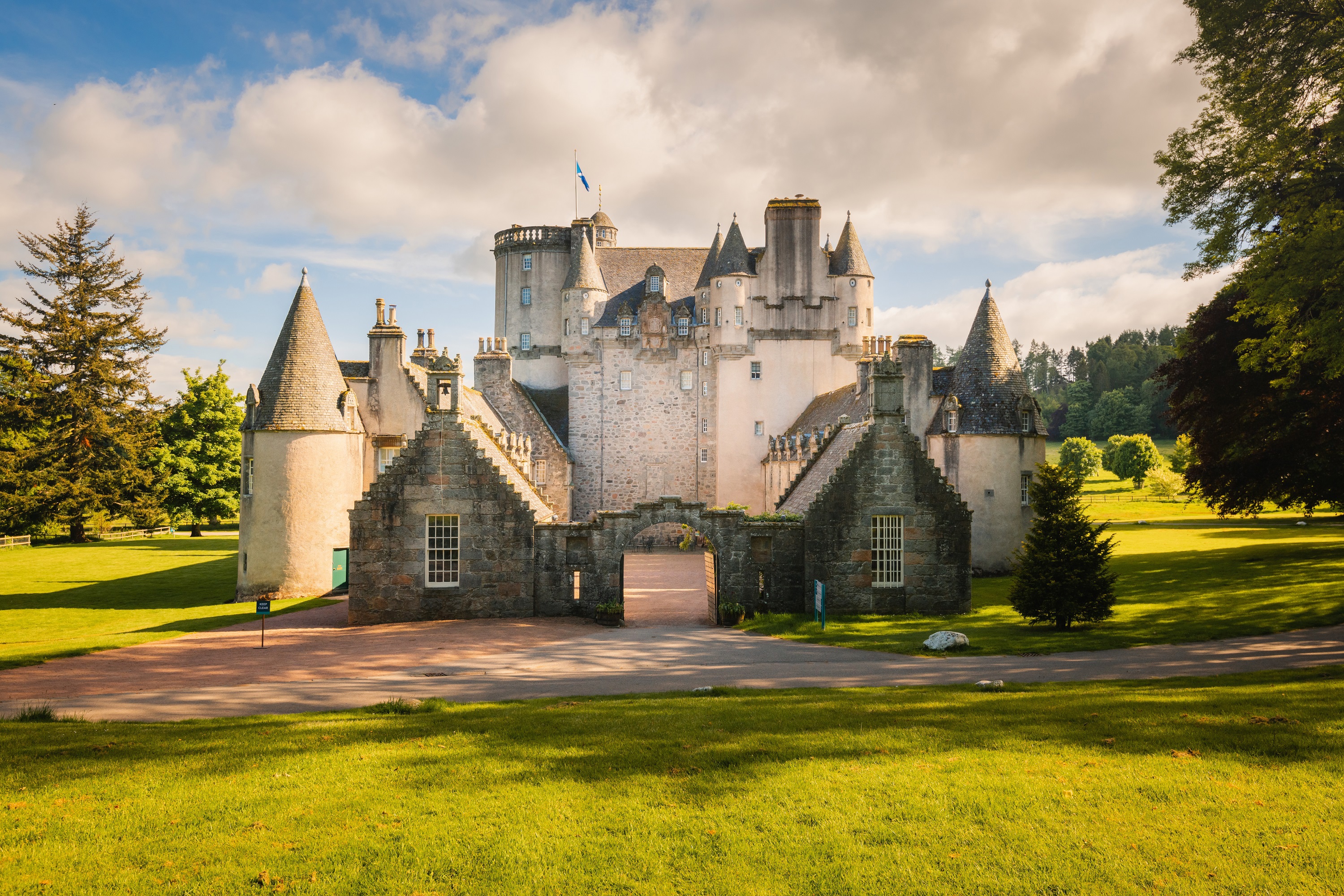
Castle Fraser is the largest of the Z-plan tower houses in Aberdeenshire. The body of the castle was completed around 1636 in granite Scottish Baronial style, with the principal builder Andrew Fraser, 1st Lord Fraser, working with master masons John Bell of Midmar and the Bell family dynasty. The crisp granite shell, the rounded corner towers and the integrated walled-garden enclosure place Castle Fraser firmly within the cluster that MacGibbon and Ross documented as the densest concentration of surviving Scottish tower houses.[1]
The interior holds Fraser family portraits, working kitchens and servants' quarters, plus a panelled great hall on the first floor. The walled garden and the woodland walks across the wider estate are part of the visit. The castle's secret stairs and concealed listening recesses are part of the family lore that NTS guides tend to draw on.
Practical: open seasonally late March to mid-December. Summer (29 June–30 August) 10:30–16:30 daily; spring/autumn shoulders generally Friday–Tuesday 10:30–16:30; reduced winter days October–December (closed Wednesday–Friday). Closed late December and January through late March. Adult £17, concession £13.50; NTS members free. Family pricing not confirmed via primary source. From Aberdeen by car, 40 minutes west; train to Inverurie (5 miles north), then taxi. Plan your visit.[4]
6. Huntly Castle
65 km 1h Year-round, Sat–Wed in winter Renaissance Gordon palace Map
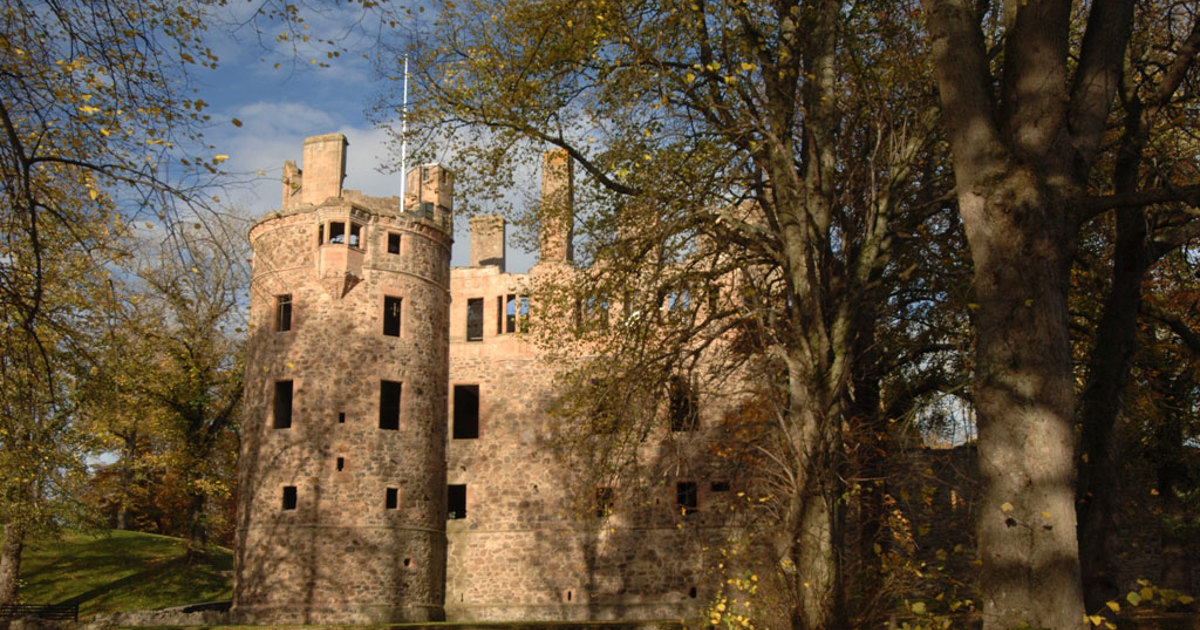
Huntly Castle was the principal seat of Clan Gordon, one of the dominant families in Scottish politics through the medieval and early-modern periods. The surviving fabric is largely 16th and 17th century, built progressively under successive Earls of Huntly. MacGibbon and Ross documented the inscribed datestone with the Gordon initials and the year 1586, and the "boldly corbelled and machicolated parapet or turret, which has evidently been erected in this situation for the defence of the doorway" above the south entrance.[1] The French-influenced Renaissance heraldic doorway is among the finest of its kind in Scotland; inscribed fireplaces still bear the names of the lord and his wife in the principal chambers. Mary Queen of Scots stayed here during her 1562 northern progress.
The Historic Environment Scotland 2024–25 annual report records continued portfolio-wide visitor recovery across the Aberdeenshire properties, including Huntly, Tolquhon and Kildrummy.[5] Huntly town has a railway station on the Aberdeen–Inverness line, which makes this one of the easier castle visits to do without a car.
Practical: open daily 1 April–30 September 10:00–16:30 (last entry 15:30); 1 October–31 March closed Thursday–Friday and reduced hours otherwise. No on-site visitor toilets at time of writing. Online tickets adult £7.50, concession £6, child £4.50; walk-up adult £8.50; HES members free. From Aberdeen by train (~50 min) or car (~1h on the A96). Plan your visit.[5]
7. Tolquhon Castle
32 km 35 min Apr–Sep, Wed–Sun Renaissance courtyard ruin Map
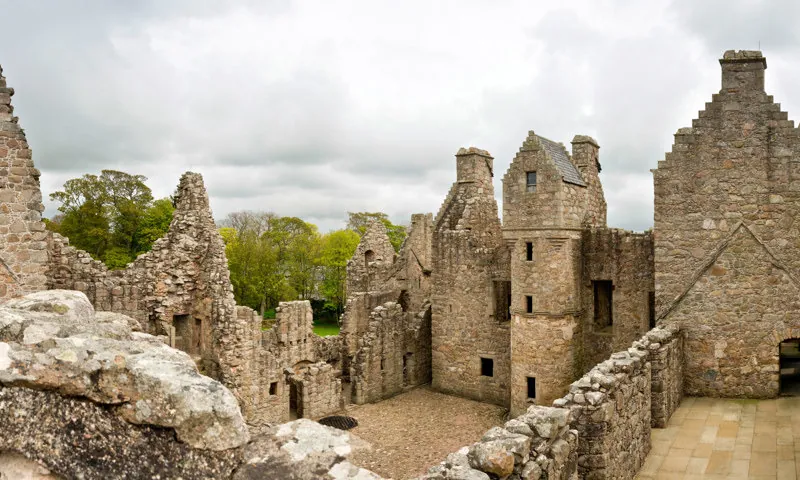
Tolquhon is a picturesque ruin with one of the most photogenic gatehouses in Scotland: the Forbes Memorial Gatehouse, commissioned by William Forbes in 1584 and decorated with the Forbes family heraldry alongside carved figures representing the William Forbes dynastic claim. The MacGibbon and Ross survey discusses Tolquhon's staircase turret in its courtyard as evidence of how northern Scottish architecture lagged about half a century behind contemporary southern Scottish work, with comparable round towers and gateways in the south predating the Tolquhon example "by at least fifty years".[1]
The castle sits in open Aberdeenshire countryside with the Forbes family tomb in the nearby kirkyard. The ruin is small enough to do in 45 minutes to an hour, and combines naturally with Pitmedden Garden a few miles further on for a half-day in this corner of the shire.
Practical: open April–September, Wednesday–Sunday 10:00–16:30 (lunch break 12:30–13:30, last entry 16:00); closed October–March. Online tickets adult £7.50, concession £6, child £4.50; walk-up adult £8.50; HES members free. Advance booking advised. From Aberdeen by car, 35 minutes north via the A920 near Pitmedden; no nearby rail. Plan your visit.[5]
8. Kildrummy Castle
56 km 1h 5min Apr–Sep, Wed–Sun Most extensive 13th-century ruin Map
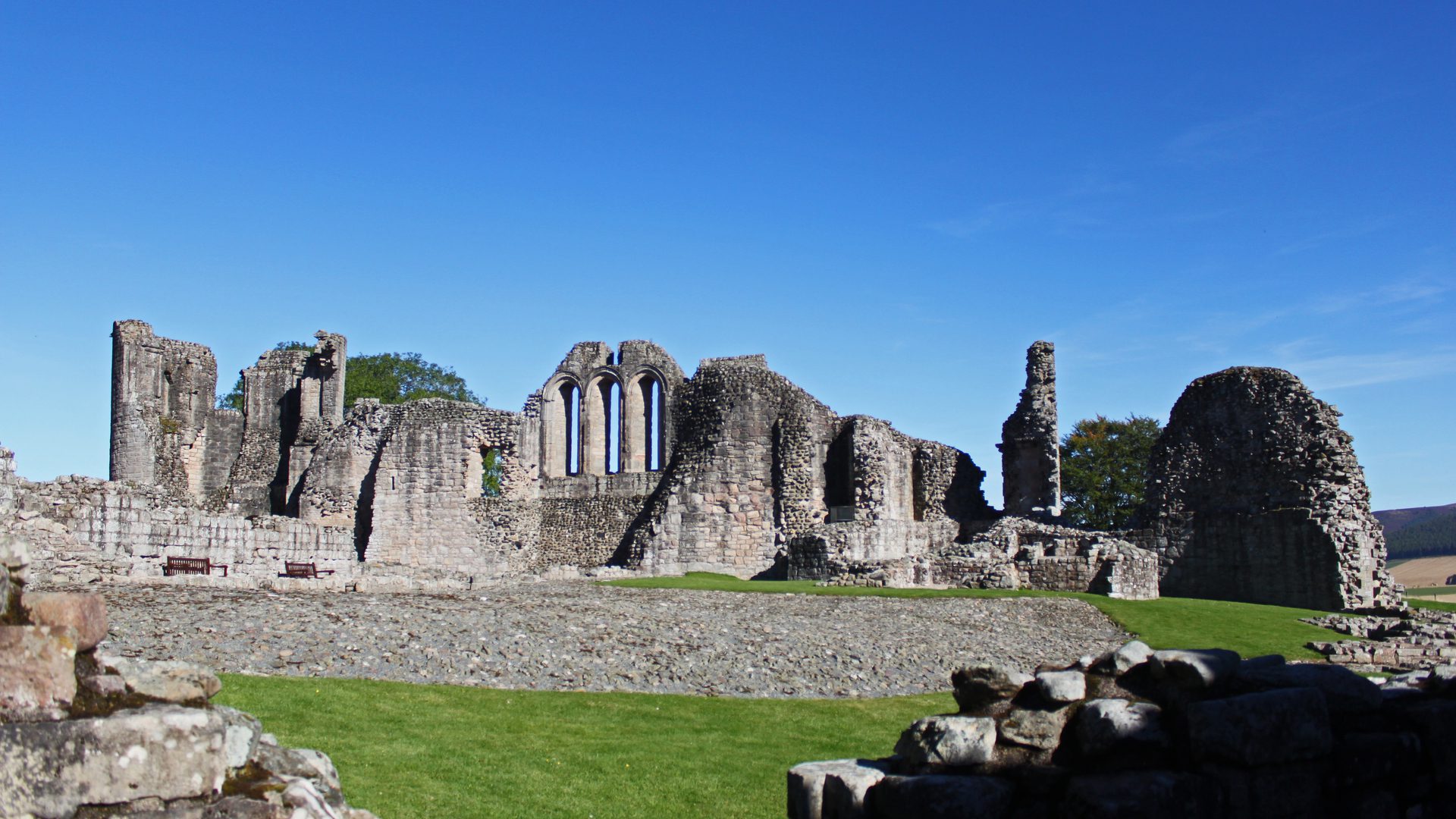
Kildrummy is the most extensive 13th-century castle ruin in north-east Scotland, built around 1240 by the Earl of Mar as a concentric stronghold in the Don Valley. The plan combines a high curtain wall with round flanking towers and a gatehouse, all of it in the early-Anglo-French castle tradition rather than the later tower-house form that came to dominate the shire. The castle was repeatedly besieged through the Wars of Independence and the later Jacobite uprisings, and was eventually slighted and abandoned in the early 18th century.
The ruin sits in a quiet rural setting off the A97 near Alford, with views across the Mossat valley. The site is accessible by car only; this is the more remote end of the Aberdeenshire castle trail and combines well with Corgarff a further hour on into the upper Don.
Practical: open 1 April–30 September, Wednesday–Sunday 10:00–16:30 (lunch break 12:30–13:30); closed October–March. Online tickets adult £7.50, concession £6, child £4.50; walk-up adult £8.50; HES members free. From Aberdeen by car only, ~1h 5min west on the A944 and A97. Plan your visit.[5]
9. Delgatie Castle
64 km 1h Open daily, tearoom Painted ceilings from 1575 Map
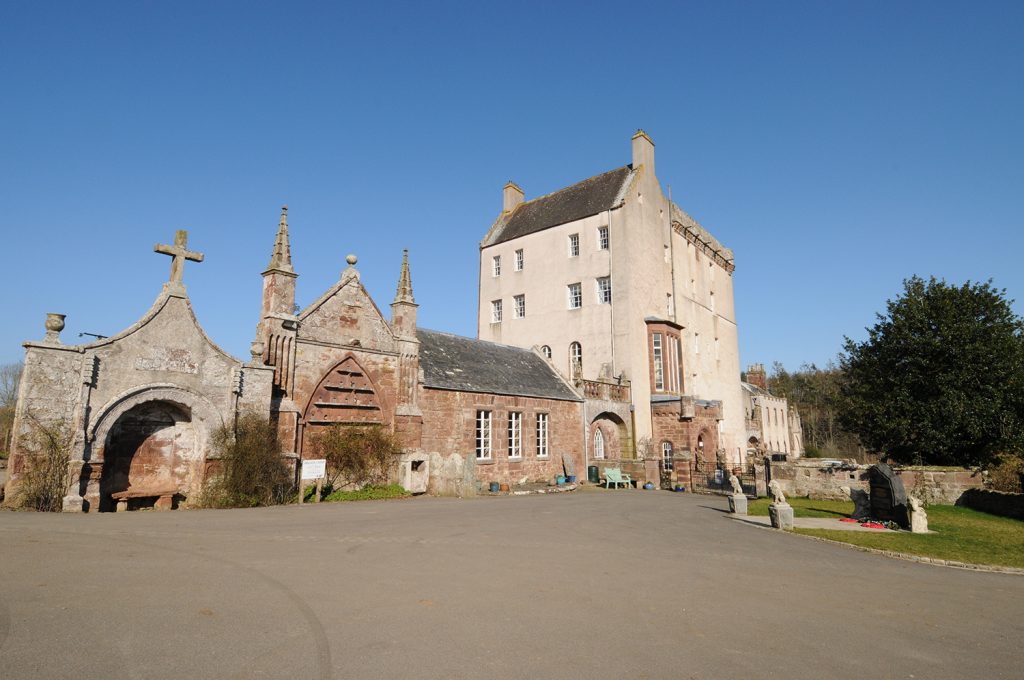
Delgatie has been a Hay family seat from the 14th century. The painted ceilings, dating to 1575 and 1597, are among the earliest surviving in Scotland and rank with those at Crathes for art-historical importance. The castle was a refuge for Mary Queen of Scots in 1562 after her victory at the Battle of Corrichie; her bedchamber is preserved as part of the visit. The collection inside includes Hay family portraits, weaponry, period furniture and clan memorabilia, and the Laird's Kitchen tearoom on the ground floor is an unusual perk among Scottish castle visits.
The visitor model at Delgatie is unusually open for the region: castle, grounds and tearoom open daily year-round, where most of the surrounding portfolio runs seasonal hours. The castle is run by the independent Delgatie Castle Trust rather than by the Trust or HES.
Practical: open daily year-round 10:00–16:00. Adult around £8 (per VisitScotland and visitor reports); concession and child rates not published online, confirm at the gate. From Aberdeen by car, 1 hour north-west via the A947; the castle sits 3 miles from Turriff. Plan your visit.[6]
10. Balmoral Castle
90 km 1h 30min Apr–Aug only Royal Highland retreat Map
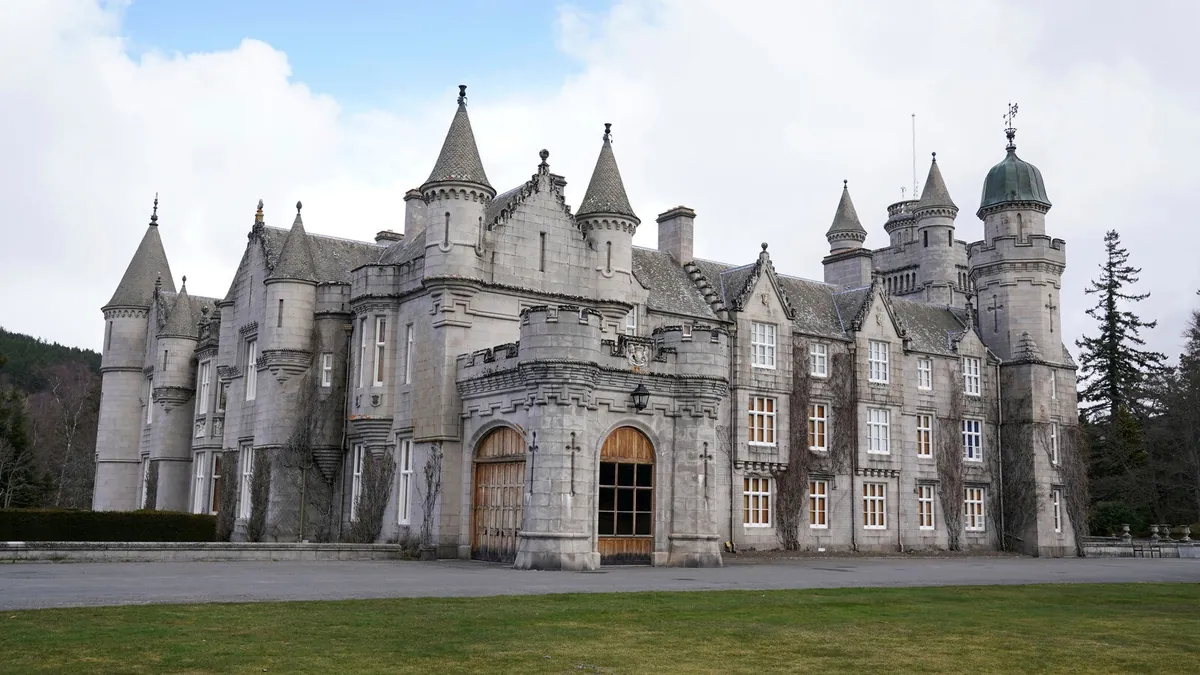
Balmoral is the British monarch's private Highland residence, the only royal castle in Britain owned outright by the monarch personally rather than held as Crown property. Queen Victoria and Prince Albert bought the original estate in 1852; Albert designed the current castle and oversaw construction from 1853 to 1856 in the Scottish Baronial style. The granite shell is essentially as he left it. The estate covers 50,000 acres of Royal Deeside scenery including substantial deer forest, salmon-fishing rights on the Dee, and Lochnagar (the 1,155 m munro that tops the Cairngorms ridge above the estate).
The 2026 season is the first to offer expanded interior tours since King Charles III's accession; previously only the ballroom was open to ticketed visitors. The Castle Ballroom is the largest room in the building and the venue for the annual Ghillies Ball. The Royal Lochnagar Distillery sits within the estate boundary and produces single malt for the royal household alongside its commercial output. Land Rover safaris into the estate hills offer the best chance of seeing red deer, golden eagles and red squirrels in their working Highland habitat.
Practical: open daily 28 March–9 August 2026 only, 10:00–17:00 (last admission ~16:00); closed entirely August onward when the monarch is in residence. General admission (grounds, gardens, ballroom exhibition) adult £18.50, child £9.50, family £42. Interior castle tours are a separate booking with limited availability. From Aberdeen by car, ~1h 30min west on the A93 via Ballater; train to Aberdeen, then Stagecoach 201/202 to Crathie (~2h 30 from the city). Plan your visit.[7]
At a glance
| Castle | Distance | How to get there | |
|---|---|---|---|
| Dunnottar CastleCrown Jewels stronghold | 27 km | 30 min |
| Drum Castle13th-century tower of Irvines | 16 km | 25 min |
| Crathes CastlePainted ceilings, Garden of the year | 24 km | 30 min |
| Craigievar CastlePink fairytale tower house | 42 km | 50 min |
| Castle FraserZ-plan tower house | 26 km | 40 min |
| Huntly CastleRenaissance Gordon palace | 65 km | — |
| Tolquhon CastleRenaissance courtyard ruin | 32 km | 35 min |
| Kildrummy CastleMost extensive 13th-century ruin | 56 km | — |
| Delgatie CastlePainted ceilings from 1575 | 64 km | — |
| Balmoral CastleRoyal Highland retreat | 90 km | — |
How many castles near Aberdeen?
Aberdeenshire has the densest castle landscape in Scotland and, by extension, the densest in the UK. VisitAberdeenshire's heritage listings catalogue more than 300 castles, towers and fortified houses within the historic county boundaries.[8] The MacGibbon and Ross architectural survey treated the corbelled-tower style as "most profusely ornamented" in this shire, and Hubert Fenwick's 1976 Scotland's Castles survey identified the Aberdeenshire cluster (Craigievar, Crathes, Craigston, Delgatie, Corgarff, Tolquhon, Dunnottar) as the densest concentration of intact 16th- and 17th-century Scottish tower houses.[1][2]
Public access splits across three operators. The National Trust for Scotland holds Drum, Crathes, Craigievar and Castle Fraser. Historic Environment Scotland holds Huntly, Tolquhon, Kildrummy, Corgarff and Spynie Palace in Moray. Dunnottar is privately operated by the Cowdray family, Delgatie is run by an independent trust, and Balmoral remains in royal hands. The Aberdeenshire Castle Trail, signposted from the A93 and A944, links the principal sites for a self-driving itinerary.
Famous, medieval, Renaissance and largest
Famous. Dunnottar carries the strongest single visitor draw on the back of the Crown Jewels story and the cliff-top setting; Craigievar's pink-harled silhouette is the regional postcard. Balmoral pulls a separate, royal-tourism market in its short April–August window.
Medieval. Kildrummy is the standout 13th-century concentric ruin in the region. Drum's 14th-century tower is the oldest substantially intact stone structure on the trail, and Huntly preserves medieval-into-Renaissance fabric across 16th- and 17th-century rebuildings.
Renaissance. Crathes (1596) and Craigievar (1626) are the canonical Scottish-Renaissance tower houses on the MacGibbon and Ross reading, with painted-ceiling cycles at Crathes (1599–1602) and Delgatie (1575, 1597) that are among the finest in Scotland. Tolquhon's 1584 Forbes Memorial Gatehouse and Huntly's heraldic doorway round out the Renaissance set.
Largest. Balmoral covers the largest estate (50,000 acres on Royal Deeside) and, given Albert's 1850s rebuild, occupies the largest residential footprint of the cluster. Among the medieval ruins, Kildrummy is the most extensive by ground area; among the inhabited or recently inhabited stock, Castle Fraser is the largest tower house.
If you're looking to buy
The Aberdeenshire and wider Scottish castle market is the deepest and most data-rich in the UK. Castle Collector's Castle Price Index (March 2026) tracks Scotland as the standout European market for verified appreciation: Dalhousie Castle in Midlothian moved from £2,499,994 (April 2012) to £5,599,998 (October 2023), a 124% gain across 11 years against an active hotel operation, with the chain of title verified through Registers of Scotland.[9] Aberdeenshire-specific listings tend to cluster in the smaller restored-tower-house tier, where the recent precedent runs from the historic restoration economics (Towie Barclay Castle, an L-plan tower bought for £4,000 in 1972 and restored over fifty years[10]) up to current asking prices in the £1m–£3m range for a turn-key property. Transaction costs include Scottish Land and Buildings Transaction Tax with the Additional Dwelling Supplement on second homes; foreign buyers face no restrictions on ownership.
If you're seriously looking, the castles for sale in Scotland page tracks current listings against this benchmark. For the operational side (surveys, listed-building consents, restoration budgeting) see our guide to buying a castle.
Sources
1. MacGibbon, D. and Ross, T. The Castellated and Domestic Architecture of Scotland from the Twelfth to the Eighteenth Century, Volume II. David Douglas, Edinburgh, 1887. References at pp. 24, 31, 100, 119–120, 452.
2. Fenwick, H. Scotland's Castles. Robert Hale, 1976. Aberdeenshire tower-house cluster discussed pp. 39–40, 74, 86, 90, 129, 189, 227–255 passim.
3. Dunnottar Castle, official site.
4. National Trust for Scotland, property pages. Drum:
5. Historic Environment Scotland, Annual Report and Accounts 2024–25; property pages: Huntly
6. Delgatie Castle, official site.
7. Balmoral Castle, official site.
8. VisitAberdeenshire, History and heritage listings.
9. Castle Collector, Castle Price Index, March 2026 edition.
10. WSJ Mansion, "Inside A Castle Home, Restored After 430 Years" (Towie Barclay Castle, Aberdeenshire), 2023.