
Castles near Glasgow: 8 Lowland and Highland-edge day-trips
Glasgow puts Lowland strongholds (Bothwell, Dumbarton) and Highland classics (Stirling, Inveraray, Doune) within reach: 8 castles for the day-trip list.
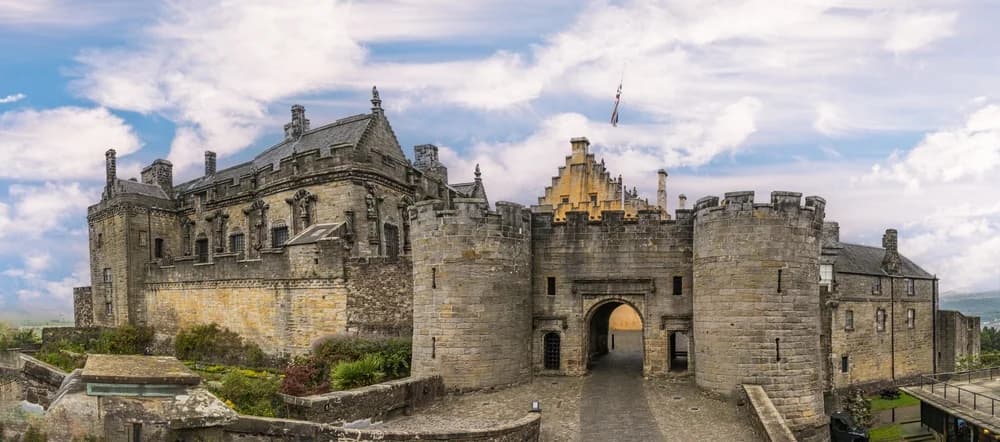
Glasgow opens onto the western Lowlands, the Clyde and the southern Highlands. Eight castles within day-trip reach, from a 13th-century red-sandstone donjon to the screen castle of Outlander, Monty Python and Game of Thrones.
Glasgow is a smaller castle city than Edinburgh, but it sits at the head of one of the most varied castle radii in Britain. Within twenty minutes you can reach Crookston, the only surviving medieval castle inside the city, and Bothwell, with the largest 13th-century stone keep in Scotland. Half an hour by train puts you on Dumbarton Rock, fortified continuously since the 5th century when it was the capital of the Brittonic kingdom of Strathclyde.
Push out a little further. Stirling Castle, the Stewart royal palace, is fifty minutes north. Doune (Castle Leoch in Outlander, the principal interior set for Monty Python and the Holy Grail, and Winterfell in the Game of Thrones pilot) is forty minutes by car. An hour and a quarter west takes you to Inveraray, the Duke of Argyll's seat on Loch Fyne, with Kilchurn's ruin on Loch Awe a little beyond. Kelburn, with its Brazilian graffiti facade, fills in the Ayrshire coastal slot at forty-five minutes.
Each entry below covers what to see, when to go, what it costs, and how to get there from Glasgow. Distances run from inside the city limits out to about ninety minutes by car.
1. Crookston Castle
10 km 20 min by car 14th–15th century Free, year-round Only medieval castle inside Glasgow Map
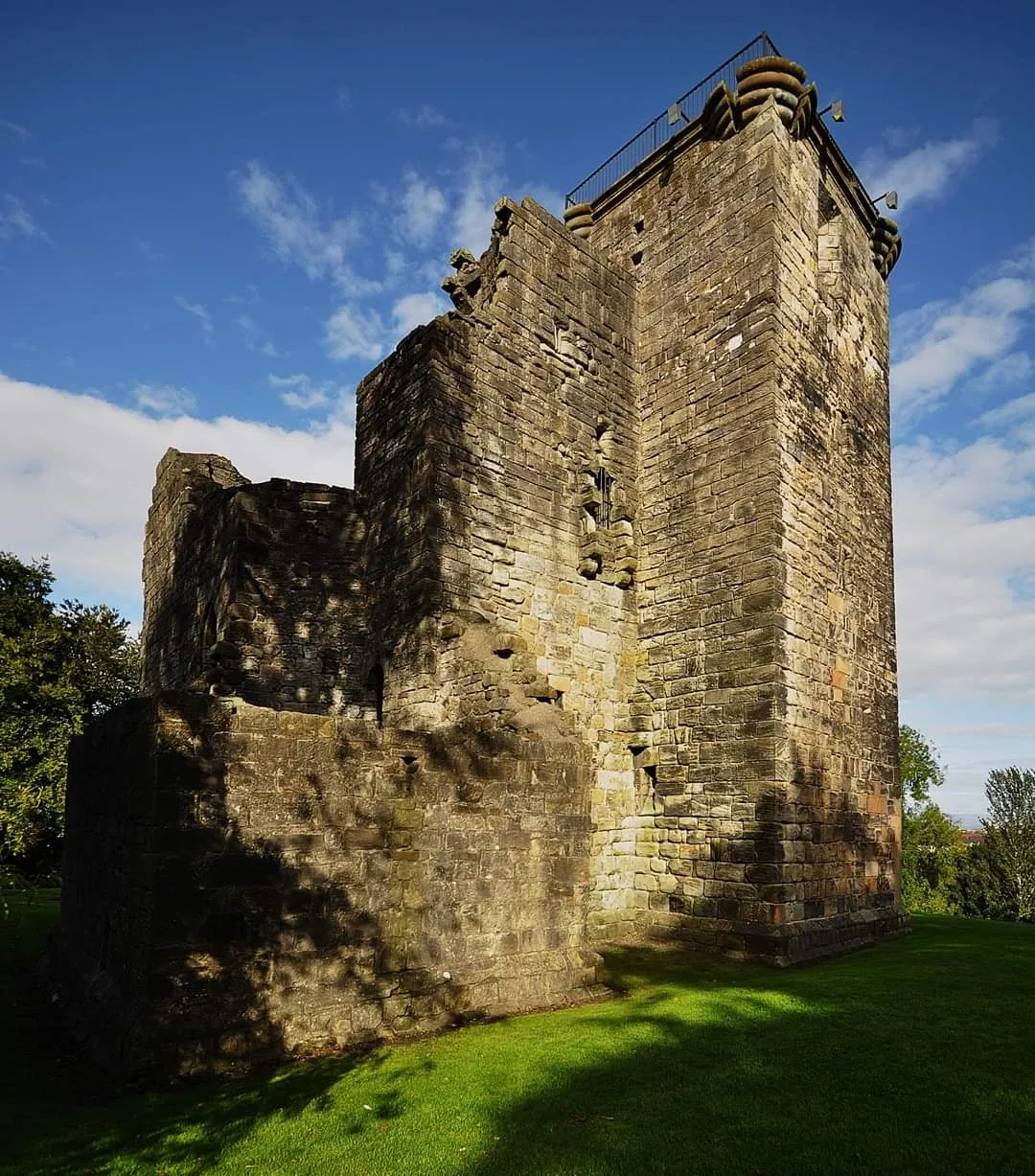
Crookston is the only surviving medieval castle within Glasgow city itself, sitting on a low hill in Pollok in the city's south-west. The X-plan tower house was built in the late 14th or early 15th century, on land originally held by the Croc family (from whom the name derives) and later passed to the Stewart Lords of Darnley. MacGibbon and Ross identified Crookston, alongside Bothwell and Mugdock, as part of the substantial late-medieval fortified residence inheritance of the Strathclyde and West Highland tradition within reach of Glasgow.[1] Hubert Fenwick covers Crookston in his Renfrew survey as the M8-corridor counterpoint to Bothwell.[2]
The castle is open-access and unstaffed, run by Historic Environment Scotland as a free site. The tower offers wide views across the city, and visitors can see where Mary, Queen of Scots, is traditionally said to have watched the 1568 Battle of Langside, the engagement at which her forces were decisively defeated by the Earl of Moray and which triggered her flight to England.
Practical: open year-round, free; 09:30–17:30 (Apr–Sep), 10:00–16:00 (Oct–Mar), closed Thursday and Friday in winter. No tickets, no staff. Drive south-west on the M8 and M77 to Brockburn Road, Pollok, or take the train to Nitshill (~30 min from Glasgow Central) plus a 20-minute walk. Plan your visit.[3]
2. Bothwell Castle
15 km 20 min by car 13th century Year-round, reduced days Largest 13th-c stone keep in Scotland Map
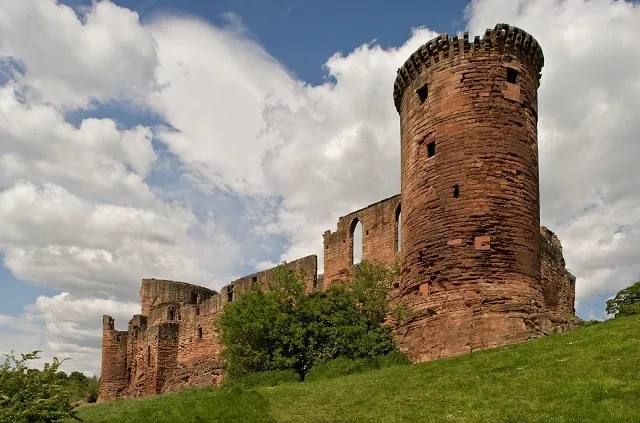
Bothwell is one of the largest and finest 13th-century castles in Scotland, set above the River Clyde at Uddingston. The massive circular donjon tower in red sandstone is the load-bearing piece: 20 metres in diameter as built, originally rising over 30 metres, intended as one of the most ambitious medieval keeps anywhere in Britain. MacGibbon and Ross treat Bothwell as a key reference for their Third Period courtyard fortresses.[4] The castle changed hands repeatedly during the Scottish Wars of Independence: Edward I of England held it briefly, the Scots recaptured it under Robert the Bruce, and the great donjon was deliberately slighted in 1336 to deny it to a returning English army. The 14th and 15th-century rebuildings produced the curtain walls, prison tower and chapel that survive today.
The site sits on a wooded loop of the Clyde with riverside walks below; the broader Clyde Walkway connects to other Glasgow-area heritage on foot.
Practical: open year-round but with reduced days; 09:30–17:00 (Apr–Sep, closed Sun–Mon) and 10:00–16:00 (Oct–Mar, closed Thu–Fri); closed midday 12:30–13:30 every day. Adult ticketing structure follows the standard Historic Environment Scotland tier (online ticketing was offline at the time of research; expect £7.50 online / £8.50 walk-up by current pattern). The Donjon, South East Tower and Great Hall are currently closed for safety inspections, so the visitor route is reduced. Drive 15 km south-east via the M74 to Castle Avenue, Uddingston; nearest rail Uddingston station. Plan your visit.[5]
3. Dumbarton Castle
25 km 30 min by train 5th century onwards Daily, year-round Volcanic rock stronghold Map
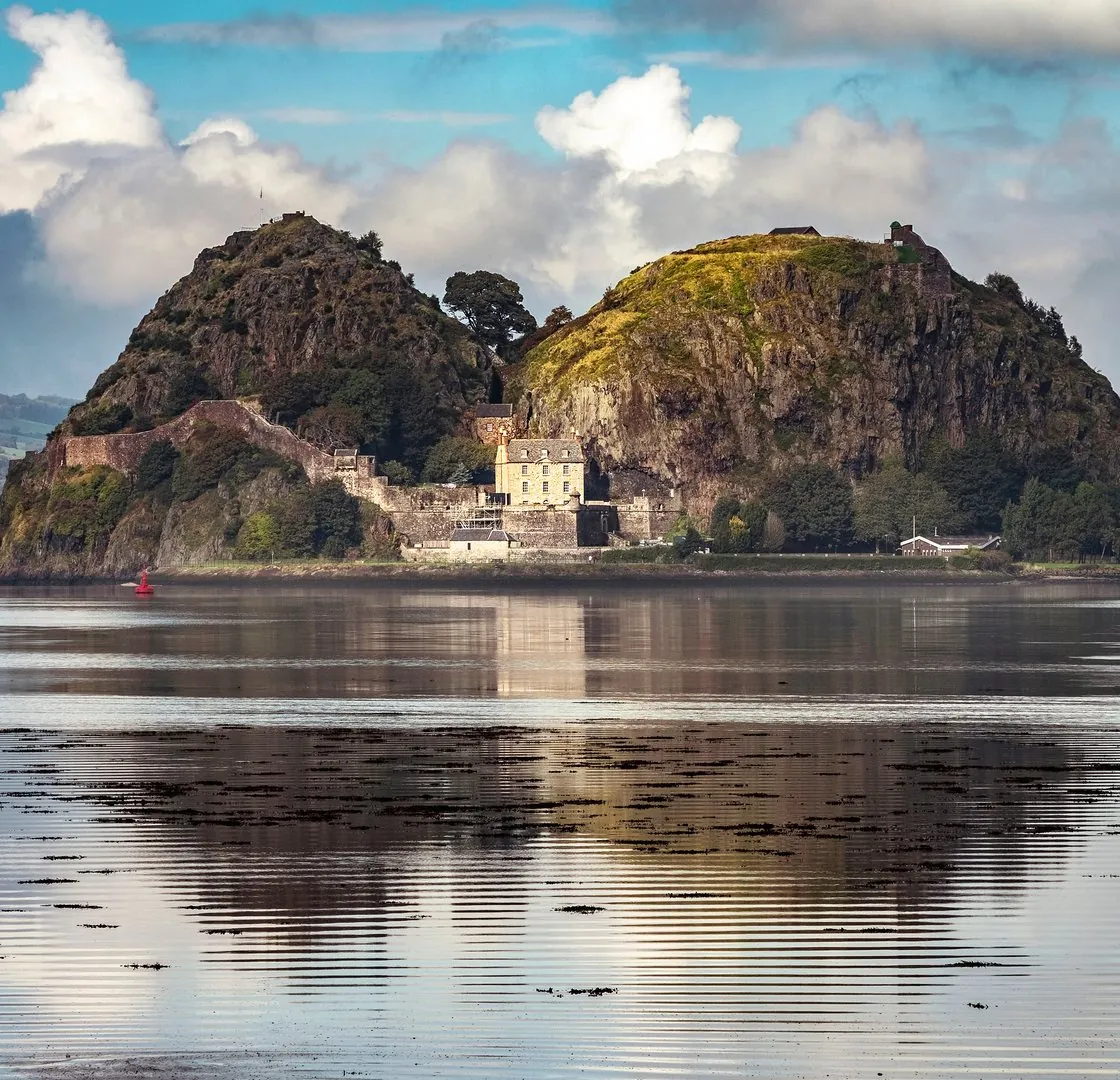
Dumbarton Castle sits on a 73-metre volcanic plug at the meeting of the Firth of Clyde and the River Leven, fortified continuously since at least the 5th century. The site was the capital of the Kingdom of Strathclyde, the Brittonic-speaking kingdom that controlled what is now southwest Scotland and Cumbria from late Roman times until the 11th century, when it was absorbed into the unified Scottish kingdom under Malcolm III. That makes Dumbarton one of the longest continuously fortified sites in Britain.
The climb to the summit involves over 500 steps. From the top the view stretches east toward Glasgow and west to Ben Lomond, with the Georgian Governor's House open to visitors. Inside the Rock of Ages exhibition you will find a Viking-period sword pommel, medieval coins, and a replica of an embroidery Mary, Queen of Scots, made during her 1548 stay at Dumbarton before her departure for France. The artillery fortifications around the rock were added in the 1740s and 1750s during the post-Jacobite military buildup.
Practical: open year-round; 09:30–17:00 (Apr–Sep) or 10:00–16:00 (Oct–Mar), closed Thursday and Friday in winter. Adult £7.50 online / £8.50 walk-up; concession from £6; child from £4.50. Take the train from Glasgow Queen Street to Dumbarton East (~30 min) and walk 10 minutes to the rock. Plan your visit.[6]
4. Doune Castle
55 km 40 min by car Late 14th century Daily, year-round Outlander, Monty Python and Winterfell Map
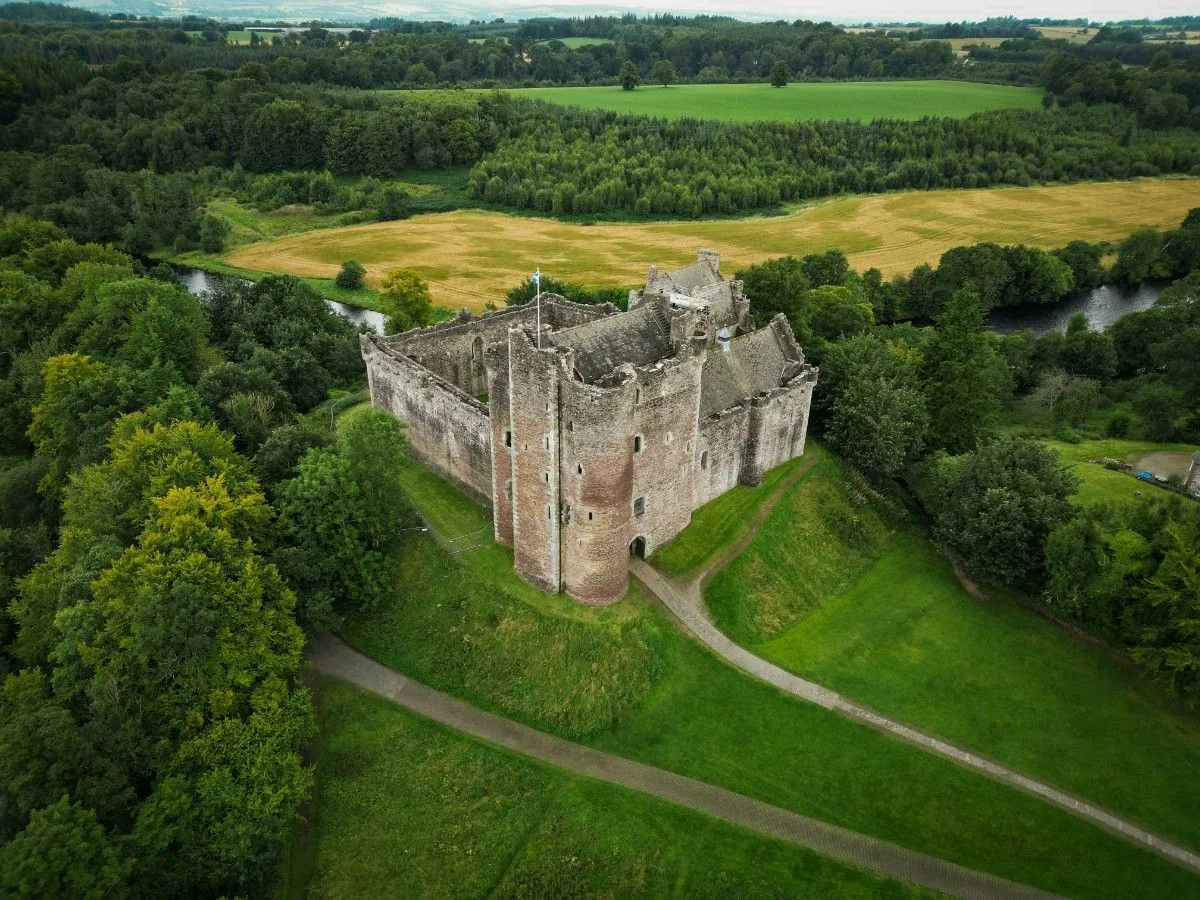
Doune is the screen castle. Outlander uses it as Castle Leoch; Monty Python and the Holy Grail (1975) shot every interior scene there; the Game of Thrones pilot used the gatehouse as Winterfell exterior. Robert Stewart, Duke of Albany (the regent of Scotland during the captivity of his nephew James I) built Doune in the late 14th century. The castle was left unfinished at his fall in 1425, which has the lucky side-effect of making it one of the most architecturally legible late-medieval Scottish residences in the country: a single building campaign, frozen at the moment construction stopped. MacGibbon and Ross treat Doune (with Tantallon) as one of the earliest Scottish examples of the courtyard plan in the manner of certain French castles.[7]
The audio guide is narrated in part by Sam Heughan (Jamie Fraser in Outlander) and the late Terry Jones (of Monty Python). Visitors can climb the 30-metre gatehouse, walk the Lord's Hall where medieval banquets were held, and stand in the kitchen with its eight-metre fireplace. The on-site car park is small; most visitors park in the village.
Practical: open daily; 09:30–17:30 (Apr–Sep) or 10:00–16:00 (Oct–Mar); closed 25–26 December and 1–2 January. Adult £10 online / £11 walk-up; concession from £8; child from £6; family 2A+2C £29 online; HES members free; Young Scot Card £1. Drive north on the M9 to Junction 11, then the A84 to Doune (around 40 minutes from Glasgow); the nearest rail station is Stirling, with bus connections from there. Plan your visit.[8]
5. Kelburn Castle
50 km 45 min by car 13th c. (current 18th c.) Tours only, estate open daily Brazilian graffiti facade Map
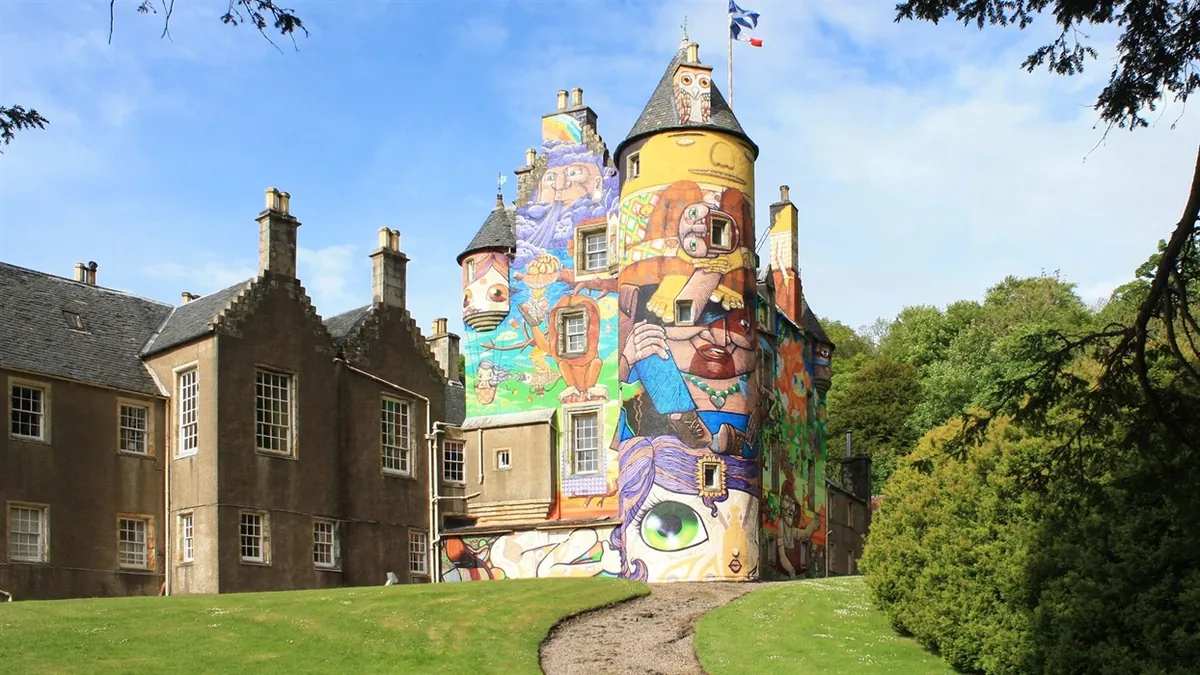
Kelburn Castle and Estate sits in north Ayrshire, on the Firth of Clyde coast. The current 18th-century mansion stands on the site of an earlier 13th-century castle and is still the family seat of the Earls of Glasgow, who have held the land since the late 12th century. The exterior has been the most-photographed castle facade in Scotland since 2007, when four Brazilian street artists (Os Gêmeos, Nina, Nunca) applied a vast contemporary graffiti mural across the harled walls as a temporary art project before a planned re-harling cycle. The mural has remained in place beyond its originally planned removal date and is now treated as the castle's defining feature.
The estate covers around 1,500 acres of glen, woodland and waterfall trails. The Secret Forest is the headline themed-walk attraction. Castle interior access is by guided tour only and currently subject to availability while re-roofing and internal structural work continue through 2026; the estate, gardens and visitor centre remain open year-round.
Practical: estate open daily 10:00–18:00 in summer (visitor centre and grounds); reduced winter hours. Castle tour, when available, £10 adult / £6 child, separate from estate admission. Drive west via the M8 and A78 to Fairlie; or take ScotRail to Fairlie station (~1.5 miles short of the castle, with onward bus or taxi). Plan your visit.[9]
6. Stirling Castle
45 km 35 min by train 12th–16th century Daily, year-round Renaissance royal palace Map
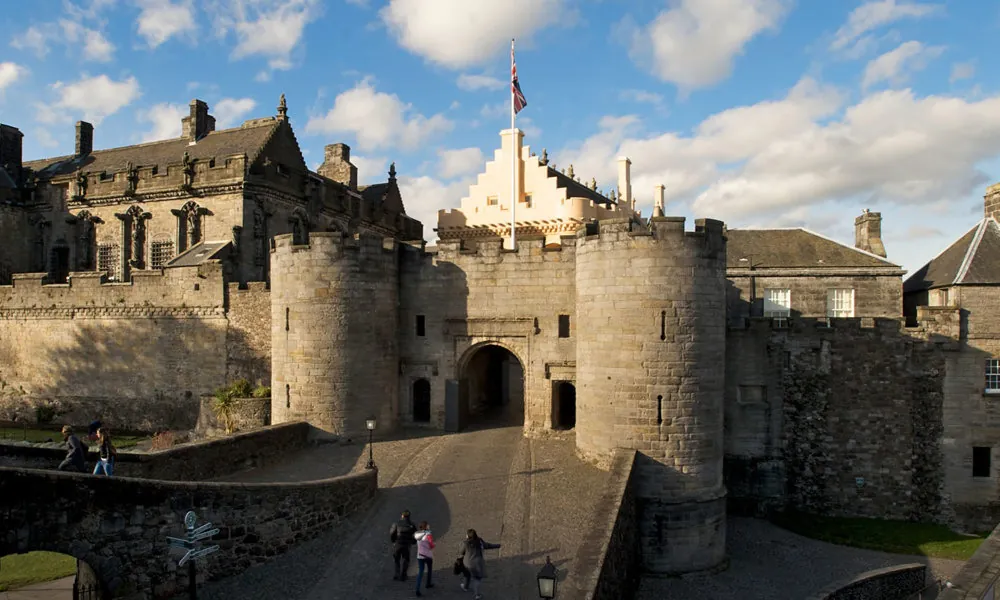
Stirling Castle is the principal Stewart royal residence of central Scotland, set on a volcanic crag controlling the lowest crossing of the River Forth. James VI was baptised in the Chapel Royal in December 1566; Mary, Queen of Scots, was crowned there in 1543 at nine months old. The recently re-presented Royal Palace interiors, finished in 2011 with replicated Renaissance unicorn tapestries and reproduced ceiling carvings, are the finest surviving register of Scottish royal court decoration anywhere in the country.[10]
Around the castle, Stirling Old Town includes the Wallace Monument and the Battle of Bannockburn visitor centre, both worth half a day if you have the time. Stirling reads as the natural pair-up with Doune (35 minutes apart, both off the M9) for a two-castle Stewart-history day.
Practical: open daily 09:30, last entry 17:00 (Apr–Sep) or 16:00 (Oct–Mar); closed 25–26 December, 11:00 start on 1 January. Adult £18.50 online / £20.50 walk-up; concession from £15; child from £11; family tiers up to 2A+3C £63 online. Twenty-five per cent off admission for car-free arrivals. Direct trains from Glasgow Queen Street take around 35 minutes, with a 15-minute walk uphill to the castle gate. Plan your visit.[10]
7. Inveraray Castle
95 km 1h 15 min by car 1746–1789 Open Thu–Mon, late Mar to late Oct Duke of Argyll's family seat Map
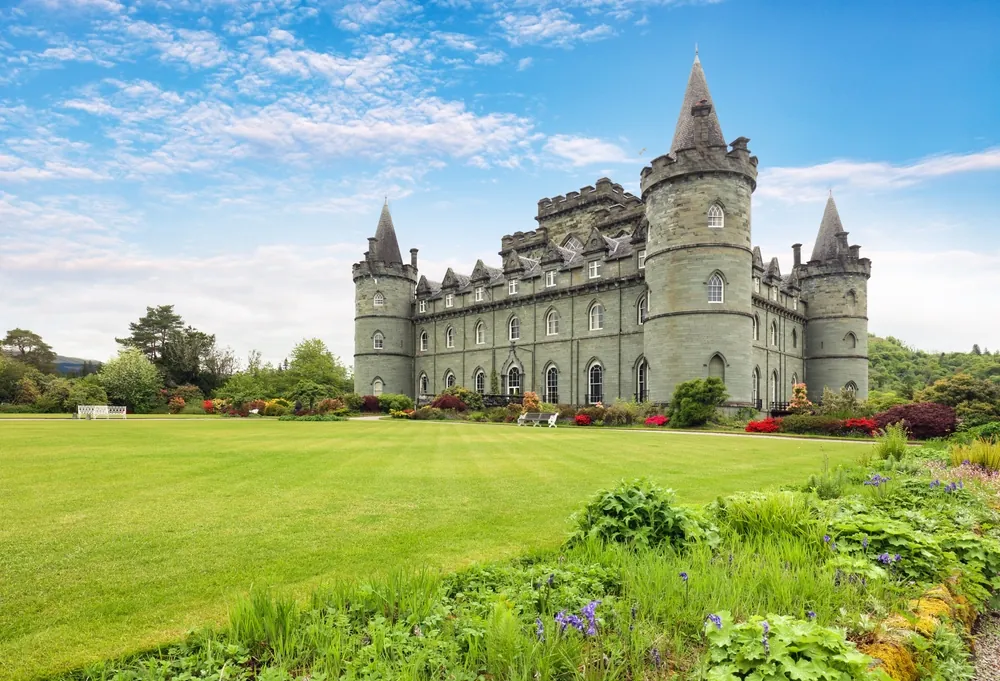
Inveraray Castle is the seat of the Duke of Argyll, head of Clan Campbell, built between 1746 and 1789 in early Scottish Baronial-Gothic Revival style on the site of an earlier Campbell stronghold on the shore of Loch Fyne. The castle has remained in the Campbell family across the entire post-1789 fabric, an unbroken ducal ownership now nearing its 240th year. The 11th Duke of Argyll's Decline and Fall-era predecessor disposed of 50,000 acres on Tiree, Lismore and Benmore between 1920 and 1922 in the post-WWI Scottish estate dispersal: a part of the broader story of how the great Highland estates contracted in the early 20th century while the castles themselves stayed under family ownership.[11]
The State Dining Room, the Armoury Hall (with its display of pikes, muskets and Lochaber axes from the Jacobite period) and the Tapestry Drawing Room are the visit. Inveraray played the Duke of Sandringham's seat in Outlander; Downton Abbey used the castle as Duneagle. The town of Inveraray itself, a planned 18th-century Royal Burgh laid out by the 3rd Duke around the same project, is the natural lunch stop.
Practical: open Thu–Mon, 26 March to late October; 10:00–17:00 (Apr–Sep), 10:00–16:00 (1–26 Oct); closed Tuesday and Wednesday year-round and from November to March. Adult castle and gardens £18.50; concession (60+, student) £16; child (5–15) £12; under 5 free; family 2A+3C £60. Gardens-only £12 adult. Drive 95 km via the A82 along Loch Lomond and the A83 over the Rest and Be Thankful pass; Citylink coaches run from Glasgow Buchanan Street. Plan your visit.[12]
8. Kilchurn Castle
110 km 1h 30 min by car 1450 (extended 17th c.) Exterior only, free Iconic Loch Awe ruin Map
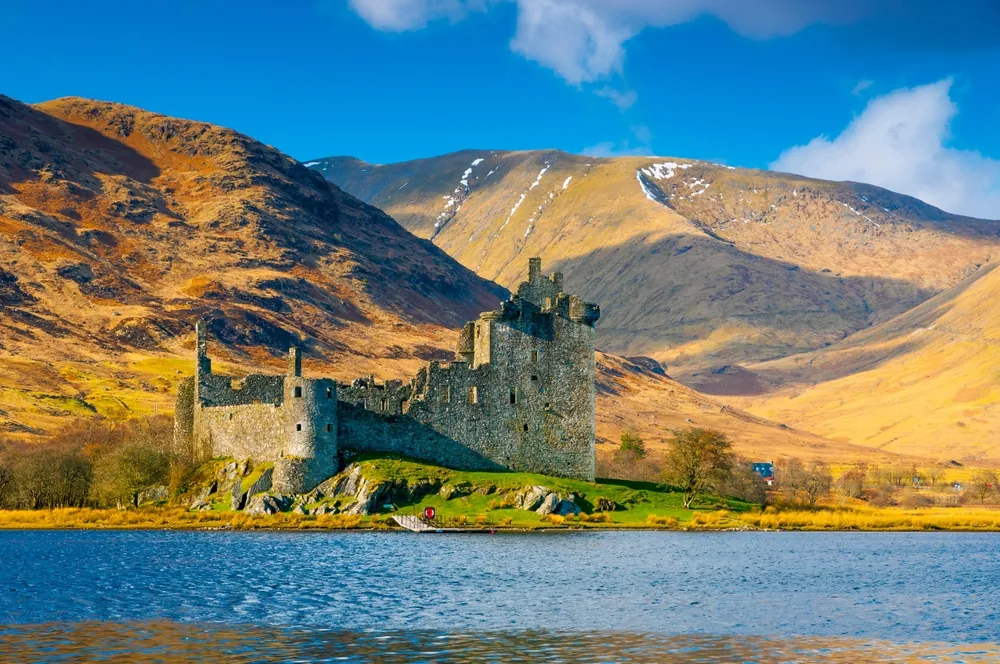
Kilchurn sits on a low promontory at the northeastern end of Loch Awe, an hour and a half west of Glasgow through some of the finest landscape in Argyll. Sir Colin Campbell of Glenorchy built it around 1450 as the Campbell ancestral seat in the Loch Awe lands, and it was substantially extended in the 17th century with a barracks block (one of the earliest purpose-built army barracks in Scotland) under the 1st Earl of Breadalbane. The castle was abandoned after the 1746 Jacobite rising and stands today as one of the most-photographed castle ruins in Scotland, framed by the loch and the surrounding hills.
Access is from a layby on the A85 near Dalmally: a 10-minute walk across rough farmland under the railway viaduct that crosses Loch Awe. Interior access is closed and protective fencing is in place around the structure while works are ongoing; the exterior viewing across the loch is what visitors come for. Pair it naturally with Inveraray on a single Argyll day, or with Oban as part of a longer west coast loop.
Practical: exterior viewing only, free, year-round in daylight hours. No staff, no tickets. Park at the A85 layby and walk; the path can be muddy. Operator notice.[13]
At a glance
| Castle | Distance | How to get there | |
|---|---|---|---|
| Crookston CastleFree, year-round | 10 km | 20 min by car |
| Bothwell CastleYear-round, reduced days | 15 km | 20 min by car |
| Dumbarton CastleDaily, year-round | 25 km | 30 min by train |
| Doune CastleDaily, year-round | 55 km | 40 min by car |
| Kelburn CastleTours only, estate open daily | 50 km | 45 min by car |
| Stirling CastleDaily, year-round | 45 km | 35 min by train |
| Inveraray CastleOpen Thu–Mon, late Mar to late Oct | 95 km | 1h 15 min by car |
| Kilchurn CastleExterior only, free | 110 km | 1h 30 min by car |
How many castles are near Glasgow?
Within roughly 90 minutes of Glasgow by road or rail you can reach the eight castles above plus a handful of smaller sites: Newark Castle in Port Glasgow on the Clyde, Mugdock Castle in the country park north of the city, and (a longer drive) Dean Castle in Kilmarnock and the Ayrshire cluster around Culzean. Hubert Fenwick's 1976 survey treats Crookston, Bothwell, Mugdock, Dean and Culzean as the cluster of substantial Strathclyde and West Highland fortified residences accessible from the city.[2] MacGibbon and Ross document Bothwell and Crookston as anchor sites in the late-medieval Scottish architectural inheritance of the region.[4]
Historic Environment Scotland operates the bulk of the publicly ticketed sites (Bothwell, Crookston, Dumbarton, Doune, Stirling, Kilchurn). Inveraray remains in private Campbell ownership; Kelburn in private Glasgow-family ownership. The Glasgow castle radius is therefore split fairly evenly between the public-heritage and the private-ducal traditions, which gives the area its distinctive mix.
Famous, medieval, screen and largest
Famous. Stirling and Doune lead by recognition factor: Stirling for the Stewart royal heritage, Doune for the screen-castle status. Inveraray follows on the back of Downton Abbey and Outlander. Bothwell and Dumbarton pull substantial heritage-traveller numbers within Scotland.
Medieval. Bothwell, Crookston, Dumbarton and Doune are the strongest medieval-period survivors. Bothwell's red-sandstone donjon and Doune's complete late-14th-century plan are the architectural anchors of the cluster.
Screen. Doune covers Outlander, Monty Python and the Holy Grail and the Game of Thrones pilot in a single building. Inveraray plays Duneagle in Downton Abbey and the Duke of Sandringham's seat in Outlander. Few areas in Britain match this density of screen-castle pedigree inside a 90-minute radius.
Largest. Bothwell holds the largest stone keep of its 13th-century period in Scotland.[4] Stirling is the largest by ceremonial-room volume once the Royal Palace, Chapel Royal and Great Hall are added. Inveraray is the largest single domestic interior in private hands.
If you're looking to buy
The Scottish private-castle market is the most accessible UNESCO-grade heritage market in Europe outside Eastern Europe, and the Glasgow region carries a meaningful share of the supply. Highland castle ruins regularly list from £130,000 to £500,000 as restoration projects, while substantial restored Scottish castles trade at £2–10 million; the trophy tier (Inveraray, Cawdor, properties of comparable nobility-tier provenance) rarely come to open market and sit at £15–50 million when they do.[14] Land and Buildings Transaction Tax runs 0–12% on a sliding scale with no non-resident surcharge, distinct from the English regime. The standard transaction timeline is 3–5 months. David Cannadine documents the post-WWII contraction of the great Argyll holdings in The Decline and Fall of the British Aristocracy (the 1920–22 disposal of 50,000 acres on Tiree, Lismore and Benmore is the canonical case): the family castles often survived where the surrounding agricultural estates did not.[11] See castles for sale in Scotland for live listings, and the guide to buying a castle for the operational side.
Sources
1. MacGibbon, D. and Ross, T. The Castellated and Domestic Architecture of Scotland from the Twelfth to the Eighteenth Century, Volume II. David Douglas, Edinburgh, 1887; chapter on Strathclyde (Bothwell, Crookston, Mugdock as substantial late-medieval fortified residences within reach of Glasgow).
2. Fenwick, H. Scotland's Castles. Robert Hale, 1976; pp. 292–299, 323–328 (Glasgow-region castles: Crookston, Dean Castle Kilmarnock, Ayrshire cluster including Culzean).
3. Crookston Castle, Historic Environment Scotland.
4. MacGibbon and Ross, op. cit., pp. 74, 237, 583, 594, 596 (Bothwell Castle in Third Period courtyard-plan analysis).
5. Bothwell Castle, Historic Environment Scotland.
6. Dumbarton Castle, Historic Environment Scotland.
7. MacGibbon and Ross, op. cit., p. 585 ("Some of the earlier examples, such as Doune and Tantallon, seem to have been erected on the model of certain French castles of the period").
8. Doune Castle, Historic Environment Scotland.
9. Kelburn Castle and Estate, official site.
10. Stirling Castle, Historic Environment Scotland.
11. Cannadine, D. The Decline and Fall of the British Aristocracy. Yale University Press, 1990 (Vintage Books edition 1999); p. 109 (Duke of Argyll disposed of 50,000 acres, Tiree, Lismore and Benmore, 1920–22).
12. Inveraray Castle, official site.
13. Kilchurn Castle, Historic Environment Scotland.
14. Castle Collector, Castle Price Index, March 2026 edition.