
Castles in Portugal: 10 fortresses to visit, from Sintra to the Algarve
Portugal's castle landscape reads as four registers stacked on a single Atlantic peninsula. Pre-Roman and Visigothic foundations sit at the base.
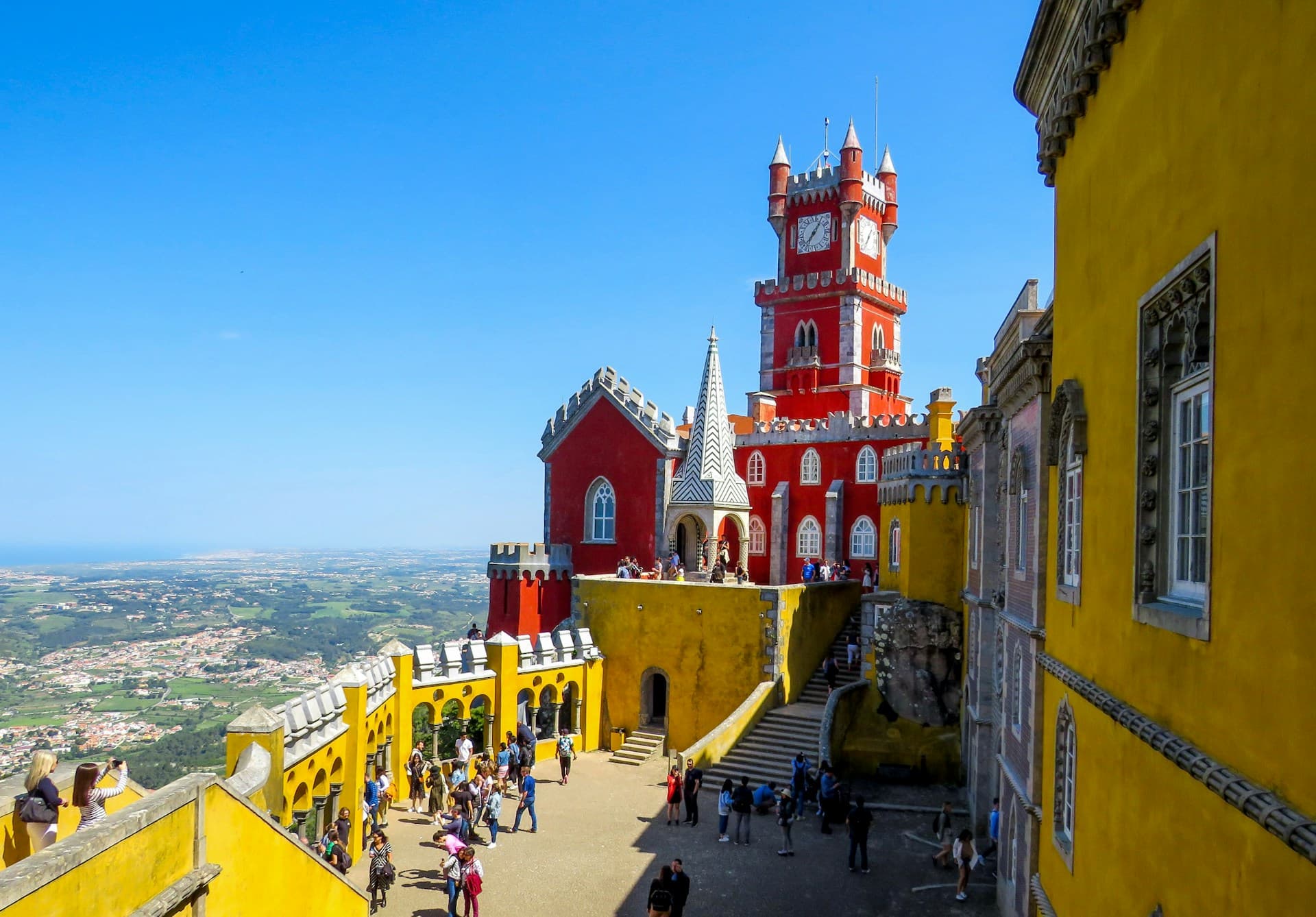
Portugal stacks four registers on a single Atlantic peninsula: pre-Roman foundations, Moorish ramparts, Reconquista frontier, and the Manueline golden age. Ten castles and walled towns that frame 2,000 years of Iberia in a country small enough to cross in a day.
Portugal carries the densest castle layering in Iberia. The Direcção-Geral do Património Cultural (DGPC) lists 310 protected castle, palace and manor properties across three tiers.[1] Most pre-date the country itself: Afonso I founded the Kingdom of Portugal in 1139, but the foundations he conquered run back through the Iberian caliphate to Visigothic, Roman and pre-Roman strata.
The castles that warrant a traveller's day cluster in five regions. Sintra-Lisbon holds the prestige tier (UNESCO-inscribed 1995, Romantic palaces above Moorish ramparts). Centro around Tomar carries the Templar and Order of Christ heartland. Norte holds Guimarães, the cradle of the country. Alentejo preserves the Roman-to-Reconquista frontier. The Algarve closes the sequence at the 1249 Reconquista completion, 250 years before Spain finished its parallel reconquest at Granada in 1492.[2]
The ten below are the ones that warrant the day. Each entry covers what to see, when to go, what it costs, and how to get there from Lisbon.
1. Pena Palace
Sintra Closed Tuesdays Romantic-historicist showpieceMap
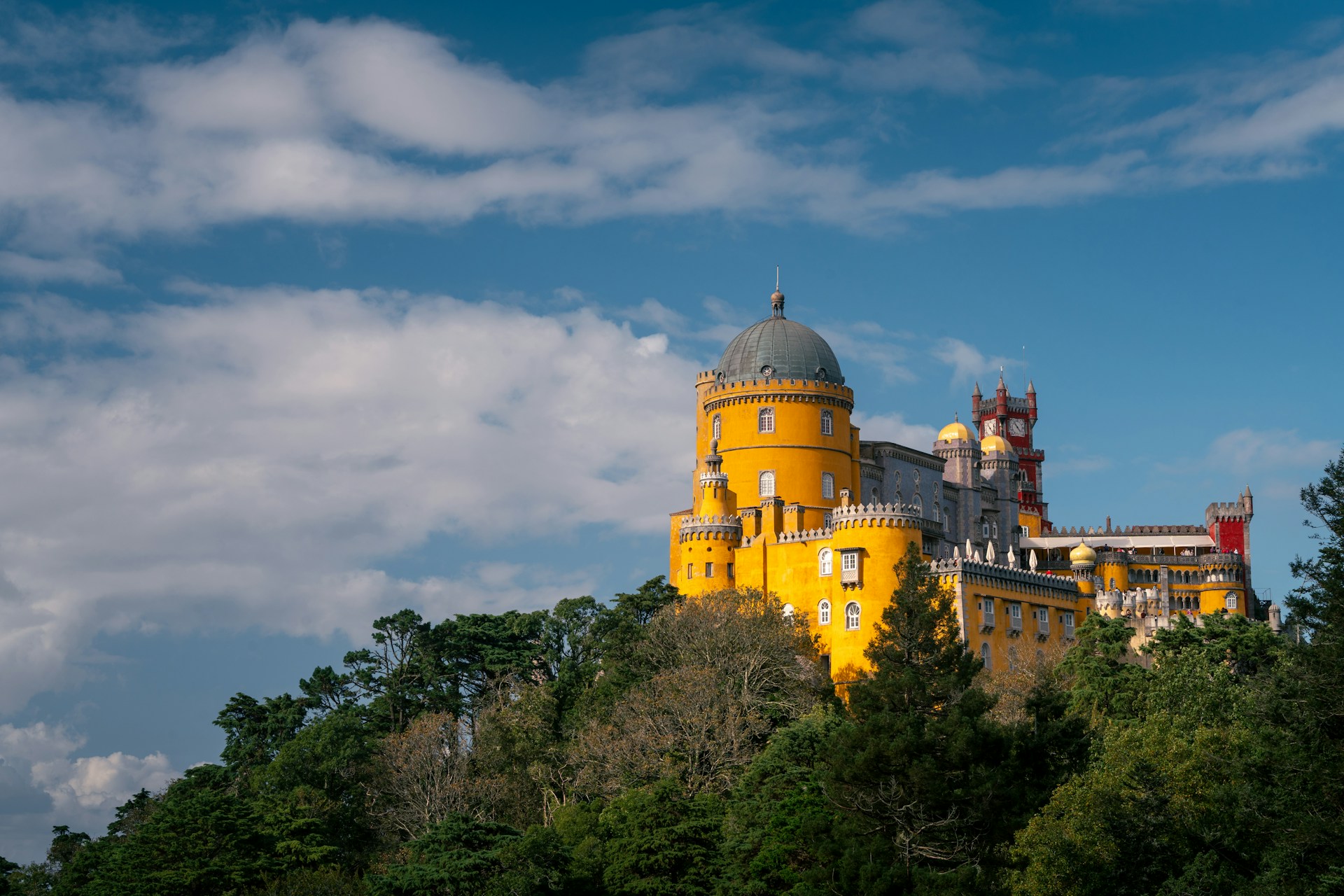
Pena was built between 1842 and 1854 by King Ferdinand II, designed by the Saxon engineer Baron Wilhelm von Eschwege on the site of a medieval Hieronymite monastery the 1755 Lisbon earthquake had destroyed. The exterior is deliberately polychrome (pink, yellow, ochre) and the architectural language curates Manueline, Moorish-Revival and neo-Gothic quotations on one building. Pena predates Bavaria's Neuschwanstein by a generation; the Romantic-historicist tradition runs through both into the Disney visual lineage.[3] The Cultural Landscape of Sintra was UNESCO inscribed in 1995, with Pena as its centrepiece.[4]
Practical: open daily 09:30–18:30, closed 25 Dec and 1 Jan. Adult €20 (palace + park), €14 park only; children 6–17 €18. From Lisbon, urban train Rossio to Sintra (~40 min), then bus 434. Plan your visit.[5]
2. Castelo dos Mouros
Sintra Daily, year-round Moorish hilltop fortressMap
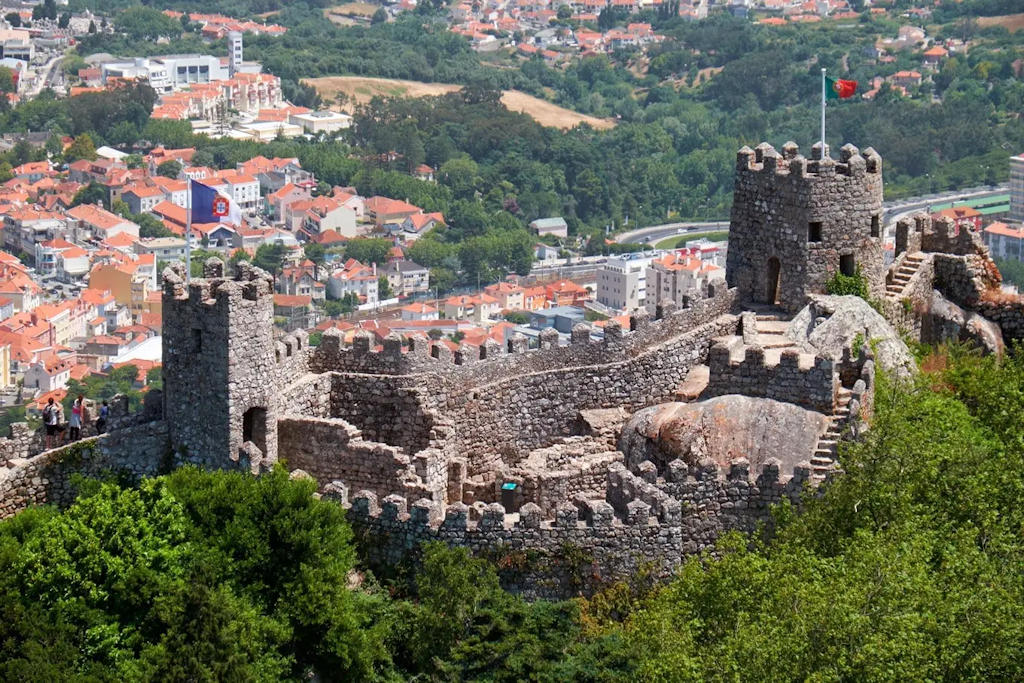
Set lower on the same ridge as Pena, the Castle of the Moors is the foundation Pena sits above. Built in the 8th and 9th centuries under the Iberian caliphate, the fortress was captured by Afonso I, the first King of Portugal, in 1147, the same year an Anglo-Norman crusader fleet en route to the Holy Land helped him take Lisbon. Substantially intact Moorish curtain walls run along a serrated ridge, with the Atlantic visible 15 km west on clear days. Part of the same UNESCO inscription as Pena.[4]
Practical: open daily 09:30–18:00. Adult €12, child 6–17 €10; combined Pena + Moors €27.50. Same train and bus from Lisbon as Pena. Official site.[6]
3. Quinta da Regaleira
Sintra Daily, year-round Esoteric estateMap
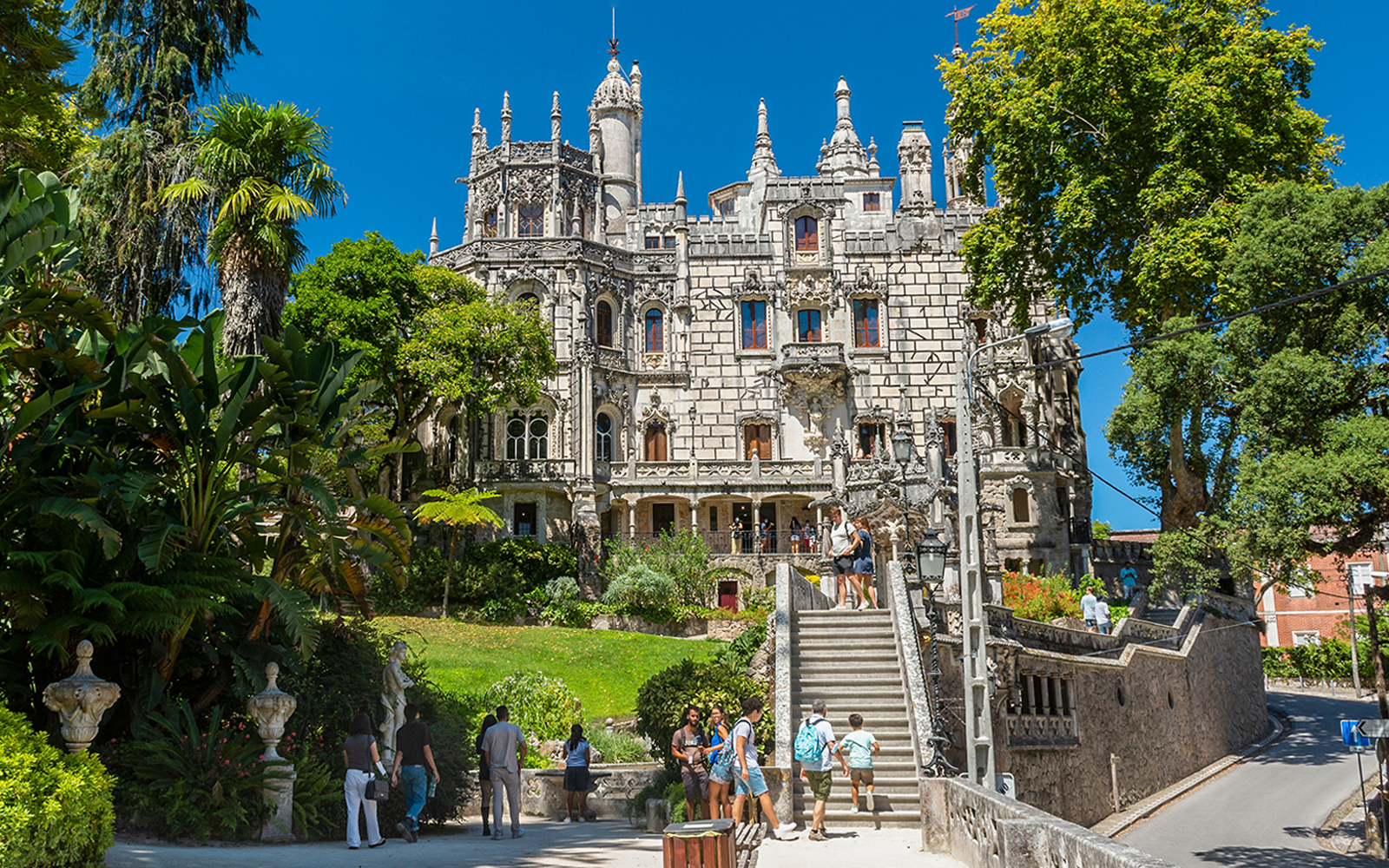
The third Sintra set piece. António Augusto Carvalho Monteiro, on a Brazilian-Portuguese coffee fortune, commissioned the property between 1904 and 1910 with the Italian architect Luigi Manini. The Initiation Well drops 27 metres in an inverted spiral cut into the rock, with Masonic and Rosicrucian symbolism through the gardens. The walk down the well, through the tunnels, and back via the lake grotto is the visit.
Practical: open daily; Apr–Sep 09:30–20:00, Oct–Mar 09:30–18:00. Adult €15, child 6–17 €8. About 1 km uphill from Sintra station. Plan your visit.[7]
4. Castelo de São Jorge
Lisbon Daily, year-round Royal castle of PortugalMap
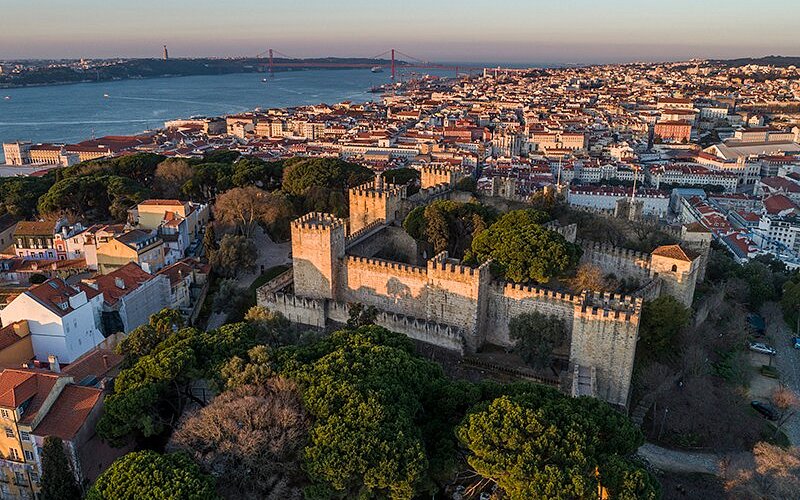
São Jorge was the royal castle of Portugal until the 16th century, when the court moved down to the Ribeira palace on the Tagus. The 11th-century Moorish citadel was captured by Afonso I in the same 1147 campaign that took Sintra. The 1755 earthquake damaged it heavily; most of what visitors see is the 1940s reconstruction under Salazar's Estado Novo. Eleven surviving towers stand above archaeological excavations exposing Iron Age, Roman and Moorish layers; the terrace gives the canonical view across the Baixa to the Tagus.
Practical: open daily 09:00–21:00 (Mar–Oct) / 09:00–18:00 (Nov–Feb). Adult €15, student/youth €7.50, under 12 free. From central Lisbon, tram 28 to Largo das Portas do Sol or bus 737 to the gate. Plan your visit.[8]
5. Belém Tower
Lisbon Closed Mondays Manueline coastal blockhouseMap
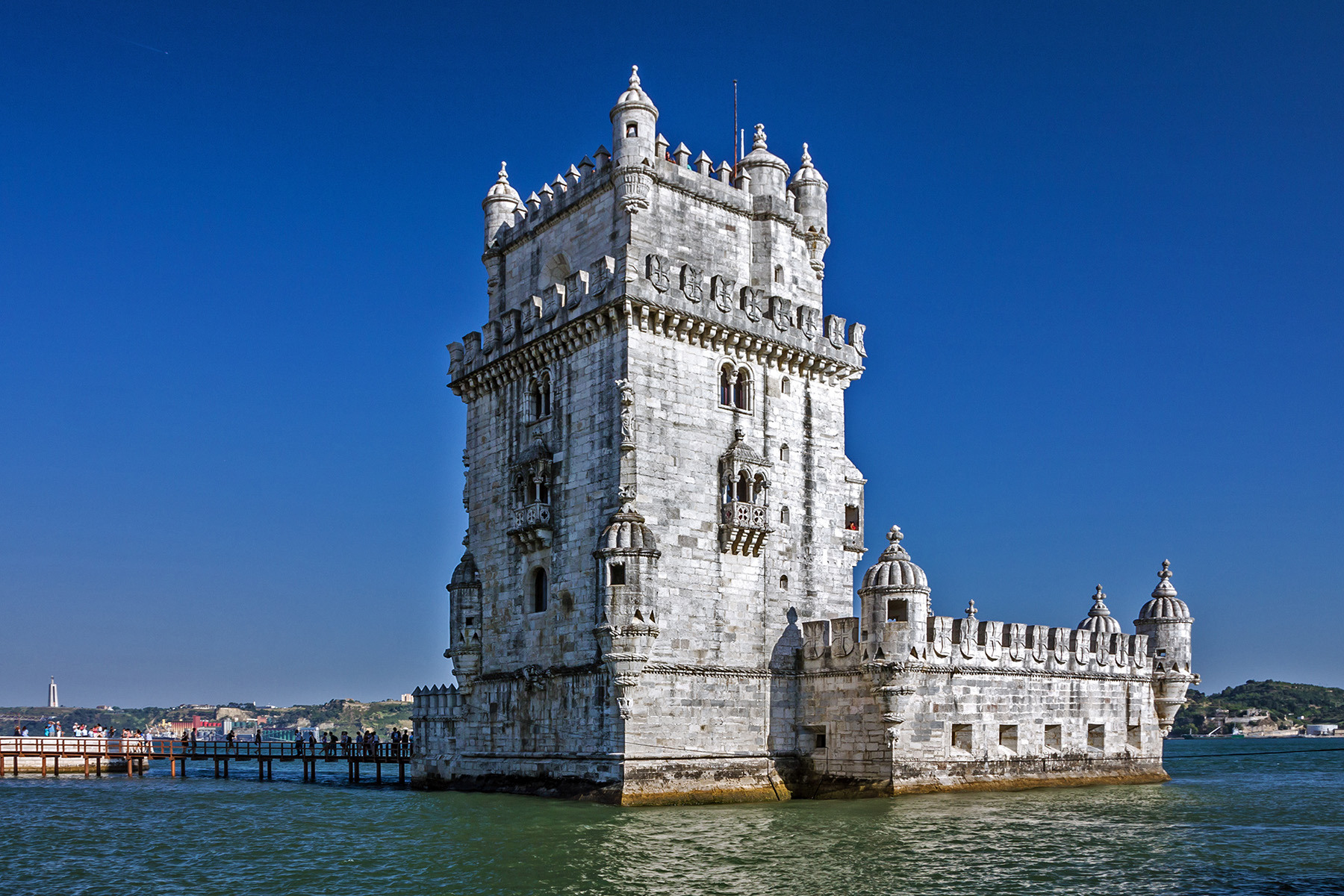
The headline Manueline survival in Portugal. Built between 1514 and 1519 by King Manuel I as a coastal blockhouse defending the mouth of the Tagus during the Age of Discoveries; architect Francisco de Arruda. The stonework carries armillary spheres (Manuel I's personal device), Maltese crosses of the Order of Christ, and maritime motifs of knotted ropes and anchors. UNESCO inscribed Belém alongside the adjacent Hieronymites Monastery in 1983.[9] The late-Tudor English coastal blockhouses Henry VIII commissioned in the 1540s were modelled on its plan.[10] Belém features in our European list of most famous castles.
Practical: open Tue–Sun 09:30–18:00 (May–Sep) / 09:30–17:30 (Oct–Apr), closed Mondays. Adult €8, youth €4; combined Hieronymites ticket €15. From central Lisbon, tram 15E or train Cais do Sodré to Belém. Official site.[11]
6. Convent of Christ, Tomar
Centro (Tomar) Closed Mondays Templar and Order of Christ headquartersMap
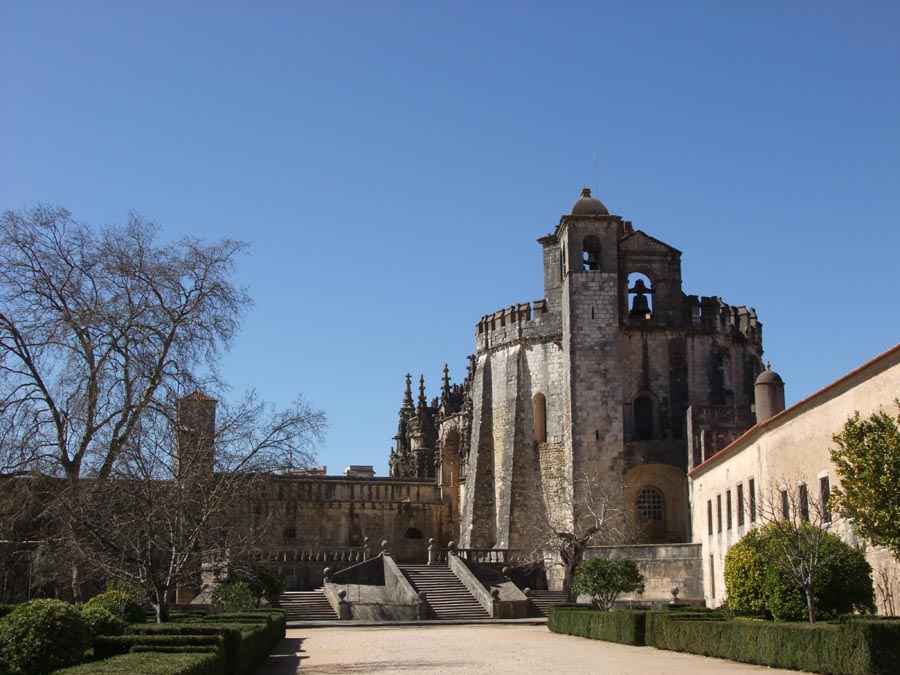
The institutional centre of the Templar and Order of Christ inheritance, and the highest-resolution Manueline ecclesiastical complex in the country. Founded as a Templar fortress in 1160 by Gualdim Pais, the Portuguese Templar Master; the Charola at its heart was modelled on the Holy Sepulchre in Jerusalem. After Pope Clement V suppressed the Templars in 1314, the Portuguese branch was transferred intact to a newly created Order of Christ under King Dinis in 1319: the only European Templar inheritance to survive uninterrupted. Henry the Navigator served as Grand Master from 1420 to 1460, funding the Atlantic voyages from the Order's revenues. UNESCO inscribed the complex in 1983.[12] The Manueline chapter-house window, carved under Manuel I, is the most-photographed piece of late-Manueline stonework in Portugal.
Practical: open Tue–Sun 09:00–18:30 (Jun–Sep) / 09:00–17:30 (Oct–May), closed Mondays. Adult €15, youth €7.50. From Lisbon, Intercidades train Santa Apolónia to Tomar (~2 h). Official site.[13]
7. Castelo de Almourol
Centro (Vila Nova da Barquinha) Closed Mondays Templar river-island fortressMap
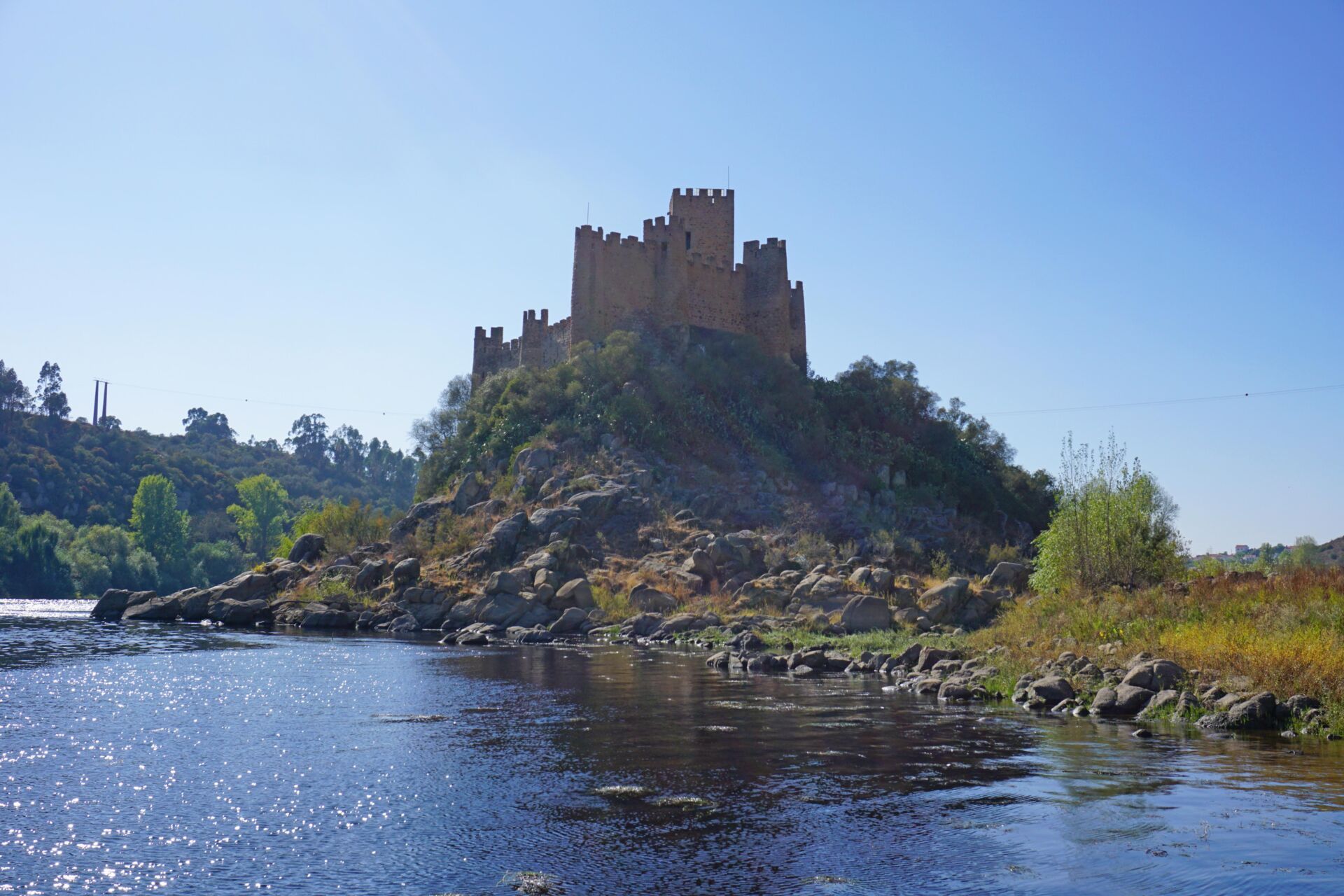
Almourol sits on a rocky island in the middle of the Tagus, 15 km south of Tomar. The fabric is the 1171 Templar reconstruction by Gualdim Pais on an earlier Roman and Moorish site. Almourol carries the cleanest silhouette of any castle in the country: a medieval keep on its own island, reachable only by boat. The keep takes about 30 minutes; the boat trip is the experience.
Practical: open Tue–Sun 10:00–17:30 (Apr–Sep) / 10:00–17:00 (Oct–Mar). Castle free; boat €2.50 each way, every 30 min. From Lisbon, train Santa Apolónia to Tancos (~1 h 30). Tourism site.[14]
8. Castelo de Óbidos
Centro (Óbidos) Daily, year-round Walled medieval townMap
The most intact surviving medieval walled town and castle in Portugal. The walls form a complete 1.5 km circuit you can walk in full. Roman and Moorish foundations sit underneath the 12th-century reconstruction; the Reconquista reached Óbidos in 1148, and successive 13th and 14th-century monarchs gave the town as a wedding gift to the Queen consort. Óbidos became vila das rainhas, the queens' town.[15] The keep runs today as a 17-room Pousada de Portugal; streets and ramparts are free.
> [!NOTE] > Rule of thumb. The Pousada at Óbidos books out months ahead in summer and on Portuguese national holidays. If the keep itself is the draw, plan a midweek night in shoulder season.
Practical: town and ramparts free 24 hours; Pousada rooms from ~€220 in low season. From Lisbon, Rede Expressos coach Sete Rios to Óbidos (~1 h). Pousadas site.[16]
9. Castelo de Guimarães
Norte (Guimarães) Daily, year-round Cradle of PortugalMap
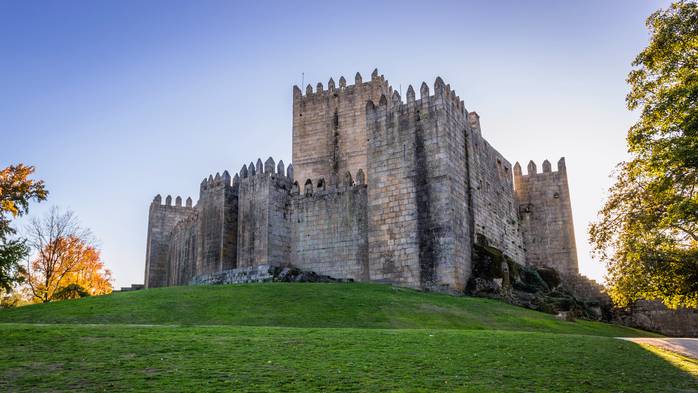
The most important castle on the Norte tier and the symbolic foundation of the country. Tenth-century foundation attributed to Mumadona Dias, Countess of Portucale; substantial 12th-century expansion under Afonso I, traditionally born here around 1109. The phrase Aqui nasceu Portugal, "here Portugal was born", is inscribed at the city gate below the keep, and the €0.05 euro coin carries Guimarães on the reverse. UNESCO inscribed the Historic Centre in 2001.[17] The keep, the chapel of São Miguel where Afonso I was reportedly baptised, and the Palace of the Dukes of Braganza are the visit.
Practical: open daily 10:00–18:00. Adult €4 (castle), €5 (Palace of the Dukes), €15 combined; under 12 free. From Lisbon, Alfa Pendular to Porto Campanhã (~3 h), urban train to Guimarães (~1 h 15). Day-trip realistic from Porto, not Lisbon. Official site.[18]
10. Castelo de Marvão
Alentejo (Portalegre) Daily, year-round Granite frontier outcropMap
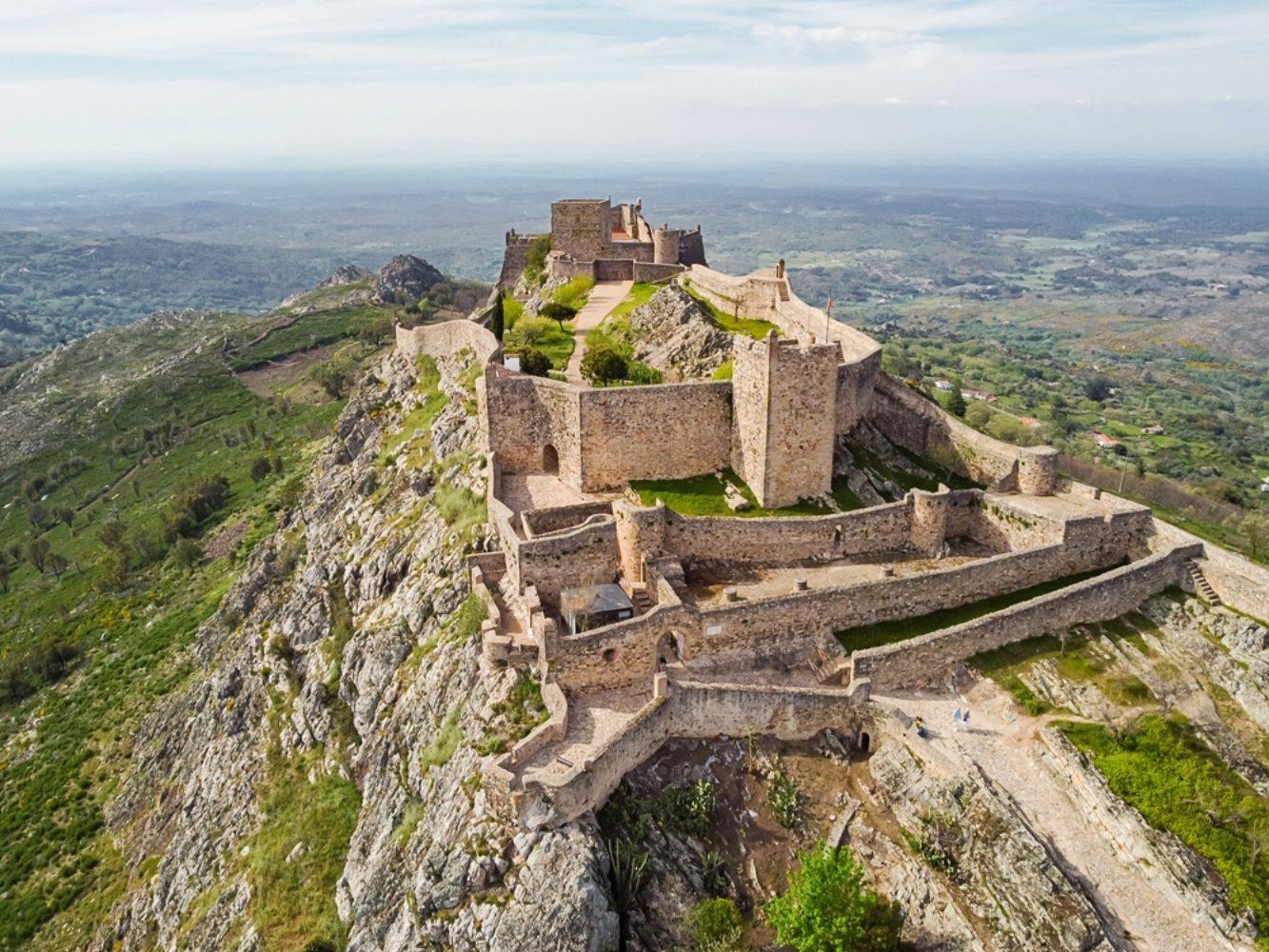
Marvão sits on a granite outcrop at 860 metres, overlooking the Spanish border 100 km north-east of Évora. The 9th-century Moorish foundation was reconstructed under King Dinis in the 13th century as part of the Portuguese-Spanish frontier line. The white-walled village on the granite peak is the most photographed Portuguese frontier-castle silhouette; views into Extremadura reach 50 km on clear days. Pairs well with Évora and Elvas as a three-day Alentejo loop.
Practical: open daily 10:00–19:00 (Apr–Sep) / 10:00–17:00 (Oct–Mar). Adult €1.50, under 12 free. No direct public transport from Lisbon; rent a car (2 h 45 from Lisbon by road). Tourism site.[19]
At a glance
Castle | Region | When to go | |
|---|---|---|---|
| Pena PalaceRomantic-historicist showpiece | Sintra | Closed Tuesdays |
| Castelo dos MourosMoorish hilltop fortress | Sintra | Daily, year-round |
| Quinta da RegaleiraEsoteric estate | Sintra | Daily, year-round |
| Castelo de São JorgeRoyal castle of Portugal | Lisbon | Daily, year-round |
| Belém TowerManueline coastal blockhouse | Lisbon | Closed Mondays |
| Convent of Christ, TomarTemplar and Order of Christ headquarters | Centro (Tomar) | Closed Mondays |
| Castelo de AlmourolTemplar river-island fortress | Centro (Vila Nova da Barquinha) | Closed Mondays |
Castelo de ÓbidosWalled medieval town | Centro (Óbidos) | Daily, year-round | |
| Castelo de GuimarãesCradle of Portugal | Norte (Guimarães) | Daily, year-round |
| Castelo de MarvãoGranite frontier outcrop | Alentejo (Portalegre) | Daily, year-round |
Évora, Elvas and the Alentejo frontier
The Alentejo plateau carries the Roman-to-Reconquista layer in its most legible form. Évora was one of the principal Visigothic-era fortified centres of 5th to 9th-century Iberia.[20] The Roman Temple of Évora (traditionally the Temple of Diana) survives intact in the medieval square; the Corinthian columns have stood on the same ground since the 1st century CE. UNESCO inscribed Évora's Historic Centre in 1986.[21]
Castelo de Elvas, 80 km south-east of Évora, leads the 17th-century star-fortress tradition. The Garrison Border Town of Elvas was UNESCO inscribed in 2012 and carries the largest dry-moat fortifications in the world.[22] The system was built during the Portuguese-Spanish War of Restoration (1640 to 1668).
The Algarve castles close the Reconquista sequence. Castro Marim was Order of Christ headquarters from 1319 to 1356. Silves preserves the most substantial Moorish fabric in the south. Fortaleza de Sagres at Cape St Vincent is where tradition places Henry the Navigator's school of navigation, the launching point of the 15th-century voyages to the African coast.
> [!WARNING] > Watch out. Several inland Alentejo and Algarve castles (Marvão, Castro Marim, Sagres) have no direct public transport from Lisbon. If you do not drive, plan a multi-day loop with Évora as the rail base, or skip the inland tier on a short trip.
How many castles are in Portugal?
The DGPC heritage register lists 310 protected castle, palace and manor properties across three tiers.[1] The figure climbs higher if you count fortified manor houses (solares), towers and minor walled enclosures: tourism authorities cite more than 150 castles open to public visit.[23] Several dozen run through the DGPC and Parques de Sintra; another tranche through the Pousadas de Portugal heritage-hotel network (Óbidos, Estremoz, Alvito, Crato).
Famous, medieval, Manueline and largest
Famous. Pena, Belém Tower and Castelo dos Mouros lead by visitor numbers; Guimarães carries the strongest national-symbolic weight; Tomar the strongest international-historical weight.
Medieval. Óbidos, Almourol and Marvão are the strongest medieval survivors as standalone visits. Bragança, in the far north-east, preserves the best medieval citadel walls in the country with the 33-metre Torre de Menagem inside an intact 12th-century enclosure.
Manueline. The architectural language Manuel I (1495 to 1521) sponsored is unique to Portugal: late-Gothic structure with maritime and globe motifs. Belém Tower and the Convent of Christ chapter window are canonical; the Hieronymites Monastery and the Mosteiro da Batalha complete the four-site Manueline circuit.
Largest. The Palace of Mafra, 30 km north of Lisbon, is one of the largest Baroque palaces in Europe. João V built it between 1717 and 1755 from Brazilian colonial gold; UNESCO inscribed it in 2019. We treat Mafra in detail in our piece on the largest palace in the world.
If you're looking to buy
Castle Collector's Castle Price Index (March 2026) tracks Portugal at a median asking of €2,957 per square metre, roughly 32% above the European all-market median, reflecting Sintra and Cascais coastal premiums.[24] At the trophy end, Penha Longa in Sintra (a 14th-century monastery converted to the 194-room Ritz-Carlton) traded at €100 million in 2018; Casa da Viúva Patiño in Cascais traded at €12 million in 2016.[24]
Foreign-buyer access is open. IMT (property transfer tax) runs 0 to 7.5% progressive by value, plus 0.8% stamp duty and 1.5% notary, for a 3 to 10% all-in transaction cost.[24] The October 2023 Golden Visa restrictions narrowed the investment-residency pathway, not the acquisition pathway: direct castelo purchase as a private residence remains essentially open. Portuguese real estate investment ran +16% year-on-year in 2025, part of the broader southern European cycle.[25] If you're seriously looking, the castles for sale in Portugal page tracks current listings; for the operational side see our guide to buying a castle.
Sources
1. Direcção-Geral do Património Cultural (DGPC), national heritage register.
2. Fletcher, R. Moorish Spain. University of California Press, 2006. Chapter on the 1249 Algarve completion and 1492 Granada parallel.
3. Coulson, C. L. H. Castles in Medieval Society: Fortresses in England, France, and Ireland in the Central Middle Ages. Oxford University Press, 2003.
4. UNESCO World Heritage Centre, "Cultural Landscape of Sintra" (inscribed 1995).
5. Parque e Palácio Nacional da Pena, Parques de Sintra official site.
6. Castelo dos Mouros, Parques de Sintra official site.
7. Quinta da Regaleira, official site.
8. Castelo de São Jorge, official site.
9. UNESCO World Heritage Centre, "Monastery of the Hieronymites and Tower of Belém in Lisbon" (inscribed 1983).
10. Pounds, N. J. G. The Castle in England and Wales: An Interpretive History. Routledge / Leicester University Press, 1990, p. 200.
11. Torre de Belém, DGPC official site.
12. UNESCO World Heritage Centre, "Convent of Christ in Tomar" (inscribed 1983).
13. Convento de Cristo, DGPC official site.
14. Câmara Municipal de Vila Nova da Barquinha, Castelo de Almourol.
15. Mattoso, J. História de Portugal: A Monarquia Feudal (1096–1480). Editorial Estampa, 1993. Chapter on the vilas das rainhas tradition.
16. Pousadas de Portugal, official site.
17. UNESCO World Heritage Centre, "Historic Centre of Guimarães" (inscribed 2001).
18. Paço dos Duques de Bragança, DGPC official site.
19. Câmara Municipal de Marvão, tourism site.
20. Lepage, J.-D. G. G. Castles and Fortified Cities of Medieval Europe: An Illustrated History. McFarland, 2002, pp. 15, 18, 20, 40, 63.
21. UNESCO World Heritage Centre, "Historic Centre of Évora" (inscribed 1986).
22. UNESCO World Heritage Centre, "Garrison Border Town of Elvas and its Fortifications" (inscribed 2012).
23. Turismo de Portugal, Visit Portugal: Castles and Fortifications.
24. Castle Collector, Castle Price Index, March 2026 edition.
25. Savills Research, Spotlight: Southern Europe Investment 2026.