
Castle Evolution: How Fortifications Changed Across 1,000 Years
From the Norman motte-and-bailey of the 1060s to Edwardian concentric fortresses and Renaissance country houses, castle architecture evolved across 11 centuries.
Eleven centuries, six big turning points. From earthwork forts raised against Viking raiders in the 880s to the fantasy silhouettes Ludwig II built in the 1880s. The defensive castle ended around 1500. The visual idea of a castle did not.
The medieval castle had a working life of roughly 600 years. It peaked with Edward I's Welsh ring in the 1280s and lost its defensive purpose to gunpowder by the mid-1500s. Everything after is residential, ceremonial or romantic, even when the building still calls itself a castle.[1][2][3][4][6]
The 1,000-year timeline at a glance
Period | Castle type | Defining example | Built | Innovation |
|---|---|---|---|---|
Late 9th-10th c. | Proto-castle / hill-fort | Burh fortifications, Carolingian palaces | c.880-1000 | Mass-and-earthwork defence |
Late 11th c. | Motte-and-bailey | Hundreds across England post-1066 | 1066-1100 | Mound-plus-courtyard wood/earth |
12th c. | Square Romanesque keep | Tower of London (White Tower 1078), Rochester | 1078-1180 | Stone reconstruction; great keep |
Late 12th-13th c. | Curtain-wall + drum tower | Dover (1180s), Château Gaillard (1198) | 1180-1280 | Curtain wall + circular flanking towers |
Late 13th c. | Concentric castle | 1283-1330 | Inner + outer concentric walls; Edward I | |
14th c. | Brick Teutonic castle | Marienburg / Malbork (HQ from 1309) | 1274-1400 | Standardised brick Order design |
15th c. | Late-medieval transitional | Italian Quattrocento princely palaces | 1400-1500 | Defensive function gives way to palatial |
16th-17th c. | Renaissance castello-palazzo | Beltramo, Cantatore, Folin survey period | 1500-1700 | Pure palatial residence; defence obsolete |
18th c. | Post-defensive country house | Blenheim, Hampton Court Tudor expansion | 1700-1800 | No defensive function at all |
19th c. | Romantic-era reconstruction | Neuschwanstein, Burg Stolzenfels, Pierrefonds | 1825-1886 | Historicist Romantic fantasy castles |
Key shift
Three turning points matter most. The Norman Conquest of 1066 brought mass-produced motte-and-bailey castles to England. Edward I's 1283-95 Welsh programme perfected concentric defence. Gunpowder artillery killed off the medieval castle by the mid-16th century. Everything before, between and after these dates fits inside that arc.
Motte-and-bailey, 1066-1100
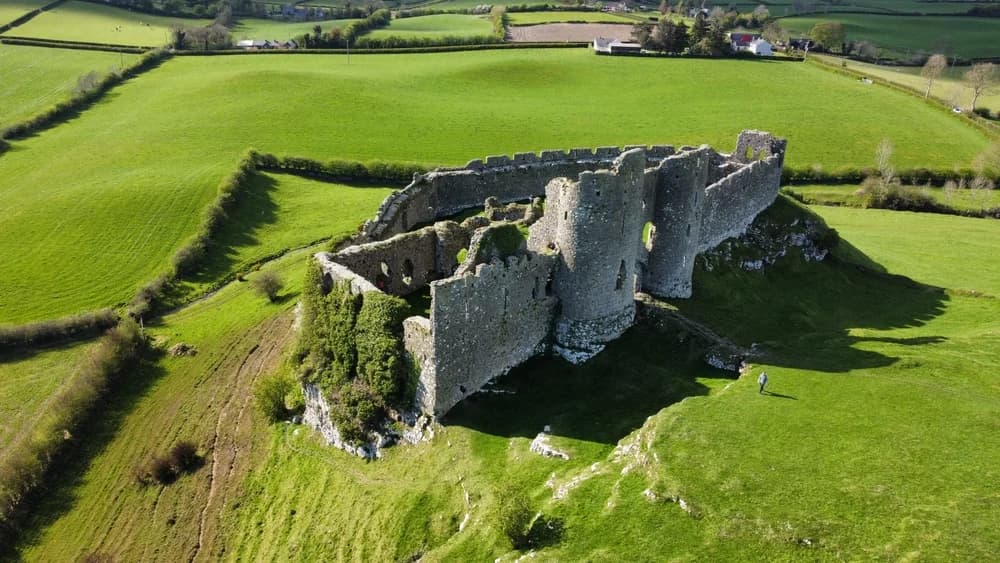
The Norman Conquest brought a systematic castle-building tradition to England. Pounds (1990) shows that within decades of 1066, William the Conqueror and his lords had built several hundred motte-and-bailey castles across England, most rebuilt in stone during the 12th and 13th centuries.[2] The design was a steep earthen mound (the motte) topped by a wooden tower, with a walled courtyard (the bailey) at the base. A few weeks of forced labour was enough, which let the Normans hold new territory quickly.
Square Romanesque keep, 1078-1180
The shift to stone began in the 1080s. The White Tower at the Tower of London, finished around 1078 under William the Conqueror, is the canonical early-Norman royal stone keep, built over the original earthwork. Rochester, Hedingham and Norwich form the broader 12th-century English Romanesque tradition.
Coulson (2003) treats the medieval castle as a social and legal idea as much as a building. Being licensed by the king to add battlements (the "licence to crenellate") carried as much weight as actually using the place for war. The licence system operated across England, France and Ireland from the 12th century onwards, and its written record is one of the main sources we have for identifying which buildings counted as castles in legal terms.[1]
Curtain wall and drum tower, 1180-1280
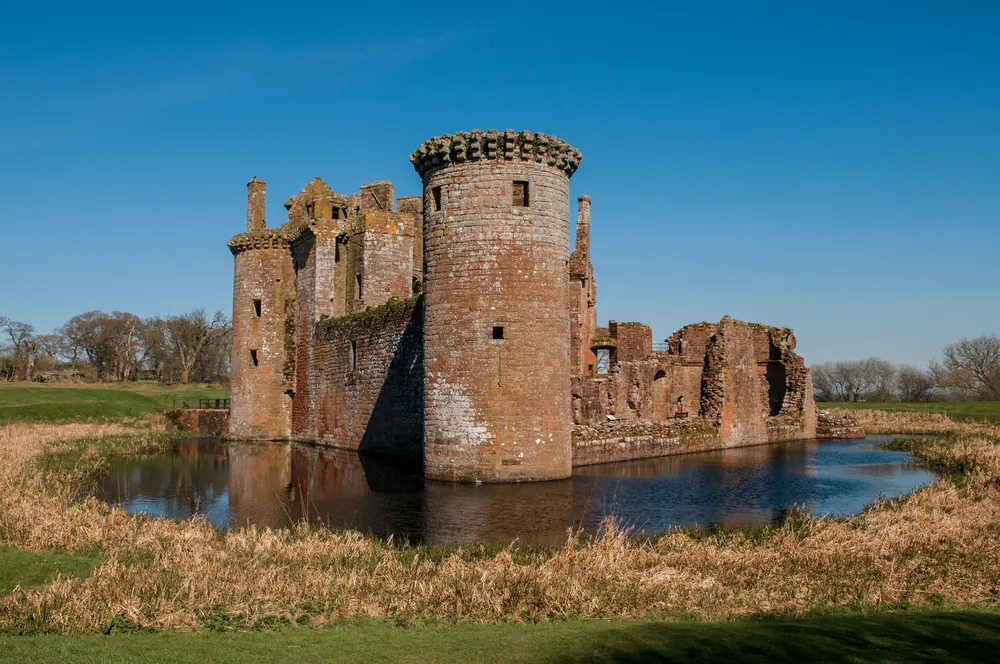
Drum-tower architecture (round towers) emerged from around 1200 and was standard by the mid-13th century. Pounds tracks this as the key marker in the shift from Norman square keeps to fully round defensive walls by the 1280s.[2] Round towers had two big advantages over square ones: no blind corners where attackers could approach undetected, and better resistance to mining and trebuchet impacts.
Dover Castle has one of the earliest twin-tower gatehouses in England (attacked in 1216). With the Constable's Gate, the Avranches tower and the Norfolk towers, it became the prototype of high-medieval English castle defence.[2]
Concentric castle, 1283-1330
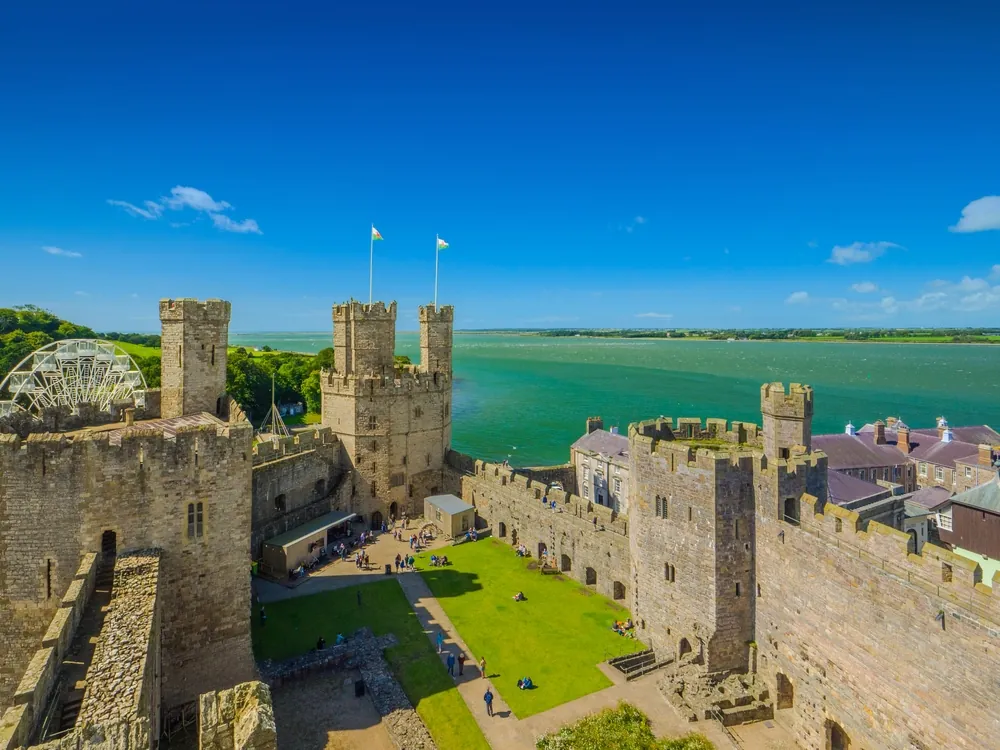
Edward I's post-1283 conquest programme in Wales produced the high-water mark of the medieval European castle. Caernarfon, Conwy, Beaumaris and Harlech were designed by Master James of St. George of Savoy as one connected system of concentric defensive fortifications.
Across the four castles, the build cost roughly £80,000 in 1280s money, around £80 million today, well above the entire Crown revenue for several years of the campaign.[4] Davies notes that the 1294-95 Madog ap Llywelyn revolt added £55,000 in campaign costs plus £16,000+ in Caernarfon repairs, which fed the financial crisis that overwhelmed Edward I in the late 1290s.
Why it matters
The Edwardian Welsh ring is the ceiling of the medieval castle. Nothing built after 1300 added a defensive idea the Welsh castles weren't already using. Later castles got bigger, brick-built, or more decorated, but the basic geometry (two rings of walls, round flanking towers, defended gatehouses) was set.
Brick Teutonic castle, 1274-1400
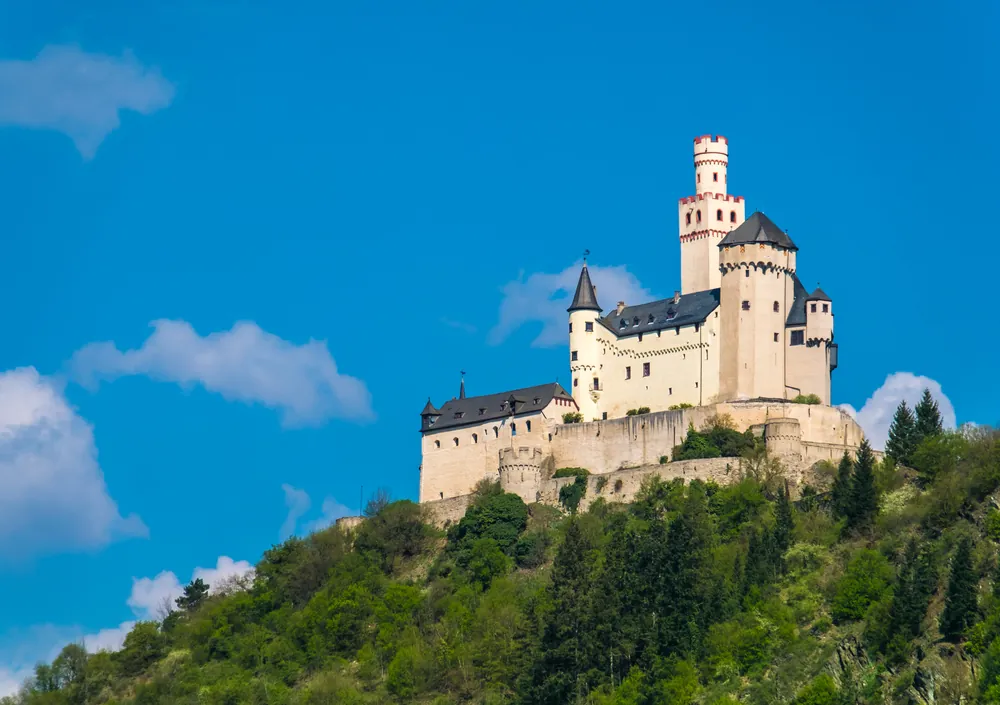
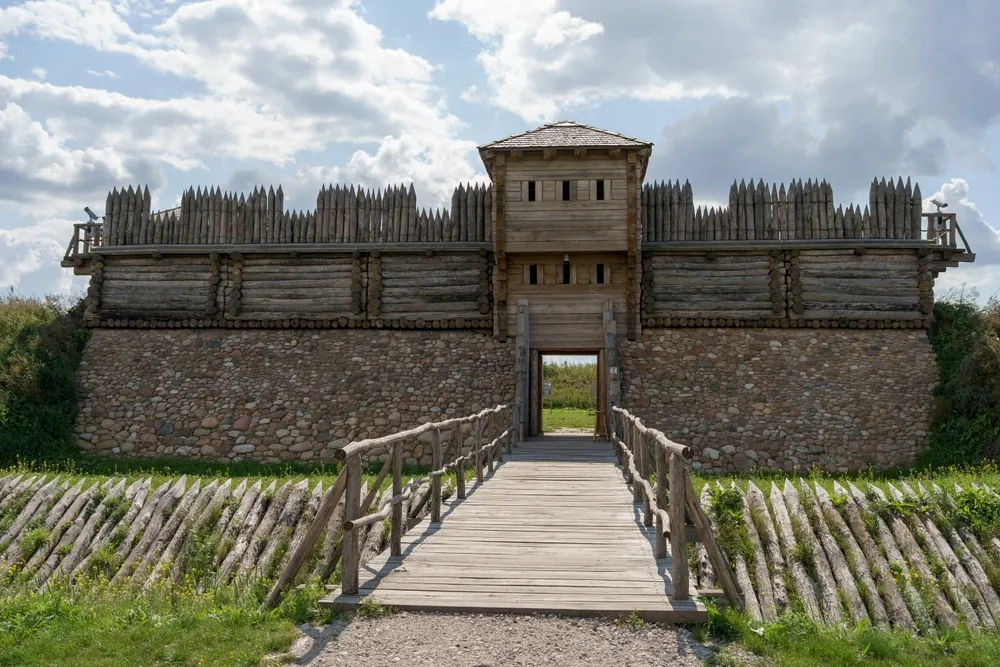
The Teutonic Order's Baltic conquest network is the next turning point.[3] Marienburg (Malbork) on the Nogat river became the Order's headquarters in 1309, after construction began in 1274. Across the 14th century it grew into the largest brick castle in the world by floor area, at 143,591 m². UNESCO listed it in 1997. The Order built a network of smaller castles across Prussia, Pomerania and Lithuania (Lochstedt, Lauenburg, Lyck, Lötzen, Löbau, Leipe) using the same brick template.
Italian Quattrocento, 1400-1500
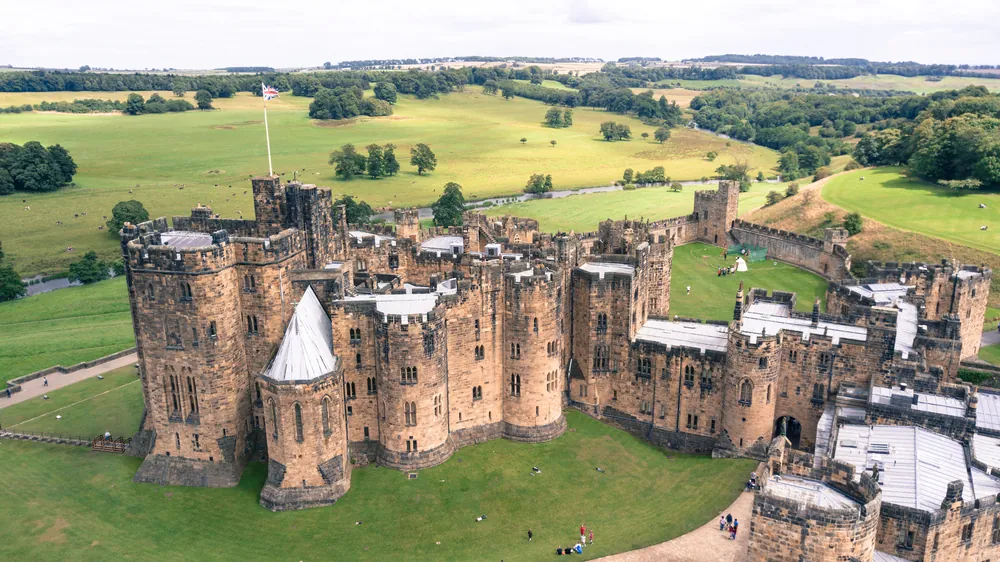
The Italian 15th century marked the transition from medieval defensive castle to Renaissance princely palace. Beltramo, Cantatore and Folin's A Renaissance Architecture of Power (Brill 2016) is the foundational survey.[7] Castello del Buonconsiglio in Trento, redeveloped under Cardinal Bernardo Cles in 1528-36, captures the moment: the medieval castello giving way first to the palazzo fortificato and then to the pure palazzo.
Renaissance and gunpowder, 1500-1700
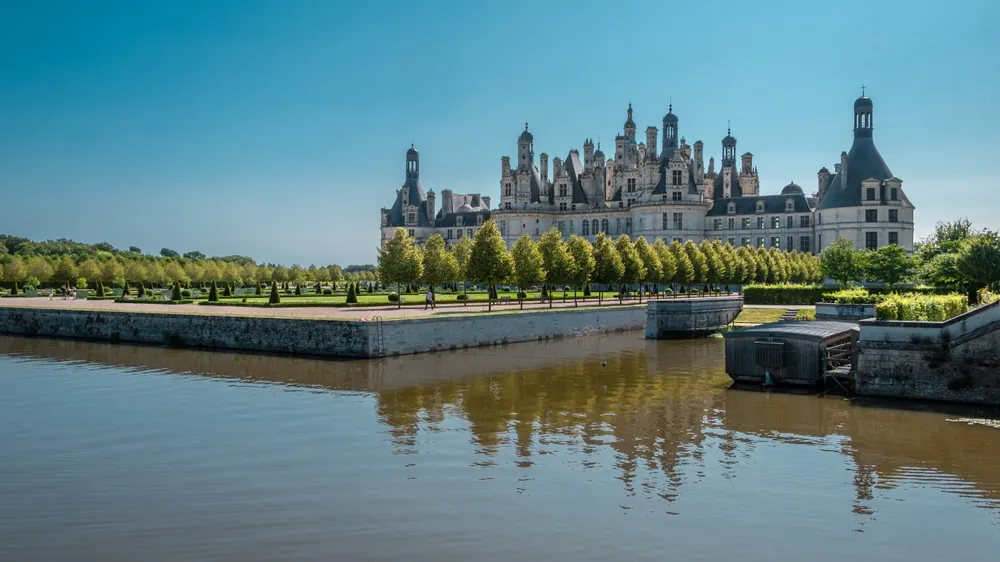
By the 16th century, gunpowder artillery had made medieval castle walls useless. The response split in two directions. Purely military building moved to the low, angled star-fortress associated with the French engineer Vauban (Festung Marienberg in Würzburg is the textbook example). Wealthy residential owners built palatial Schlösser, palais and country houses without any real intent to defend them.
Watch out
"Castle" as a marketing term covers buildings from any of the next 400 years, but the medieval defensive castle effectively ended in the mid-1500s. A 17th-century "castle" is almost always a country house with castle-style decoration. The distinction matters for which heritage tier the building falls into and what restoration is allowed; see the palace vs castle distinction.
Post-defensive country house, 1700-1800
The 17th and 18th centuries produced the post-defensive country house: Blenheim, Hampton Court's Tudor expansion, Versailles (1682), Sanssouci (1745-47). The vocabulary borrows from the medieval castle (towers, crenellations, donjons), but the function is purely residential and ceremonial.
Romantic-era reconstruction, 1825-1886
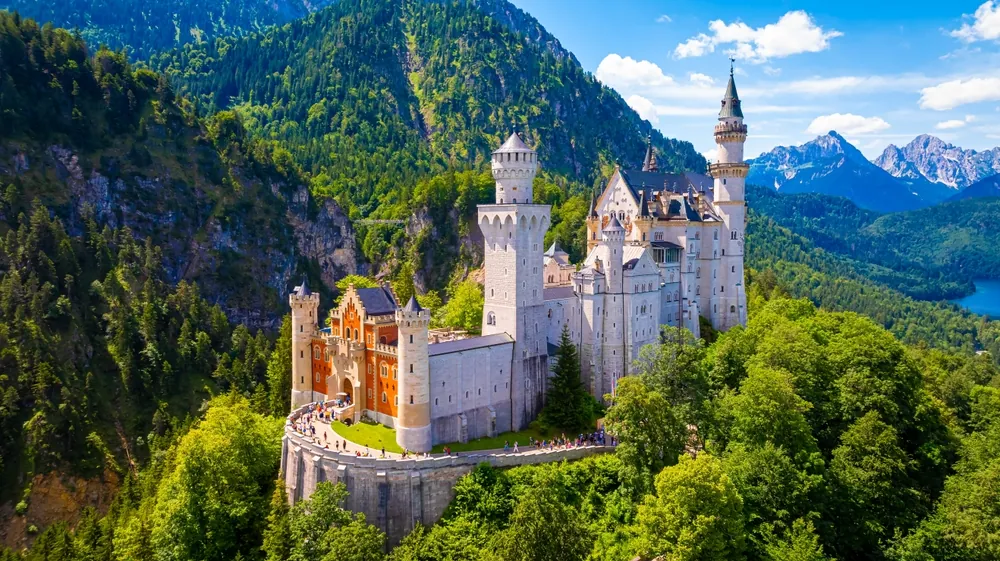
The 19th century produced the reconstruction phase that defines what most modern visitors picture when they think "castle". The Hohenzollern programme along the Rhine is the founding event. Burg Rheinstein was the first Rhine ruin rebuilt, in 1825-29, by Prince Frederick Louis; Burg Stolzenfels followed in 1836-45 under Frederick William IV of Prussia.[5] Both established the Romantic-historicist style that produced the Neuschwanstein generation of fantasy castles under Ludwig II of Bavaria (1869-1886).
The French equivalent is Pierrefonds Castle, the Viollet-le-Duc neo-medieval restoration commissioned by Napoleon III in the 1860s, which rebuilt a ruined 14th-century castle into a fantasy state exceeding the original ambition. Walt Disney's "Sleeping Beauty Castle" silhouette derives from the Neuschwanstein roofline. Both inherit from the Pierrefonds-Stolzenfels-Rheinstein tradition, not from actual medieval survivals.
Goodall draws a useful line between the historical castle (a defended home) and the cultural meaning of the word we've inherited.[6] The two have steadily drifted apart since the late 16th century, and the visual idea continues in Disney silhouettes and in modern castle hotels and wedding venues.
Common questions
When did castles stop being built for defence?
The medieval defensive castle effectively ended in the mid-16th century when gunpowder artillery made the high curtain wall obsolete. Military building moved to the low, angled Vauban star-fortress. Residential elites kept building "castle-style" homes without serious defensive intent.
What was the most expensive castle of the Middle Ages?
Edward I's Welsh ring (Caernarfon, Conwy, Beaumaris, Harlech) cost roughly £80,000 in 1280s pounds across the four sites, equivalent to about £80 million today. The 1294-95 revolt added £55,000 in campaign costs plus £16,000+ in Caernarfon repairs.
Why are round towers better than square ones?
Round towers have no blind corners where attackers can approach unseen, and they spread the force of mining and trebuchet hits more evenly. Square towers concentrate stress at the corners and leave attackers blind spots to approach through.
Is Neuschwanstein a real medieval castle?
No. It was built 1869-1886 under Ludwig II of Bavaria in the Romantic-historicist style established earlier by the Rhine reconstructions. It has no medieval defensive function and inherits from the Stolzenfels-Pierrefonds tradition, not authentic medieval survivals.
What is the largest castle in the world?
Marienburg (Malbork) in Poland, by built floor area at 143,591 m² of integrated brick structure. It became the Teutonic Order's headquarters in 1309 and grew across the 14th century.
When did the Normans build their first stone castles in England?
The shift from earth-and-timber motte-and-bailey to stone began in the 1080s. The White Tower (c.1078) is the canonical early example, with Rochester, Hedingham and Norwich following in the 12th century.
What is "licence to crenellate"?
A royal grant giving a landowner permission to build battlements on a home. Coulson (2003) argues the licence carried as much social and legal weight as the actual ability to fight from the building, and its written record helps us identify which buildings counted as castles in legal terms.
Sources
1. Coulson, C. L. H. Castles in Medieval Society: Fortresses in England, France, and Ireland in the Central Middle Ages. Oxford University Press, 2003.
2. Pounds, N. J. G. The Castle in England and Wales: An Interpretive History. Routledge / Leicester University Press, 1990.
3. Pluskowski, A. The Archaeology of the Prussian Crusade: Holy War and Colonisation. Routledge, 2013.
4. Davies, R. R. The Age of Conquest: Wales, 1063-1415. Oxford University Press, 1991 (originally 1987).
5. Taylor, R. R. Castles of the Rhine: Recreating the Middle Ages in Modern Germany. Wilfrid Laurier University Press, 1998.
6. Goodall, J. The Castle: A History. Yale University Press, 2022.
7. Beltramo, S., Cantatore, F. & Folin, M. (eds.) A Renaissance Architecture of Power: Princely Palaces in the Italian Quattrocento. Brill, 2016.