
Castles in Scotland: 11 to visit, from Edinburgh to Eilean Donan
Edinburgh draws 2.2 million visitors a year. Eilean Donan is the most-photographed Highland castle. Cawdor inspired Macbeth. 11 Scottish castles to know.
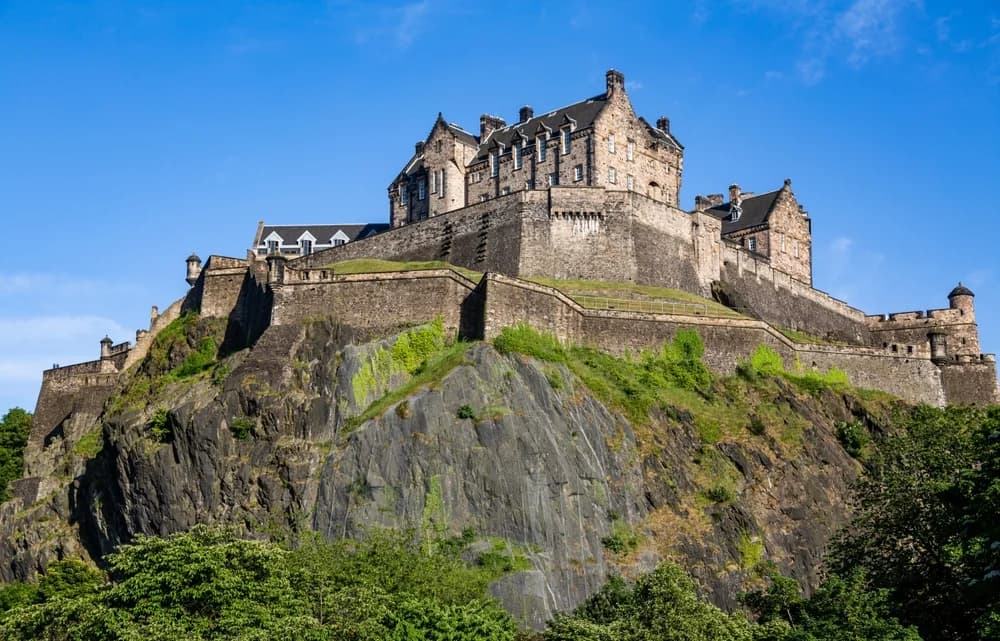
From a fortress on a volcanic crag in Edinburgh to a tidal-island castle on Loch Duich, eleven Scottish castles that anchor a serious itinerary.
Scotland holds one of the densest castle landscapes in Europe. Historic Environment Scotland's listed-buildings register protects more than a thousand castle sites, and the architectural historians MacGibbon and Ross argued in 1887 that Scotland's surviving castles "form a complete and independent chapter in the general history of the art, marked by a native and national character … quite distinct from that of any other country".[1] The 14th- to 17th-century tower house, with its corbelled angle turrets and stepped gables, is the form most identified with Scottish castle building.
The castles a traveller comes for cluster in three regions. Edinburgh and the central belt give you the great royal fortresses (Edinburgh, Stirling, Linlithgow). The Highlands give you the picture-postcard sites (Eilean Donan, Urquhart on Loch Ness, Cawdor near Inverness). The north-east, around Aberdeenshire, gives you the densest concentration of intact tower houses anywhere in Britain (Crathes, Craigievar, Dunnottar on its sea-cliff).
The eleven below are the ones that warrant the journey. Each entry covers what to see, when to go, what it costs, and how to get there.
1. Edinburgh Castle
Edinburgh Daily, year-round Honours of Scotland Map
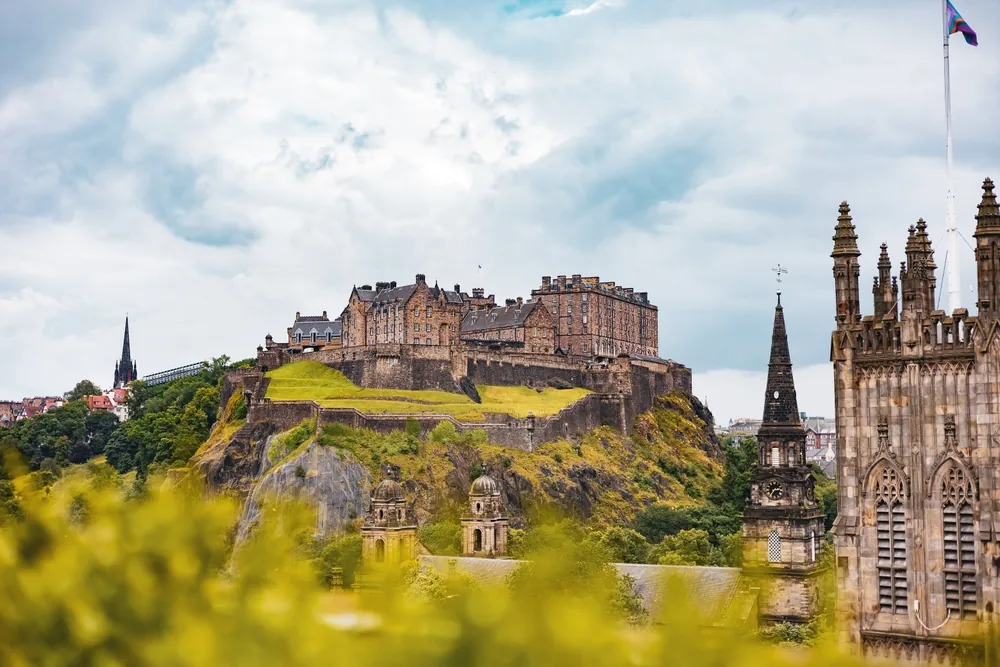
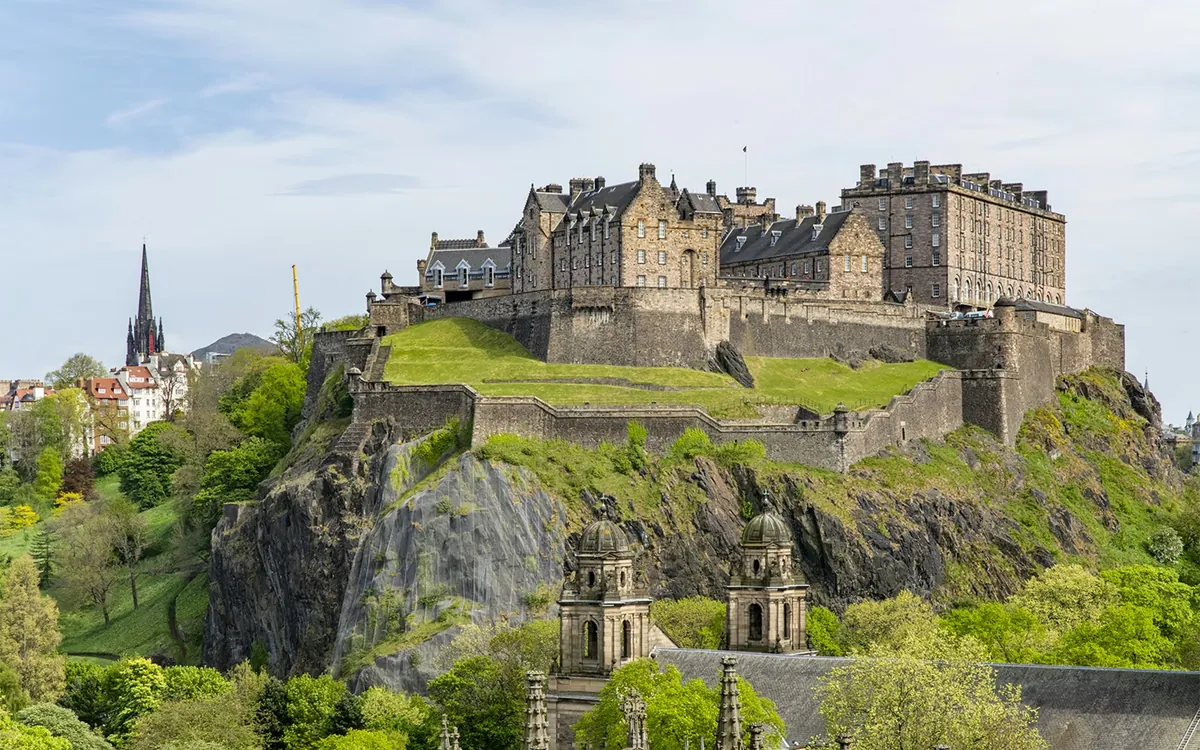
The fortress on Castle Rock has dominated the Edinburgh skyline since the 12th century, with successive royal building campaigns from David I onwards laying down what is now Scotland's most-visited paid attraction. The Honours of Scotland (the Scottish crown jewels: crown, sword and sceptre) sit in the Crown Room of the Royal Palace; the historian Marc Morris notes that Edinburgh "continues to top the league as Scotland's most famous historic monument", driven by its capital location and the annual Royal Edinburgh Military Tattoo on the esplanade each August.[2]
The castle drew 1,981,152 visitors in 2024 according to ALVA's annual visitor figures, up 4% year on year, making it Scotland's most-visited paid attraction.[3] The visit covers the Crown Room, St Margaret's Chapel (the oldest building in Edinburgh, c. 1130), the Great Hall, the Honours, the National War Museum, and the One O'Clock Gun. The Stone of Destiny, the medieval coronation stone returned from Westminster Abbey in 1996, was permanently moved to Perth Museum in 2024 and is no longer at Edinburgh.
Practical: open daily, year-round (closed 25–26 December); 09:30–18:00 in summer (last entry 17:00), 09:30–17:00 in winter (last entry 16:00). Adult £23.50 online (£26 at the gate), concession £19.00, child (7–15) £14.00, under 7 free; family tickets from £48.50. Note: the Crown Room is closed from 12 January through April 2026 for refurbishment displays. From central Edinburgh, walk up the Royal Mile from Waverley Station (around 15–20 minutes) or take bus 23, 27 or 41 to George IV Bridge. Plan your visit.[4]
2. Stirling Castle
Stirlingshire Daily, year-round Renaissance royal palace Map
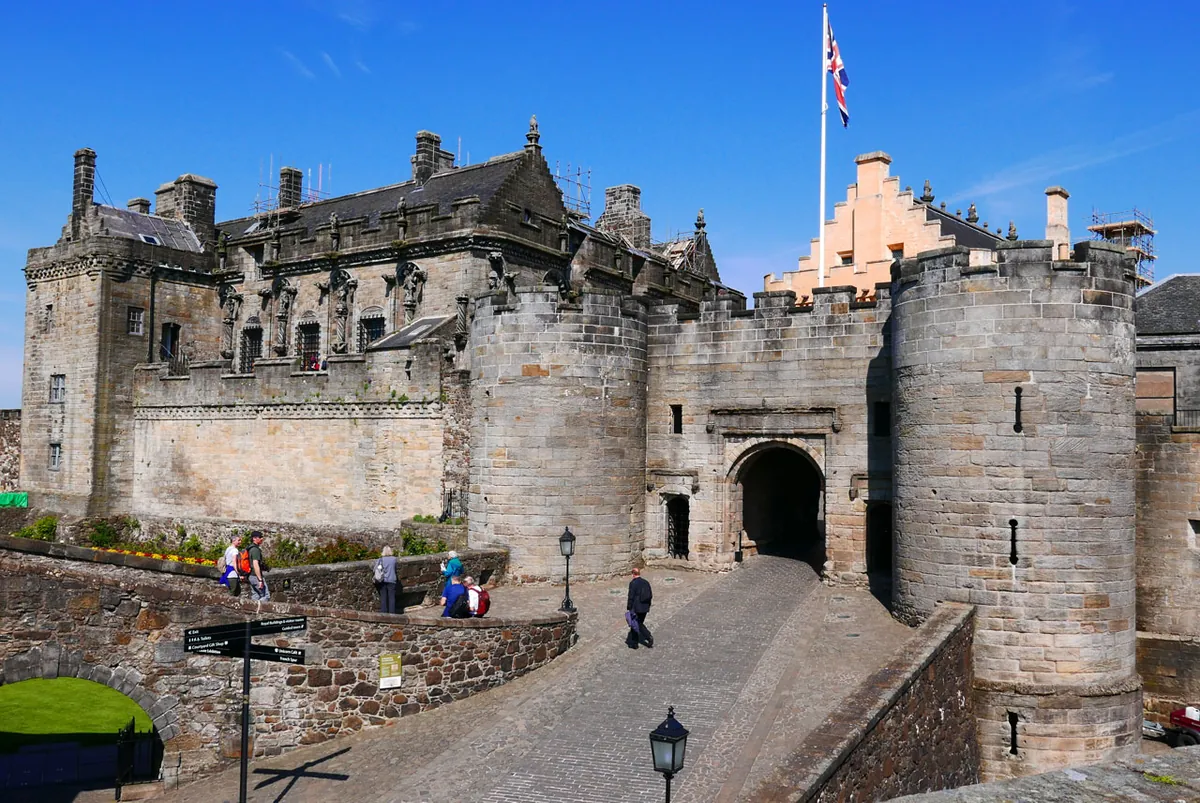
Stirling stands on a volcanic crag controlling the strategic narrows between the Lowlands and the Highlands, the reason it changed hands more often than any other Scottish castle in the medieval era. Edward I besieged it in 1304 and refused to accept the garrison's surrender before testing his largest siege engine, "The War Wolf", on the walls; Scottish forces afterwards adopted a policy of razing castles rather than garrisoning them, to deny their use to the English.[5] The Stewart kings used Stirling as a Renaissance palace from the 15th century: James IV built the Great Hall (now restored to its original ochre limewash), James V built the palace block, and Mary Queen of Scots was crowned here aged nine months in 1543.
The recently restored Royal Palace interiors are the finest surviving example of Scottish royal court decoration anywhere; the Stirling Heads, carved oak roundels from the King's Inner Hall ceiling, are among the most important Scottish Renaissance survivals. The Great Hall, the Chapel Royal where James VI was baptised in 1566, and the Castle Esplanade with its long view westward to the Trossachs are the rest of the visit.
Practical: open daily, year-round (closed 25–26 December); 09:30–18:00 (Apr–Sep), 09:30–17:00 (Oct–Mar); last entry one hour before close. Adult £18.50 online (£20.50 at the gate), concession £15.00, child £11.00; family tickets from £36.50; 25% off for car-free arrivals. From Edinburgh, ScotRail train Edinburgh Waverley to Stirling (around 50 minutes), then a 20-minute walk uphill to the castle. Plan your visit.[6]
3. Urquhart Castle
Highland (Loch Ness) Daily, year-round Loch Ness viewpoint ruin Map
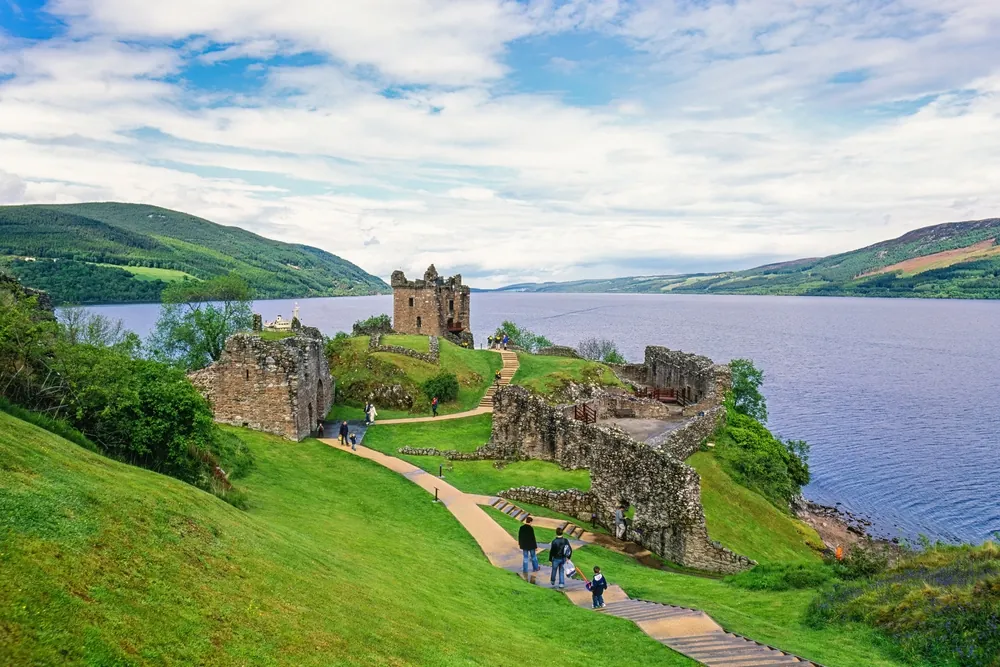
The ruined fortress on a headland above Loch Ness was the principal royal stronghold of the Great Glen, fought over repeatedly during the Wars of Independence and again during the Jacobite risings. The garrison blew up the gatehouse in 1692 to deny it to the Jacobites, leaving the dramatic broken silhouette that visitors see today. The five-storey Grant Tower at the north end is the tallest surviving element; the rest is a sprawl of curtain wall, gatehouse and lower bailey along a half-kilometre of loch shore.
Urquhart is the most-visited Loch Ness attraction in its own right and the spot from which most of the more credible "Nessie" sightings have been logged from. The visit takes in a substantial visitor centre, the trebuchet replica, the Grant Tower lookout and a steep walk down to the water's edge. The view from the tower across the loch toward the Monadhliath mountains is the photograph everyone takes home.
Practical: open daily, year-round (closed 25–26 December, reduced hours 24 December and 1 January); 09:30–20:15 in peak summer (last entry 19:15), 09:30–16:30 in winter (last entry 15:30). Adult £14.00 online (£16.00 at the gate), concession £11.00, child (7–15) £8.50; family £40.50 online. Pre-booking is recommended in summer due to capacity. From Inverness (around 16 miles), drive south on the A82 along Loch Ness, or take Stagecoach bus 19 toward Fort William. Plan your visit.[7]
4. Eilean Donan
Highland Open Feb–Dec Most-photographed Scottish castle Map
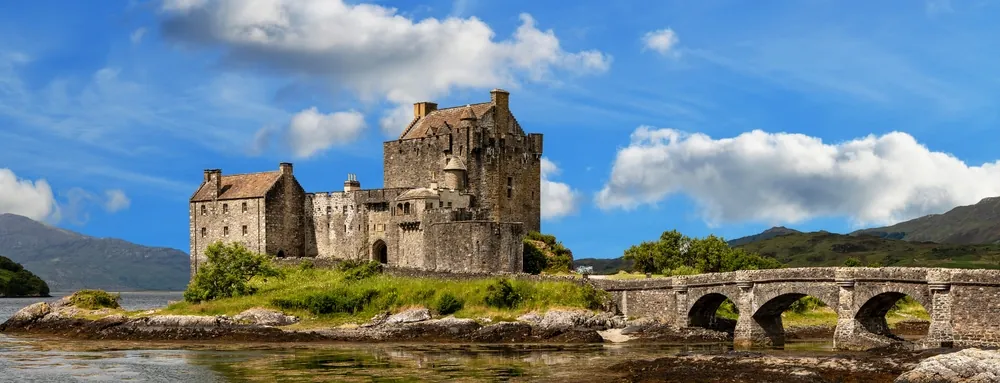
The small island fortress at the meeting of three sea lochs (Loch Duich, Loch Long and Loch Alsh) is the most-photographed castle in Scotland and one of the most internationally recognisable. The original 13th-century stronghold was destroyed in 1719 when Royal Navy frigates shelled and dynamited it during the abortive Jacobite rising of that year. The castle stood as a ruin for almost two hundred years until Lt Col John MacRae-Gilstrap bought the island in 1911 and rebuilt it between 1912 and 1932 to a romantic interpretation of the medieval plan.[8]
The reconstructed interiors include the Banqueting Hall, the bedrooms, and the Billeting Room with its display of Jacobite-era weapons and clan history. The arched stone bridge across the tidal causeway is the photograph people travel for; the castle has appeared in Highlander (1986), The World Is Not Enough (1999) and a long list of others.
Practical: open daily February to December (closed 23 December–31 January); 09:00–18:00 in high summer (last entry 17:00), 10:00–16:00 in winter shoulder season (last entry 15:00). Adult £13, concession £12 (60+), child (5–15) £6.50, under 5 free; family £38. Tickets are sold on-site only on the day of visit. From Inverness, drive west on the A82 then A87 to Dornie (around 80 miles, two hours), or take Citylink coach 915/916 from Inverness or Glasgow. Plan your visit.[9]
5. Dunnottar Castle
Aberdeenshire Daily, year-round Sea-cliff fortress Map
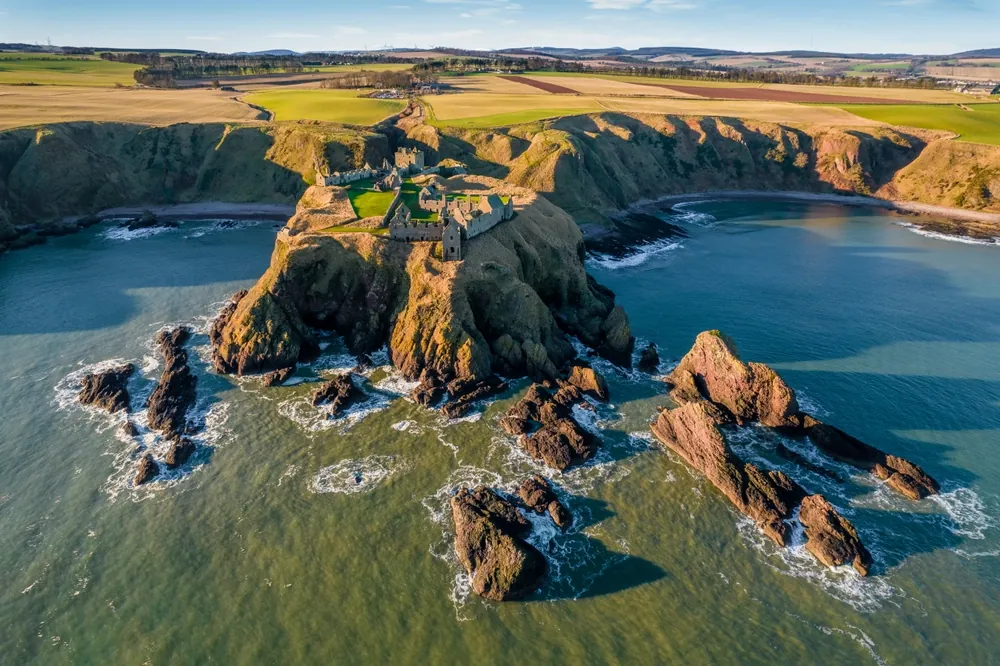
Dunnottar sits on a 50-metre rock stack jutting into the North Sea south of Stonehaven, accessible only by a steep path down a saddle and back up a stairway, with a sheer drop on three sides. It is one of the most dramatically sited fortresses in Britain, the Earls Marischal seat from the late 14th century. The castle's most famous episode is the 1685 imprisonment of 167 Covenanters in the Whigs' Vault, a damp cellar where dozens died of disease and others were tortured during an eight-week confinement; the vault is still visible. Dunnottar was also the hiding place of the Honours of Scotland during Cromwell's invasion of 1652, smuggled out under siege and buried in a parish churchyard until the Restoration.
The visit covers the gatehouse, the Whigs' Vault, the chapel, the Earls Marischal lodgings, the great kitchen and the rooftop. The cliff-edge views and the seabird colonies below the walls are the rest of it. The castle was used as a principal filming location for Mel Gibson's Hamlet (1990).
Practical: open daily, year-round, with seasonal hours (closed 17 December, 25–26 December and 1–2 January); 09:00–18:00 in summer, 10:00–15:00 to 17:00 in winter depending on month; last entry one hour before close. The castle may close in adverse weather. Adult £13, concession £11.50, child (5–15) £6, family (2 adults + 2 children) £32. Card payment only. From Aberdeen, train to Stonehaven (around 20 minutes), then a 1.6-mile walk south along the Aberdeenshire Coastal Trail or short taxi ride. Plan your visit.[10]
6. Glamis Castle
Angus 20 Mar–31 Oct, daily Childhood home of HM Queen Mother Map
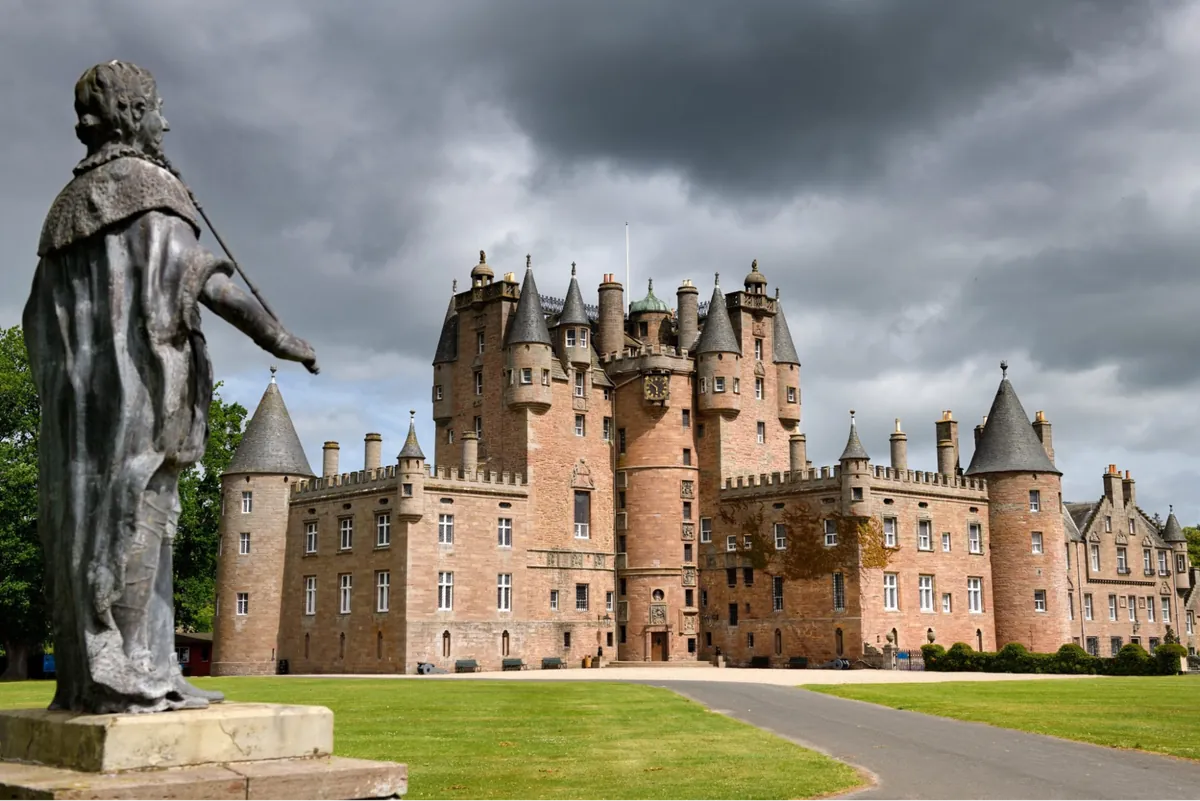
Glamis has been continuously inhabited by the Strathmore-Bowes-Lyon family since 1372, the longest unbroken family residence at any castle in Scotland. The present 17th-century reconstruction sits over a 14th-century medieval tower-house core, with the pink-sandstone turreted silhouette characteristic of the Scottish Baronial revival. Glamis was the childhood home of Queen Elizabeth The Queen Mother, born here in 1900, and the birthplace of Princess Margaret in 1930. Shakespeare set part of Macbeth at Glamis (Macbeth himself, the historical king, predated the present castle by several centuries, but the literary association is the one most visitors arrive with).
The visit takes in the Drawing Room, the Crypt, the Queen Mother's Sitting Room, the Royal Apartments and the Italian Garden. The Friends of Glamis membership (£100 annually) gives unlimited access for repeat visitors.
Practical: open daily 20 March to 31 October 2026, 10:00–17:00 (last tour 16:30); gardens and grounds only 1 November to 22 December; closed January to mid-March. Castle, gardens and grounds: adult £19.50, senior/student £17, child (5–16) £11, family (2 adults + 3 children) £65; gardens-only ticket £9.50 in summer, £5 in winter shoulder. From Edinburgh or Glasgow, train to Dundee (around 90 minutes from Edinburgh), then taxi or bus to Glamis (around 15 miles north of Dundee on the A94). Plan your visit.[11]
7. Cawdor Castle
Highland Apr–Oct, daily Five-star castle of Macbeth Map
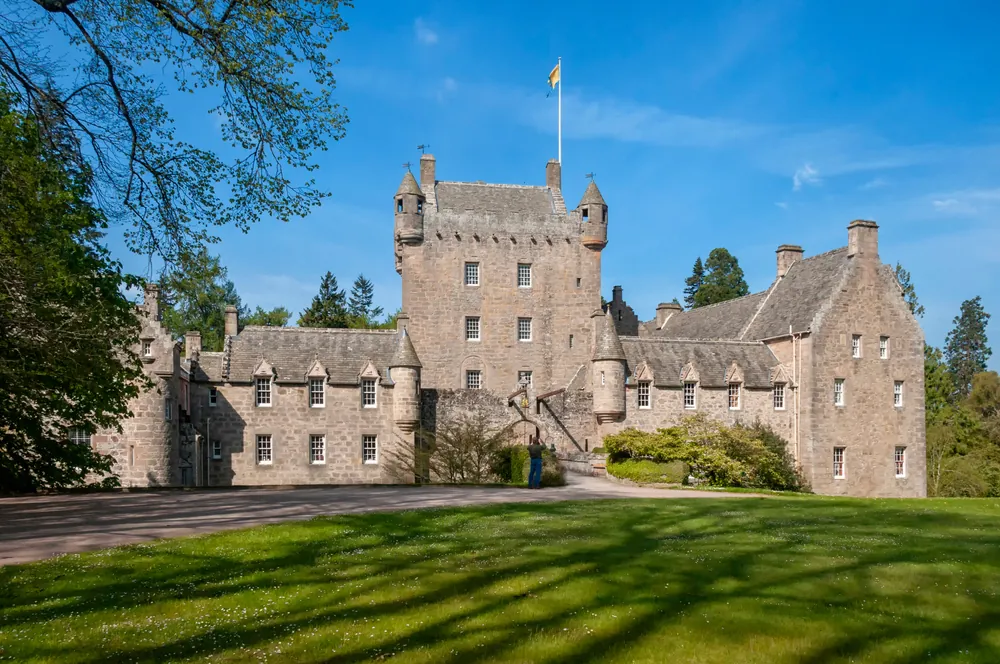
The medieval keep at Cawdor was built around 1454 over an older tower, and the castle has been in the Cawdor (Campbell of Cawdor) family ever since. Shakespeare's reference to "Thane of Cawdor" in Macbeth gave it an outsized literary profile, although the real King Macbeth (d. 1057) predates the surviving castle by some four centuries; the family's official line is a polite "the Cawdor of Macbeth is not the Cawdor of the play". The drawbridge, the iron yett, the dungeon kitchen and the family-portrait galleries are the canonical visit. The gardens are the other half of the trip: a Walled Garden, a Flower Garden, and a Wild Garden laid out across three centuries of Campbell stewardship.
The castle is the only one in Scotland built around a still-living tree: a hawthorn now carbon-dated to the 14th century stands in a vaulted basement chamber, with the rest of the building put up around it according to family legend.
Practical: open daily 25 April to 4 October 2026, 10:00–17:00 (last entry 17:00); closed 5 October to 24 April. Adult £17, concession £15 (60+), child (6–15) £8.50, under 5 free; family £40; gardens-only ticket £10. From Inverness, drive east on the A96 then south on the B9090 (around 14 miles, 25 minutes), or train to Nairn then taxi (5 miles southwest). Plan your visit.[12]
8. Inveraray Castle
Argyll Open Thu–Mon Apr–Oct Downton Abbey filming seat Map
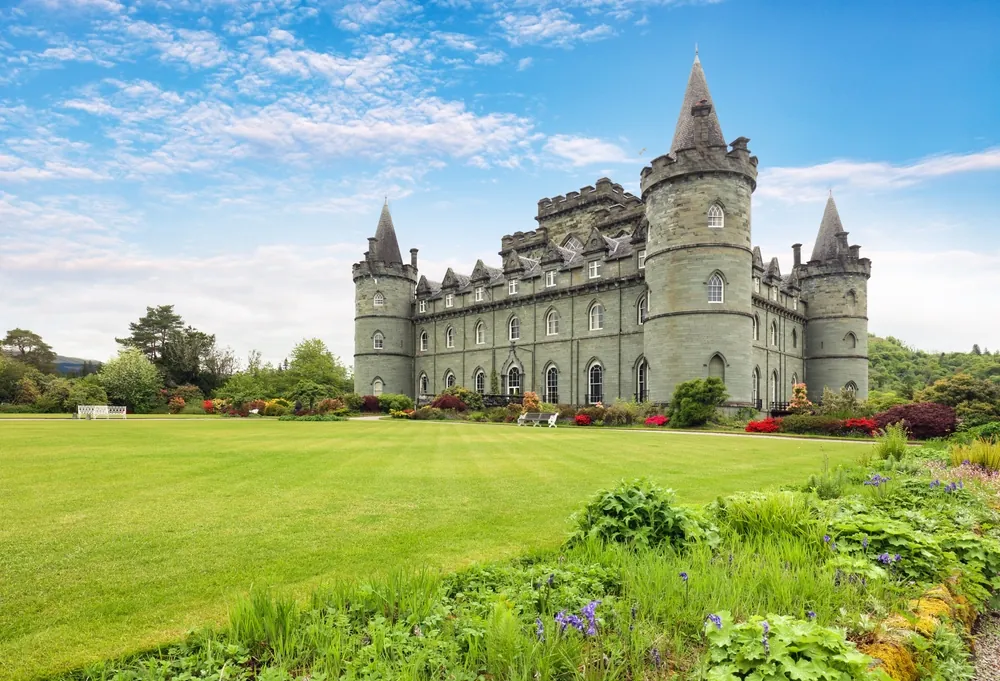
The seat of the Duke of Argyll, chief of the Clan Campbell, built between 1746 and 1789 on the shore of Loch Fyne in a pioneering Gothic-revival style designed by Roger Morris and William Adam. The plan (a square block with corner towers and pointed-arch windows) predates the wider Scottish Baronial revival by a full century and is one of the earliest Gothic-revival country houses in Britain. The State Dining Room, the Armoury Hall (with its display of Highland weaponry on a barrel-vaulted ceiling), the Tapestry Drawing Room and the Saloon are the canonical visit.
Inveraray served as "Duneagle Castle" in the Downton Abbey 2012 Christmas special; for many British visitors, this is now the strongest reason for the detour from Glasgow. The Argyll family has held the surrounding estate continuously since the 15th century.
Practical: open Thursday to Monday (closed Tuesday and Wednesday), late March to late October; 26 March–30 September 10:00–17:00; 1–26 October 10:00–16:00; closed November to March. Adult £18.50, senior/student £16, child (5–15) £12, under 5 free; family (2 adults + 3 children) £60; gardens-only ticket £12. From Glasgow, drive north on the A82 then west on the A83 (around 60 miles, 1h 45), or Citylink coach. Plan your visit.[13]
9. Balmoral Castle
Aberdeenshire Apr–Aug only Royal Highland retreat Map
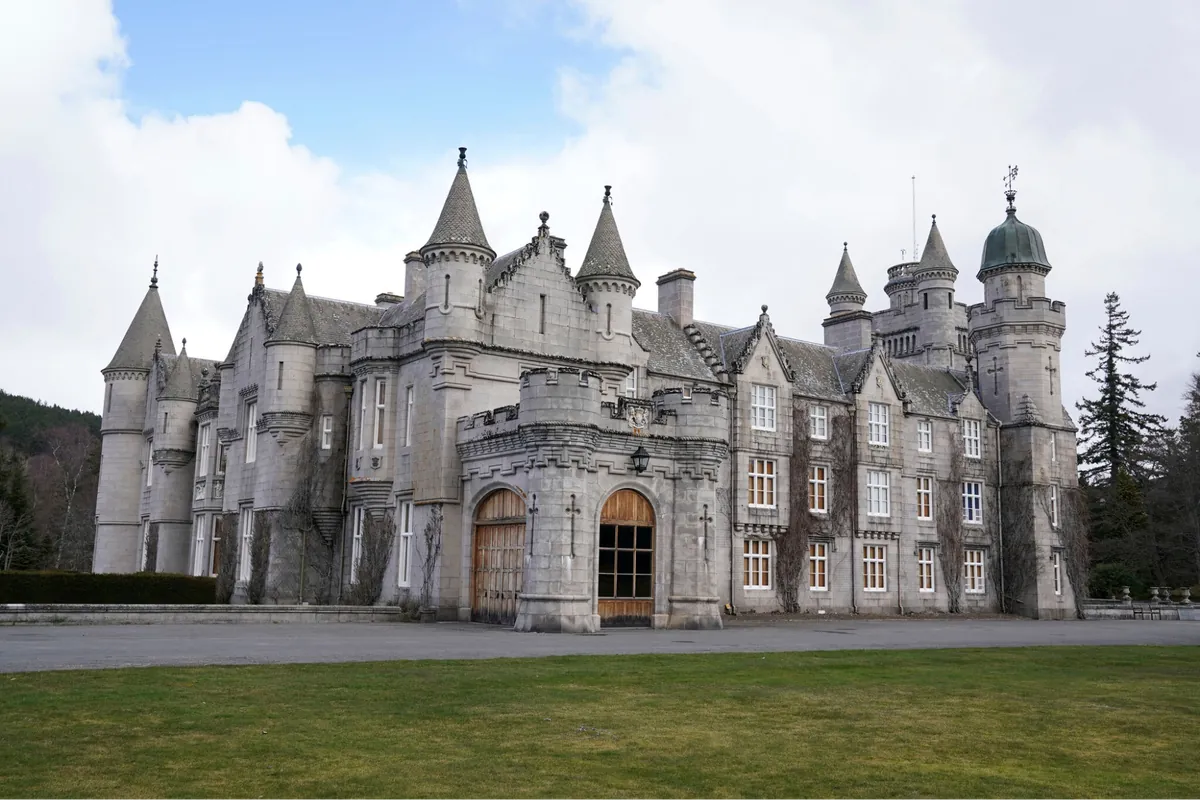
The private Highland residence of the British monarch, bought by Prince Albert in 1852 and rebuilt in the Scottish Baronial style by William Smith of Aberdeen, completed in 1856. The castle has been a royal summer residence ever since. Public access has historically been limited to the gardens, the ballroom exhibition and the grounds; under King Charles III, the 2026 season expands the interior tours for the first time since the accession, with limited-availability guided tours of the castle rooms (separate booking required, twelve people per tour).
The grounds visit takes in the Sunken Garden, the Castle Lawn, the Conservatory and the Highland Wildlife exhibition. The Land Rover-driven Balmoral Expedition Tour, a separate paid experience, covers the wider estate including the deer forest and Loch Muick.
Practical: open daily 28 March to 9 August 2026, 10:00–17:00 (last admission around 16:00); the castle closes entirely from August onwards when the monarch is in residence. General admission (grounds, gardens, Ballroom exhibition) £18.50 adult, £9.50 child (5–16), family £42. Interior tours are separately booked with limited availability. From Aberdeen, drive west on the A93 via Ballater (around 50 miles, 1h 20), or train to Aberdeen then Stagecoach bus 201/202 to Crathie (around 2h 30 total). Plan your visit.[14]
10. Craigievar Castle
Aberdeenshire Apr–Oct, guided tour only Pink fairytale tower house Map
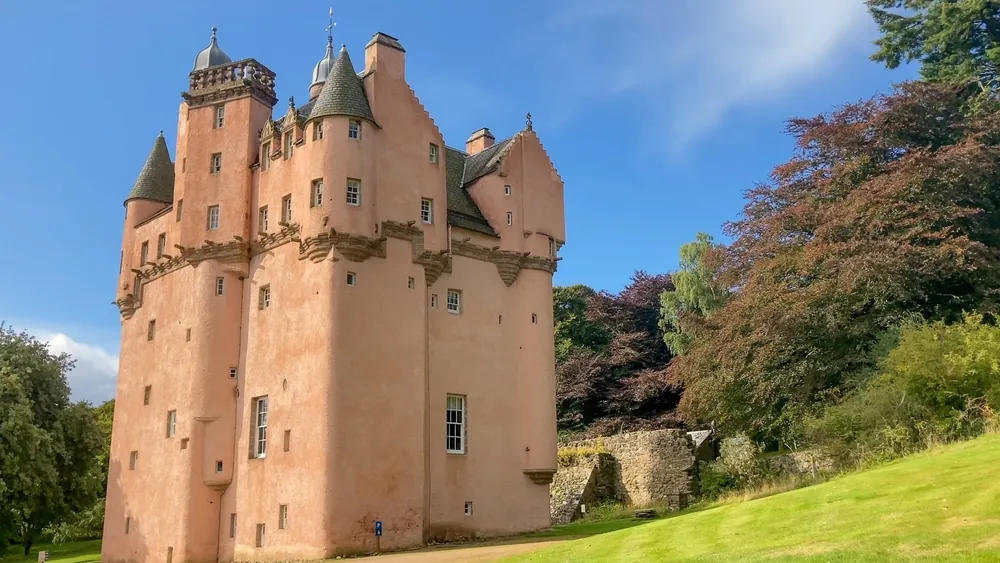
Craigievar is the pink-harled seven-storey tower house built between 1610 and 1626 by William Forbes, a wealthy merchant trading with the Baltic. The architectural historian Marc Morris places Craigievar at the end of a three-hundred-year Scottish tower-house tradition that runs back through Borthwick to Threave in Galloway, built by Archibald "the Grim" Douglas after 1369.[2] The corbelled angle turrets, the stepped gables and the pink lime-render harling are the characteristic features of the Aberdeenshire Castle Trail cluster (Craigievar, Crathes, Castle Fraser), and Craigievar is widely cited as the most visually striking of them.
The castle is still presented as a single residence frozen at the height of the early-17th-century Forbes occupation, with the Great Hall, the painted plaster ceilings and the spiral staircase the centrepieces. The harling was repainted in its original "Craigievar pink" lime-mortar tone after a 2010s restoration; the hue is now the most-photographed exterior detail of any Scottish tower house.
Practical: open April to October on a guided-tour basis; days vary by season (Friday to Monday in spring and autumn, daily 10:00–16:15 in June–August, weekend-only 11:00–15:00 from 29 September to 25 October); closed November to March. Adult £13, concession £10; family (1 adult) £25, family (2 adults) £30; National Trust for Scotland members free. Maximum ten people per tour, first-come first-served. From Aberdeen, drive west on the A944 then A980 (around 26 miles, 50 minutes); the castle sits on the official Aberdeenshire Castle Trail. Plan your visit.[15]
11. Crathes Castle
Aberdeenshire Daily Apr–Oct Painted ceilings, walled gardens Map
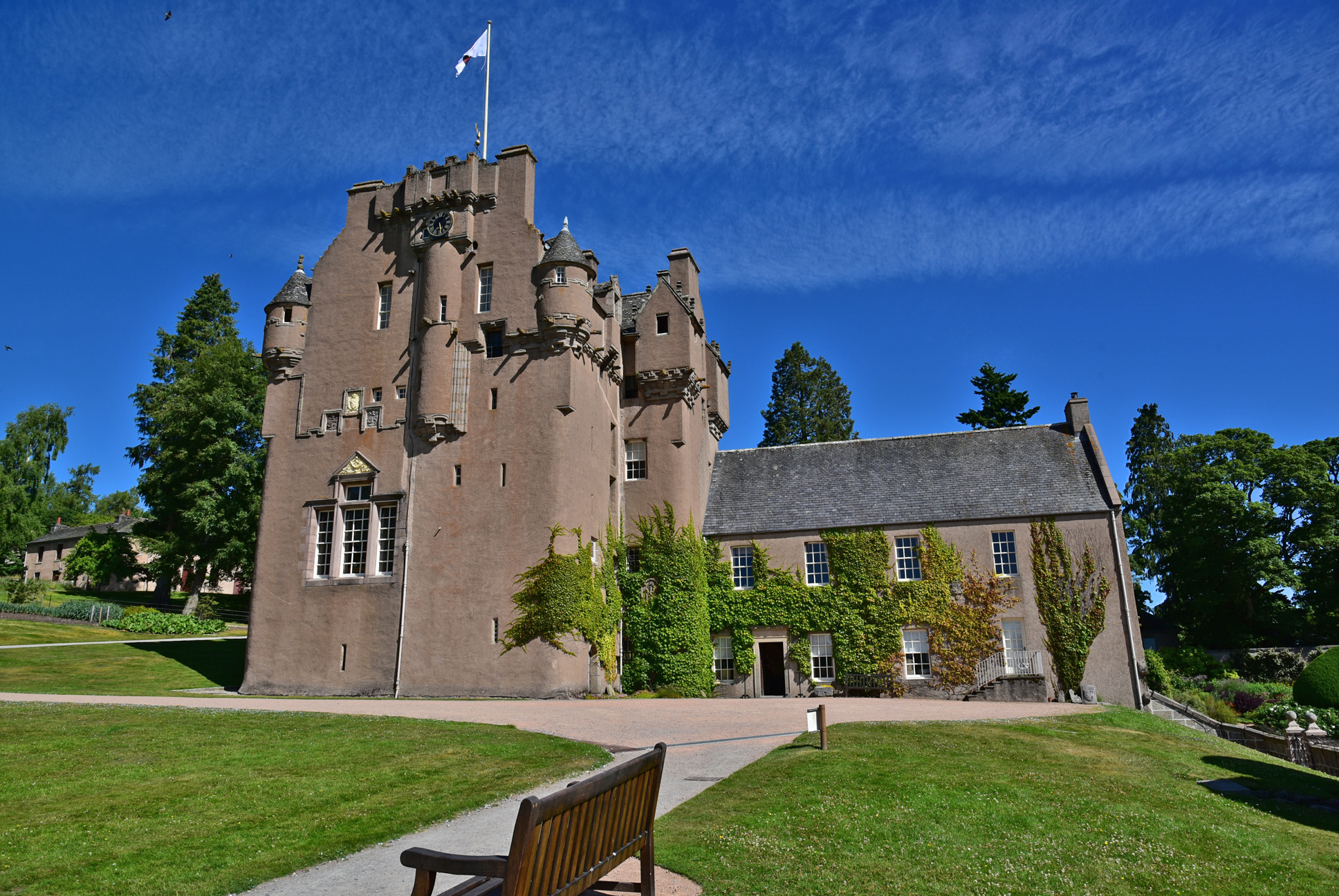
Crathes is the L-plan tower house built by the Burnett family between 1553 and 1596 on land granted to them by Robert the Bruce in 1323. The Horn of Leys, an ivory drinking horn presented by Bruce in person, still hangs in the High Hall. The castle is famous above all for its painted ceilings: three rooms (the Chamber of the Nine Worthies, the Chamber of the Nine Muses and the Chamber of the Green Lady) preserve original 1599 painted-board ceilings of European-tier rarity, with allegorical figures, mottoes and ornament that survive almost nowhere else in Scotland.
The walled garden (eight separate rooms enclosed by 300-year-old yew hedges) is among the most-celebrated formal gardens in Scotland, regularly cited as a "Garden of the Year" candidate by the National Trust for Scotland. The garden alone justifies a half-day visit.
Practical: castle open daily April to October 10:30–16:45, Thursday to Sunday only in winter 10:30–15:45 (closed Monday to Wednesday); closed late December to early January. Adult around £18, concession £15, child £12; National Trust for Scotland members free. From Aberdeen, drive west on the A93 toward Banchory (around 15 miles, 25 minutes), or take Stagecoach bus 201/202 from Aberdeen. Plan your visit.[16]
At a glance
| Castle | Region | When to go | |
|---|---|---|---|
| Edinburgh CastleHonours of Scotland | Edinburgh | Daily, year-round |
| Stirling CastleRenaissance royal palace | Stirlingshire | Daily, year-round |
| Urquhart CastleLoch Ness viewpoint ruin | Highland (Loch Ness) | Daily, year-round |
| Eilean DonanMost-photographed Scottish castle | Highland | Open Feb–Dec |
| Dunnottar CastleSea-cliff fortress | Aberdeenshire | Daily, year-round |
| Glamis CastleChildhood home of HM Queen Mother | Angus | 20 Mar–31 Oct, daily |
| Cawdor CastleFive-star castle of Macbeth | Highland | Apr–Oct, daily |
| Inveraray CastleDownton Abbey filming seat | Argyll | Open Thu–Mon Apr–Oct |
| Balmoral CastleRoyal Highland retreat | Aberdeenshire | Apr–Aug only |
| Craigievar CastlePink fairytale tower house | Aberdeenshire | Apr–Oct, guided tour only |
| Crathes CastlePainted ceilings, walled gardens | Aberdeenshire | Daily Apr–Oct |
How many castles are in Scotland?
The widely cited estimate is around 3,000 castles, of which Historic Environment Scotland's listed-buildings register protects more than a thousand and roughly 750 are still substantially intact.[17] The Scottish stock is structurally distinctive in two ways. First, the dominant form is the tower house: the Marc Morris Scottish-castle survey identifies Borthwick (12 miles southeast of Edinburgh, 108 feet tall) as the biggest and best-preserved tower house in the country, with the form running from 14th-century Threave through to early-17th-century Craigievar.[2] Second, the architectural lineage is native rather than borrowed: MacGibbon and Ross's foundational 1887 survey explicitly disputed the claim that Scottish baronial style was a French import, demonstrating that "the ornamentation of this style may also be proved to be of direct descent from the earlier Scottish Architecture".[1]
Public access varies. Historic Environment Scotland operates around 350 properties in care, including Edinburgh, Stirling, Urquhart, Doune and Linlithgow. Charitable activities income across the HES portfolio reached £53.1 million in 2024/25, up from £49.0 million the previous year, with grants programme spend rising to £10 million from £5.7 million.[18] The National Trust for Scotland operates Crathes, Craigievar, Castle Fraser, Drum and Culzean among others. The remainder are privately owned: some open seasonally (Glamis, Cawdor, Inveraray), most are private homes.
Famous, medieval, Gothic and largest
Famous. Edinburgh and Stirling lead by visitor numbers; Urquhart and Eilean Donan lead by photographic recognition. Dunnottar is the most dramatically sited; Glamis the longest in continuous family ownership; Balmoral the only one with a still-active royal occupant.
Medieval. Urquhart, Stirling and Edinburgh are the strongest survivors of the medieval Scottish royal-castle tradition. Among the tower houses, Borthwick at 108 feet is "the biggest and best-preserved tower house in Scotland" per Morris, and Threave in Galloway, built around 1369 by Archibald the Grim, is the foundational example of the form.[2] Doune Castle in Stirlingshire (the 14th-century tower-courtyard fortress better known to most visitors as the Monty Python and the Holy Grail and Outlander filming location) rounds out a medieval-only itinerary.
Gothic. Inveraray is the canonical Scottish Gothic-revival country house, predating the wider Scottish Baronial revival by almost a century. The 19th-century Scottish Baronial style, exemplified at Balmoral and at the rebuild of Eilean Donan, is the romantic Gothic-revival idiom most associated with Highland castle imagery.
Largest. Stirling has the largest Renaissance royal palace block in Scotland; Edinburgh covers the largest fortified hilltop site. Among the privately owned, Inveraray is the largest single Gothic-revival country house. The Aberdeenshire tower-house cluster (Craigievar, Crathes, Castle Fraser, Drum) is the densest concentration of intact 16th–17th-century Scottish tower houses anywhere; Hubert Fenwick's 1976 Scottish-castle survey treats the cluster as the regional architectural high-water mark.[19]
If you're looking to buy
Scotland is the most accessible UNESCO-grade castle market in Western Europe by entry-tier price. Castle Collector's Castle Price Index (March 2026 edition) tracks Scottish-verified transactions including Dalhousie Castle in Midlothian (£2,499,994 in April 2012, sold for £5,599,998 in October 2023, a 124% gain across 11 years against an active 29-room hotel operation) and Ayton Castle in the Scottish Borders (£2.4m in 2014, £3.25m in February 2026 to Alan Carr).[20] Highland castle ruins regularly list from £130,000 to £500,000 for restoration projects; substantial restored castles trade at £2–10 million; trophy properties (Inveraray-tier) rarely come to open market and sit at £15–50 million when they do. Land and Buildings Transaction Tax runs 0–12% on a sliding scale with no non-resident surcharge, distinct from English SDLT. Foreign buyers face no purchase restrictions; closing typically runs three to five months.
If you're seriously looking, the castles for sale in Scotland page tracks current listings against this benchmark. For the operational side (surveys, restoration budgeting, foreign-buyer mechanics) see our guide to buying a castle.
Sources
1. MacGibbon, D. and Ross, T. The Castellated and Domestic Architecture of Scotland from the Twelfth to the Eighteenth Century, Volume II. David Douglas, Edinburgh, 1887; pp. 11, 20, 22–23, 583.
2. Morris, M. Castles: Their History and Evolution in Medieval Britain. Pegasus Books, 2017; Chapter 5 ("Safe as Houses").
3. ALVA, 2024 Visitor Figures (Edinburgh Castle: 1,981,152 visits, +4% YoY).
4. Edinburgh Castle, official site (Historic Environment Scotland operator). Tickets and prices at
5. Goodall, J. The Castle: A History. Yale University Press, 2022; pp. 94–95.
6. Stirling Castle, Historic Environment Scotland.
7. Urquhart Castle, Historic Environment Scotland. Prices and times at
8. Eilean Donan Castle, Conchra Charitable Trust official site.
9. Eilean Donan Castle, opening hours and tickets.
10. Dunnottar Castle, official site.
11. Glamis Castle, official site. Tickets and tours at
12. Cawdor Castle, official site.
13. Inveraray Castle, official site. Visitor information at
14. Balmoral Castle, official site. Opening times at
15. Craigievar Castle, National Trust for Scotland.
16. Crathes Castle, National Trust for Scotland. Planning your visit at
17. Historic Environment Scotland, listed-buildings register.
18. Historic Environment Scotland, Annual Report and Accounts 2024–25; charitable activities income £53.1m (2024/25) vs £49.0m (2023/24); grants programme spend £10m (2024/25) vs £5.7m.
19. Fenwick, H. Scotland's Castles. Robert Hale, 1976; passim.
20. Castle Collector, Castle Price Index, March 2026 edition.