
The Castles That Inspired Disney: Why It's Never Been Just Neuschwanstein
The Disney castle isn't one castle. Neuschwanstein in Bavaria is the visual primary for Sleeping Beauty Castle at Disneyland California, and that part is…
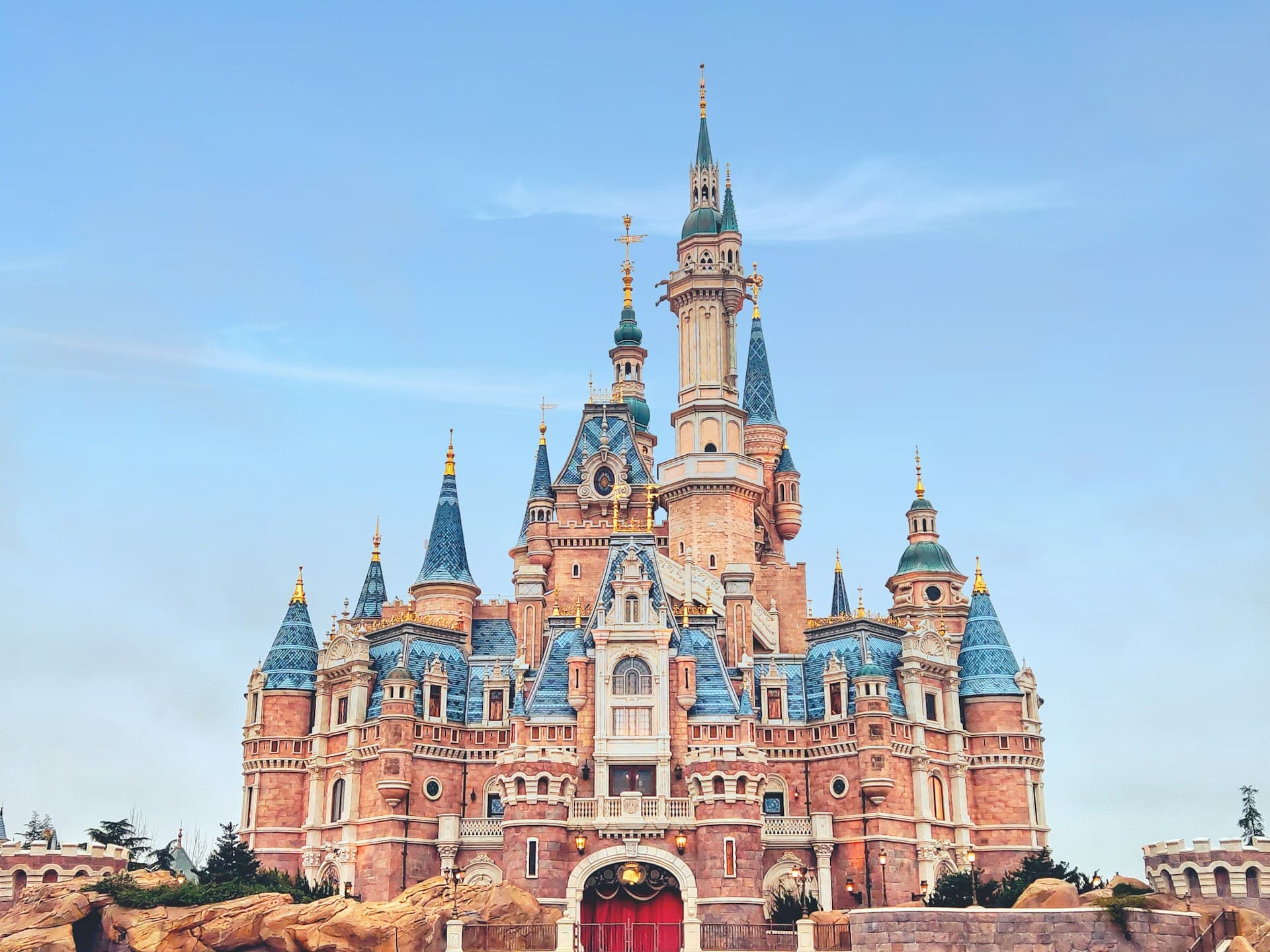
The Disney castle isn't one castle. Neuschwanstein in Bavaria is the visual lead for Sleeping Beauty Castle at Disneyland California, and that part is straightforward. Cinderella Castle at Walt Disney World is a different design problem, drawing from at least four real castles. So which buildings actually shaped the silhouette every visitor recognises?
The whole Disney-castle look traces back to a 19th-century European Romantic-historicist movement that pre-dated Walt Disney by half a century. The fairy-tale-castle silhouette was already eighty years old when Walt visited Bavaria in 1935. He didn't invent it; he inherited it.[2]
The line runs through four generations of European reconstruction before Disney's Imagineers ever lifted a pencil. Hohenzollern princes rebuilt Rhine castles as Romantic-era theatrical fantasies from the 1820s. Napoleon III commissioned Eugène Viollet-le-Duc to do the same thing on the grand scale at Pierrefonds in the 1850s. Ludwig II of Bavaria, working in the 1860s, hired a theatrical scenographer rather than a trained architect to design Neuschwanstein. Neuschwanstein was designed as a built opera set, not a residence. Walt Disney's design team in the 1950s inherited the visual language fully formed.
The honest answer names six real castles, not one.
Castle | Country | Built | Disney connection |
|---|---|---|---|
Schloss Neuschwanstein | Bavaria | 1869 to 1886 | Sleeping Beauty Castle visual lead |
Alcázar of Segovia | Spain | 12th to 18th c. (rebuilt 1882 to 96) | Cinderella Castle visual lead |
Château d'Ussé | Loire Valley | Renaissance | Sleeping Beauty story source (Charles Perrault, 1697) |
Burg Stolzenfels | Rhine, Germany | 1836 to 1845 | Romantic-historicist precursor to Neuschwanstein |
Château de Pierrefonds | France | 1857 to 1885 (rebuilt) | French Romantic-historicist parallel |
Craigievar Castle | Scotland | 1626 | Tower-house silhouette in the Disney visual register |
Why it matters
If you came in looking for the one real castle behind Disney, the answer is that there isn't one. The Disney silhouette is a composite of six real buildings, and most of those buildings are themselves 19th-century reconstructions rather than medieval survivals. The "fairy-tale castle" is a stack of imitations, all the way down.
Schloss Neuschwanstein: the silhouette Disney borrowed for Sleeping Beauty Castle
Schloss Neuschwanstein is the canonical answer for Sleeping Beauty Castle (1955), and it is the right one. Ludwig II of Bavaria commissioned the design from Christian Jank, a theatrical scenographer with no architectural training, in 1869. Construction ran 1869 to 1886 and remained incomplete at Ludwig's death that June, three days after his deposition for "incurable insanity." No one ever really lived in the building.
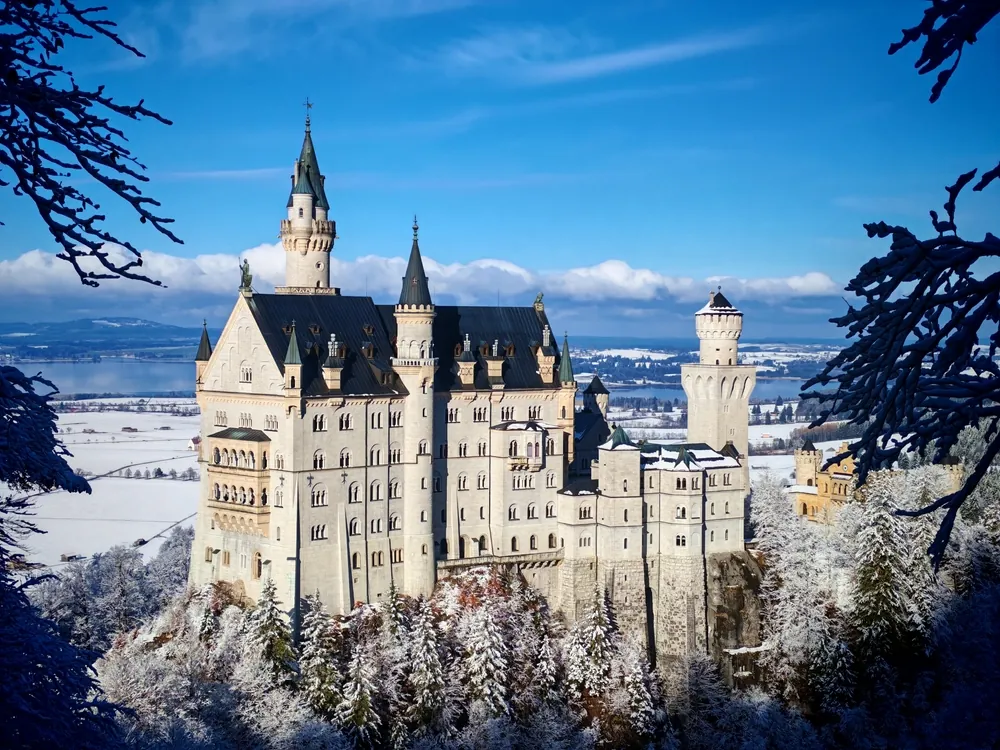
What rarely registers is that Neuschwanstein was a 19th-century reconstruction, not a medieval survival. Ludwig was reading Wagner and commissioning a built opera-stage rather than a residence. The architectural reference was the Wartburg in Thuringia, but the treatment was theatrical: visual effect and silhouette before residential function or defence.
The Bavarian state opened the unfinished castle to the public almost immediately after Ludwig's death to recover the construction debts. Visitor income has paid for Neuschwanstein since 1886, and the Bayerische Schlösserverwaltung records around 1.4 million paying visitors a year.[4] The castle features in our most famous castles ranking by international visitor draw.
Walt Disney visited Bavaria during his 1935 European tour and carried the Neuschwanstein roofline back to Burbank. The Imagineering team produced the Sleeping Beauty Castle design in the early 1950s for the Anaheim park's 1955 opening. The conical-roofed corner turrets, the verticality, the white limestone walls against forest: Neuschwanstein with the cinematic palette turned up.
Alcázar of Segovia: the Cinderella Castle visual lead
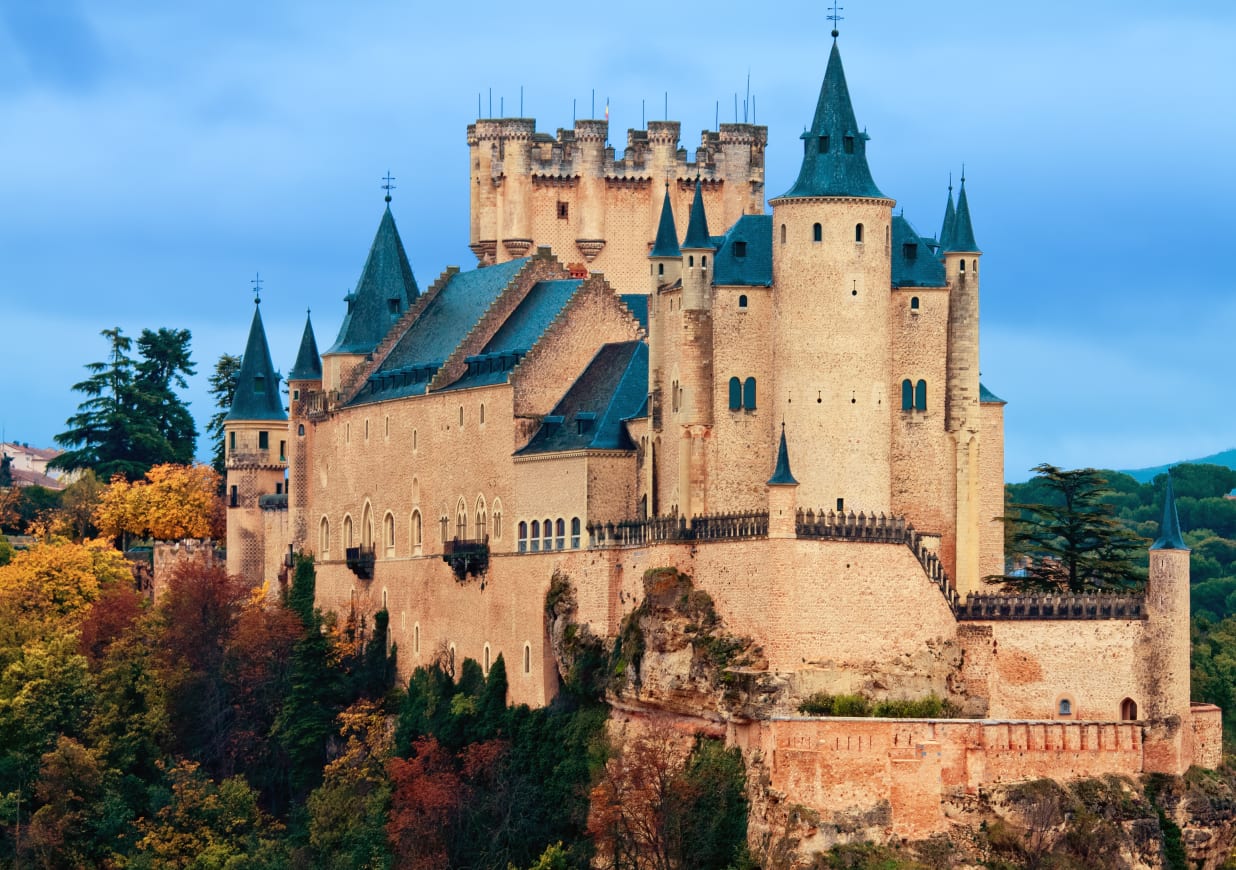
The 1971 Cinderella Castle at Walt Disney World Florida is a more architecturally complicated design problem than its 1955 Anaheim sibling. Sleeping Beauty Castle is essentially a Neuschwanstein homage. Cinderella Castle is a pastiche, with at least three real castles in its visual DNA, and the most distinctively recognisable is the Alcázar of Segovia in Castile.
The Alcázar sits on a volcanic plug at the meeting point of the Eresma and Clamores rivers, and the whole fortress reads as a stone ship sailing out from the head of the medieval city. The prow-shaped main tower, the slate-roofed turrets, and the silhouette from below are the details Disney's Imagineers borrowed for the central tower of Cinderella Castle. The Alcázar's history runs Roman to Moorish to Castilian with successive rebuildings between the 12th and 18th centuries. The current silhouette is mostly the result of the 1882 to 1896 reconstruction following the 1862 fire that gutted the medieval interior. Like Neuschwanstein and Pierrefonds, the "medieval" appearance is largely Victorian-era invention.
Approach from the cathedral square through the old Jewish quarter and the prow-shaped fortress emerges suddenly above the Eresma valley. The Cinderella-Castle-as-pastiche argument writes itself.
For the live listings of castles for sale in Spain, browse the regional pages.
Simple test
Sleeping Beauty Castle reads as one building because it leans on one source: Neuschwanstein. Cinderella Castle reads as a fairy tale because it leans on three or four. If a Disney castle feels like it could be real, it's borrowing from one place. If it feels storybook in a way no real building quite is, it's borrowing from several at once.
Château d'Ussé: the literary source for Sleeping Beauty
Disney's 1959 Sleeping Beauty film took its visual cues from Neuschwanstein. The story it adapted, however, came from a different castle entirely. Charles Perrault published La Belle au bois dormant in 1697 in his collection Histoires ou contes du temps passé, and the Loire-Valley tradition holds that Perrault visited Château d'Ussé and used the silhouette as the imaginative seed for the fairy tale that Disney would adapt two and a half centuries later.[3]
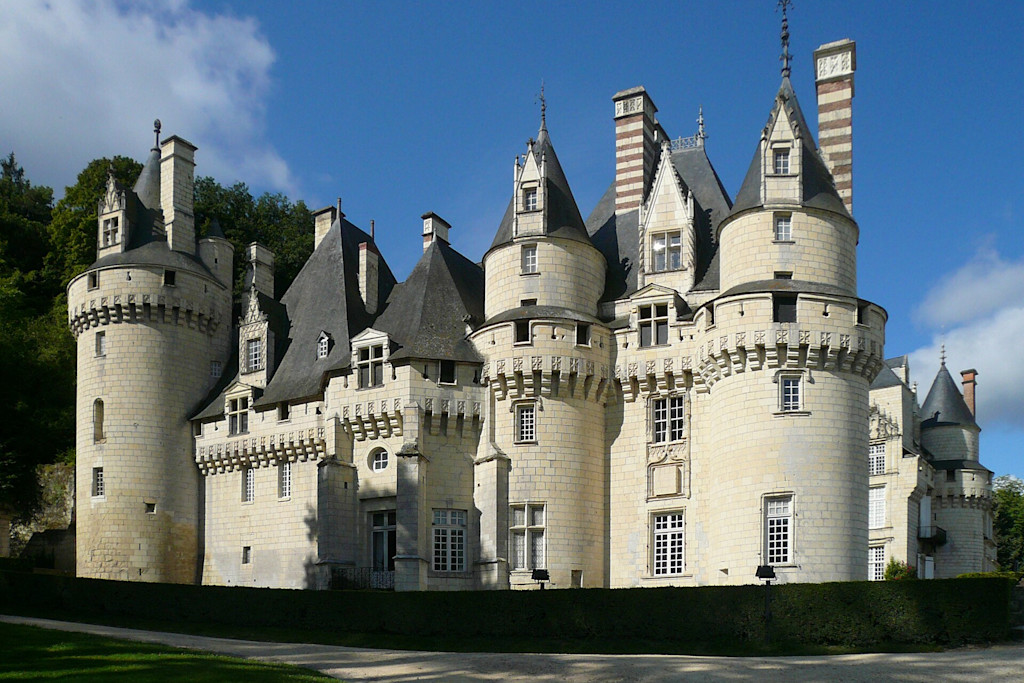
Ussé is a mid-sized white-stone Renaissance château with conical-roofed towers on the edge of the Forêt de Chinon. It is privately operated, attractive enough that the Perrault connection feels natural even without architectural-source confirmation. The article keeps the two parentages separate. Sleeping Beauty's visual line is Neuschwanstein and the 19th-century Romantic-historicist tradition. Sleeping Beauty's literary line runs Charles Perrault 1697, the Brothers Grimm 1812 (their Dornröschen retelling), Tchaikovsky 1890 (the ballet), Disney 1959. Ussé sits at the head of the literary line, and Disney drew its plot from the same source even when its silhouettes came from elsewhere.
For the broader Loire architectural tradition that Ussé belongs to, see Loire Valley castles.
The Hohenzollern Rhine programme: where the visual idiom started
Two Prussian princes, working in the second quarter of the 19th century, built the visual language Ludwig II would inherit at Neuschwanstein and Walt Disney would inherit a century later from Ludwig.
Burg Rheinstein (originally Voigtsburg), a ruined medieval castle on a steep cliff above the Rhine south of Bingen, was bought by Prince Frederick Louis of Prussia in 1823 and rebuilt 1825 to 1829 in deliberately Romantic-historicist style. It was the first Rhine ruin restored as a fairy-tale silhouette rather than as a working defensive structure.[1] Whitewashed walls, slate-roofed turrets, fully visible from the river below. Rheinstein was the proof of concept.
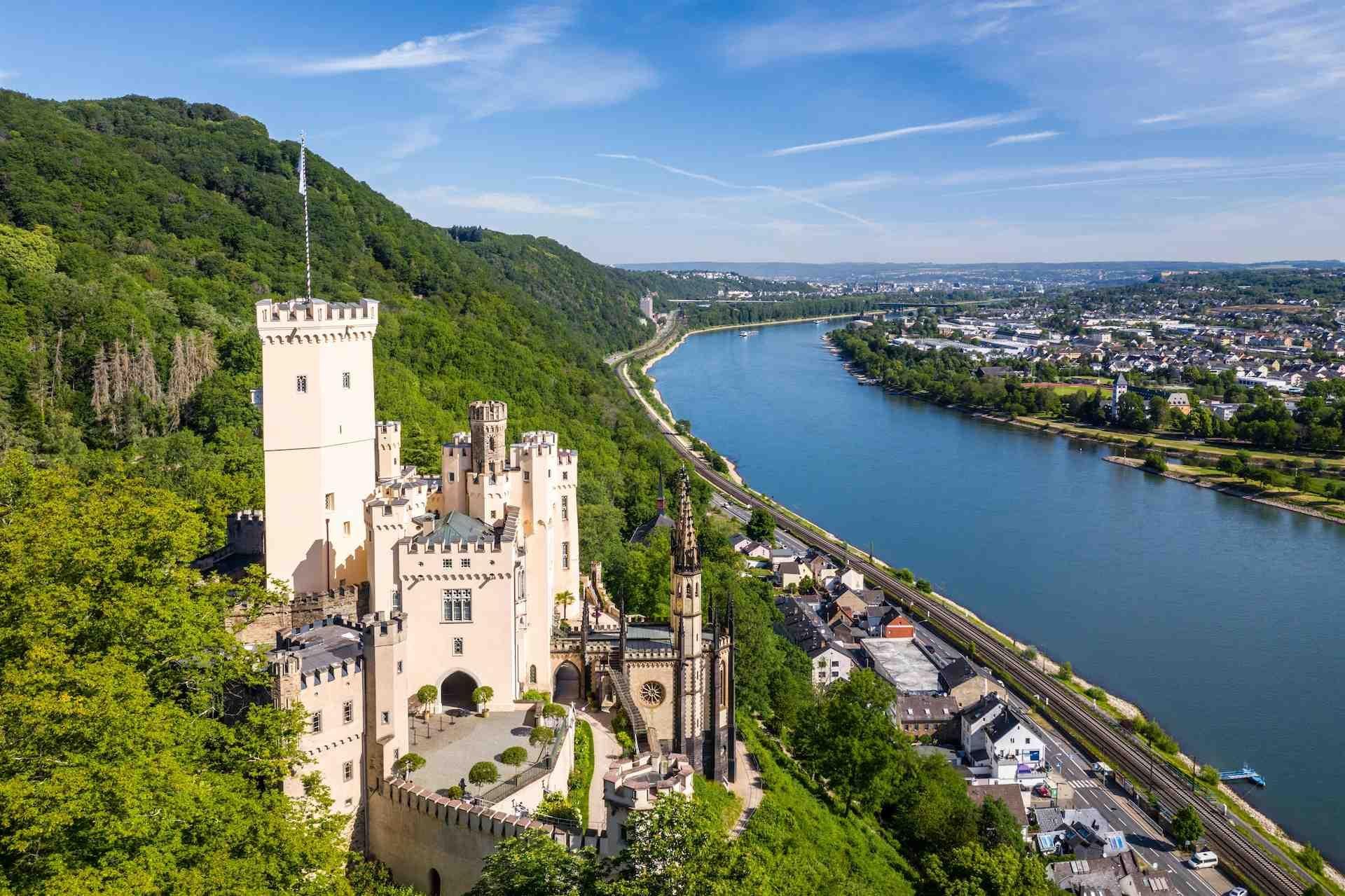
Burg Stolzenfels followed a generation later. The ruined Hohenzollern fortress above Koblenz was rebuilt 1836 to 1845 under Crown Prince (later King) Frederick William IV of Prussia, the same theatrical vocabulary on a grander scale, the silhouette deliberately tuned to look right from a riverboat passing below.[1] The castle is now operated by the Generaldirektion Kulturelles Erbe Rheinland-Pfalz.
The full Disney-inspiration line runs Rheinstein 1825, Stolzenfels 1836, Pierrefonds 1857, Neuschwanstein 1869, Disneyland 1955, Walt Disney World 1971. Six generations of the same visual instinct, three of them in Germany, one in France, two in California and Florida. Walt Disney is the fourth-generation inheritor of a look European princes invented when they had more money than sense.[1]
For the chronological evolution of the castle from defensive structure through Romantic-historicist reconstruction into popular-culture cipher, see the evolution of the castle across roughly a thousand years.
Château de Pierrefonds: the French parallel
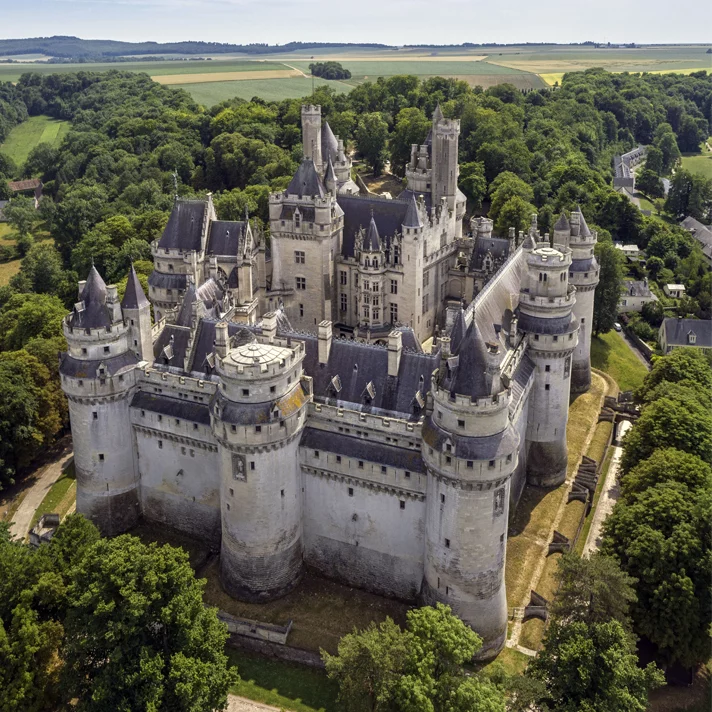
Château de Pierrefonds sits in the Forêt de Compiègne north of Paris, and it is the most spectacular example of the Romantic-historicist reconstruction tradition in France. Napoleon III commissioned Eugène Viollet-le-Duc in 1857 to rebuild the 14th-century ruin as a deliberate fantasy-medieval state. Construction ran 1857 to 1885. The result is a castle completed even more ambitiously than the original 14th-century fabric had ever been.
Viollet-le-Duc's Dictionnaire raisonné de l'architecture française du XIe au XVIe siècle, published in ten volumes between 1854 and 1868, was the architectural reference work that spread Romantic-historicist medieval-castle imagery internationally. Ludwig II's Neuschwanstein design team would have consulted it. Walt Disney's design team almost certainly did too. Viollet-le-Duc is the figure most directly responsible for the visual vocabulary the entire Romantic-historicist tradition shares, and Pierrefonds is the most readable built example of his approach.
The Centre des Monuments Nationaux operates Pierrefonds today, and the 2024 annual report records 164,130 paying visitors at the site.[5] The castle has had a recent cultural afterlife as the main location for the BBC Merlin television series (2008 to 2012). The silhouette from the lake below at sunset is the most-photographed Viollet-le-Duc image, and stylistically it is the bridge between the medieval source material and the 19th-century reconstruction tradition Disney would later inherit.
For the live French castle listings, browse castles for sale in France.
Craigievar Castle: the Scottish tower-house silhouette
The Disney visual register isn't entirely Continental. Craigievar Castle in Aberdeenshire is a pink-harled seven-storey tower house completed 1626, held by the Burnett of Leys family for two and a half centuries before passing to the National Trust for Scotland.
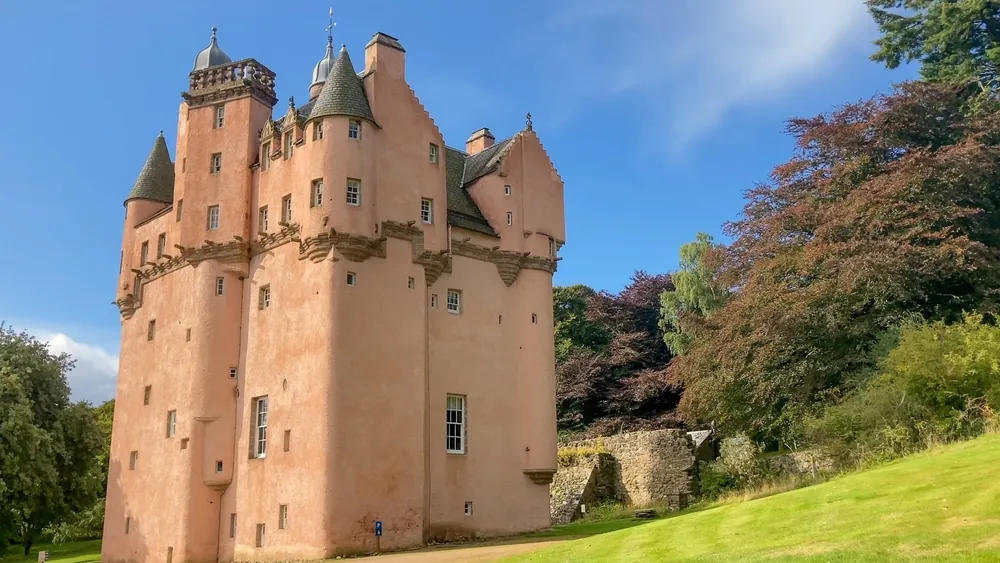
Craigievar's silhouette is distinctively Scottish: corbelled corner turrets, a verticality the Continental Romantic-historicists never quite matched, and a pink lime harl that throws an entirely different palette from the white limestone of Neuschwanstein or the slate-and-stone of the Rhine programme. Walt Disney is widely cited as having drawn on Craigievar for elements of the fairy-tale-castle vocabulary, and the Pixar Castle Dunbroch in Brave (2012) is sometimes connected specifically with the Craigievar silhouette. The Scottish tower-house verticality is what saves the Disney castle from being purely Continental Romantic-historicist pastiche. For the Aberdeenshire architectural tradition Craigievar belongs to, see best castles in Scotland.
What Disney really inherited
The "fairy-tale castle" silhouette is what 19th-century European princes built when they had more money than function. Ludwig II commissioned a theatrical scenographer to design Neuschwanstein as a built opera set. Frederick William IV rebuilt Stolzenfels for the silhouette from the riverboat below. Napoleon III hired Viollet-le-Duc to rebuild Pierrefonds as a fantasy-medieval state.
Walt Disney inherited a fully theatrical visual language. He didn't invent it; he selected from it. Sleeping Beauty Castle is Neuschwanstein with the saturation turned up. Cinderella Castle is Neuschwanstein cross-bred with the Alcázar of Segovia and the Loire-château idiom, with a Scottish tower-house verticality grafted on for height. The Disney castle is real-castle pastiche refined for cinema, taken from European princes who themselves were grafting earlier idioms onto reconstructed ruins.
Bottom line
The reader who came in via "what castle inspired Disney" walks away with a list to travel to. Neuschwanstein on its Hohenschwangau ridge. The Alcázar of Segovia on its volcanic plug. Pierrefonds in the Forêt de Compiègne. Stolzenfels and Rheinstein on the Rhine. Ussé in the Loire. Craigievar in Aberdeenshire. Six real castles, one inherited visual language.
For Bavaria, the live listings are at castles for sale in Germany.
Common questions
Which single castle inspired Disney?
Neuschwanstein in Bavaria is the closest answer for Sleeping Beauty Castle (Disneyland, 1955), and it is the building Walt Disney saw in person on his 1935 European tour. For Cinderella Castle (Walt Disney World, 1971) the picture is mixed: the Alcázar of Segovia is the most recognisable single source, with Neuschwanstein, the Loire châteaux and Craigievar all present in the silhouette.
Did Walt Disney visit Neuschwanstein?
Yes. Walt toured Bavaria in 1935 and carried the Neuschwanstein roofline back to the Burbank studio. The Imagineering team developed the Sleeping Beauty Castle design in the early 1950s for the 1955 Anaheim opening, and the conical turrets and vertical massing of Neuschwanstein are the visual lead.[2]
Is Neuschwanstein a real medieval castle?
No. Neuschwanstein was built between 1869 and 1886, designed by a theatrical scenographer rather than an architect, and was never finished or properly lived in. The "medieval" look is 19th-century Romantic-historicist invention, the same tradition that produced Stolzenfels on the Rhine and Pierrefonds in France.[1]
What inspired Cinderella Castle at Walt Disney World?
At least four real castles. The Alcázar of Segovia gives the prow-shaped main tower and slate-roofed turret palette. Neuschwanstein contributes the verticality. The Loire châteaux (Ussé and others) supply the white-stone Renaissance idiom. Craigievar in Scotland is widely cited for the tower-house verticality at the upper levels.
Was Sleeping Beauty based on a real castle?
Two, in different ways. The visual silhouette of Sleeping Beauty Castle is Neuschwanstein. The story Disney adapted came from Charles Perrault's 1697 La Belle au bois dormant, and Loire tradition holds that Perrault drew the imaginative seed from Château d'Ussé.[3]
Which Disney film used Craigievar Castle?
Pixar's Brave (2012) is sometimes connected to the Craigievar silhouette for the fictional Castle DunBroch, and Walt Disney is widely cited as having drawn on Craigievar for elements of the broader fairy-tale-castle vocabulary. The Scottish tower-house verticality is what distinguishes the Disney register from a purely Continental look.
Can you visit the castles that inspired Disney?
Yes, all six. Neuschwanstein and Stolzenfels in Germany are state-operated and ticketed. The Alcázar of Segovia in Spain is open to the public. Pierrefonds is run by the Centre des Monuments Nationaux. Ussé is privately operated and seasonal. Craigievar is held by the National Trust for Scotland.
Sources
1. Taylor, Robert R. Castles of the Rhine: Recreating the Middle Ages in Modern Germany. Wilfrid Laurier University Press, 1998.
2. Goodall, John. Castle: A History. Yale University Press, 2022.
3. Mansfield, M. F. Castles and Châteaux of Old Touraine and the Loire Country. L. C. Page & Company, 1906.
4. Bayerische Schlösserverwaltung. Bilanz 2025. Schloss- und Gartenverwaltung des Freistaates Bayern, 2025.
5. Centre des Monuments Nationaux. Rapport Annuel 2024. CMN, 2024.