
Loire Valley Castles: 7 châteaux to visit, from Chambord to Villandry
The Loire is one of the few European regions where a single eighty-year window produced enough architectural concentration to define a national style.
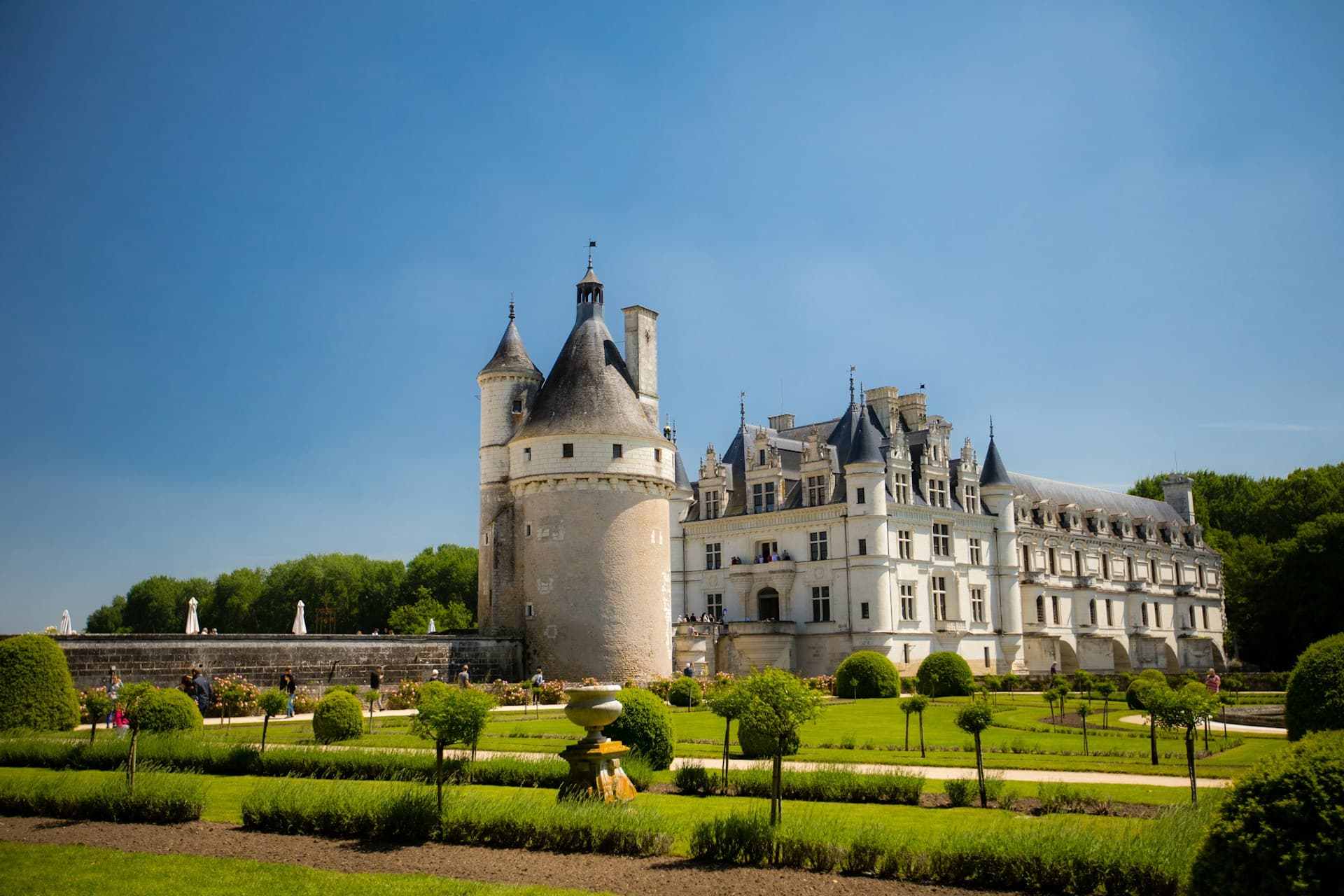
Eighty years between 1490 and 1570 produced enough architectural concentration along one river to define a national style. Seven châteaux that read the French Renaissance from François I's hunting folly to a vegetable garden as architecture.
The Loire is one of the few European regions where a single short window produced a coherent royal style. Roughly 1490 to 1570, the kings stopped building for sieges, the Hundred Years' War was finally over, and the French royal court turned its energy to spectacle, gardens, and Italian Renaissance imports. Chambord went up under François I from 1519. Chenonceau extended its gallery across the Cher between 1514 and 1577. Blois became a four-wing palimpsest that every Valois king added to in his own period's idiom. You can read the entire French Renaissance by walking through three Loire châteaux in a long weekend.[1]
The contrarian beat is that the most-photographed Loire silhouettes (Chambord, Chenonceau, Azay-le-Rideau) are essentially Renaissance court ornament, not medieval defensive architecture. The actual medieval Loire sits at Loches (the eleventh-century royal donjon) and Chinon (the Plantagenet seat where Henry II of England died in 1189), and most tourists never go. The Loire that the coach tours love is the post-defensive Loire: the moment the kings stopped building castles to survive in and started building them to perform in.[1]
The seven below are the ones that warrant the day. Amboise is where you sleep, two hours south of Paris by TGV. Chenonceau is where you photograph at sunrise. Chambord is where you photograph at sunset. Cheverny is where you watch the dogs eat. Each entry covers what to see, when to go, what it costs, and how to get there.
1. Château de Chambord
Loir-et-Cher Daily, year-round François I's hunting folly Map
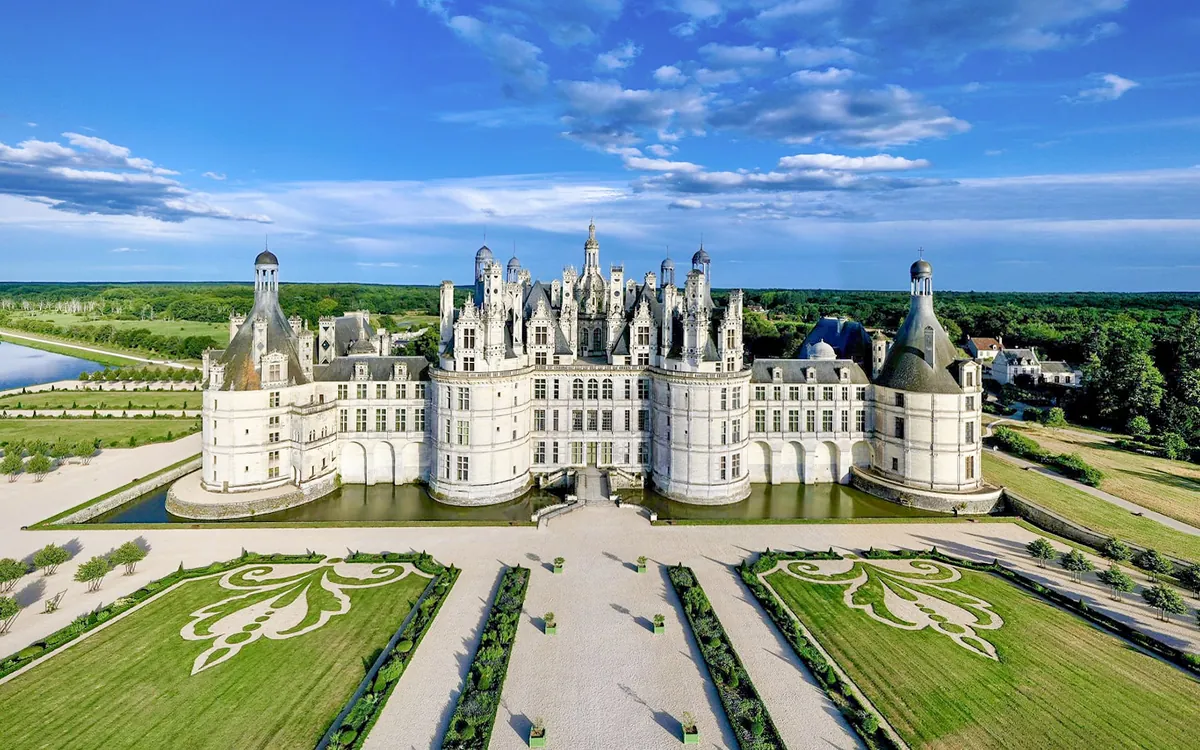
François I commissioned Chambord at the age of twenty-four in 1518, two years after his Marignano victory had made him effectively the most powerful king in Europe. Construction ran 1519 to 1547, on a site lost in the middle of a forest 110 miles south of Paris, with around 1,800 workmen on the job across the build.[2] The façade runs 156 metres. The interior carries between 400 and 440 rooms (depending on how you count the inner chambers) and 77 staircases, more than the Palace of Versailles built almost two centuries later. There are 282 chimneys, all visible from the southern lawn against any sky you choose.
The double-helix staircase at the centre of the keep is the architectural moment: two spirals winding around a single axis, so that two people can climb at the same time without ever meeting. Leonardo da Vinci was working at the nearby Château du Clos Lucé in the run-up to construction; François I had brought him to France in 1516, and he died at Clos Lucé in May 1519 in the year Chambord broke ground. The Leonardo attribution for the staircase is widely held but cannot be documented from a surviving drawing.[2] During the Second World War the Louvre used Chambord as wartime safe-storage; the Mona Lisa was among the works held at the château.
Practical: open daily, year-round, 09:00–17:00 (winter) / 09:00–18:00 (summer). Adult €16, free under 18 and EEA 18–25. From Paris, TGV from Austerlitz or Montparnasse to Blois-Chambord, then shuttle bus or taxi (about 18 km from Blois). The 5,440-hectare walled estate around the building is free to enter. Plan your visit.[2]
2. Château de Chenonceau
Indre-et-Loire Daily, year-round The ladies' château Map
Chenonceau is the silhouette every visitor remembers second after Chambord. The five-arch gallery spanning the River Cher is the single most-photographed architectural composition in the Loire, and the entire history of the building is a sequence of women claiming and reclaiming the property.[1] Construction began in 1514 and the original château went up between 1514 and 1521. Diane de Poitiers, mistress of Henri II, received Chenonceau as a royal gift in 1547 and built the original bridge across the Cher to extend the house onto the river. After Henri II's death in 1559, his queen Catherine de' Medici took the property back from Diane and added the gallery on top of the bridge: the move that produced the silhouette tourists travel to see.[1]
The kitchens sit inside the river piers, with goods historically arriving by boat at the level beneath the gallery floor, a practical demonstration of the bridge-as-gallery design that no other French château matches.[2] The Menier family bought Chenonceau in 1913 and have held it since; the chocolate dynasty's stewardship now runs over a century, paying-visitor-funded, with no state subsidy. The morning view across the Cher is the canonical photograph: mist rises off the river before the buses arrive from Tours and Amboise, and the gallery's five arches reflect in still water for about an hour before the day starts.
Practical: open daily, all year. Adult €16; child (7–18) €13; under 7 free. Audio-guide €5 extra. From Paris, TGV Montparnasse to Tours (~1h15), then TER train to Chenonceaux station (180 m walk). Plan your visit.[3]
> [!callout] Rule of thumb > Photograph Chenonceau at sunrise and Chambord at sunset. The Cher mist clears by 09:00 and the Chambord chimneys catch the warm light only in the last hour before close.
3. Château d'Amboise
Indre-et-Loire Daily, year-round Royal residence to four kings Map
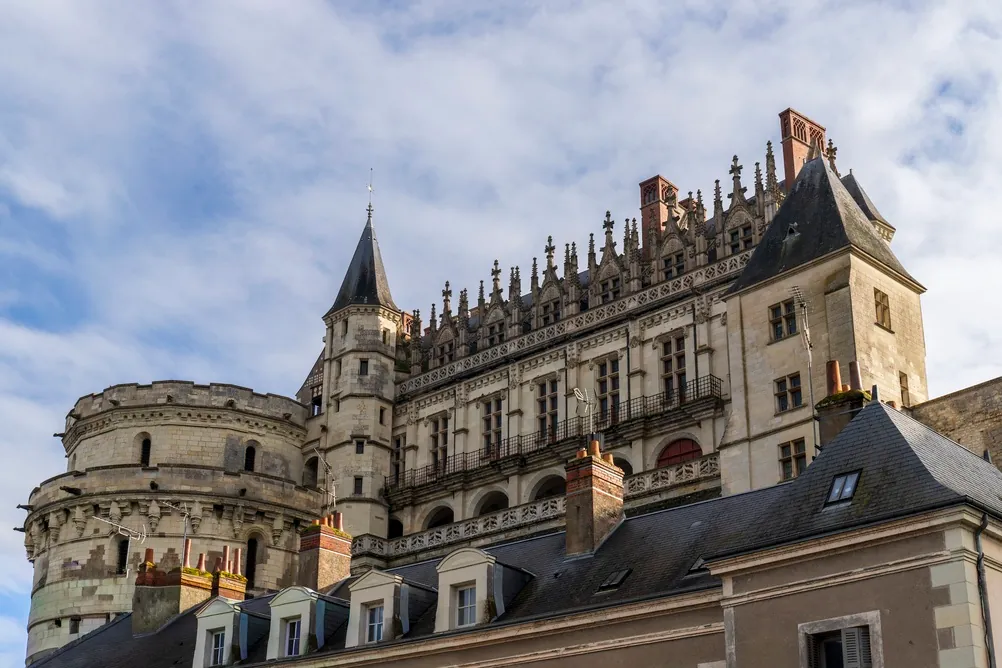
Amboise sits on a high terrace above the Loire, looking down to a long bend of slow water and a wide alluvial floodplain. Eleventh-century origins underlie 15th- and 16th-century structures, and the château served as principal royal residence to four successive kings: Charles VIII, Louis XII, François I, and the early Henri II.[1] Charles VIII died here in 1498 after striking his head on a low door lintel. François I spent his childhood at Amboise and later invited Leonardo to nearby Clos Lucé in 1516.
The single most visited element is not the château itself but the small Saint-Hubert chapel in the grounds, where Leonardo da Vinci is buried. Leonardo died at Clos Lucé in 1519, the small manor house François I had given him as a residence, and his remains were moved to Saint-Hubert.[1] The chapel is small enough that visitors line up at the door; the tomb is visible from a few feet away. Clos Lucé itself is now a museum operated by the Saint-Bris family, and the bedroom Leonardo died in is preserved with period detail.
Practical: open daily, year-round. Adult €17; child (7–18) €11; under 7 free. From Paris, TGV from Gare Montparnasse to Saint-Pierre-des-Corps (1h05), TER connection to Amboise (15 min). Plan your visit.[4]
4. Château de Blois
Loir-et-Cher Daily, year-round Four-wing palimpsest Map
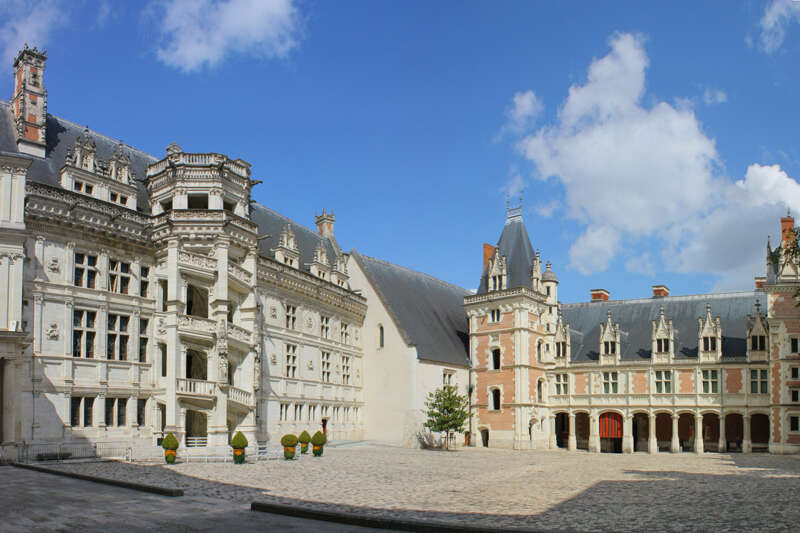
Blois is the architecturally most complete demonstration of the French royal château style across four separate periods. Each Valois king who used the place added a wing in his own period's idiom, and the result is a four-wing palimpsest visible from a single courtyard.[5] The Louis XII wing went up 1498 to 1503 in late Gothic: brick-and-stone, the principal entrance, royal-arms ornament still visible above the main gate. The François I wing followed 1515 to 1524 in early French Renaissance, with the famous open spiral staircase tower projecting from its façade, the staircase you see in every guidebook image of Blois. The Gaston d'Orléans wing went up 1635 to 1638 in Classical / French Baroque under François Mansart, never completed for political and financial reasons. Behind them survives the medieval thirteenth-century wing carrying the Counts of Blois Gothic hall.[5] Four periods of French royal architecture, four wings, one courtyard.
Seven Valois kings and ten queens used Blois.[1] Henri III had his rival Henri de Guise, leader of the Catholic League, assassinated in the king's own bedchamber on 23 December 1588: a single event that defines the most-photographed Wars of Religion site in France. The room is part of the standard tour. The political crisis that followed pulled France into the eighth and most destructive of its religious civil wars.
Practical: open daily, year-round. Apr–Sep 09:00–19:00; Oct–Mar 10:00–17:00. Adult €14, concession €10.50; child (6–17) €7; under 6 free. From Paris, TGV from Austerlitz or Montparnasse to Blois-Chambord (~1h30), then a 10-minute walk from the station. Plan your visit.[5]
5. Château de Cheverny
Loir-et-Cher Daily, year-round Longest unbroken family ownership Map
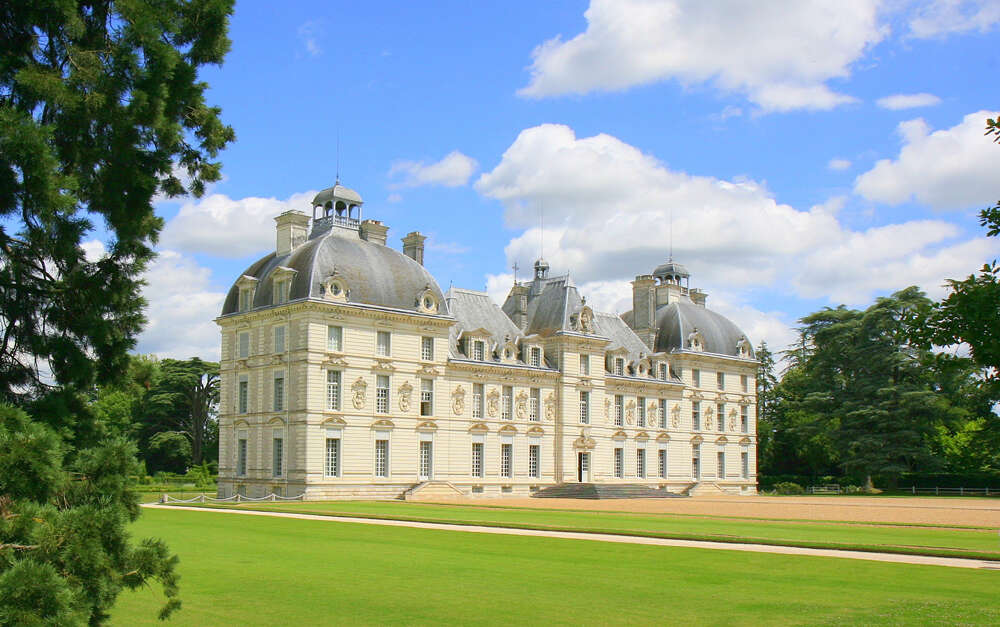
Cheverny was built 1604 to 1634 in early French Classical, pre-Versailles and post-Renaissance, the moment when the Loire stopped being the cutting edge and started being the conservative tradition.[2] What matters now is that the Hurault family has held it since the seventeenth century: over four hundred years of unbroken family ownership, the longest single-family Loire stewardship by a clear margin.[2]
The contemporary cultural footprint is unusual. Hergé visited Cheverny in the 1940s and used the central façade as the model for Marlinspike Hall (Château de Moulinsart in French), the home of Captain Haddock in the Tintin albums. The château now runs a permanent Tintin exhibition, and the Hergé connection drives a meaningful share of modern visitor traffic.[2] Cheverny still maintains a working pack of around a hundred hounds, the meute, fed publicly each afternoon. The soupe des chiens (the four o'clock or five o'clock kennel feed depending on season) is a vivid surviving register of the Loire's pre-1789 noble-hunting culture.[2] A hundred dogs eating at once in synchronised silence is unforgettable. It is not a performance for tourists; it is a working kennel that lets visitors watch.
Practical: open daily, year-round. Apr–Sep 09:15–18:30; Oct–Mar 09:45–17:00. Adult €14.50; child (7–14) €10.50; under 7 free. From Paris, TGV to Blois-Chambord, then bus or taxi (about 16 km). Plan your visit.[6]
6. Château d'Azay-le-Rideau
Indre-et-Loire Daily, year-round Indre-island Renaissance composition Map
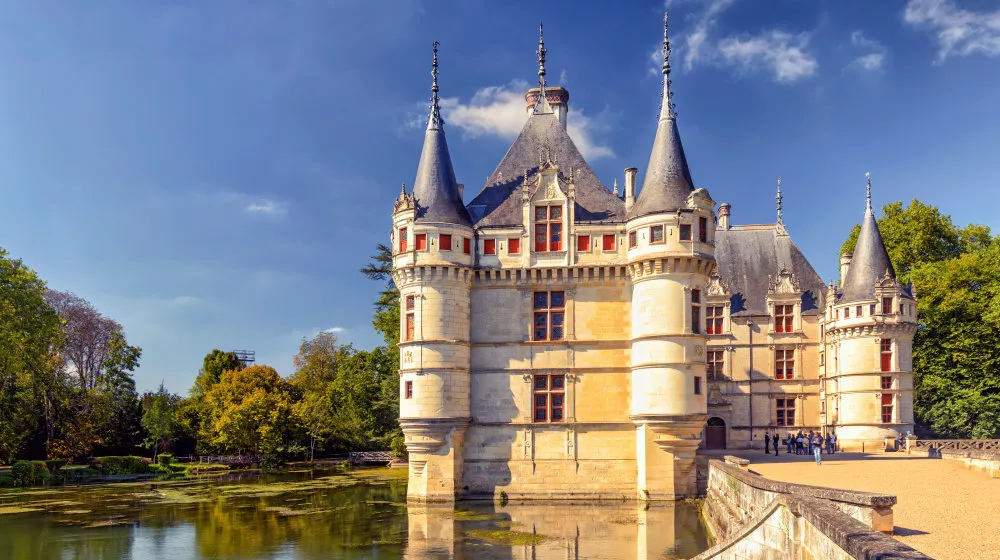
Built 1518 to 1527 on an island in the River Indre, Azay-le-Rideau is the integrated water-and-architecture composition the early French Renaissance produced to compete with Chenonceau.[1] The reflection of the château in the Indre at dawn is one of the most-photographed French Renaissance images, and the Centre des Monuments Nationaux operates the property today, drawing around 250,000 visitors a year.[7] The architectural register is Italianate, the geometry deliberate, and the entire structure was conceived around the water that surrounds it.
The interior is smaller than Chambord or Chenonceau and reads as the more intimate visit. Renaissance staircases, a Salamander emblem (François I's personal device, granted to the builder Gilles Berthelot as a royal favour), and the open-air loggia on the river side are the elements to watch for. The walk around the moat at first light, before the gates open, gives the same composition without the crowd.
Practical: open daily, closed 1 Jan, 1 May, 25 Dec. Apr–Jun and Sep 09:30–18:00; Jul–Aug 09:30–19:00; Oct–Mar 10:00–17:15. Adult €11.50, free under 18 and EEA 18–25. From Paris, TGV Montparnasse to Tours, then TER to Azay-le-Rideau (about 25 min). Plan your visit.[7]
7. Château de Villandry
Indre-et-Loire Daily, year-round The gardens, not the building Map
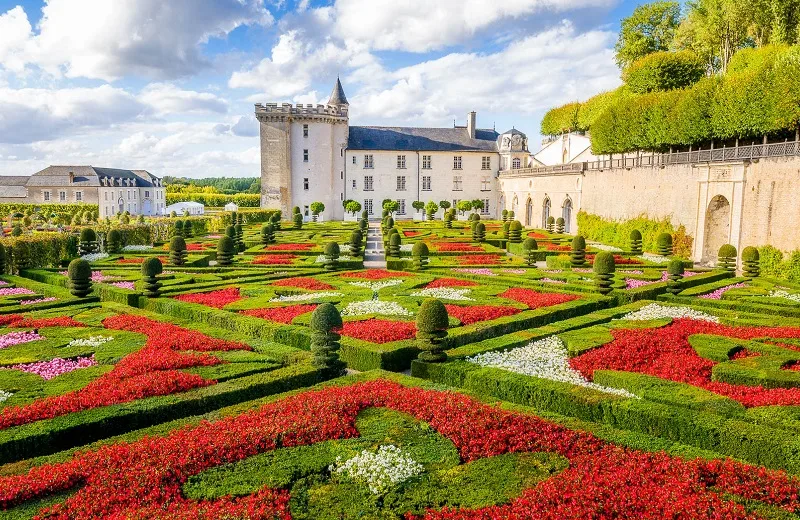
The last of the great Renaissance Loire châteaux, Villandry was completed in 1532. The château is a competent Renaissance reference. The reason anyone visits is the gardens. Joachim Carvallo, a Spanish doctor who bought the property in 1906, restored the original 16th-century garden plan from archival research, producing one of the most-photographed formal gardens in France: the jardin d'amour (the love garden, with allegorical bedding), the jardin potager (the ornamental kitchen garden), and the maze.[1]
In late June and July the jardin potager hits peak colour: red cabbages, purple aubergines, green leek tops, white onion. The visit becomes vegetable garden as architecture. The gardens survive today through Carvallo's descendants, who continue the private operation. Pair Villandry with a morning at Azay-le-Rideau for a single Indre-and-Cher day; both sit within 30 minutes of Tours.
Practical: open daily, year-round (gardens daily; château seasonal closures in Jan). Adult (gardens + château) €13; gardens-only €8; child (8–18) €8.50 / €5.50. From Paris, TGV Montparnasse to Tours, then bus or taxi (~17 km). Plan your visit.[8]
> [!callout] Watch out > The Loire châteaux are spread across roughly 100 km of river. Driving beats train-and-shuttle once you leave the Tours-Blois TGV spine. A rental car from Tours airport or Saint-Pierre-des-Corps is the working solution for a multi-castle week.
At a glance
| Castle | Region | When to go | |
|---|---|---|---|
| Château de ChambordFrançois I's hunting folly | Loir-et-Cher | Daily, year-round |
| Château de ChenonceauThe ladies' château | Indre-et-Loire | Daily, year-round |
| Château d'AmboiseRoyal residence to four kings | Indre-et-Loire | Daily, year-round |
| Château de BloisFour-wing palimpsest | Loir-et-Cher | Daily, year-round |
| Château de ChevernyLongest unbroken family ownership | Loir-et-Cher | Daily, year-round |
| Château d'Azay-le-RideauIndre-island Renaissance composition | Indre-et-Loire | Daily, year-round |
| Château de VillandryThe gardens, not the building | Indre-et-Loire | Daily, year-round |
Common questions
Where should I sleep for a Loire châteaux trip? Amboise is the canonical base. Two hours south of Paris by TGV (via Saint-Pierre-des-Corps), within an hour's drive of Chenonceau (mornings), Chambord (afternoons), Blois (next day), and Cheverny (when you want to watch the kennel feed at five). Tours and Blois work as alternatives if you want a larger town.
How many days do I need? Three days covers the headline three (Chambord, Chenonceau, Amboise/Clos Lucé). Five days lets you fit all seven plus Loches or Chinon on the medieval side. The full seven-castle itinerary works as a five-day base from Amboise.[2]
Do I need a car? For two or three flagship châteaux, no: TGV plus shuttle works for Chambord and Chenonceau. For five or more, a rental car from Tours or Blois saves several hours a day and unlocks the smaller villages around the river.
When is the best time of year to visit? Late May to early July, and September, are the best windows: gardens at peak (Villandry in particular), tolerable crowds, and long Loire light at sunset. August is the busiest month and the hottest. Winter visits are quiet but several smaller châteaux close in January.
Is Chambord really the largest château in the Loire? Yes. 156-metre façade, 400-plus rooms, 77 staircases, 282 chimneys, and a 5,440-hectare walled estate, the largest enclosed forest park in Europe. It is the architectural high-water mark of François I's reign and France's largest Renaissance château.[2]
Did Leonardo da Vinci really design Chambord? He almost certainly contributed to the early design thinking. Leonardo lived at the nearby Clos Lucé in Amboise from 1516 until his death in May 1519 (the year Chambord broke ground), and produced architectural sketches that resemble the Chambord plan. The double-helix staircase attribution is widely held but cannot be documented from a surviving Leonardo drawing.[2]
Is the Loire UNESCO listed? Yes. The Loire Valley between Sully-sur-Loire and Chalonnes was inscribed as a UNESCO cultural landscape in 2000 (ref. 933), covering more than 280 km of river and its tributaries. The inscription is the regulatory backbone behind the regional preservation framework.
Sources
1. Mansfield, M. F. Castles and Châteaux of Old Touraine and the Loire Country. L. C. Page & Company, Boston, 1906 (archive.org).
2. Lonely Planet. Châteaux of the Loire Valley Trips. Lonely Planet Publications, 2015.
3. Château de Chenonceau, official site.
4. Château Royal d'Amboise, official site.
5. Fenwick, Hubert. The Châteaux of France. Robert Hale & Company, 1976.
6. Château de Cheverny, official site.
7. Centre des Monuments Nationaux, Azay-le-Rideau.
8. Château de Villandry, official site.