
Abandoned Castles in Europe: 12 Spectacular Ruins Still Standing
Europe's most spectacular abandoned castles: Heidelberg's blown façade, Tantallon's Cromwellian ruin, Kilchurn after the Jacobite rising, Spiš and 8 more.
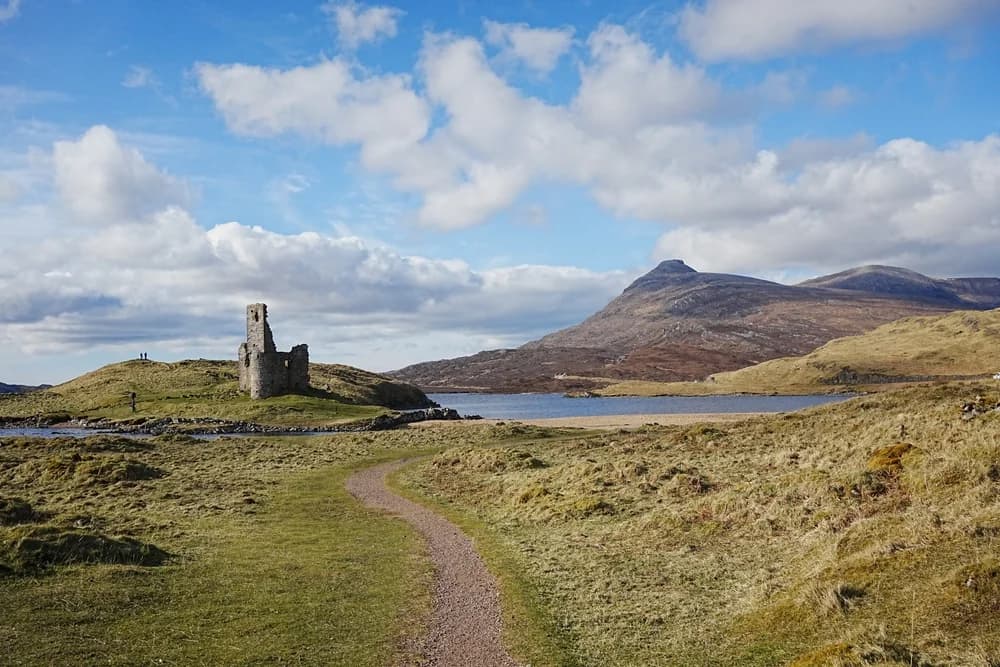
A ruin that has been gardened, fenced and ticketed is still a ruin. Ten European castles where the walls did not finish the story, but the operator does keep the gate open.
Some of Europe's most affecting castle visits are the ones the owners gave up on. Heidelberg's powder tower stands open to the sky after a French detonation in 1693. Tantallon's red sandstone curtain shows a hole punched by Cromwell's gunners in 1651. Kilchurn sits empty on its Loch Awe spit after the 1746 garrison walked off. Each one was lost in a different way, slighted after capture, abandoned when the politics moved on, or lost to a single fire, and each is now run by a heritage agency that keeps the path mown and the visit safe.
The ten below are not the obscure private wreckage in deep woodland. They are the ruins where a state body (English Heritage, Cadw, Historic Environment Scotland, the OPW, the Slovak national museum, the City of St. Goar, the Generaldirektion in Baden-Württemberg) has put a ticket desk or an open-access stile on the gate. Atmospheric, dramatic, photographed to death, and worth seeing in person.
Each entry covers what to see, when to go, what it costs, and how to get there.
1. Heidelberger Schloss
Baden-Württemberg, Germany Open daily, year-round Synonymous with Romanticism Map
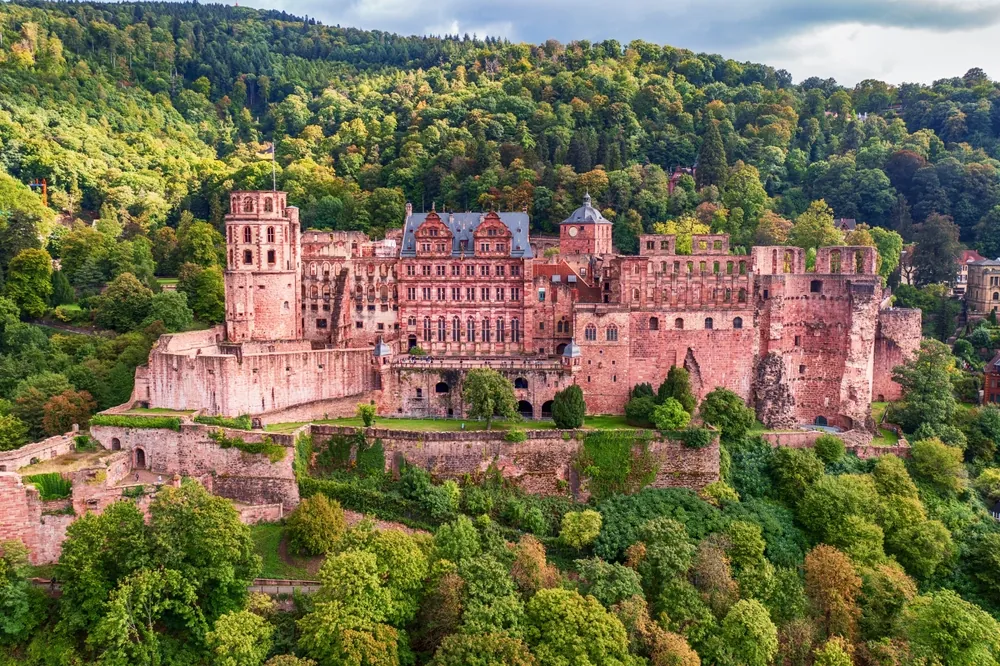
The red-sandstone palace above Heidelberg is the canonical European castle ruin. The Wittelsbach Electors Palatine built and rebuilt the schloss across the late medieval and Renaissance period; in 1693, during the War of the Grand Alliance, French troops blew up the powder store and the curtain wall, and a 1764 lightning strike finished what the French had started. The 19th-century debate over whether to rebuild Heidelberg as a Hohenzollern-era pleasure-palace or to conserve it as a ruin produced the modern German conservation principle that ruins are kept as ruins. The site is now run by Staatliche Schlösser und Gärten Baden-Württemberg.[1]
The visit covers the funicular up from Kornmarkt, the courtyard with the Friedrichsbau and the Ottheinrichsbau façades, the German Pharmacy Museum, and the Heidelberg Tun (a 219,000-litre wine cask in the cellars). The viewpoint over the Neckar valley is the photograph everybody has seen and is the reason Goethe and Mark Twain both came back.
Practical: castle grounds open daily 08:00–18:00 year-round; funicular runs roughly 09:00–17:30. Combined ticket (funicular round-trip plus courtyard plus Heidelberg Tun plus Pharmacy Museum) €9.50 adult, €5.30 child (6–14), under 6 free. From Heidelberg Hauptbahnhof, tram to Kornmarkt then the Bergbahn funicular up to the castle. Plan your visit.[1]
2. Spiš Castle
Prešov Region, Slovakia Open daily, Mar–Oct UNESCO 1993, fire-ruined giant Map
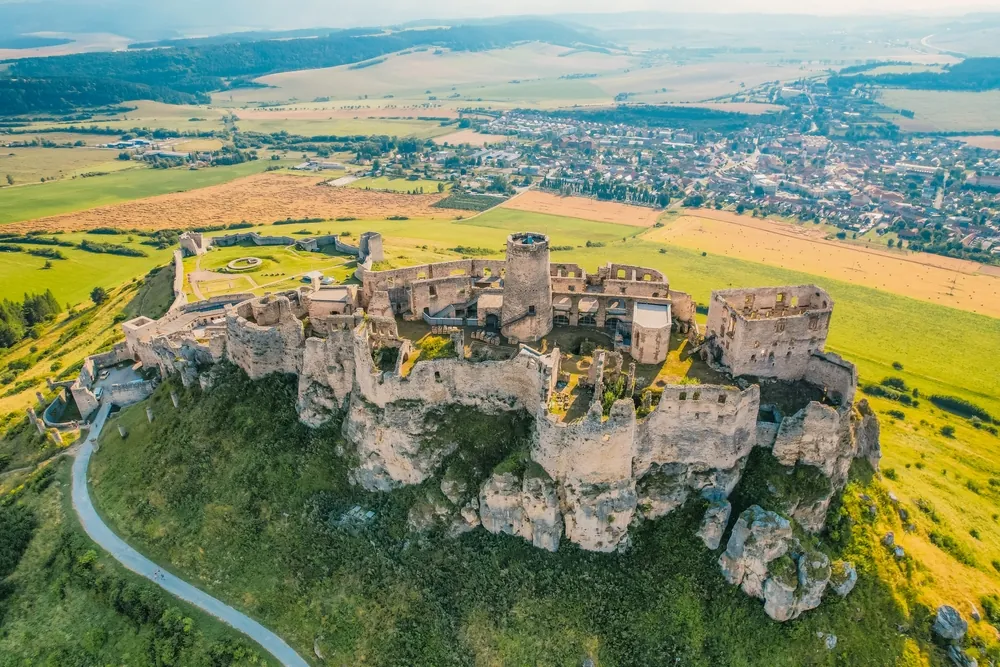
Spišský hrad sits on a travertine ridge above the small town of Spišské Podhradie in eastern Slovakia, visible across the valley from twenty kilometres away. The original 12th-century Romanesque keep was extended through the late medieval period until the complex became one of the largest castle compounds in central Europe. A 1780 fire ended continuous occupation; the abandoned shell is what visitors see today. UNESCO inscribed Spiš (together with Spišské Podhradie, Spišská Kapitula and the Žehra church) on the World Heritage List in 1993.[2]
The site is run by the Slovak National Museum's Spiš Museum from Levoča. Visitors enter through the lower courtyard, climb past the middle bailey, and reach the Romanesque tower at the highest point. A current note from the operator flags that the upper castle is partly closed for reconstruction; the lower courtyard, middle courtyard and tower remain open.
Practical: open daily 09:00–17:00 (Mar/Oct), 09:00–18:00 (Apr), 09:00–19:00 (May–Sep). Closed Nov–Feb. Adult €12, students/seniors €8, children (6–18) €6, family ticket €25. Parking is a 10-minute walk from the entrance via Hodkovce; on foot from Spišské Podhradie allow about an hour uphill. Plan your visit.[2]
3. Tantallon Castle
East Lothian, Scotland Open daily, year-round Cliff-top Douglas fortress Map
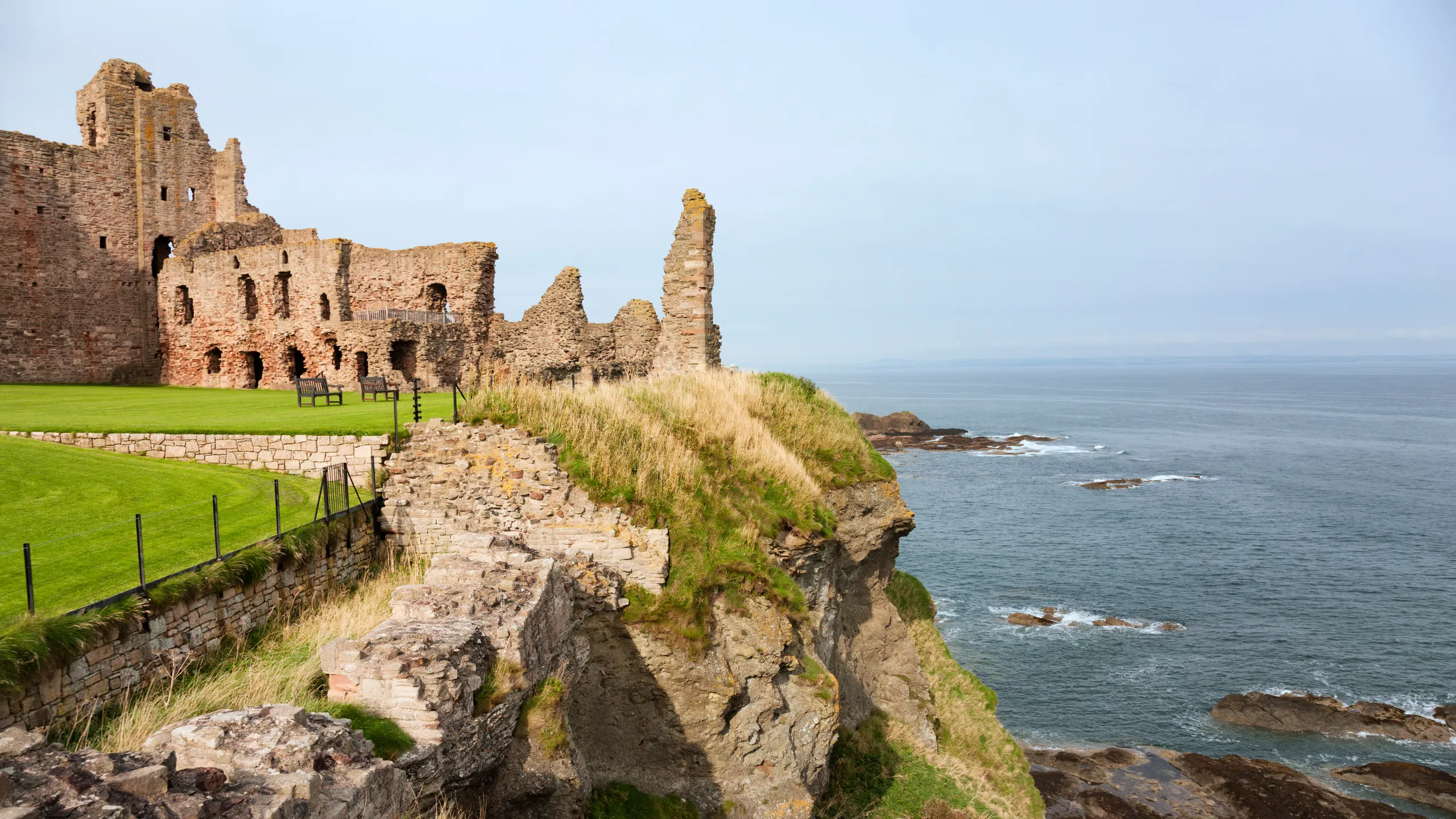
A red sandstone curtain wall, four storeys high and 15 metres thick at the base, on a cliff above the North Sea facing the Bass Rock. Tantallon was the seat of the Red Douglases, Earls of Angus, from the 1350s onward, and was twice besieged by James V before its 1651 reduction by Cromwellian forces under General Monck. Monck's gunners spent twelve days battering the front before the garrison surrendered; the breach is still there, and the castle was never significantly re-fortified afterwards.[3]
The visit covers the gatehouse, the Mid Tower with its long views over the Firth of Forth, the Sea Gate that drops to a tidal cove, and the ditch and outer earthworks on the landward side. Historic Environment Scotland has restricted access to the east tower staircase, the doocot and the vaults under the standard masonry-inspection programme; the courtyard, the Mid Tower and the cliff walks are open.
Practical: open daily, year-round; Apr–Sep 09:30–17:00, Oct–Mar 10:00–16:00. Adult £7.50 online (£8.50 walk-up), concessions £6.00, child £4.50. From Edinburgh, train to North Berwick (~35 min) then taxi or bus to Tantallon, about 5 km east. Plan your visit.[3]
4. Kilchurn Castle
Argyll, Scotland Open access, exterior only Iconic Loch Awe ruin Map
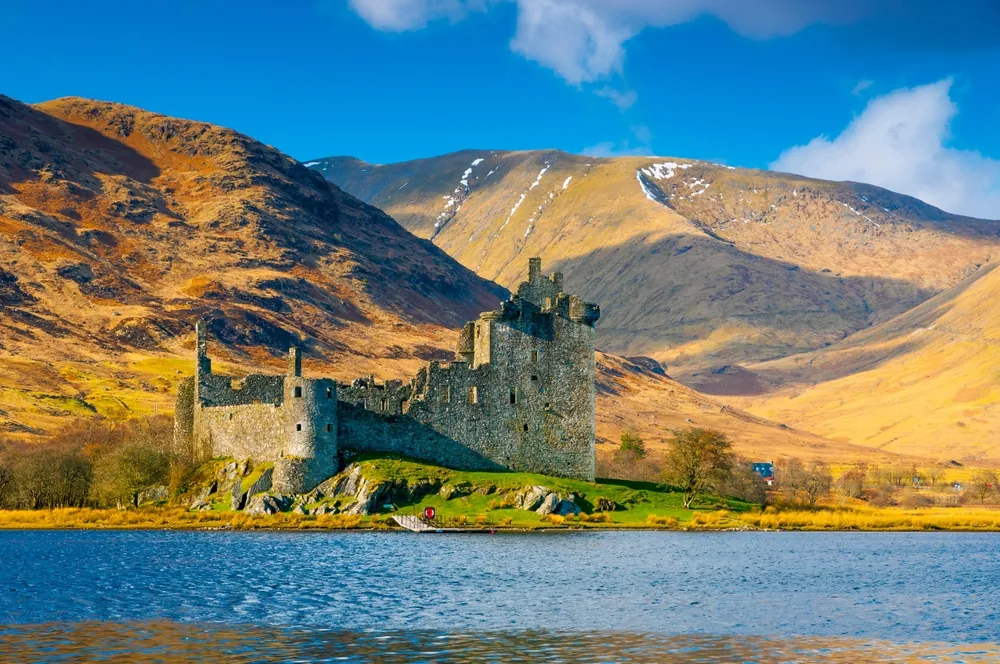
Built around 1450 by Sir Colin Campbell of Glenorchy, Kilchurn sits on a rocky spit at the northeastern end of Loch Awe with the Ben Cruachan ridge behind it. The Campbells extended the original tower house with a barrack block in 1693, the last major castle building in Scotland to be designed for a permanent garrison rather than a country household. The garrison left after the 1746 Jacobite defeat at Culloden, and a lightning strike in 1760 took the roof off the south range. The castle has been a roofless ruin ever since.[3]
The image of Kilchurn at sunrise reflected in still loch water is the canonical Scottish-castle photograph. Historic Environment Scotland keeps the exterior open all year; the interior is currently fenced for masonry safety work. The walk in from the A85 layby crosses a small bog and reaches the castle in about ten minutes.
Practical: exterior only, free, daylight hours, year-round. Interior closed for safety. From Glasgow, train to Loch Awe station (~2h) then a 1.5 km walk along the loch shore; or by car on the A85. No on-site facilities. Plan your visit.[4]
5. Dunluce Castle
County Antrim, Northern Ireland Open daily, year-round Cliff-edge MacDonnell ruin Map
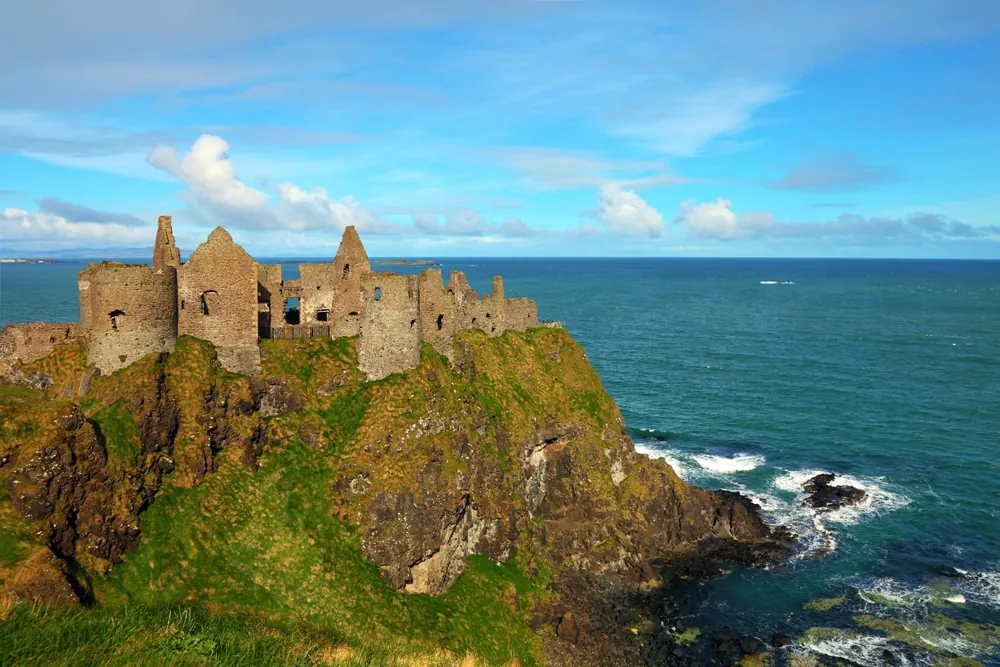
Dunluce sits on a basalt headland on the north Antrim coast between Portrush and Bushmills, joined to the mainland by a narrow stone bridge. The original castle was built by the de Burgo earls in the 13th century; the MacDonnells of Antrim took it in 1513 and rebuilt the gatehouse, the inner ward and the great hall. Coastal erosion is part of the story: in 1639, part of the kitchen block fell into the sea during a storm, taking several servants with it, and the family eventually abandoned the site in the late 17th century.[5]
The visit takes in the twin gate-towers, the Renaissance loggia in the inner ward, the great hall foundations and the basalt cliff walks on either side. Game of Thrones fans will recognise the silhouette as the Greyjoy seat of Pyke. The walk down to the Mermaid's Cave under the gatehouse is open at low tide.
Practical: open daily; 09:30–17:00 (Feb–Nov), 09:30–16:00 (Dec–Jan). Adult £6, concessions £4.50, child (5–17) £4, family up to 5 (max 3 adults) £18. Tickets sold on-site only, no online booking. From Coleraine (nearest mainline station, ~16 km), taxi or the Translink Causeway Rambler bus 402. Plan your visit.[5]
6. Tintagel Castle
Cornwall, England Year-round, reduced winter King Arthur's legend Map
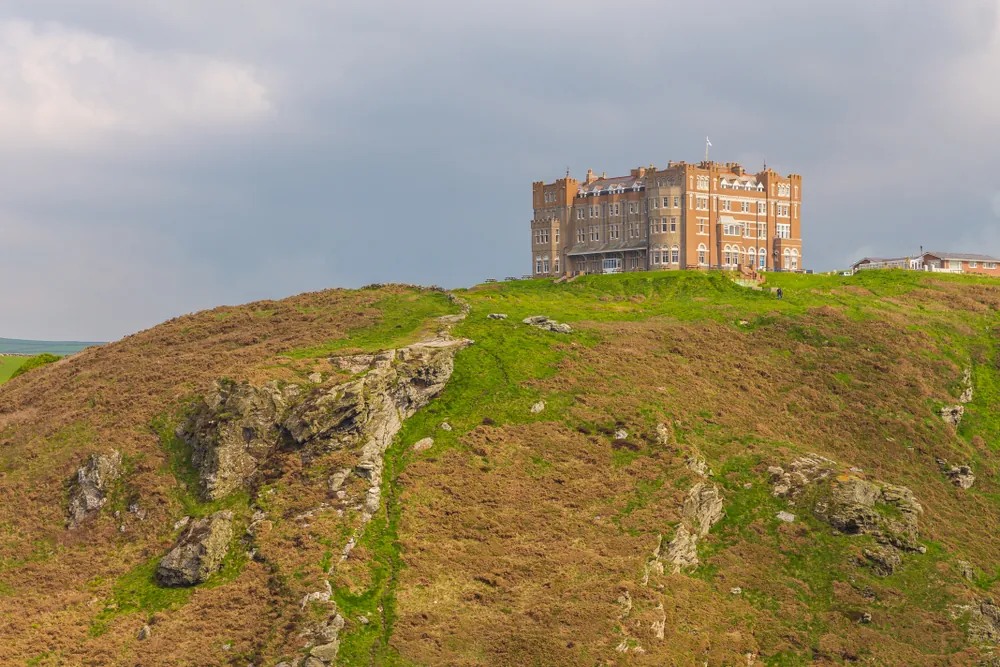
Tintagel sits on a near-island headland on the north Cornish coast, joined to the mainland by a narrow neck and now by a steel-and-oak footbridge installed by English Heritage in 2019. The visible 13th-century castle was built by Richard, Earl of Cornwall, brother of Henry III, on top of an early-medieval high-status settlement that the late Geoffrey of Monmouth identified as the conception-place of King Arthur. The Earl seems to have built the castle as a piece of romantic theatre rather than a working stronghold; it had no real military value and was already ruinous by the 14th century.[6]
The visit covers the lower gatehouse, the upper bailey, the cliff walks above the Atlantic, and Merlin's Cave at sea level (open at low tide). The footbridge is a useful shortcut between the two halves of the headland; the older route via the steps is still open and worth doing one way for the perspective.
Practical: 28 Mar–24 Oct daily 10:00–17:00; shoulder seasons reduced to Wed–Sun 10:00–16:00; December Fri–Sun only. Closed Christmas Day. Adult £15.00 advance (peak), £16.50 with donation; concessions and discounted child rates available; under-5 free; English Heritage members free. From Bodmin Parkway (nearest mainline station), bus to Tintagel village then a 10-minute walk. Plan your visit.[6]
7. Dunstanburgh Castle
Northumberland, England Open daily, year-round Coastal ruin reached on foot Map
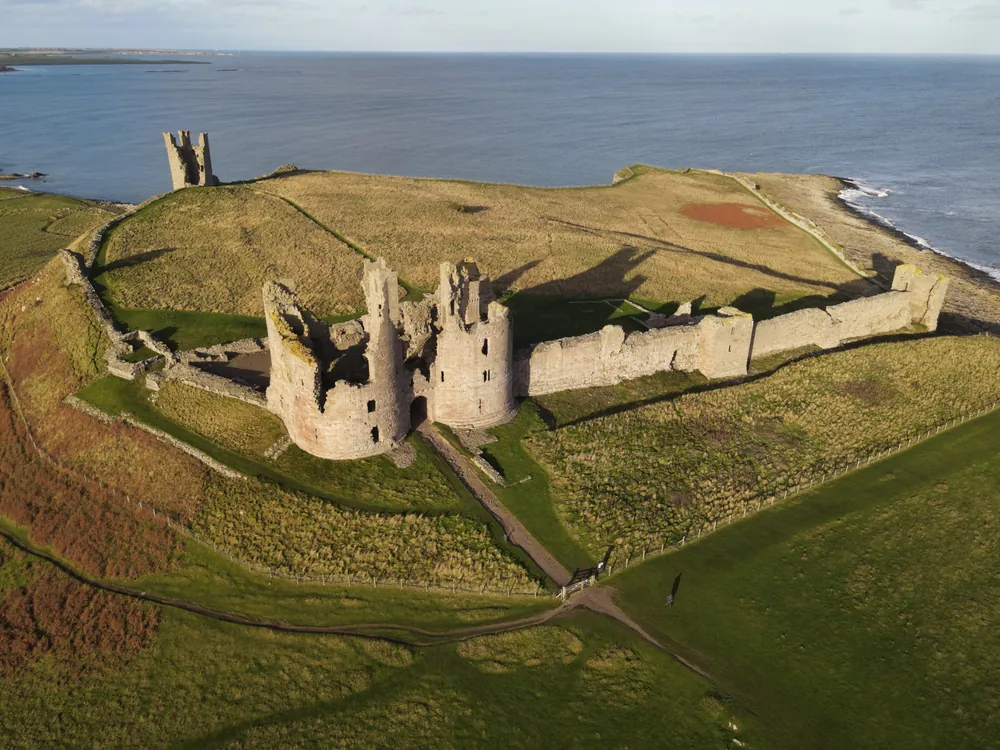
Dunstanburgh is the largest castle in Northumberland by area and one of the most atmospheric coastal ruins in England. Earl Thomas of Lancaster, cousin and rival of Edward II, began the castle in 1313 on a basalt headland north of Craster, intending it as both a stronghold and a deliberate political statement against the king. Lancaster was executed in 1322 before the work was finished. John of Gaunt extended the gatehouse in the 1380s; by the late 15th century, after Wars of the Roses sieges in 1462 and 1464, the castle had passed out of use and been allowed to decay.[7]
The site is owned by the National Trust and managed by English Heritage. There is no road access. Visitors walk the 1.3-mile coastal path from Craster harbour, with the ruin coming into view across the dunes about halfway. The twin-towered Lilburn Tower keep, the great gatehouse and the curtain wall above the cliffs are the visit; the seaward side of the headland is a SSSI.
Practical: open daily 10:00–17:00, last entry 16:00. Adult £6.80 advance, concessions £5.90, child £3.60; family (2A+3C) £17.20. From Alnmouth station, taxi or bus to Craster, then the coastal walk. 20% bus discount available. Plan your visit.[7]
8. Burg Rheinfels
Rhineland-Palatinate, Germany Daily Apr–Oct, reduced winter Rhine's mighty ruin Map
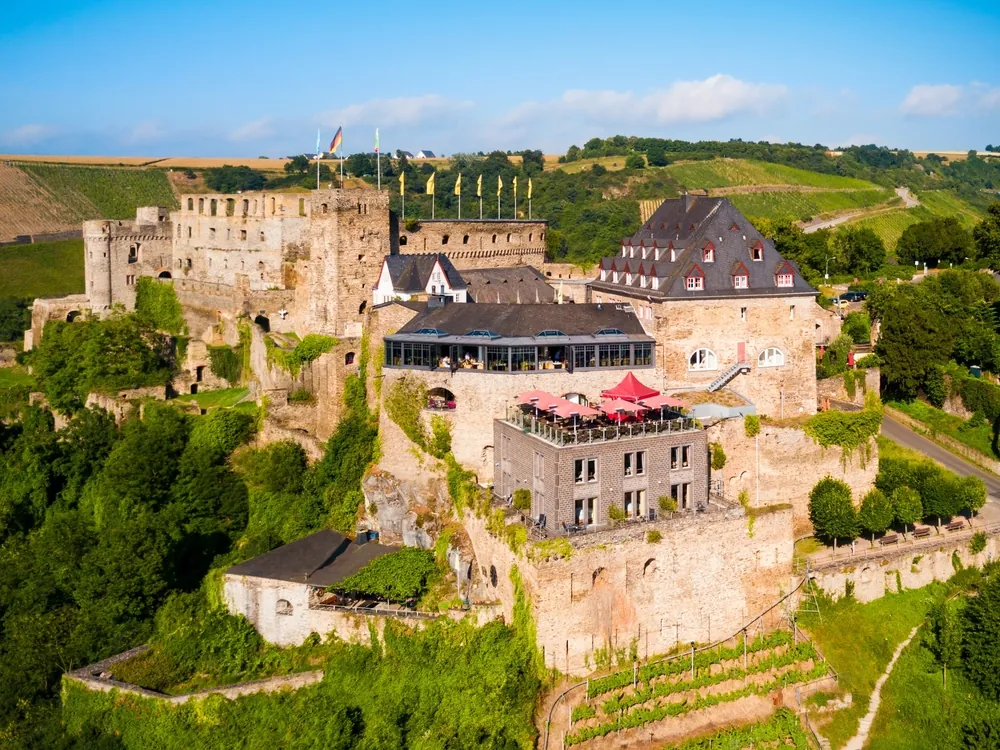
Built in 1245 by Count Diether V of Katzenelnbogen above the Rhine at St. Goar, Burg Rheinfels was the largest fortress on the Middle Rhine and the only one in the Rhine Gorge that successfully resisted the French in 1692. Resistance lasted until 1794, when the garrison surrendered without a shot to French Revolutionary forces who then used the site as a quarry. The ruin sprawls across the hillside in stripped-back masonry, casemates and dry moats; what survives is a fraction of the original footprint, but the surviving fraction is still the biggest castle ruin on the river.[8]
Operated by the City of St. Goar, the visit covers the upper castle, the casemate tunnels (bring a torch) and the rampart walks with views down to the Loreley rock and the Lorch hairpin. Guided tours run weekends and holidays at 11:00, 13:00 and 15:00.
Practical: Apr–30 Oct daily 09:00–18:00 (last entry 17:00); 31 Oct–late Mar Fri–Sun 10:00–15:00; closes in snowy/icy conditions. Adult €6.00, concessions €4.00, child (6–14) €3.00, family €13.00, under 5 free. From St. Goar regional rail station, the 699 shuttle bus runs every 30 minutes, or walk up via the nature path (~15 min). Plan your visit.[8]
9. Carreg Cennen
Carmarthenshire, Wales Open daily, year-round Limestone-crag fortress Map
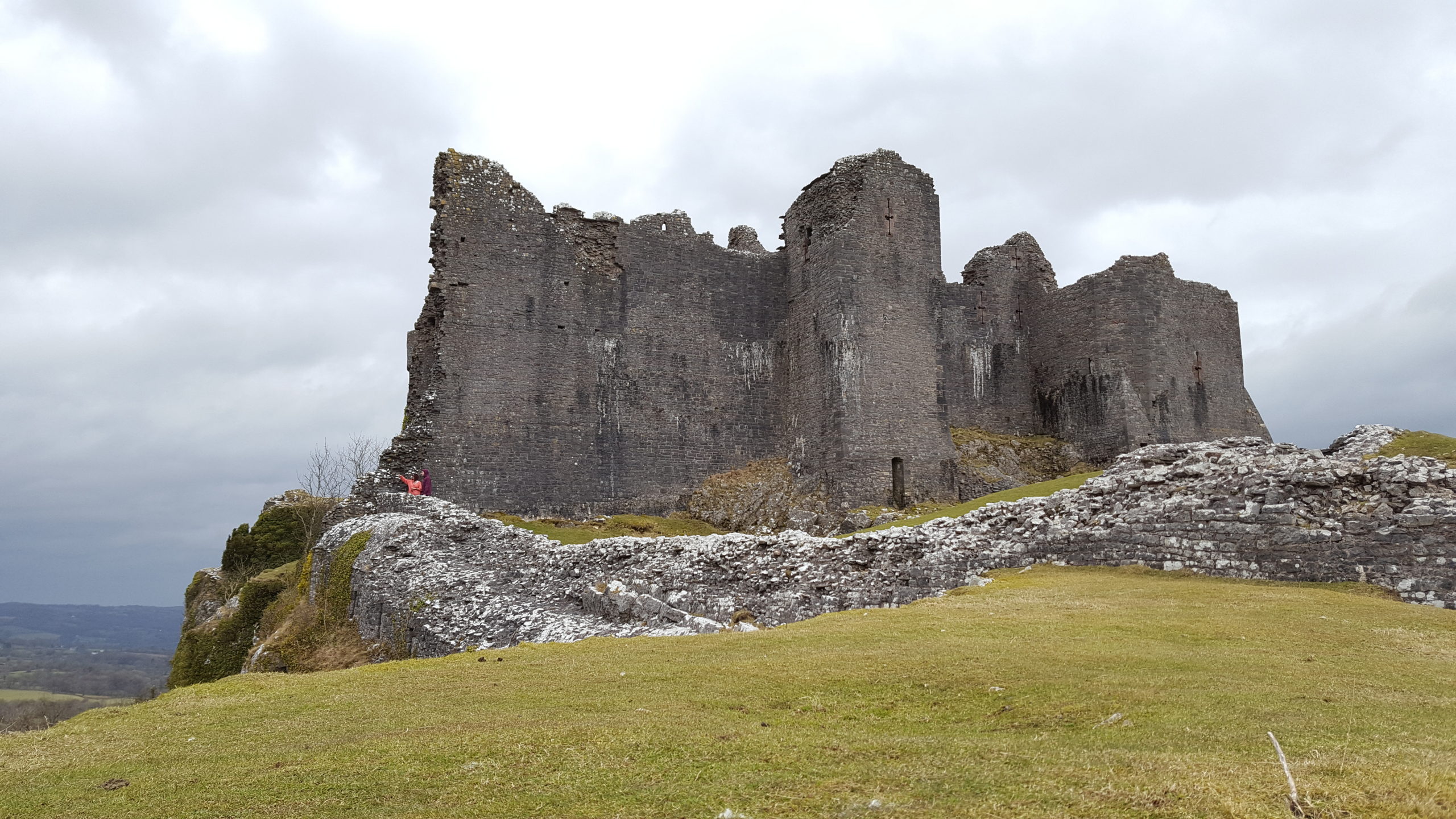
Carreg Cennen sits on a limestone crag nearly 90 metres above the River Cennen in the foothills of the Black Mountain. The visible castle was built in the late 13th century by John Giffard for Edward I as part of the Edwardian campaign in south Wales, though earlier native Welsh fortifications occupied the site. The castle was deliberately slighted in 1462 during the Wars of the Roses, on Yorkist orders, after Lancastrian outlaws had taken refuge there; 500 men with picks and crowbars were paid to bring down the walls.[9]
The site is a Cadw monument managed jointly with the working farm at the base of the crag (it is not staffed by Cadw, and Cadw membership cards do not give free entry). The visit takes in the gatehouse, the inner ward, and the underground passage that runs down the cliff face to a natural cave under the castle (bring a torch or hire one at the gate). The view from the curtain wall over the Cennen valley is the reason most visitors come.
Practical: Apr–Oct 09:30–17:30; Nov–Mar 09:30–16:30; last entry one hour before close. Adult £7.35, junior (5–17) £5.10, senior (65+) £6.60, family (2A+up to 3C) £23.50. Disabled visitors free. From Llandeilo station (~5 km), no public transport to the site; taxi or car along minor roads from the A483. Plan your visit.[9]
10. Trim Castle
County Meath, Ireland Daily, year-round; keep guided tour only Largest Anglo-Norman ruin in Ireland Map
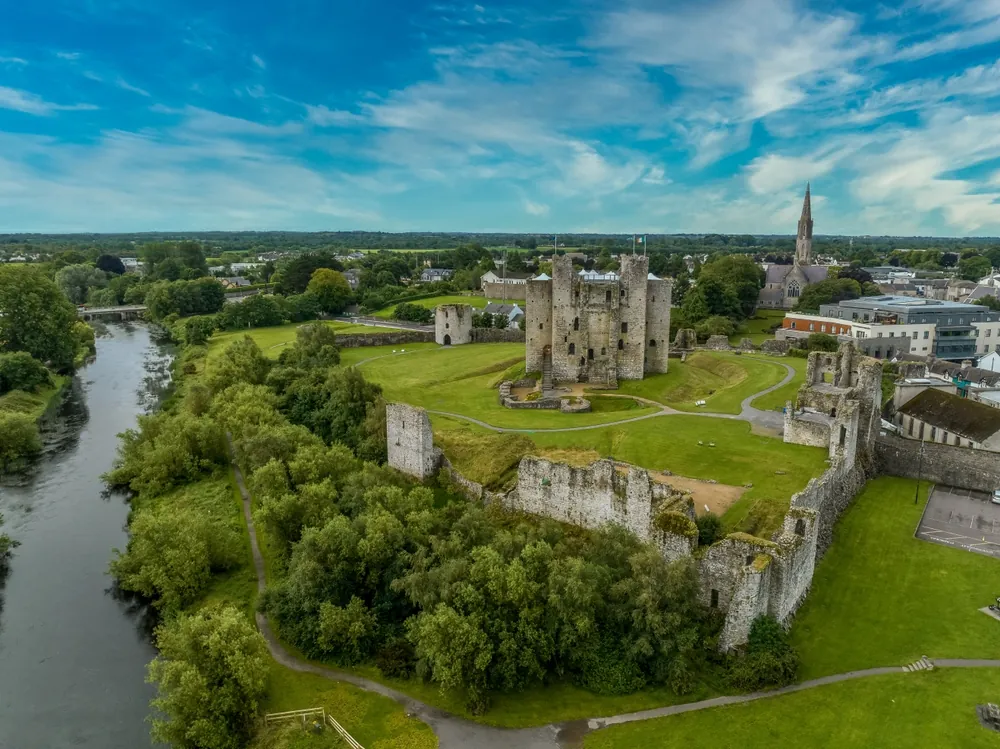
Trim is the largest Anglo-Norman fortification in Ireland. Hugh de Lacy, Lord of Meath under Henry II, began the castle in the 1170s; building work continued under his successors for thirty years and produced a 20-sided cruciform keep and an irregular curtain wall enclosing more than 1.4 hectares above the River Boyne. Richard II held court here in 1399; the future Henry V was briefly imprisoned in the keep as a teenager. The castle declined gradually after the Cromwellian period and was a roofless ruin by the early 18th century.[10]
The site is managed by the Office of Public Works. The grounds are free to walk year-round; the keep is accessed only by guided tour, with the OPW guide running parties up to the wall walks and down through the lower vaults. Plan for the tour rather than just the walls; the keep is the visit.
Practical: keep guided tour: 17 Mar–30 Sep daily 10:00–17:00; Oct daily 09:00–16:00; 5 Feb–16 Mar daily 09:30–16:00; Nov–Jan weekends only. Adult €5.00, senior €4.00, child/student €3.00, family €13. Castle grounds free. Closed 25, 26, 31 Dec, 1 Jan. From Dublin, Bus Éireann 109 or 111 to Trim (~50 km, ~1h15). Plan your visit.[10]
At a glance
| Castle | Region | When to go | |
|---|---|---|---|
| Heidelberger SchlossSynonymous with Romanticism | Baden-Württemberg, Germany | Open daily, year-round |
| Spiš CastleUNESCO 1993, fire-ruined giant | Prešov Region, Slovakia | Open daily, Mar–Oct |
| Tantallon CastleCliff-top Douglas fortress | East Lothian, Scotland | Open daily, year-round |
| Kilchurn CastleIconic Loch Awe ruin | Argyll, Scotland | Open access, exterior only |
| Dunluce CastleCliff-edge MacDonnell ruin | County Antrim, Northern Ireland | Open daily, year-round |
| Tintagel CastleKing Arthur's legend | Cornwall, England | Year-round, reduced winter |
| Dunstanburgh CastleCoastal ruin reached on foot | Northumberland, England | Open daily, year-round |
| Burg RheinfelsRhine's mighty ruin | Rhineland-Palatinate, Germany | Daily Apr–Oct, reduced winter |
| Carreg CennenLimestone-crag fortress | Carmarthenshire, Wales | Open daily, year-round |
| Trim CastleLargest Anglo-Norman ruin in Ireland | County Meath, Ireland | Daily, year-round; keep guided tour only |
Why castles end up as ruins
Three structural causes account for almost every European castle ruin you can visit today.
Deliberate destruction (slighting) after capture or surrender. Heidelberg in 1693 is the canonical case: French troops under Marshal de Lorge blew up the powder store and the curtain wall to deny the schloss to the next garrison. Tantallon in 1651 was reduced under Cromwellian gunners; Carreg Cennen in 1462 was brought down on Yorkist orders by 500 paid labourers with picks and crowbars.[9] The English Civil War of 1642–1651 produced a generation of slighted English castles, including Raglan in Monmouthshire, deliberately dismantled in summer 1646 on Parliament's orders and left as the rose-coloured shell that today's visitor sees.[11]
Abandonment as the politics changed. Kilchurn was held until the 1746 Jacobite defeat at Culloden, after which the Highland defensive logic disappeared and the garrison walked off; Dunstanburgh was a Lancastrian stronghold whose use ended with the Wars of the Roses; Old Sarum was effectively abandoned in 1220 when Salisbury Cathedral was relocated 3 km south to a better-watered site and the town followed. The castle stock that survived as ruin (rather than as recycled rubble) usually owes its survival to the site being too remote or too steep to quarry economically.
Catastrophic single events. Spiš burned in 1780 and was never reoccupied, leaving the largest castle compound in central Europe as a cleared ruin on a travertine ridge. Heidelberg was hit by lightning in 1764 (after the 1693 detonation), which finished the roof and confirmed the abandonment. The Bungay Castle keep in Suffolk was simply demolished in 1766 to provide rubble for new roads; that fate, the gradual quarrying of an unloved ruin, accounts for many castles that never made it through the 18th century.[12]
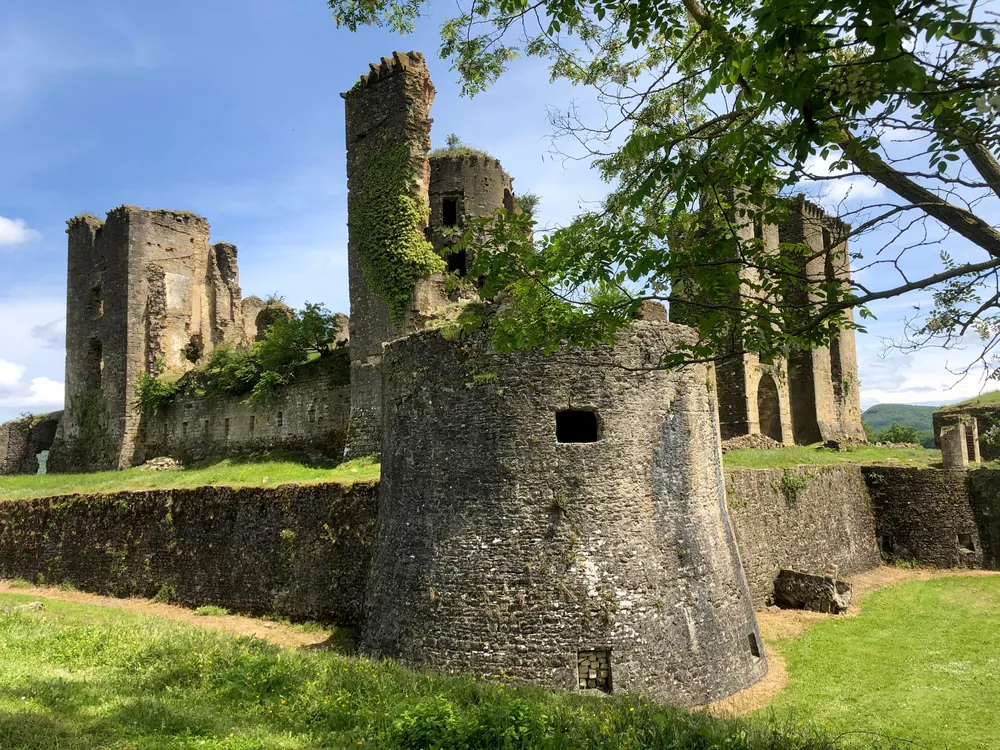
A fourth category, less visible, is the timber motte-and-bailey castle that simply rotted. Lepage's survey notes that "most motte-and-bailey castles have disappeared. The earthworks have completely vanished, the excavations have been filled in, and timber works have left no trace on the surface." The visible castle ruins across Europe represent the small subset that were rebuilt in stone.[13]
How conservation actually works at a ruin
The 19th-century debate about what to do with a ruin (rebuild it or stabilise it) defines how today's visitor sees Heidelberg, Tantallon and Carreg Cennen. The Rhine produced one answer in the 1820s: after Burg Rheinstein's reconstruction, "ruins as such seemed less interesting and there was a trend to rebuild them using the old foundations".[14] That logic produced a generation of romantic reconstructions on the Middle Rhine, several of which are now period pieces in their own right.
The opposite answer, conservation as a ruin, became the European convention by the early 20th century. Lord Curzon's purchase and stabilisation of Tattershall Castle in 1911 and Bodiam Castle in 1916 set the template: research, dredging, fabric repair, opening to the public.[15] Curzon's approach is contrasted with the more destructive state-led method applied at Farleigh Hungerford in Somerset (where, after transfer to state guardianship in 1915, "vegetation was cut down, wall footings revealed and any structure deemed irrelevant cleared away") and with the heavier reconstructions at Trim and Falaise that "saw ruined keeps of the twelfth century flamboyantly restored with new roofs and floors using stridently modern materials".[15] The Landmark Trust's 2012 conversion of Astley Castle in Warwickshire (a 12th-century ruin with a contemporary house inserted inside the surviving walls) was described as "a new approach to saving ruinous buildings".[16]
Most of the ruins on this page operate under state guardianship rather than rebuilding: free or low-cost access, fabric stabilisation, no re-roofing. The exceptions (Heidelberg's 19th-century partial rebuild; Trim's modern keep roof and walkways) are partial reconstructions rather than ruins in the strict sense.
Sources
1. Schloss Heidelberg, official site, Staatliche Schlösser und Gärten Baden-Württemberg.
2. Spišský hrad / Spiš Castle, Slovak National Museum (SNM-Spišské múzeum), official site.
3. Tantallon Castle, Historic Environment Scotland, official site.
4. Kilchurn Castle, Historic Environment Scotland, official site.
5. Dunluce Castle, Discover Northern Ireland, official tourism board listing.
6. Tintagel Castle, English Heritage, official site.
7. Dunstanburgh Castle, English Heritage, official site.
8. Burg Rheinfels, Stadt St. Goar, official municipal site.
9. Carreg Cennen Castle, Cadw, official site.
10. Trim Castle, Heritage Ireland (Office of Public Works), official site.
11. Morris, M. Castles: Their History and Evolution in Medieval Britain. Pegasus Books, 2017; Chapter 6 / Epilogue. Raglan dismantled summer 1646 on Parliament's orders.
12. Morris, op. cit., Epilogue: "In 1766, a noble twelfth-century tower at Bungay in Suffolk was destroyed in order to provide rubble for new roads."
13. Lepage, J.-D. G. G. Castles and Fortified Cities of Medieval Europe: An Illustrated History. McFarland & Company, 2002; p. 44.
14. Taylor, R. R. Castles of the Rhine: Recreating the Middle Ages in Modern Germany. Wilfrid Laurier University Press, 1998; pp. 15–16.
15. Goodall, J. The Castle: A History. Yale University Press, 2022; pp. 326–333. Tattershall, Bodiam, Farleigh Hungerford and Trim/Falaise contrasted.
16. The restoration of Astley Castle, The Landmark Trust, video, 12 November 2012.