
Houska Castle: The Fortress Built to Keep Hell In
A 13th-century castle deep in the Bohemian woods, with no water supply, no view to defend, and no road worth guarding. Its fortifications point inward. Its chapel sits on top of a hole in the rock.
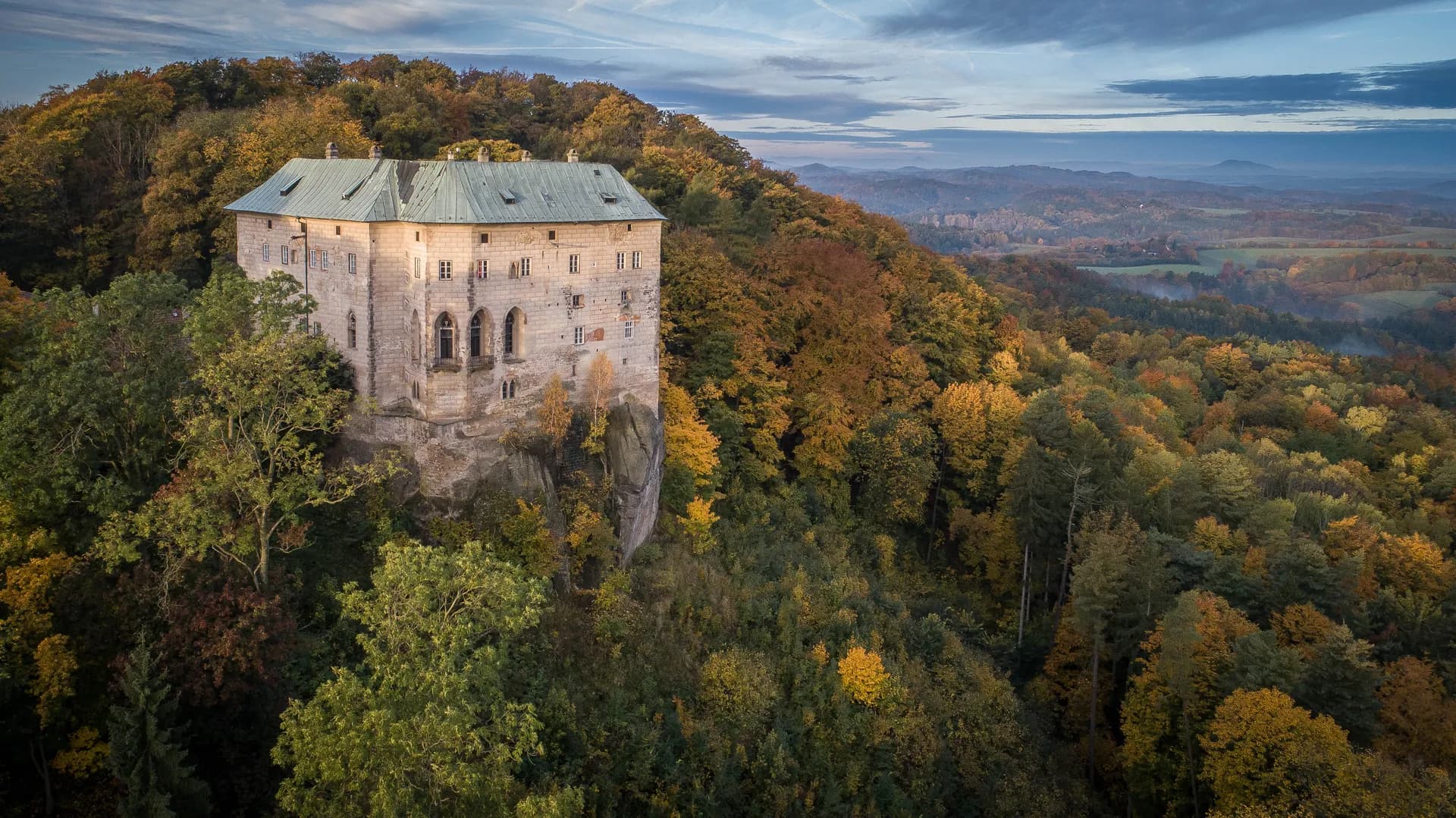
A 13th-century castle deep in the Bohemian woods, with no water supply, no view to defend, and no road worth guarding. Its fortifications point inward. Its chapel sits on top of a hole in the rock. The legend says the builders were not keeping enemies out, they were keeping something in. Here is what the story claims, and what the building actually tells us.
Most castles announce their purpose. They sit on a trade route, a river crossing, a border, somewhere worth holding. Houska sits on none of these. It was built in the second half of the 13th century in dense forest north of Prague, on a sandstone outcrop with no spring, no farmland and no road of any importance nearby. For a royal castle of its age, almost nothing about its location makes practical sense, and that absence of an obvious reason is what has kept people talking about it for seven hundred years.
The story that grew to fill the gap is one of the most repeated castle legends in Europe: that Houska was built to seal a bottomless pit, a gateway to hell, and that its strange design follows from that single grim job. It is folklore, and this guide treats it as folklore. But the building underneath the story is genuinely odd, and worth taking seriously on its own terms.
At a glance
| Location | Kokořínsko, near Mácha's Lake, around 47 km north of Prague |
| Built | 13th century, early Gothic; Renaissance wing 1584–1590 |
| Founder | King Přemysl Otakar II of Bohemia (possibly begun under Wenceslas I) |
| Style | Early Gothic, later remodelled in Renaissance style |
| Status | Protected cultural monument of the Czech Republic |
| Known for | The "gateway to hell" legend and the chapel built over the pit |
| Open | April to October, guided tours |
The Gateway to Hell They Couldn't Fill
The folklore is specific. A crack in the rock at the site was said to be bottomless, and so deep and so wrong that animals avoided it and locals would not go near. Half-formed creatures, the story goes, crawled out of it at night. When the castle was built, the chapel was placed directly over the opening to cap it, with the rest of the structure raised around the seal rather than around any military or domestic need.
One of the most retold versions involves a condemned prisoner. Offered a pardon if he agreed to be lowered into the pit on a rope and report what he saw, he is said to have screamed within seconds, and to have come back up aged decades, his hair white, raving, and dead soon after. Another thread is the figure of a faceless black monk said to guard the opening. None of this is documented history. It is the kind of story that attaches itself to a building nobody can fully explain, and the castle's modern owners lean into it, including a hand-carved mechanical sculpture called Inferno, loosely based on Dante, depicting the punishments of hell.[1]
A Castle That Makes No Sense
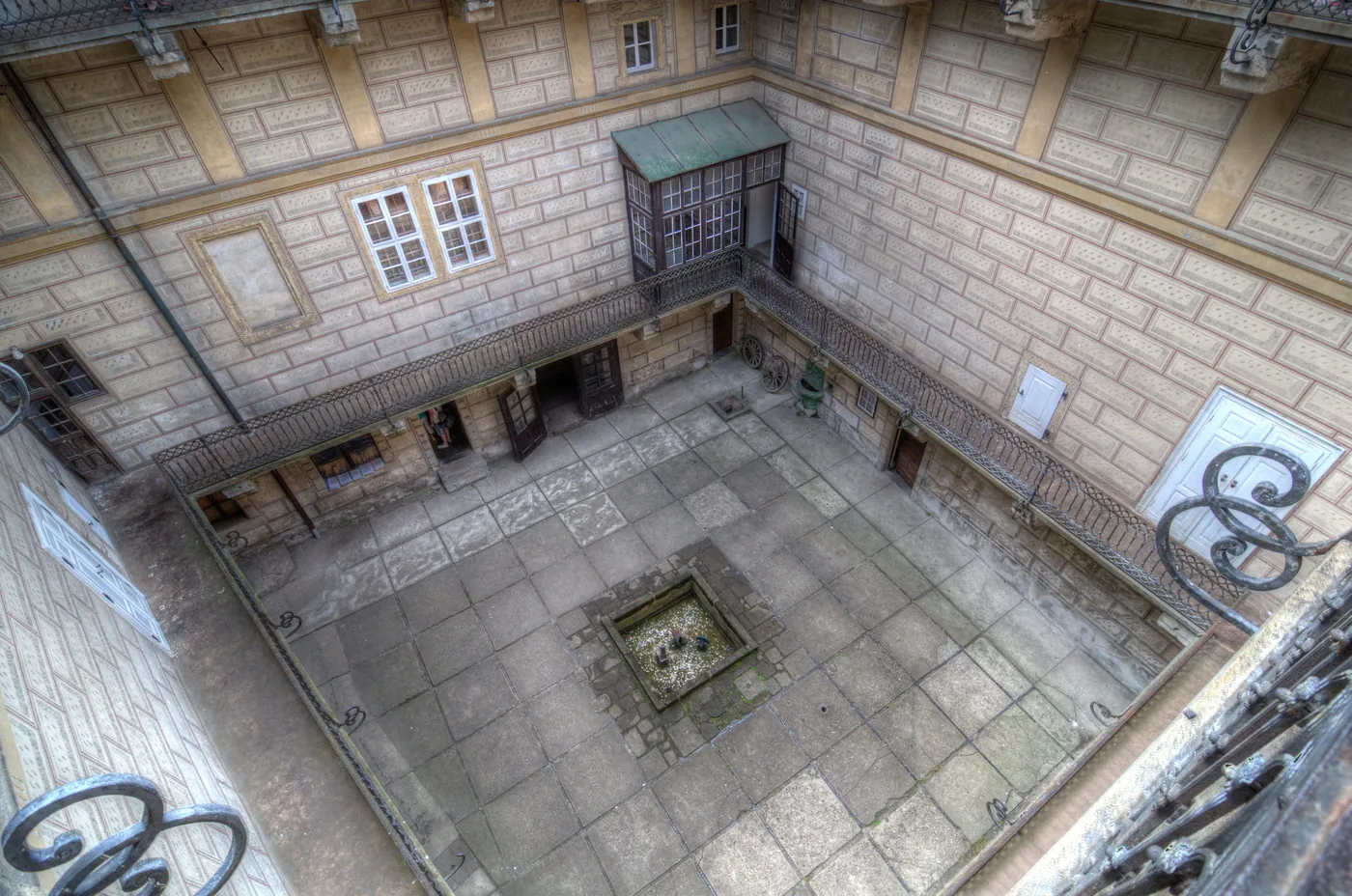
Strip the legend away and the architectural puzzle remains. Houska is missing the things a 13th-century castle is normally built around. It has no natural water source, which makes it almost impossible to hold under siege. It sits on no trade route or border. And in the most-repeated version of its story, even the fortifications point the wrong way, inward toward the courtyard and the chapel rather than outward at an enemy. That last detail belongs as much to the lore as to the record, but the missing water and the purposeless location are plain enough from the site itself.
A rock formation pierces up through the structure itself, visible both in the courtyard and inside the walls, and the chapel is built around it. Whatever the truth of the pit, the castle was clearly raised in relation to that rock rather than to any strategic feature of the landscape. Most medieval castles exist for reasons we set out in why were castles built: defence, control, status, administration. Houska fits the administrative category on paper, as a centre for managing royal estates, but its site fits none of the practical logic the others share, which is exactly why the building keeps inviting stranger explanations.
A Chapel Painted With Demons
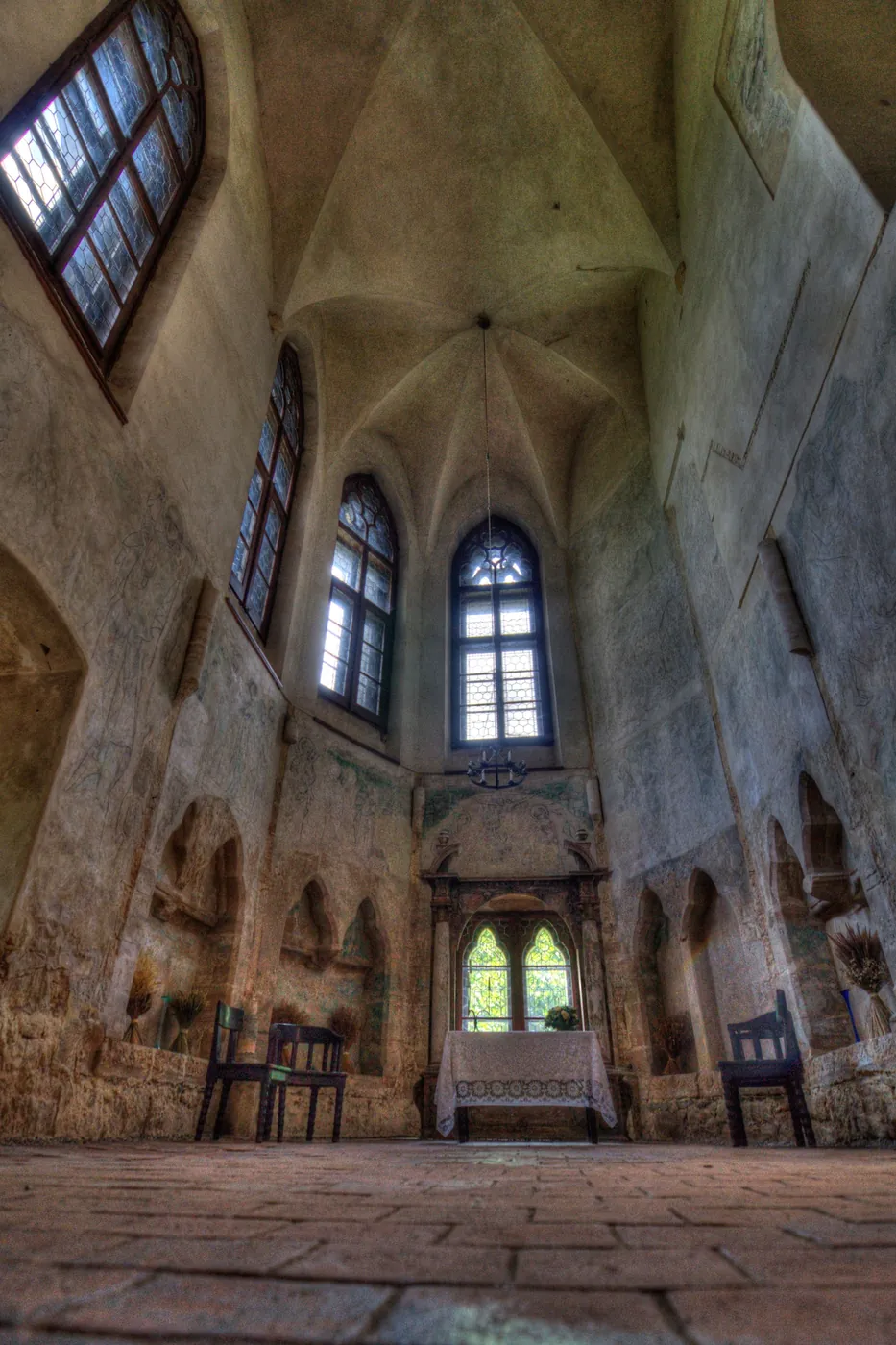
The chapel is the heart of both the legend and the building. It is dedicated to Saint Michael the Archangel, the figure who in Christian tradition leads the heavenly armies against Lucifer and the fallen angels, a fitting patron if your aim is to hold something demonic shut. The dedication is real; the reading of it is where fact shades into interpretation.
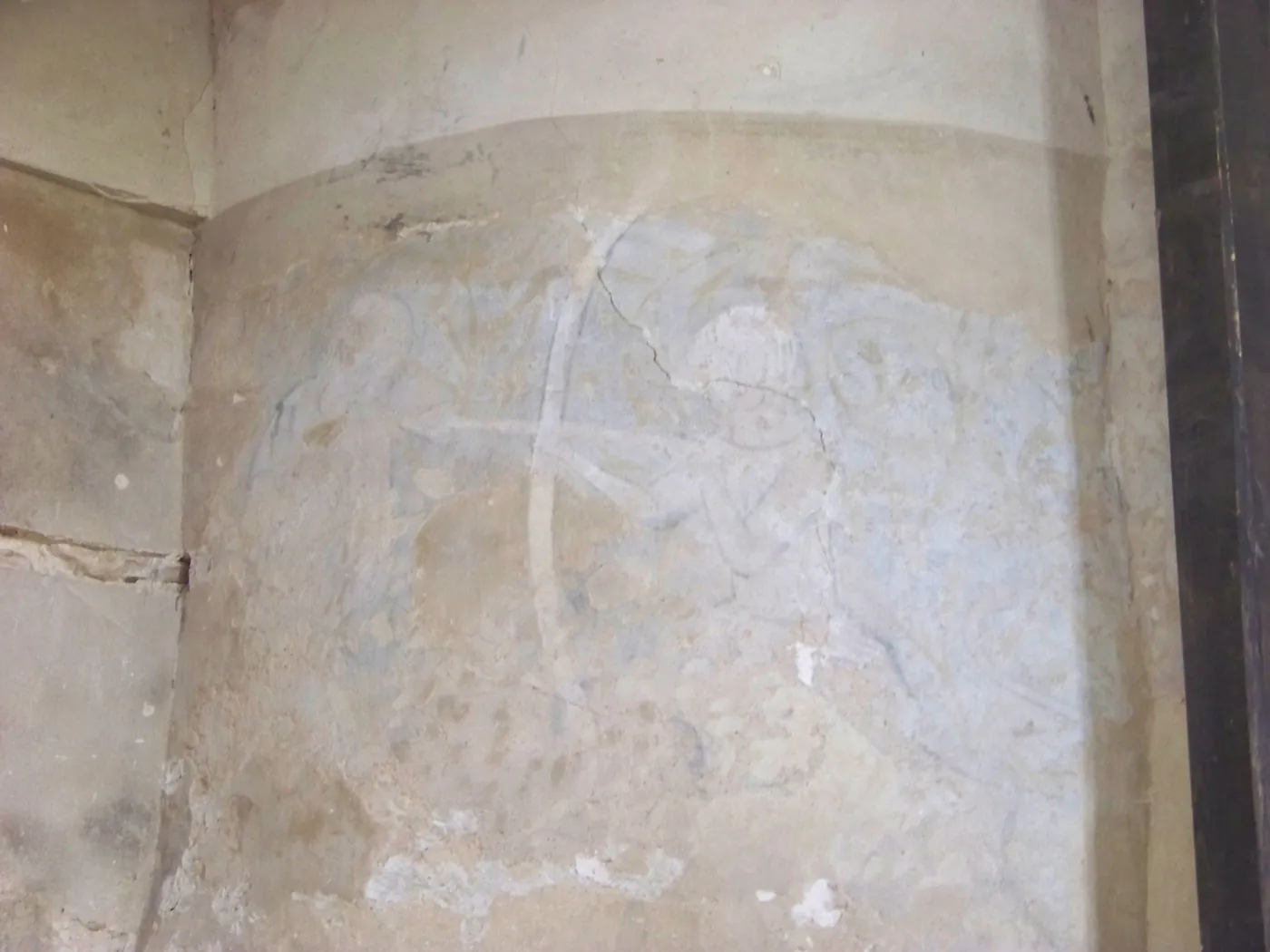
What makes the chapel genuinely unusual is its surviving Gothic frescoes. Alongside conventional religious scenes, they include demonic and half-animal figures of a kind rarely painted inside a place of worship, the sort of imagery that fuels every retelling of the gateway story. The frescoes are faded now but still visible, and they are the single most striking thing a visitor sees inside the castle.[1]
The Real History Behind the Legend
The documented history is quieter than the legend but not without interest. The early-Gothic castle was founded in the 13th century under King Přemysl Otakar II of Bohemia, one of the most powerful Czech monarchs of the age, though the work may have been begun by his father, Wenceslas I.[2] It rose on or near the site of a much older hillfort, and its first role was administrative, a base for managing the royal estates spread through the region.[3]
Between 1584 and 1590 the Hrzán of Harasov family rebuilt Houska in Renaissance style, adding an entrance wing and turning the bare fortress into a noble residence; they held it into the early 17th century.[2] A round of Neo-Renaissance alterations followed in 1823. The castle then passed through a long line of owners and slipped into obscurity, too remote and impractical to matter much, until the 1920s, when the industrialist Josef Šimonek, president of the Škoda works, bought it and paid for the substantial restoration that is much of the reason it survives in good condition today.[4]
The Nazis, the Occult, and a Storehouse of Books
The castle's strangest documented chapter is also its most recent. During the German occupation in the Second World War, Houska was seized, and from 1943 it served as a depository for confiscated Jewish and Masonic library collections, its isolation making it a convenient store far from the front.[4] Popular accounts go further and claim the occupiers ran occult experiments in the castle, a story that circulates widely online but rests on no documented evidence, and it belongs with the folklore rather than the history.
The rumour did not come from nowhere. The SS's interest in the occult is well documented: Heinrich Himmler funded a whole pseudo-scientific research arm, the Ahnenerbe, and a castle already famous as a gateway to hell was always going to attract that kind of story. What is missing is any record tying that interest to Houska itself, and the one documented wartime use of the castle was the far more ordinary business of storing books.
After the war the castle was eventually returned to the Šimonek family's heirs and opened to the public in 1999. It is privately run today, with guided tours through the chapel and the historic rooms, and it has become a fixture of paranormal television, featured on programmes from the Travel Channel to Ghost Hunters International. For the wider tradition of Bohemian and central European castles it belongs to, see our guide to castles of eastern Europe.
Visiting Houska Castle
Houska sits in the wooded Kokořínsko landscape near Mácha's Lake, around 47 km north of Prague, which makes it one of the eeriest day trips you can take from the capital, alongside the others in our castles near Prague guide. Getting there is part of the mood. There is no easy direct public transport, so most people drive, about an hour from Prague, or join an organised tour, and the last stretch is a short walk of roughly 700 metres from the car park up to the gate.
The castle keeps a seasonal calendar, open from early April to the end of October, with the 2026 season starting on 3 April. You see the interiors, the chapel and its frescoes included, on guided tours that leave roughly every hour, so it pays to arrive well before closing, since the last tour sets off about an hour ahead of it. Tickets start at around 180 CZK for adults, near enough €7, with reduced and family rates and a cheaper option if you only want to see the Inferno sculpture. Opening times shift from month to month, so it is worth a look at the official site before you set out.[1]
Sources
1. Houska Castle, official site, history and visitor information. https://hradhouska.cz/en/houska-castle/
2. Tomáš Durdík, Encyklopedie českých hradů (Encyclopedia of Czech Castles), Libri, Prague, 2006, pp. 104–105, for the dating, the 1584–1590 Renaissance rebuild and the Hrzán of Harasov ownership. Attributed to this entry via standard secondary references; not yet checked against the primary text.
3. National Heritage Institute (Národní památkový ústav), Heritage Catalogue, hrad Houska, cultural monument no. 153069. https://pamatkovykatalog.cz/pravni-ochrana/hrad-houska-153069
4. VisitCzechia (Czech Tourism Authority), Houska Castle, including the 1920s Šimonek restoration and wartime use as a library depository. https://www.visitczechia.com/en-us/things-to-do/places/landmarks/castles-and-ruins/c-houska-castle