
Castles with Moats and Drawbridges: The Architectural Heritage
10 medieval castles still flood the moat: Bodiam's mirror reflection, Hever's Boleyn halls, Leeds Castle on its island and Caerphilly's concentric walls.
Ten European castles where the water (or the dry ditch) still does the work it was built for, and where the bridge over it survives, hinges and all.
A "moat" in this listicle covers both the wet kind, fed by a river, a lake or a deliberately tapped spring, and the dry kind, a deep ditch cut into bedrock or earth. A "drawbridge" covers both the surviving working examples, which can still be raised on chains or pivots, and the historic bridge structures (timber decks, masonry piers, gatehouse arches) that hold the line of the original entry even when the lifting mechanism has gone.
The castles below cluster in two regions. The Belgian and Flemish lowlands favoured water defences because the geography made flooding straightforward; Jean-Denis Lepage's pan-European fortification survey treats the waterburchten tradition as a regionally distinctive form in which the moat is the primary defensive feature rather than a finishing touch.[1] England and Wales developed parallel traditions on the chalk and sandstone of the southeast and the river valleys of the Marches. Add in Lake Geneva's island fortress, the Sound of Helsingør's sea moat at Kronborg, and a Hohenzollern dry ditch above the Swabian Alb, and the typology spreads across the continent.
Each entry below covers what to see, when to go, what it costs, and how to get there.
1. Bodiam Castle
England (East Sussex) Open daily, NT Moat-ringed medieval icon Map
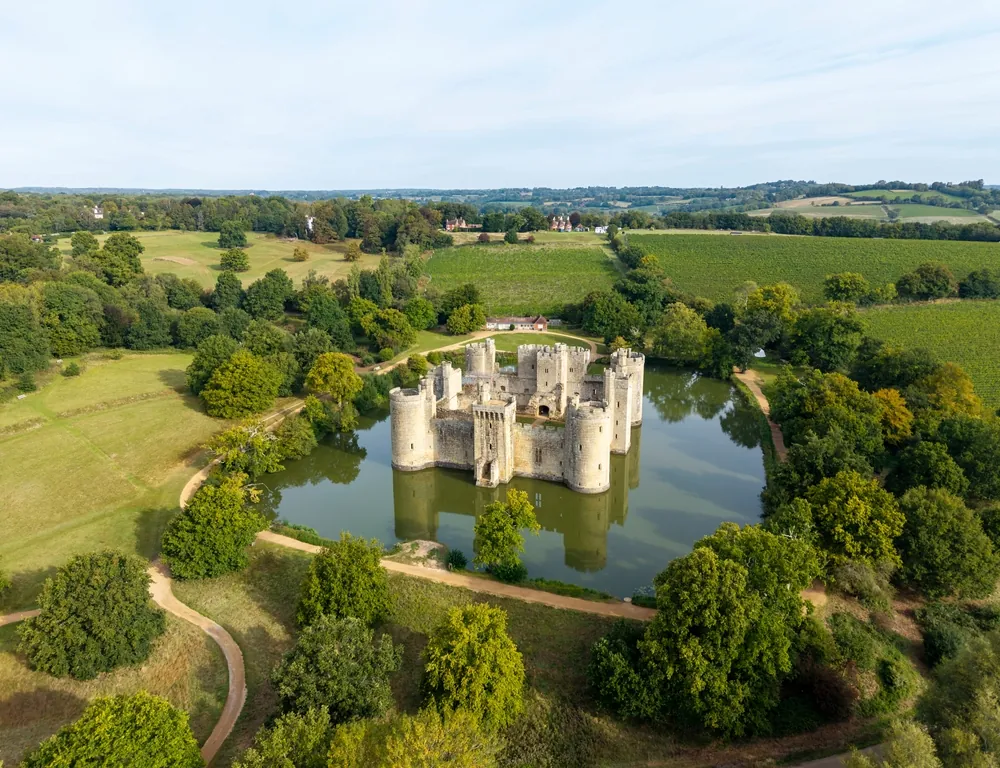
Bodiam is the canonical English moated castle. Sir Edward Dalyngrigge, a Knight of the Shire and former soldier of the Hundred Years' War, built it under licence to crenellate from Richard II between 1385 and 1388. Sidney Toy describes it as a rectangular plan with a drum tower at each corner, set in a "large rectangular moat" and defended on the north by two advanced works (a barbican and an octagonal outwork) standing isolated in the same water.[2] Lepage adds detail: walls 12 m high and 2 m thick, four corner towers 18 m high and 9 m in diameter, the design influenced by Edward I's late-13th-century Welsh castles at Harlech and Beaumaris.[1]
Marc Morris notes the sting in the tale. The moat looks defensive but, on closer inspection, is shallow (about six feet deep) and the gatehouse contains no holes in the stonework for drawbridge chains and no room to house a working mechanism: Bodiam was built as much for the look of the thing as for active use.[3] John Goodall records that Lord Curzon bought the castle around 1919, dredged the moats, repaired the fabric and ran a year of excavations with a staff of around 25 men before opening it to the public.[4] The National Trust has run the site since 1925.
Practical: open daily, year-round, 10:00–17:00. Adult £13 standard, £14.30 with Gift Aid; child £6.50. Family tickets and concessions are available; National Trust members enter free. Reach it via the Kent and East Sussex Railway's seasonal steam service from Tenterden, the Stagecoach 349 bus from Hastings, or by car (£5 non-member parking). Plan your visit.[5]
2. Leeds Castle
England (Kent) Daily, year-round Pay once, return all year Map
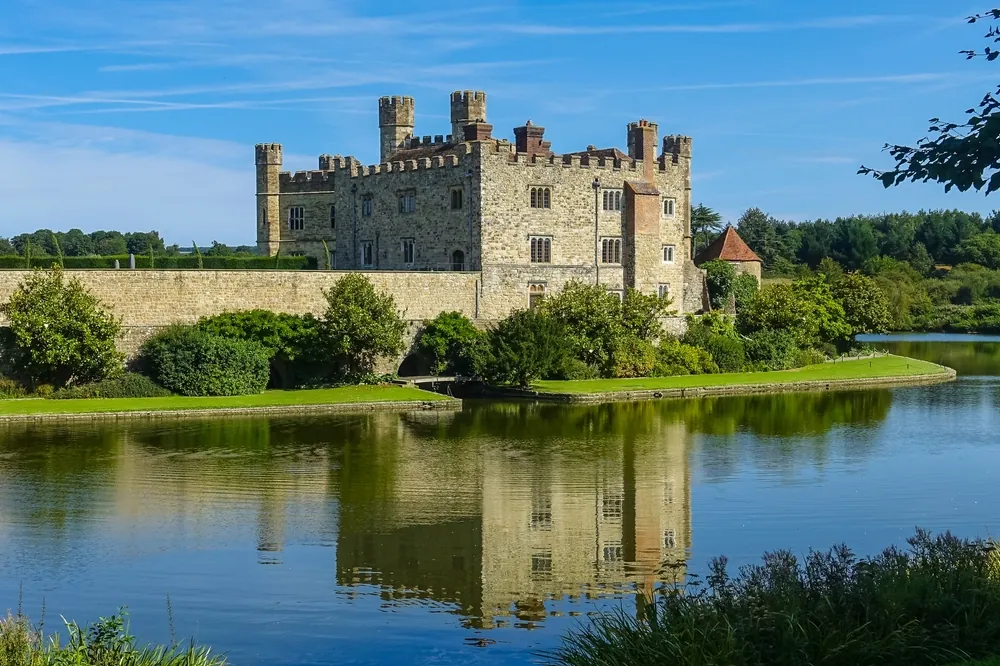
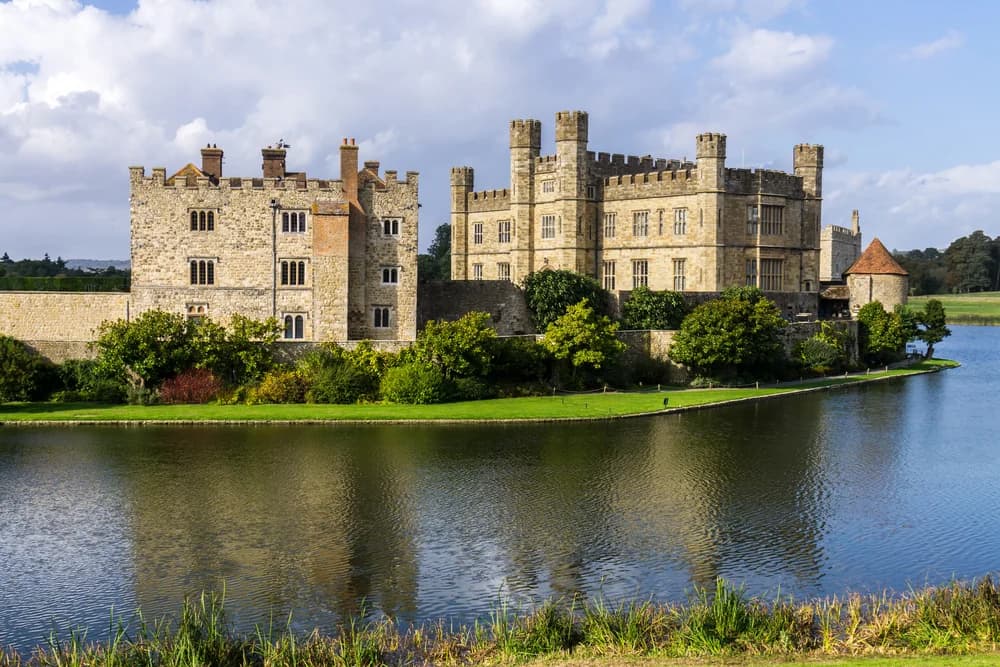
Leeds sits on two islands in the River Len in southeast Kent and joins them by a stone bridge. The current structure is largely 13th-century Edwardian palace-fortress over a 12th-century core, with later medieval and 19th-century additions; the moat-and-river complex is among the largest integrated water defences in England. A 1939 Country Life article gave the castle the "loveliest castle in the world" tag that has stuck. The Leeds Castle Foundation has owned it privately since Lady Olive Baillie bequeathed the property in 1974.
The visit covers the medieval undercroft, the Henry VIII banqueting hall (Henry held the castle as a dower for his first wife, Catherine of Aragon), Lady Baillie's 1930s Art Deco interiors, and 500 acres of grounds with a maze, a grotto, and the moat itself navigable by punt in season.
Practical: open daily, year-round, with the grounds (10:00–18:00 summer, 10:00–17:00 winter) opening earlier than the castle interiors (10:30–17:00 / 10:30–15:30). Adult £24.50 online (£25.50 walk-up), child £16.50, under 4 free; every standard ticket converts into an annual return pass. A 20% discount applies for arrivals by train, bus or bike. Closed 25 December and during the annual concert in mid-July. From London, Southeastern rail to Bearsted (about 1 hour), then the castle shuttle bus. Plan your visit.[6]
3. Caerphilly Castle
Wales (Caerphilly) Daily, year-round Britain's largest concentric castle Map
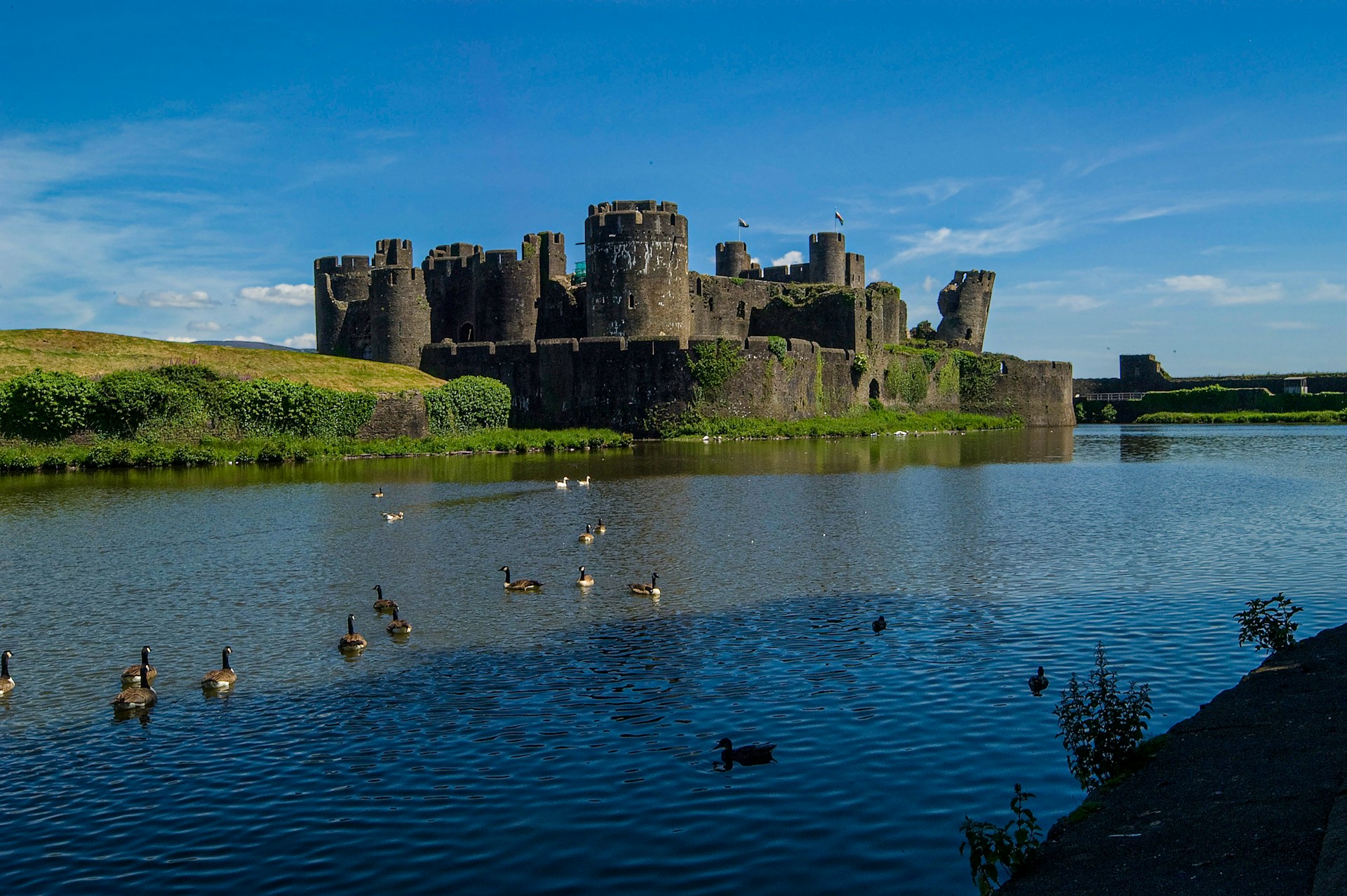
Caerphilly has the largest concentric water defences in Britain. Gilbert de Clare ("Red Gilbert") began building between 1268 and 1271 to control the rebellious Welsh Marches, ringing the inner ward with a second curtain wall and the whole site with a chain of artificial lakes that turned the approach into a sequence of crossings rather than a single bridge. Sidney Toy's analysis of the gatehouse pivots is the clearest surviving description: when the inner bridge was raised, the outer part blocked the gateway while a counterbalance descended into a pit, and the pit itself formed an additional obstacle to attackers.[2]
The standout visual feature today is the leaning south-east tower, more pronounced than Pisa's and the result of Civil War slighting that never quite finished the job. The Great Hall reopened to the public in 2024 after a two-year conservation programme. Cadw, the Welsh historic-environment service, runs the site.
Practical: open daily, year-round; summer 09:30–18:00 (Jul–Aug), spring/autumn 09:30–17:00, winter 10:00–16:00. Closed 24–26 December and 1 January. Adult £12.90, concession £11.60, child £9.00; family tickets and a £1 Universal Credit ticket are available. A joint ticket with Castell Coch is £16.30 adult. Caerphilly station is one kilometre from the castle, with direct trains from Cardiff Central. Plan your visit.[7]
4. Hampton Court Palace
England (Greater London) Daily, year-round Henry VIII's Tudor seat Map
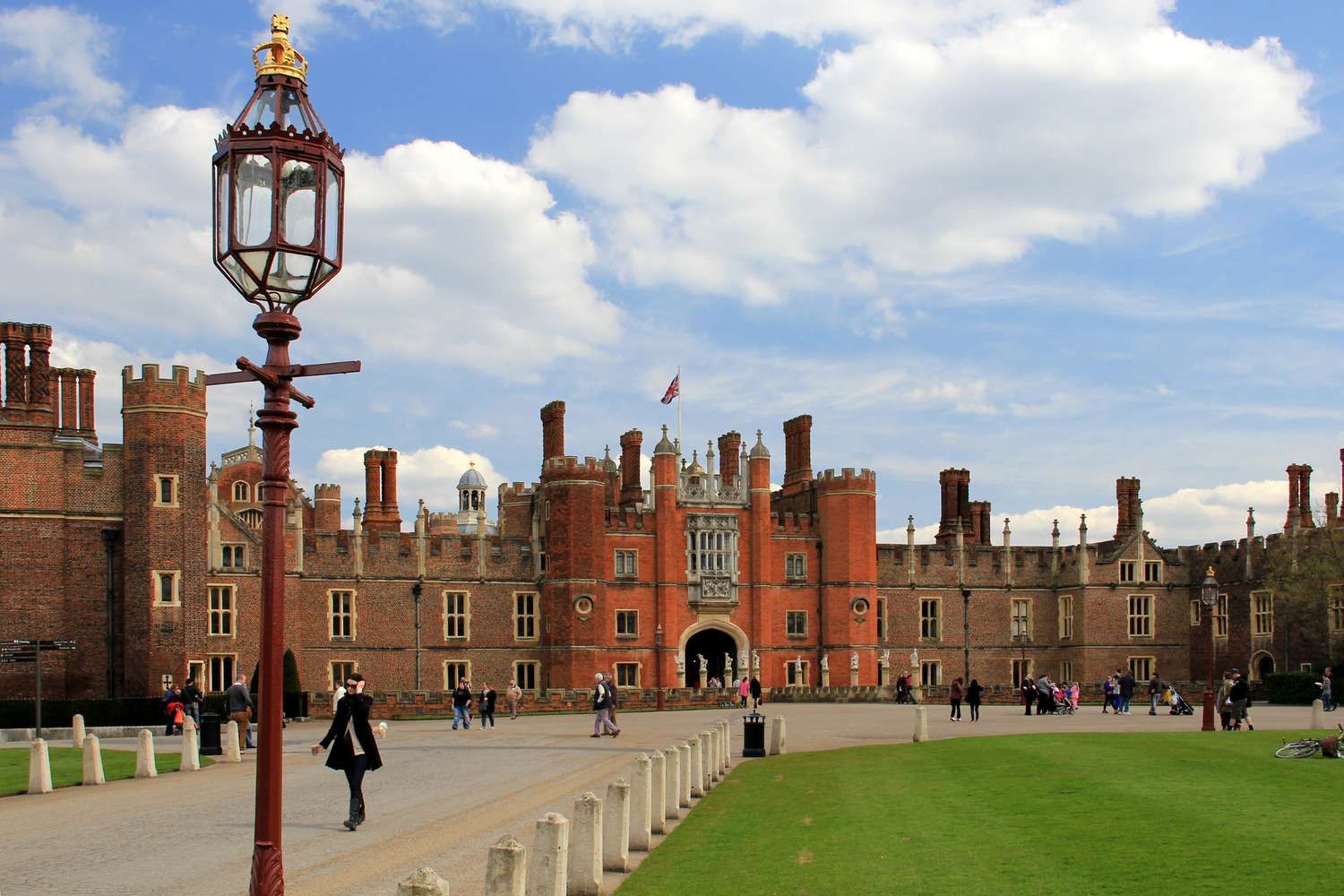
Hampton Court keeps a substantial section of its Tudor moat. Cardinal Wolsey began the palace in 1515, Henry VIII took it in 1529, and the wide brick-revetted ditch around the western forecourt formed part of the original ceremonial approach across the Great Bridge through the Great Gatehouse (the so-called Anne Boleyn Gateway). The water was drained in the 18th century and the moat is now dry, but the masonry-faced cut and the Tudor stone bridge survive in their original positions, which makes Hampton Court the largest surviving Tudor moat-and-bridge structure in England.
The visit covers Wolsey's earliest brick courtyards, Henry VIII's Great Hall (built 1532–35), the Chapel Royal, the Tudor kitchens, William III's Baroque state apartments by Christopher Wren, and 60 acres of formal gardens including the maze. Historic Royal Palaces has run the site since 1989.
Practical: open daily; 26 March to 29 October 10:00–17:30, 30 October to 25 March 10:00–16:30. Closed 24–26 December. Adult advance off-peak £29.00, child (5–15) £14.50, under 5 free; HRP members enter free. Active works in 2026: the Great Gatehouse is closed for conservation until June 2026 (entry rerouted via the Seymour Gate); the Mantegna Gallery is closed throughout 2026 and reopens in spring 2027.[8] South Western Railway runs from London Waterloo in about 35 minutes. Plan your visit.[8]
5. Château de Chillon
Switzerland (Vaud, Lake Geneva) Daily, year-round Lake Geneva's island fortress Map
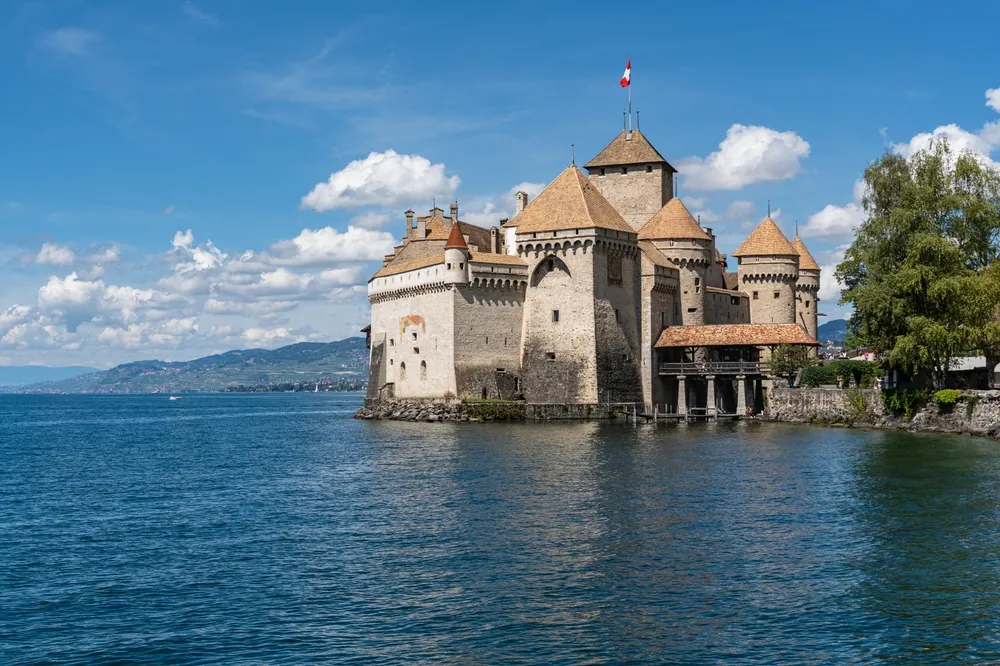
Chillon sits on a small rocky island a few metres off the Lake Geneva shore at Veytaux, between Montreux and Villeneuve. The Counts of Savoy held the site from the 12th century and used the lake itself as the moat, with a wooden bridge from the shore that doubled as the entry: in effect, a single drawbridge could isolate the entire complex from the mainland. The visit follows three courtyards, the Knights' Hall, the dungeon where the 16th-century prior François Bonivard was chained for four years (and which Lord Byron immortalised in "The Prisoner of Chillon" in 1816), and the chemin de ronde with views across the water to the French Alps.
The Fondation des Châteaux de Chillon runs the site as one of the most-visited monuments in Switzerland.
Practical: open daily, year-round; April–September 09:00–19:00 (last entry 18:00), November–February 10:00–17:00, March/October 09:30–18:00. Closed 25 December and 1 January. Adult CHF 15, concession CHF 12.50, child CHF 7; family ticket (2 adults + 1–5 children) CHF 35. Audioguide CHF 6 extra. Free with the Swiss Travel Pass. From Montreux, train to Veytaux-Chillon halt (3 minutes), bus 201, the lakeside footpath (about 45 minutes), or the CGN paddle steamer in season. Plan your visit.[9]
6. Gravensteen
Belgium (Ghent, Flanders) Daily, year-round Counts of Flanders' fortress Map
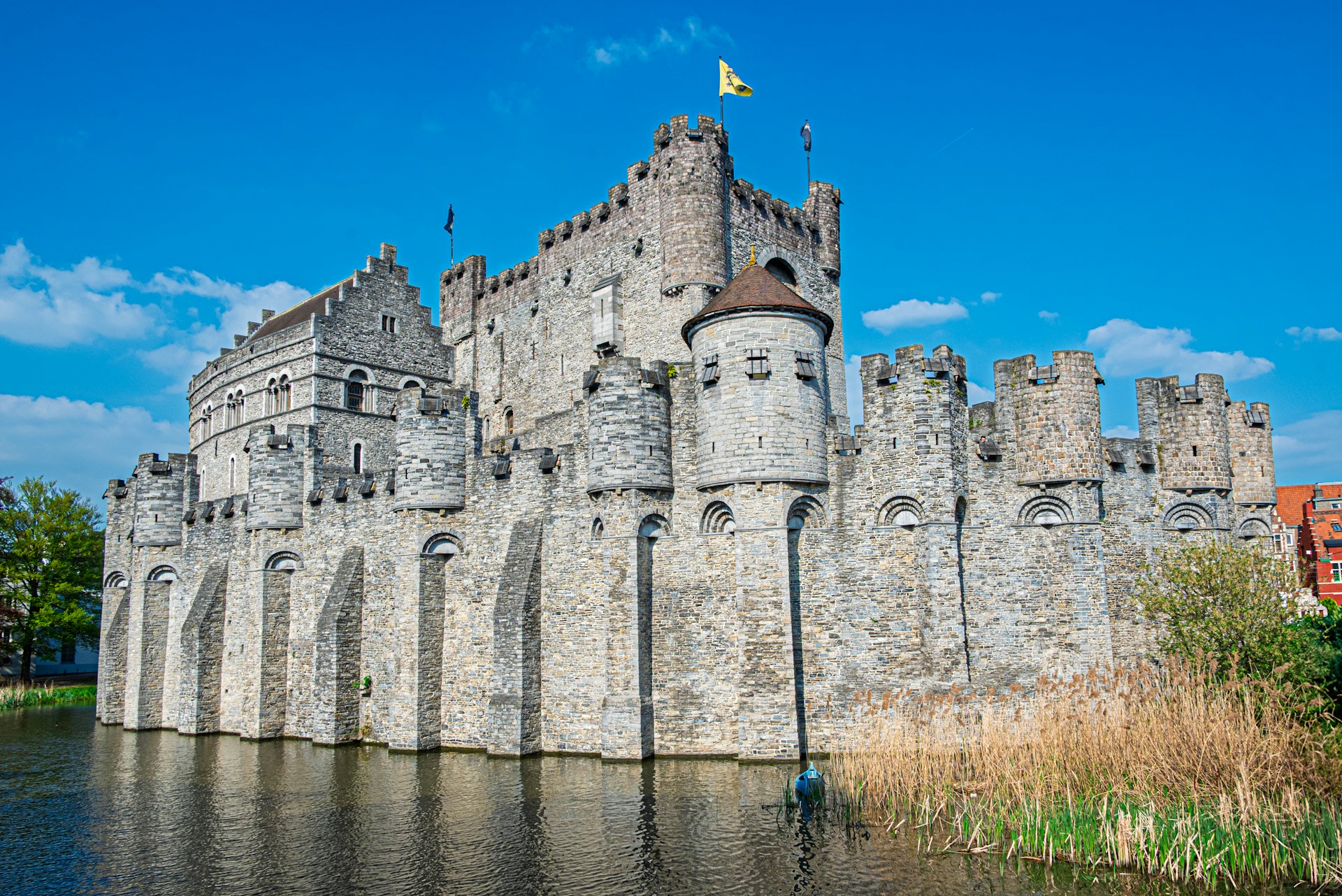
The "Castle of the Counts" stands in the centre of Ghent on what was once an island in the Lieve canal, ringed on all sides by water. Philip of Alsace, Count of Flanders, rebuilt the original 9th-century motte in stone after 1180, modelling the curtain on Crusader fortifications he had seen in the Levant. The water defences kept the building isolated from the surrounding city until the 19th century, when industrial use and infill reduced the moat to the surviving section on the south and east flanks. The City of Ghent acquired and restored the castle in 1885 and runs it today through the municipal heritage agency Historische Huizen Gent.
The visit covers the keep, the count's residence, the gatehouse, an audioguide-led circuit (included in the ticket), and a small museum of judicial instruments. The wall-walk delivers the best rooftop view of Ghent.
Practical: open daily, 10:00–18:00 (last admission 16:40). Closed 24, 25, 31 December and 1 January. Adult €15 standard / €10.50 Ghent residents; youth (19–25) €7.50; ages 13–18 €3; under 13 free. Tram 1 from Ghent-Sint-Pieters station to the Gravensteen stop, or a 15-minute walk from the central station. Plan your visit.[10]
7. Vêves Castle
Belgium (Wallonia, Namur) Mostly weekends Storybook turrets of the Lesse Map
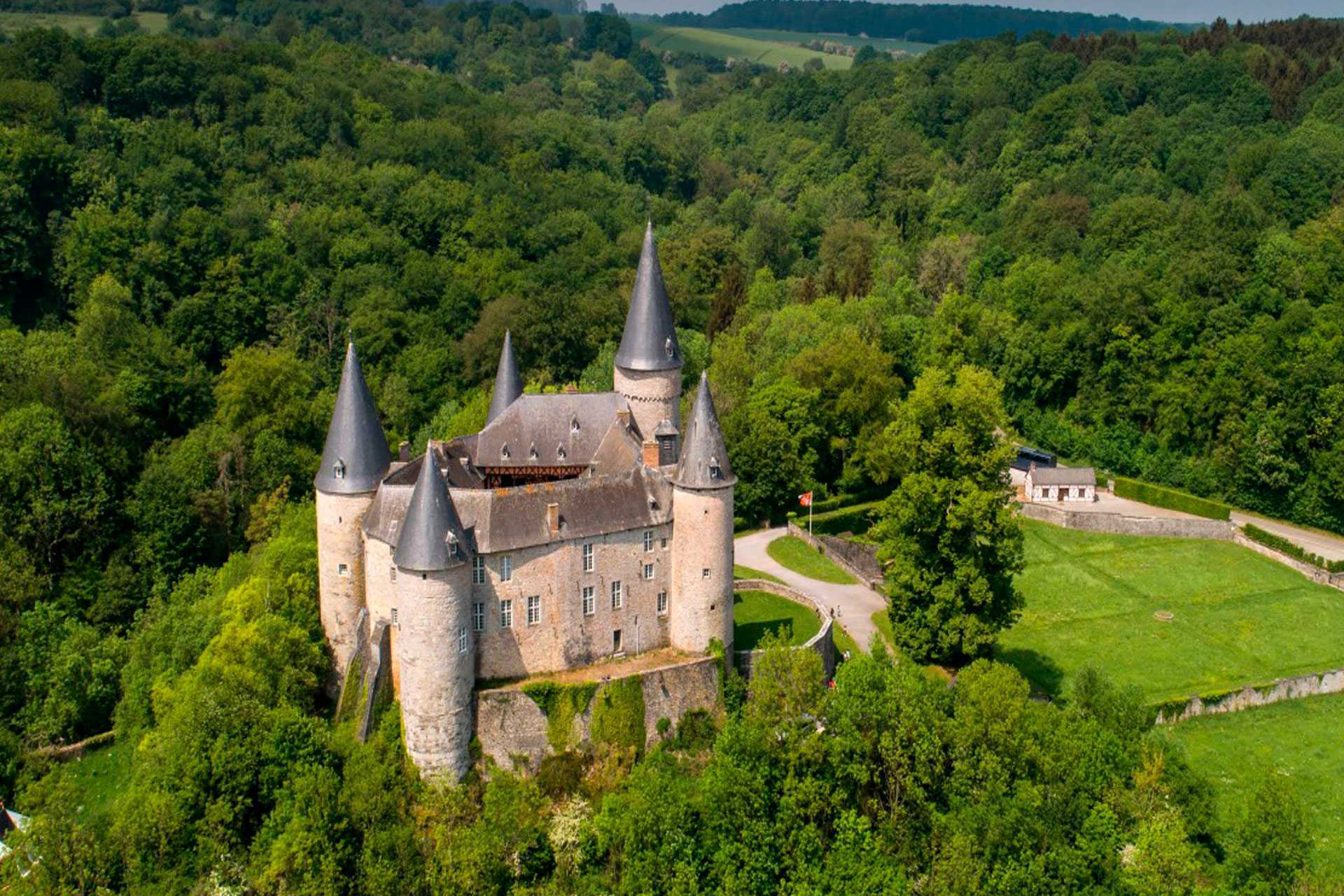
Vêves is the picture-book Belgian moated castle: five conical-roofed corner towers around a tight pentagonal courtyard, set above the Lesse valley near Celles, about 25 km southeast of Dinant. The Beaufort-Spontin family held the site from the medieval period; the current structure dates from the 15th-century rebuild that followed a destruction in the Wars of Liège. The dry ditch around the base, originally crossed by a drawbridge, frames the approach today, and the castle is listed as exceptional heritage of Wallonia. Family-owned (Liedekerke-Beaufort), it remains a private residence with a public visiting wing.
The interiors carry 17th- and 18th-century furniture, a Louis XV salon, and a small armoury; the kitchens and the chapel are accessible on the standard route.
Practical: open weekends and public holidays from 30 March to 1 November 2026, 10:00–17:00; daily 6 July to 23 August (last entry 16:30). Closed most of November to February except a Carnival opening 16–27 February (Wednesday to Sunday). Adult €10, with reduced rates for children, students and groups; free parking on site. Best access by car via the N94/E411; otherwise rail to Houyet and a short taxi ride. Plan your visit.[11]
8. Egeskov Castle
Denmark (Funen) Late Mar–Oct, daily Renaissance moated castle Map
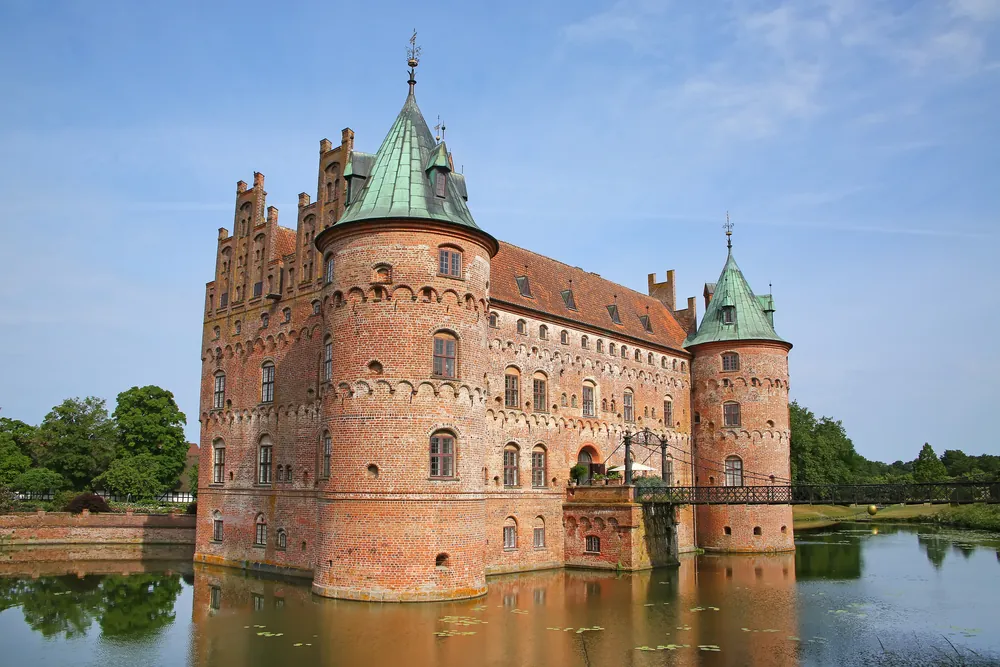
Egeskov is the canonical Danish herregård of the moated kind, built by Frands Brockenhuus in 1554 on a foundation of oak piles driven into the lake bed. The name means "oak forest", which gives some sense of the volume of timber the foundation took: contemporary accounts speak of an entire wood being felled for the piles. The castle stands on its own island in a roughly square lake-moat about 70 metres across; the medieval wooden bridge has gone, but the stone causeway and the gatehouse arch sit on the original line. The Ahlefeldt-Laurvig-Bille family has held the property continuously through the post-medieval period and runs it today as a working private estate with public visitor access.
The visit covers the Renaissance hall, the family apartments, an extensive vintage-vehicle and aircraft museum in the outbuildings, an 18th-century formal park, and a tree-top walk through the surrounding wood.
Practical: open daily 28 March to 25 October 2026, 10:00–17:00, with extended hours in peak summer; closed in winter. Combined Castle, Garden, Play and Exhibition ticket (online) DKK 265 adult, DKK 160 child (4–12); on-the-day prices higher; under-4s free. Garden, Play and Exhibition only DKK 225 / DKK 145. Annual pass DKK 440 / DKK 230. Train to Kvaerndrup on the central Funen line. Plan your visit.[12]
9. Kronborg
Denmark (Helsingør) Closed Mon (Nov–Mar) Hamlet's Elsinore Map
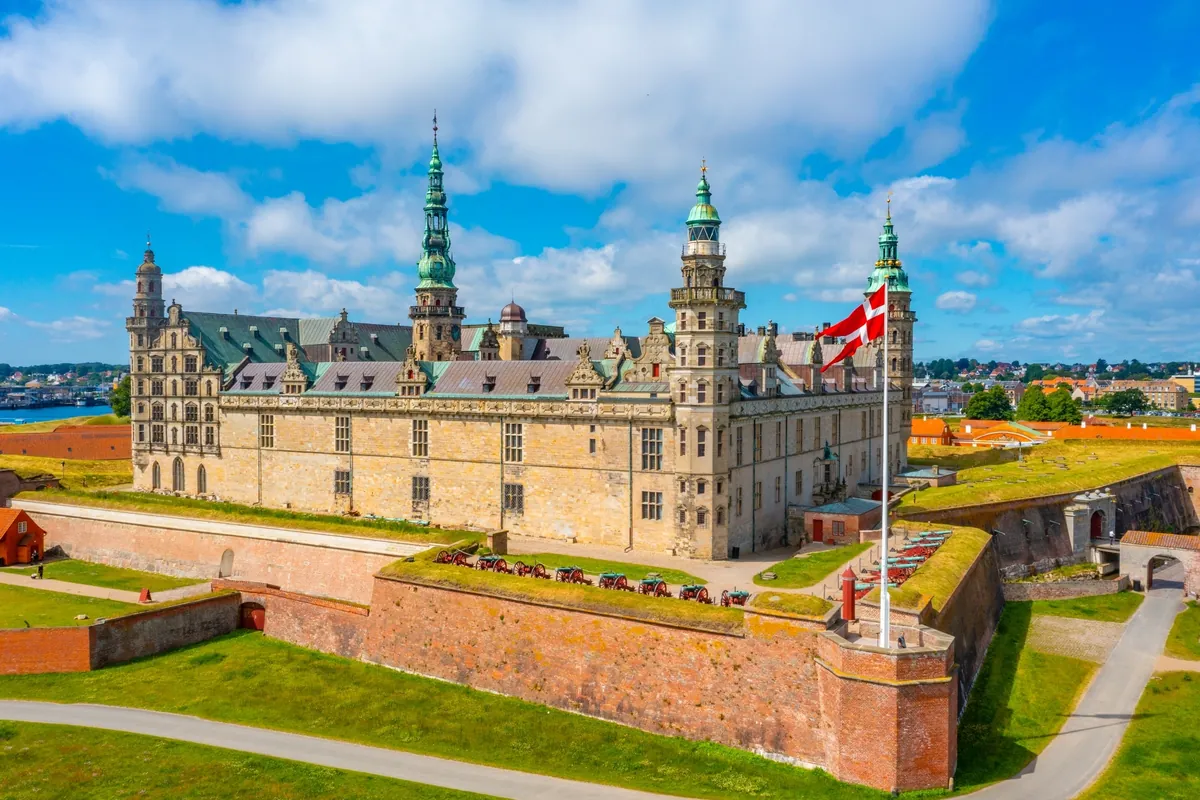
Kronborg stands on the Helsingør promontory at the narrowest point of the Sound, the strait dividing Denmark from Sweden. Frederik II rebuilt the medieval Krogen fortress between 1574 and 1585 in the Dutch Renaissance style, ringing the inner castle with a star-shaped bastion system and a wide sea-fed moat that converted the entire site into a defensible island in the Sound. The geography mattered commercially as much as militarily: from 1429 to 1857 the Danish crown collected the Sundtolden, the Sound Toll levied on every ship passing through the strait, and Kronborg was the collection point. UNESCO inscribed the castle in 2000 for its exceptional state of preservation.
Shakespeare set "Hamlet" here as Elsinore in the late 1590s; the battlement walks where the play's ghost appears are part of the standard visit, alongside the great hall, the chapel, and the casemates beneath the courtyard where Holger Danske is said to sleep until Denmark needs him.
Practical: April–October open daily 10:00–17:00 (June–August to 18:00); November–March closed Mondays, Tuesday–Friday 10:00–16:00, weekends 10:00–17:00. Closed 24–25 December, 31 December, 1 January. Adult DKK 145 in summer / DKK 95 off-peak; student DKK 135; free under 18; 10% discount online; annual pass DKK 270; free with the Copenhagen Card. Train from København H to Helsingør (about 45 minutes), then a 15-minute walk. Plan your visit.[13]
10. Schloss Hohenzollern
Germany (Baden-Württemberg) Open daily, peak season Ancestral seat of Prussian kings Map
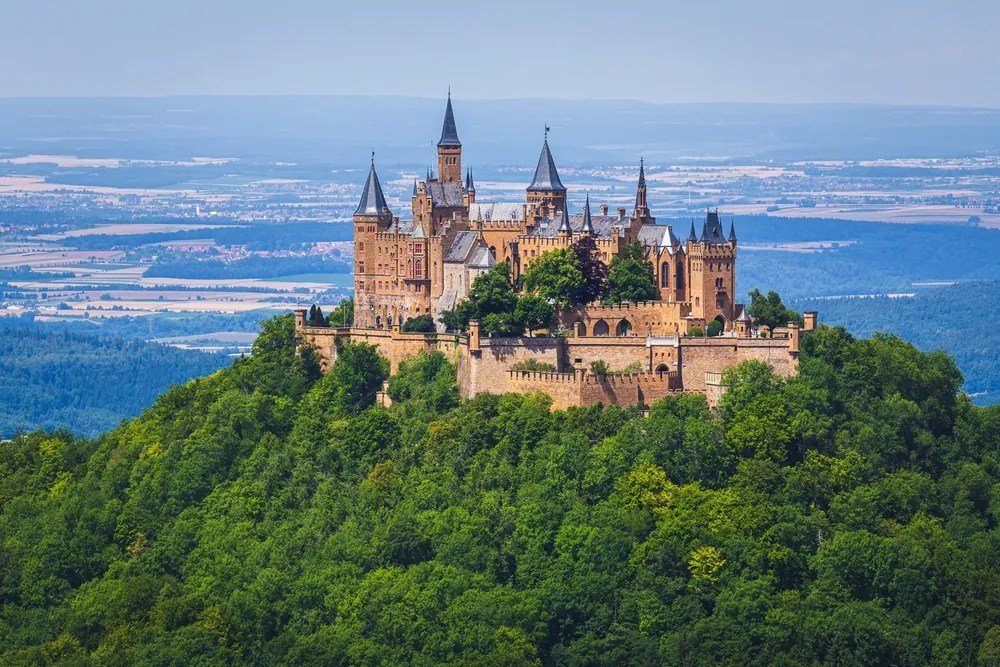
Hohenzollern sits on a 855-metre conical hill above the Swabian Alb, about 50 km south of Stuttgart, and is included here as the dry-moat counterpart to the wet-moat castles above. The current building is the third on the site: Friedrich Wilhelm IV of Prussia and Crown Prince Wilhelm I of Württemberg commissioned the architect Friedrich August Stüler to rebuild it between 1850 and 1867 as the ancestral seat of the Hohenzollern dynasty. The plan reproduces a high-medieval German Burg layout, with a sequence of three gates, a series of curtain courts, and a deep dry ditch cut into the bedrock around the inner core, crossed by a stone bridge that takes the modern shuttle traffic. The Hohenzollern family still owns the castle through two foundations.
The visit covers the chapel, the treasury (with the Prussian crown of Wilhelm II and a personal effects collection from Frederick the Great), and the inner courtyard with the named statues of the Hohenzollern princes.
Practical: main season 28 March to 1 November 2026, daily 10:00–18:30 (showrooms close 18:00, last admission to castle 17:00); shorter winter hours, confirm dates on the operator's site. Online prices: adult €26 / cash desk €29; concession (students, pupils 12+, disabled) €16/€19; child 4–11 €6/€9; child 0–3 €1. The Flex Ticket (valid through October 2026) is €55 adult / €35 under 17. Tickets include parking and the included shuttle bus from the lower car parks (running every 15 minutes from 09:45). Nearest train station Hechingen; drones forbidden. Plan your visit.[14]
At a glance
| Castle | Region | When to go | |
|---|---|---|---|
| Bodiam CastleMoat-ringed medieval icon | England (East Sussex) | Open daily, NT |
| Leeds CastlePay once, return all year | England (Kent) | Daily, year-round |
| Caerphilly CastleBritain's largest concentric castle | Wales (Caerphilly) | Daily, year-round |
| Hampton Court PalaceHenry VIII's Tudor seat | England (Greater London) | Daily, year-round |
| Château de ChillonLake Geneva's island fortress | Switzerland (Vaud, Lake Geneva) | Daily, year-round |
| GravensteenCounts of Flanders' fortress | Belgium (Ghent, Flanders) | Daily, year-round |
| Vêves CastleStorybook turrets of the Lesse | Belgium (Wallonia, Namur) | Mostly weekends |
| Egeskov CastleRenaissance moated castle | Denmark (Funen) | Late Mar–Oct, daily |
| KronborgHamlet's Elsinore | Denmark (Helsingør) | Closed Mon (Nov–Mar) |
| Schloss HohenzollernAncestral seat of Prussian kings | Germany (Baden-Württemberg) | Open daily, peak season |
What survives, and what to look for
Three points are worth carrying into a visit. First, almost no original medieval drawbridge mechanisms survive intact: where a drawbridge appears at a visitable site (Marksburg in the German Rhine, Cawdor in Scotland, parts of Caerphilly's gatehouse pit), it is generally an authentic gatehouse arch and bridge structure with a 19th- or 20th-century reconstructed lifting mechanism. The footprint and the geometry are medieval; the working timber and chains usually are not. Sidney Toy catalogues four distinct medieval drawbridge types, including the "bascule" beam method that came in around 1300, much used in France and Italy in the 14th and 15th centuries, and the counter-balance pit at Caerphilly.[2]
Second, the wet moat does not always equal a defensive moat. Bodiam's six-foot moat held a low pool with no chain holes and no mechanism in the gatehouse: the building was, in Marc Morris's phrase, an Englishman's home dressed up as a fortress.[3] Hampton Court's bridge crosses a Tudor ceremonial moat, not a defensive one. The water at both sites is a setting rather than a barrier, but it is the genuine 14th- and 16th-century setting.
Third, the geography decides the type. The Belgian waterburchten on the Flemish lowlands favour wet moats because the surrounding land is flat and well watered.[1] The Welsh and English upland castles favour dry ditches cut into rock or, where rivers permit, hybrid systems (Caerphilly's lakes were artificial). Hohenzollern, on a 19th-century hilltop reconstruction, runs a dry ditch around the inner core because the geology offers no other option.
Sources
1. Lepage, J.-D. G. G. Castles and Fortified Cities of Medieval Europe: An Illustrated History. McFarland & Company, 2002; pp. 126, 137, 147, 159, 177.
2. Toy, S. Castles: Their Construction and History. Dover Publications, 1984 reprint of 1939 original; ch. XV (Gatehouses) and ch. XVI (Tower-house Development; Drawbridges section).
3. Morris, M. Castles: Their History and Evolution in Medieval Britain. Pegasus Books, 2017; ch. 4 ("An Englishman's Home").
4. Goodall, J. The Castle: A History. Yale University Press, 2022; pp. 271–272, 328.
5. National Trust, Bodiam Castle.
6. Leeds Castle Foundation, official site.
7. Cadw, Caerphilly Castle.
8. Historic Royal Palaces, Hampton Court Palace. Tickets and prices:
9. Fondation des Châteaux de Chillon, official site.
10. Historische Huizen Gent (City of Ghent), Gravensteen.
11. Château de Vêves, official site.
12. Egeskov Slot, official site.
13. Kronborg Slot, Agency for Culture and Palaces.
14. Burg Hohenzollern, official site.